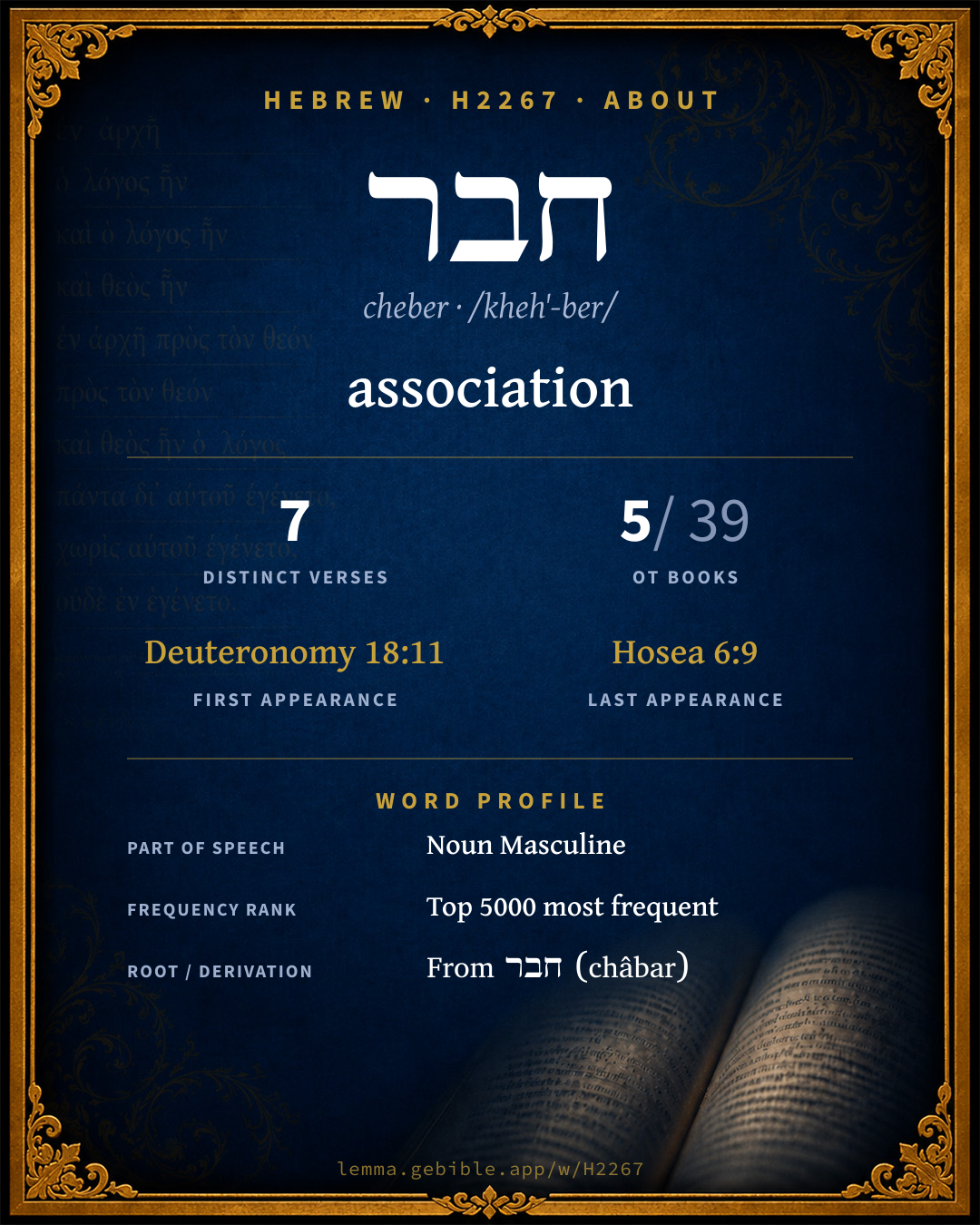
חֶ֫בֶר
association
also: company, band fuller range ↓
Full lexicon entry — Brown-Driver-Briggs (BDB)
From Brown-Driver-Briggs (BDB)
Where this word appears
See every Absolute-state word in the Hebrew Bible →
Grammar key — what these labels mean
Part of speech
- Noun
- A naming word — a person, place, thing, or idea.
Noun type
- Common
- A common noun — a general class of person, place, or thing (“king,” “city,” “water”), not a specific name.
State
- Absolute
- The independent form of a noun, not bound to a following word.
- Construct
- A noun bound to a following noun in a possessive / “of” relationship (the construct chain).
Gender
- Masculine
- Grammatically masculine.
Number
- Singular
- One.
- Plural
- More than one (in Hebrew, generally three or more).
Grammatical forms
- Noun, Common, Masculine, Singular, Absolute 3 times (43%)
- Noun, Common, Masculine, Plural, Construct 2 times (29%)
- Noun, Common, Masculine, Plural, Absolute 1 time (14%)
- Noun, Common, Masculine, Singular, Construct 1 time (14%)
Parsed forms decoded from the imported morphology (morphhb / Westminster Leningrad Codex — WLC text public domain, morphhb tagging CC BY 4.0), counted across 7 parsed occurrences — not distinct verses.
Every verse where H2267 appears — 7 distinct verses across 5 books. Click any verse to open its interlinear word-by-word view. Verse text shown in the World English Bible for context — . Each verse’s Hebrew form is shown with its reference; the English is not keyword-highlighted, since the data carries no word-level English alignment. Use “Compare translations” on any verse to read it across multiple English versions. This concordance covers the Hebrew Bible; Septuagint (Greek Old Testament) occurrences are not indexed here.
Deuteronomy 1 verse
Psalms 1 verse
Proverbs 2 verses
Isaiah 2 verses
- Isaiah 47:9 חֲבָרַ֖יִ/ךְ n c mp cs + sfx pers 2fs but these two things shall come to you in a moment in one day, the loss of children, and widowhood; in their full measure shall they come on you, in the multitude of your sorceries, and the great abundance of your enchantments.
- Isaiah 47:12 בַ/חֲבָרַ֨יִ/ךְ֙ prep + n c mp cs + sfx pers 2fs Stand now with your enchantments, and with the multitude of your sorceries, in which you have labored from your youth; if so be you shall be able to profit, if so be you may prevail.
Hosea 1 verse
About this entry
At a glance — auto-summarized from this page’s data, not written by a person. Every figure links to its source below. This summary describes the numbers; it doesn’t interpret them.
At its core, חבר (cheber) means “association.” First canonically at Deuteronomy 18:11, it enters the text early. It appears 7 verses across 5 books of the Hebrew Bible, among its uncommon vocabulary. The word gravitates to Proverbs (29%), then Isaiah and Deuteronomy. Not a single-sense word: its full sense range also takes in “company” and “band”. For the data behind this summary, explore the sense tree and the renderings breakdown below.
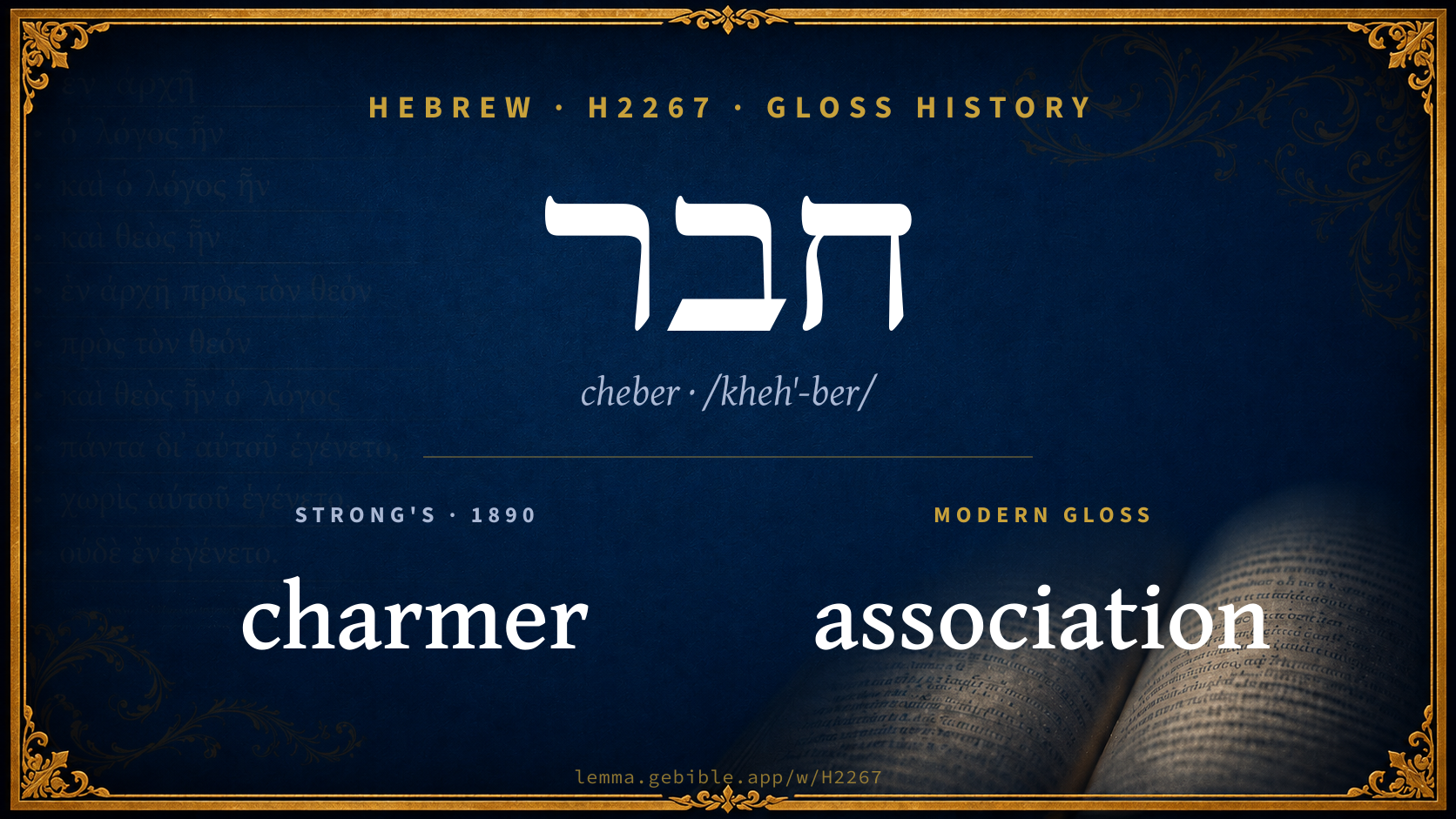
Gloss history
Strong's 1890 vs modern scholarship
About this word
Strong's H2267 catalogs a Hebrew word from the Hebrew Old Testament.
These counts are not copied from any lexicon or concordance. They are computed here, from the morphology-tagged Hebrew Old Testament. What Lemma adds →
- 7
- distinct verses
- The word appears in 7 distinct verses.
- 5 / 39
- OT books
- The word appears in 5 of 39 Old Testament books.
- #2,835
- by frequency
- Top 5000 most frequent Hebrew words (rank 2,835 of 8,640 Hebrew words by occurrence).
View all 7 occurrences in the concordance →
Most concentrated in
- Proverbs 2 verses 29%
- Isaiah 2 verses 29%
- Deuteronomy 1 verse 14%
By section of the Old Testament
By traditional corpus
Conventional, traditional groupings — biblical authorship is debated, so this is a traditional corpus grouping, not an authorship claim. Each share is this word’s portion of its verses in that division of the Hebrew canon. Each figure is a share of the word’s 7 distinct verses.
- Prophets (Nevi'im) 3 verses · 43%
- Writings (Ketuvim) 3 verses · 43%
- Torah (Pentateuch) 1 verse · 14%
How translations render this word
Counts come from each version’s own published word-to-Strong’s tagging or interlinear alignment — an approximate guide to how each version renders this word, not a word-level alignment the data otherwise carries. Because each total is that version’s own tagged count, the per-version totals vary from one another and need not match the appearance or distinct-verse counts above. These counts may also differ from a printed concordance because Lemma counts each distinctly tagged rendering and does not collapse phrase taggings into a single head-word total. This is a fixed set of word-tagged versions (KJV, ASV, BSB, ULT) and does not change with the reading translation you choose elsewhere. Each version’s license is shown beside its name below (and on Sources).
BDB lists this Strong’s number as 2 distinct words (homographs). Each count above pools all of them and is not split by sense — see the Senses section below. A low-frequency rendering may belong to a different one of those words, not the primary meaning.
- King James Version†: Wide 2×
- American Standard Version†: Wide 2×
- Berean Standard Bible†: Spells 2×, Than to share 2×
- unfoldingWord Literal Text†: Charms 2×, Companionship 2×, Spells 2×
King James Version Public Domain
Renders H2267 across 5† tagged occurrences — most commonly:
Plus 3 renderings that appear only once — usually multi-word phrases or single function words the recovered tagging swept in, not distinct renderings. Not rendered by a distinct English word in 2 further occurrences.
American Standard Version Public Domain
Renders H2267 across 5† tagged occurrences — most commonly:
Plus 3 renderings that appear only once — usually multi-word phrases or single function words the recovered tagging swept in, not distinct renderings.
Berean Standard Bible Public Domain
Renders H2267 across 5† tagged occurrences — most commonly:
Plus 1 rendering that appears only once — usually multi-word phrases or single function words the recovered tagging swept in, not distinct renderings. Not rendered by a distinct English word in 2 further occurrences.
unfoldingWord Literal Text CC BY-SA 4.0
Renders H2267 across 7† tagged occurrences — most commonly:
Plus 1 rendering that appears only once — usually multi-word phrases or single function words the recovered tagging swept in, not distinct renderings.
9 senses and sub-senses in the full BDB
What do BDB’s symbols mean?
BDB uses these scholarly abbreviations:
| Symbol | Meaning |
|---|---|
| 𝔊 | the Septuagint (the ancient Greek translation, LXX) |
| 𝔙 | the Vulgate (the Latin translation) |
| 𝔖 | the Syriac version (the Peshitta) |
| 𝔗 | the Targum (the Aramaic translation) |
| ψ | the Psalms |
| √ | root (the underlying root or stem) |
| ‖ | parallel passage (a synonymous or contrasted parallel) |
| † | the dagger: every passage where the word occurs is cited |
The 9 senses and sub-senses the full Brown-Driver-Briggs lexicon distinguishes for this word, in lexicon order (not ranked by frequency), with BDB’s own verbatim wording and sub-sense lettering. Shown in Hebrew script with BDB’s own scholarly abbreviations. The condensed entry is in the Lexicon Entry tab. See also the Forms in the corpus table below.
חבר I [m.] company, association, spell
- 1. company, band of (bad) priests Ho 6:9. e.g. Hosea 6:9
- 2. association, society (abstr.), only in בֵּית חָ֑בֶר Pr 21:9 = 25:24 house of association, i.e. shared with a contentious woman (house in common, v. RVm VB). e.g. Proverbs 21:9
- 3. spell:
- a. as acc. cogn. c. חָבַר (q.v.) Dt 18:11 ψ 58:6. e.g. Deuteronomy 18:11
- b. alone, of Babylonian magic Is 47:9, 12 (v. LenChald. Magic [1878]; Magie u. Wahrsagekunst, 1878; ScholzGötzendienst u. Zauberwesen, 1877, 80 ff. SayTBA iii. 145 ff. and Rel. Bab 396 ff., 440 ff.). e.g. Isaiah 47:9
חבר II
- 1. חֶבֶר (𝔊 Χαβερ) the Kenite, husband of Jael Ju 4:11, 17(×2), 21; 5:24. e.g. Judges 4:11
- 2. a man of Asher חִבֶר Gn 46:17 (P) 𝔊 Χοβωρ 1 Ch 7:31, 32 𝔊 Χαβερ 𝔊L Ιεχοβερ; חֵבֶר Nu 26:45 𝔊 Χοβερ; on poss. identif. with Ḫabiri of Tel el Amarna v. Jastr JBL 1892, xi. 118 ff. 1893, xii. 61 ff. e.g. Genesis 46:17
- 3. חֶבֶר name in Judah 1 Ch 4:18 𝔊 Αβεισα, 𝔊L Αβερ. e.g. 1 Chronicles 4:18
- 4. חָ֑בֶר a Benjamite 1 Ch 8:17 𝔊 Αβαρ, 𝔊L Αβερ. e.g. 1 Chronicles 8:17
Senses from the full Brown-Driver-Briggs lexicon (Brown, Driver, Briggs; Oxford 1906 — public domain), digitized via Sefaria, supplemented by the OpenScriptures HebrewLexicon (CC BY 4.0). Full attribution on Sources.
Word origin
n.[m.] company, association, spell—abs. חָ֑בֶר Dt 18:11 + 2 times; cstr. חֶבֶר Ho 6:9; pl. חֲבָרִים ψ 58:6, sf. חֲבָרַיִךְ Is 47:9, 12;—
— Brown-Driver-Briggs (Oxford 1906, public domain), digitized via Sefaria, supplemented by the OpenScriptures HebrewLexicon (CC BY 4.0). See Sources.
Derived from חבר (châbar) (H2266) — to bind together.
Jastrow Dictionary
A second Hebrew/Aramaic lexicon for comparison, covering Aramaic and post-biblical (Talmudic, Targumic, Midrashic) usage that the biblical-Hebrew BDB does not. Matched by lemma rather than by Strong’s number, so a lemma may carry more than one Jastrow headword (shown separately below), and the entries cover usage well beyond the Bible.
חָבַר
- (b. h.)
- 1. to join, befriend, assist. Y. Ab. Zar. I, 39ᵇ top (ref. to Ps. LVIII, 6) [read:] כל מי שהיה חוֹבְרוֹ הוא חוברו whoever assisted him (in his political ambition), him he befriended.—Esp. חוֹבֵר, pl. חוֹבְרִים, חוֹבְרִין having a share in the ownership of a sacrifice, v. חֲבוּרָה. Men. IX, 9 (93ᵇ bot.) אחד מניף לכל החו׳ Ms. M. (ed. חֲבֵרִים) one of the company does the waving in behalf of all of them. Ib. 94ᵃ נתמעטה בחו׳ is reduced in numbers as regards the participants (only one of them being required to act). Tem. 2ᵃ; Arakh. 2ᵃ בעלי ח׳ (sub. קרבן) partners of a sacrifice (also בעלי קרבן). e.g. Psalms 58:6
- 2. with על (cmp. זָוַג) to join against, protest. B. Bath. 11ᵃ חָבְרוּ עליו וכ׳ his brothers &c. combined to protest against his actions.
- 3. to tie, fascinate, charm. Lam. R. to I, 5 מביאין חוֹבֵר וחוֹבְרִין וכ׳ they procure a charmer and charm the serpent. Sifré Deut. 172 ה׳ מרובה he who charms large objects; Ker. 3ᵇ ח׳ גדול; Snh. 65ᵃ חַבָּר גדול. Ker. l. c. חוֹבֵר חֶבֶר דבלאו הדין הוא but what kind of charmer (Deut. XVIII, 11) is he that is liable only to lashes (v. לַאו)?; a. fr.—[ e.g. Deuteronomy 18:11
- 4. (cmp. חָבַל) to unshape, wound. Denom. חַבּוּרָה.]
- 1. to join, fasten. Yalk. Job 927 (ref. to Job XL, 30) מי שח׳ עצמו במצות whoever befriended himself with good deeds; Tanḥ. Nitsab. 4 (corr. acc.). Kel. XIV, 2 וחִבְּרָהּ לו (or וחֲבָרָהּ) and he fastened the tube to it (the staff). Ib. משיְחַבֵּר from the moment he attaches it, opp. משיחבל, v. חָבַל.—Part. pass. מְחוּבָּר. Ib. XII, 2 כל המ׳ וכ׳ whatever is fastened (belonging) to an object fit to become unclean &c.—מ׳ (לקרקע) fixed, immovable, opp. תלוש. B. Mets. 89ᵃ אוכל במ׳ may eat of what is standing in the field (Deut. XXIII, 25, sq.). Peah IV, 1, v. דָּלִית. Y. ib. 18ᵃ ואינו מ׳ and when the Mishnah says בדלית ובדקל, it does not mean במ׳ בדלית וכ׳ ‘of that which is attached to the vine and tree’; אין תימר מ׳ הוא וכ׳ if you say, it means that which is attached, then the Mishnah means to say that the owner must designate the Peah while it is up (on the tree) &c.—Ib. II, beg. 16ᵈ (in a passage misplaced and corrupted) הא גדר מ׳ ואינו מ׳ this ‘fence’ (Mish. ib. II, 3) is to be considered as something attached to the ground (like a growth) and (in other respects) as not attached. e.g. Job 40:30
- 2. to charm. Lam. R., introd. (R. Josh. 2) התחיל מְחַבֵּר חֲבָרִים (not מחבי חביים) he began to consult charmers (with ref. to Ez. XXI, 26). Snh. 65ᵃ מקטר לחַבֵּר he burns incense for charming purposes (to exorcise the demons); a. fr. e.g. Ezekiel 21:26
- to be joined, gathered. Gen. R. s. 80 (ref. to Hos. VI, 9) as the priests נֶחְכָּרִים על וכ׳ are grooped around &c.; Macc. 10ᵃ מִתְחַבְּרִין וכ׳. e.g. Hosea 6:9
- 1. same; v. supra.—2)
- to associate, make friends with. Ab. I, 7.—Num. R. s. 20, beg. נִתְחַבְּרוּ מואב וכ׳ Moab and Midian formed an alliance; Tanḥ. Balak 3.—3) to be charmed, spellbound. Ib. B’shall. 18 מיד נתח׳ וכ׳ at once the bird is spellbound (by the snake looking at its shadow) and falls to pieces; Yalk. Ex. 255 מת (read מתחבר); Mekh. B’shall., Vayassa, s. 1 מִתְחַבֵּר על צלו (not ומת׳ אל) it remains spell-bound over its own shadow.
חֲבַר
- , Pa. חַבֵּר ch. same,
- 1. to fasten, join. Targ. Ps. CXIX, 69 (Ms. חָבְרוּ Pe.; h. text טפלו).
- 2. to combine against. Targ. Job XVI, 4 (h. text אחבירה).
- 3. to charm. Targ. Y. I Deut. XVIII, 11.
- 4. to wound, v. infra. [Y. Maas. Sh. V, 56ᵇ bot., v. חֲכַר.]
- 1. to associate. Targ. Hos. IV, 17; a. e.
- 2. to be wounded. Keth. 5ᵇ דם מיפקד פקיד או חַבּוּרֵי אִיחַבַּר is the blood (in the womb) stored up, or is it the result of a wound?; ib. 6ᵃ דם חבורי מִיחַבַּר.
חָבֵר
- preced. wds.) (with suff. חֲבֵיר־)
- 1. associate, friend, partner (in sacrifices); colleague, fellow-student; fellow-being; of the same kind(also of things). Ab. II, 9 ח׳ טוב a true friend; ח׳ רע a false friend. Ib. 10 כבוד חֲבֵרְךָ thy neighbor’s honor. Sabb. 63ᵃ top בח׳ טוב with a good friend (an obscene disguise for a fair woman, v. גּוּרְדְּלִי); a. v. fr.—ח׳ ותלמיד, (in Babli) תלמיד ח׳ colleague and pupil, a title of distinction for a student, fellow. Y. Shek. III, beg. 47ᵇ; Y. B. Bath. IX, end, 17ᵇ, a. e. ח׳ ות׳ הוה וכ׳ was a fellow under R. Ak.; Bab. B. Bath. 158ᵇ. Ber. 27ᵇ דתלמיד ח׳ הוה who was a fellow (under Rab).
- 2. Ḥaber, Fellow, a scholar’s title, less than חַכִּים or זָקֵן. Kidd. 33ᵇ (in Chald. phras.) אנא ח׳, אתון חכימי ye are ḥakkime (doctors), and I merely a fellow. Snh. 8ᵇ, a. e. ח׳ אינו וכ׳, v. הַתְרָאָה; a. fr.—Gen. R. s. 84 (play on חֶ֗בְ֗ר֗ו̇ן֗) ח̇ב̇ר̇ הנ̇אה וכ׳ that worthy scholar buried &c.
- 3. Ḥaber,member of a religious or charitable association, esp. member of the order for the observance of levitical laws in daily intercourse. Dem. II, 3. Tosef. ib. II, 2 מקבלין אותו להיות ח׳ is accepted as a member of the order; a. v. fr.—Pl. חֲבֵרִים, חֲבֵי׳. Ber. 28ᵇ ולא יכשלו חֲבֵרַי וכ׳ that my colleagues (in court) may not fail in a decision of the law. Ib. הזהרו בכבוד חֲבֵירֵיכֶם take heed of your fellow-students’ honor. Bekh. 30ᵇ בפני שלשה ח׳ in the presence of three members of the order. Pesik. R. s. 11 חֲבֵרֵיהֶם שלהם עוסקים וכ׳ the members of societies among them are engaged in charitable work. Ib. ואין חביריהם מרגישים and their neighbors (the fruits in the same bag) are not affected; a. v. fr.—Fem. חֲבֵירָה, חֲבֵרָה, חֲבֶרֶת, חֲבֶירֶת. Snh. 8ᵇ אשה חבירה a scholarly woman (acquainted with the law). Ber. 48ᵇ, a. fr. אין מלכות נוגעת בחֲבֶרְתָּהּ וכ׳ one term of office does not touch upon its successor even at a hair’s breadth (duration of power is preordained). Deut. R. s. 7 אין טיפה מתערבת בחברתה one rain-drop does not mix itself with the other; a. fr.—Pl. חֲבֵרוֹת. Sabb. 129ᵃ חֲבֵרוֹתֶיהָ וכ׳, v. אֲגַף; a. fr.
חֶבֶר
- preced. wds.)
- 1. association.—חֶבֶר עיר a town organization, congregation (for divine services, study, charities). Ber. IV, 7. R. Hash. 34ᵇ. Meg. 27ᵇ top (Rashi: חֲבַר עיר a scholar maintained by the town, v. preced. w.).
- 2. charm. Snh. 65ᵃ; Ker. 3ᵇ, v. חָבַר.—Pl. חֲבָרִים. Lam. R. introd. (R. Josh. 2), v. חָבַר, Pi.
- 3. ח׳ גואלקי a load of sacks tied across an animal’s back, to unload which you must lift them before untying, contrad. to אֵבֶר גואלקי a load kept in balance by equal weight on both sides, to unload which you need only untie the knot on the animal’s back. Sabb. 154ᵇ מאי לאו בחבר גוולקי וכ׳ ed. (Ms. M. באבר גזול or גדול) do you not think (when it says, ib. XXIV, 1, ‘he unties the ropes and the sacks drop of themselves’) a ḥeber is meant which must be lifted along the sides of the animal?; לא באבר גואלקי וכ׳ Rashi Ms. a. Ar. (ed. בחבר אגלווקי, Ms. M. בגאלקי מפייהו, read: גופייהו, v. Rabb. D. S. a. l. note 7) no, a balanced load is meant &c.; v. Ar. Compl. ed. Koh. s. v. חבר. Cmp. אַבְרַוְורֵי.
חַבָּר
- associate; Talm. = חוֹבֵר, v. חָבַר)
- 1. charmer. Snh. 65ᵃ, v. חָבַר. Deut. R. s. 7; a. e.
- 2. magus (v. אַמְגּוּשָׁא), Parsee priest, guebre in gen. Parsee government. Sabb. 11ᵃ תחת נכרי ולא תחת ח׳ (v. Rabb. D. S. a. l. note 80) rather under heathen (Roman) government, than under a Parsee.—Pl. חַבָּרִין, חַבָּרִים. Kidd. 72ᵃ הראני ח׳ let me see (give me a description of) the Parsees (as opposed to Persians). Pes. 113ᵇ. Yeb. 63ᵇ (ref. to Deut. XXXII, 21 גוי נבל) אלו ח׳ this means the Parsees. e.g. Deuteronomy 32:21
חַבָּר ²
- 1. charmer, v. חַבּוּרָא II.—Lev. R. s. 22; Yalk. Koh. 972 אתא חד חבר (Gen. R. s. 10; Koh. R. to V, 8 גבר, corr. acc.) a charmer (of snakes) came; Tanḥ. Ḥuck. 1.—Pl. חַבָּרַיָּא. Snh. 65ᵇ מן ח׳ את thou art a creation of the charmers.
- 2. Parsee. Gitt. 16ᵇ, sq. אתא ההוא ח׳ וכ׳ a Parsee came and took the lamp from them.—Pl. חַבָּרֵי. Sabb. 45ᵃ מקמי ח׳ from fear of the Parsees (that they might see the lights). Yeb. 63ᵇ אתו ח׳ לבבל the Parsees have entered the Jewish colonies of Babylonia. Bets. 6ᵃ but nowadays דאיכא ח׳ when there are Parsees (forcing to public labors).
A Dictionary of the Targumim, the Talmud Babli and Yerushalmi, and the Midrashic Literature (Marcus Jastrow; London, Luzac, 1903) — Public Domain. Digitized via Sefaria. Digitized via Sefaria. Full attribution on Sources.
Forms in the corpus
The 6 distinct written forms H2267 takes in the Hebrew Bible, most frequent first — each parse links to that state’s occurrences in the concordance. Hebrew forms include their vowel points and cantillation, so a single lemma takes many written forms.
| Form | Parsing | Example | Uses |
|---|---|---|---|
| חָֽבֶר | Noun, Common, Masculine, Singular, Absolute | Proverbs 21:9 | 2 |
| בַ/חֲבָרַ֨יִ/ךְ֙ | Noun, Common, Masculine, Plural, Construct | Isaiah 47:12 | 1 |
| חֲבָרִ֣ים | Noun, Common, Masculine, Plural, Absolute | Psalms 58:5 | 1 |
| חֲבָרַ֖יִ/ךְ | Noun, Common, Masculine, Plural, Construct | Isaiah 47:9 | 1 |
| חֶ֚בֶר | Noun, Common, Masculine, Singular, Construct | Hosea 6:9 | 1 |
| חָ֑בֶר | Noun, Common, Masculine, Singular, Absolute | Deuteronomy 18:11 | 1 |
Same root — word family
Other BDB entries built from the same root as H2267, grouped by Strong’s listed origin. These share a root / origin per the lexicon — not necessarily a shared meaning. Each links to that word’s own entry.
Derives from
Shares the same root
- חבורה chabbûwrâh H2250 wound
- חבר chăbar H2269 companion
- חבר châbêr H2270 companion
- חבר chabbâr H2271 partner
- חברברה chăbarburâh H2272 stripe
- חברת chôbereth H2279 joining
- מחברת machbereth H4225 joint
- מחברה mᵉchabbᵉrâh H4226 clamp
Derived from this word
Proper names from this root
People and places named from this root — a name, not an additional meaning of the word.
Compare all same-root words → Showing 4 of 14 — not the complete family. 3 of the same-root words are proper names (people or places). They share a root, not necessarily a meaning.
Septuagint verse parallels
This word appears in 7 verses that also exist in the Greek Old Testament (Septuagint), out of the 7 Hebrew verses it occurs in. You can read those verses in Greek by switching the Old Testament edition to the Septuagint.
Read these verses in the Septuagint
This is a verse-level parallel only — the same verses exist in both the Hebrew and Greek Old Testaments. No word-level Hebrew↔Greek correspondence is claimed: the data carries no such alignment, so no Greek word is shown as this Hebrew word’s translation. Coverage is not total — the Septuagint omits the deuterocanon and renumbers the Psalms, so some Hebrew verses have no direct Greek parallel.