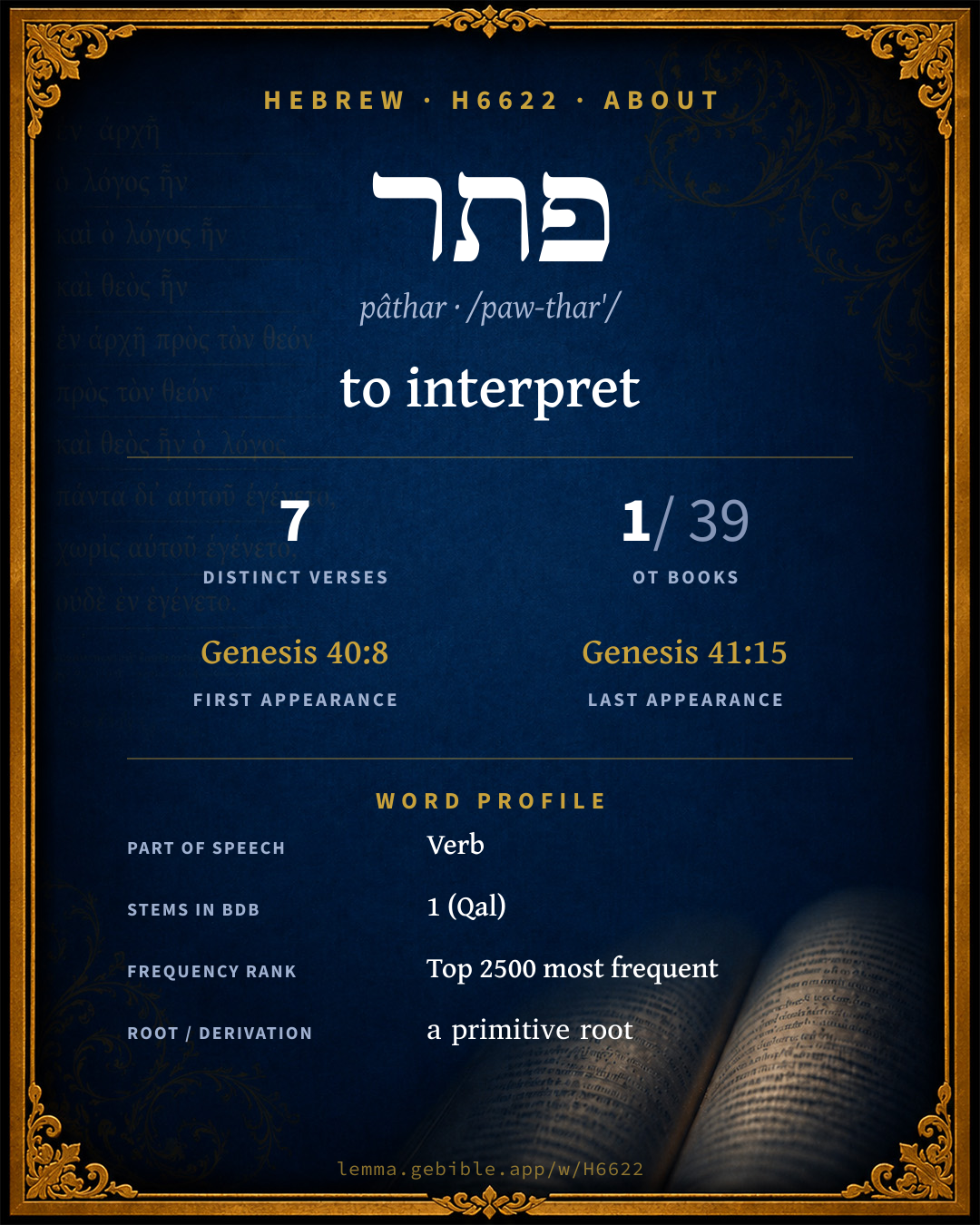
פָּתַר
to interpret
Full lexicon entry — Brown-Driver-Briggs (BDB)
From Brown-Driver-Briggs (BDB)
Where this word appears
Grammar key — what these labels mean
Part of speech
- Verb
- An action or state-of-being word.
Stem
- Qal
- The basic, simple active stem — the plain form of the verb (“he wrote”).
Form
- Perfect
- A completed action or state — Hebrew marks aspect (completeness) more than strict tense (“he wrote”).
- Participle Active
- A verbal adjective expressing ongoing or characteristic action (“writing / one who writes”).
- Sequential Imperfect
- An imperfect with prefixed waw — the standard past-narrative form (waw-consecutive imperfect).
- Infinitive Construct
- A bound verbal noun, frequently with prepositions (“to write / in writing”).
State
- Absolute
- The independent form of a noun, not bound to a following word.
Person
- 3rd Person
- The one spoken about (“he / she / it / they”).
Gender
- Masculine
- Grammatically masculine.
Number
- Singular
- One.
Grammatical forms
- Verb, Qal, Perfect, 3rd Person, Masculine, Singular 4 times (44%)
- Verb, Qal, Participle Active, Masculine, Singular, Absolute 3 times (33%)
- Verb, Qal, Sequential Imperfect, 3rd Person, Masculine, Singular 1 time (11%)
- Verb, Qal, Infinitive Construct 1 time (11%)
Parsed forms decoded from the imported morphology (morphhb / Westminster Leningrad Codex — WLC text public domain, morphhb tagging CC BY 4.0), counted across 9 parsed occurrences — not distinct verses.
Every verse where H6622 appears — 7 distinct verses across 1 book. Click any verse to open its interlinear word-by-word view. Verse text shown in the World English Bible for context — . Each verse’s Hebrew form is shown with its reference; the English is not keyword-highlighted, since the data carries no word-level English alignment. Use “Compare translations” on any verse to read it across multiple English versions. This concordance covers the Hebrew Bible; Septuagint (Greek Old Testament) occurrences are not indexed here.
Genesis 7 verses
- Genesis 40:8 וּ/פֹתֵ֖ר conj + Qal ptcp.act ms They said to him, "We have dreamed a dream, and there is no one who can interpret it." Joseph said to them, "Don't interpretations belong to God? Please tell it to me."
- Genesis 40:16 פָּתָ֑ר Qal pf 3ms When the chief baker saw that the interpretation was good, he said to Joseph, "I also was in my dream, and, behold, three baskets of white bread were on my head.
- Genesis 40:22 פָּתַ֛ר Qal pf 3ms but he hanged the chief baker, as Joseph had interpreted to them.
- Genesis 41:8 פּוֹתֵ֥ר Qal ptcp.act ms It happened in the morning that his spirit was troubled, and he sent and called for all the magicians of Egypt, and all the wise men of it. Pharaoh told them his dream, but there was no one who could interpret them to Pharaoh.
- Genesis 41:12 וַ/יִּפְתָּר פָּתָֽר conj + Qal wimpf 3ms Qal pf 3ms There was with us there a young man, a Hebrew, servant to the captain of the guard, and we told him, and he interpreted to us our dreams. To each man according to his dream he interpreted.
- Genesis 41:13 פָּֽתַר Qal pf 3ms It happened, as he interpreted to us, so it was: he restored me to my office, and he hanged him."
- Genesis 41:15 וּ/פֹתֵ֖ר לִ/פְתֹּ֥ר conj + Qal ptcp.act ms prep + Qal inf.cs Pharaoh said to Joseph, "I have dreamed a dream, and there is no one who can interpret it. I have heard it said of you, that when you hear a dream you can interpret it."
About this entry
At a glance — auto-summarized from this page’s data, not written by a person. Every figure links to its source below. This summary describes the numbers; it doesn’t interpret them.
The Hebrew verb פתר centers on the idea of “to interpret.” Genesis dominates its distribution — 7 of 7 verses. The Hebrew Bible uses it across 7 verses — uncommon. First canonically at Genesis 40:8, it enters the text early. Related forms include פשר and פתרון. Dig into 7-verse concordance and the renderings breakdown below.
Gloss history
Strong's 1890 vs modern scholarship
About this word
Strong's H6622 catalogs a Hebrew word from the Hebrew Old Testament.
These counts are not copied from any lexicon or concordance. They are computed here, from the morphology-tagged Hebrew Old Testament. What Lemma adds →
- 7
- distinct verses
- The word appears in 7 distinct verses.
- 1 / 39
- OT books
- The word appears in 1 of 39 Old Testament books.
- #2,481
- by frequency
- Top 2500 most frequent Hebrew words (rank 2,481 of 8,640 Hebrew words by occurrence).
View all 7 occurrences in the concordance →
Most concentrated in
- Genesis 7 verses 100%
By section of the Old Testament
By traditional corpus
Conventional, traditional groupings — biblical authorship is debated, so this is a traditional corpus grouping, not an authorship claim. Each share is this word’s portion of its verses in that division of the Hebrew canon. Each figure is a share of the word’s 7 distinct verses.
- Torah (Pentateuch) 7 verses · 100%
How translations render this word
Counts come from each version’s own published word-to-Strong’s tagging or interlinear alignment — an approximate guide to how each version renders this word, not a word-level alignment the data otherwise carries. Because each total is that version’s own tagged count, the per-version totals vary from one another and need not match the appearance or distinct-verse counts above. These counts may also differ from a printed concordance because Lemma counts each distinctly tagged rendering and does not collapse phrase taggings into a single head-word total. This is a fixed set of word-tagged versions (KJV, ASV, BSB, ULT) and does not change with the reading translation you choose elsewhere. Each version’s license is shown beside its name below (and on Sources).
- King James Version: Came to pass as he interpreted 1×, Had interpreted 1×, He did interpret 1×
- American Standard Version: Is none that can interpret 2×
- Berean Standard Bible: Could interpret 1×, Had described 1×, He had interpreted 1×
- unfoldingWord Literal Text: He interpreted 4×, But 2×, Could interpret 2×
King James Version Public Domain
Renders H6622 across 9 tagged occurrences — most commonly:
American Standard Version Public Domain
Renders H6622 across 9 tagged occurrences — most commonly:
Plus 7 renderings that appear only once — usually multi-word phrases or single function words the recovered tagging swept in, not distinct renderings.
Berean Standard Bible Public Domain
Renders H6622 across 8 tagged occurrences — most commonly:
Not rendered by a distinct English word in 1 further occurrence.
unfoldingWord Literal Text CC BY-SA 4.0
Renders H6622 across 11 tagged occurrences — most commonly:
Plus 3 renderings that appear only once — usually multi-word phrases or single function words the recovered tagging swept in, not distinct renderings.
Senses in the full BDB
What do BDB’s symbols mean?
BDB uses these scholarly abbreviations:
| Symbol | Meaning |
|---|---|
| 𝔊 | the Septuagint (the ancient Greek translation, LXX) |
| 𝔙 | the Vulgate (the Latin translation) |
| 𝔖 | the Syriac version (the Peshitta) |
| 𝔗 | the Targum (the Aramaic translation) |
| ψ | the Psalms |
| √ | root (the underlying root or stem) |
| ‖ | parallel passage (a synonymous or contrasted parallel) |
| † | the dagger: every passage where the word occurs is cited |
The 1 sense the full Brown-Driver-Briggs lexicon distinguishes for this word, in lexicon order (not ranked by frequency), with BDB’s own verbatim wording and sub-sense lettering. Shown in Hebrew script with BDB’s own scholarly abbreviations. The condensed entry is in the Lexicon Entry tab. See also the Forms in the corpus table below.
Qal
- Pf. 3 ms. פָּתַר, c. ל pers. Gn 40:22; 41:13; abs. פָּתָ֑ר 40:16; 41:12; c. acc. rei: Impf. 3 ms. וַיִּפְתָּר־לָנוּ 41:12; Inf. cstr. לִפְתֹּר 41:15; Pt. act. פֹּתֵר 40:8; 41:15, פּוֹי 41:8. e.g. Genesis 40:22
Senses from the full Brown-Driver-Briggs lexicon (Brown, Driver, Briggs; Oxford 1906 — public domain), digitized via Sefaria, supplemented by the OpenScriptures HebrewLexicon (CC BY 4.0). Full attribution on Sources.
Word origin
vb. interpret (dream), only Gn 40, 41 (NH id., J.Aram. פְּתַר; appar. =Aramaic פְּשַׁר, ܦܫܰܪ, dissolve, fig. solve, interpret, cf. פֵּשֶׁר);—
— Brown-Driver-Briggs (Oxford 1906, public domain), digitized via Sefaria, supplemented by the OpenScriptures HebrewLexicon (CC BY 4.0). See Sources.
Origin: a primitive root
Jastrow Dictionary
A second Hebrew/Aramaic lexicon for comparison, covering Aramaic and post-biblical (Talmudic, Targumic, Midrashic) usage that the biblical-Hebrew BDB does not. Matched by lemma rather than by Strong’s number, so a lemma may carry more than one Jastrow headword (shown separately below), and the entries cover usage well beyond the Bible.
פָּתַר
- [to divide, spread,] to solve; to interpret. Ber. 55ᵇ כ"ר פּוֹתְרֵי חלומות וכ׳ twenty-four interpreters of dreams existed in Jerusalem, ומה שפ׳ לי זה לא פ׳ וכ׳ and not two of them interpreted my dream alike. Pesik. Par., p. 33ᵃ פ׳ קרא בפרשת פרה explained the verse (Ps. XII, 7) as referring to the lesson concerning the red cow; Num. R. s. 19; a. fr. e.g. Psalms 12:7
- to be interpreted, solved. Ber. l. c. חלום שנ׳ וכ׳ a dream which was interpreted in a dream. Y. Shek. IV, 48ᵇ תִּיפָּתֵר שפודין וכ׳ it may be explained that they redeem unblemished sacrifices, and when afterwards they are blemished, (the money paid for them is secularized). Y. Ber. VII, 11ᵃ bot. תיפתר כר׳ וכ׳ the difficulty may be solved in agreement with R. Ishmael’s opinion; a. fr.
פְּתַר I
- Targ. Y. II, Gen. XL, 12; 18. Targ. Y. Num. XXII, 5 בפדן … פָּתֵיר חלמיא in Paddan which is named Pethor after him (Balaam), ‘interpreter of dreams’; Targ. Y. Deut. XXIII, 5 מן פְּתוֹר חלמיא (corr. acc.).—Tam. 32ᵃ כל … בחד פְּתַרְנָא לך whatever you asked of us, we all explained in the same way. Keth. 107ᵇ פַּתְרִיתוּ בה כילי האי have you gone so far in your interpretation? Y. Ber. II, end, 5ᵈ יכיל אנא פָּתֵר וכ׳ (= למִפְתַּר) I can explain this in agreement with the opinion of &c. Pesik. Shek., p. 10ᵇ ורבנן פַּתְרִין קרא בדואג וכ׳ and the Rabbis explain this verse (Ps. III, 3) as a reference to Doeg &c.; a. fr. e.g. Psalms 3:3
- to mollify, steep (in water &c.). Y. B. Mets. IV, end, 9ᵈ הוה מְפַתֵּר וכ׳, v. סַרְדּוּתָא.
פְּתַר II
- , m. (preced.) solution, interpretation. Y. Ber. I, 2ᵈ bot., a. fr. פ׳ לה וכ׳ there is an explanation for it (you can meet this difficulty by saying), that it refers &c. Tam. 32ᵃ מילתא דא אין לה פ׳ this problem is insolvable. Yeb. 97ᵇ [read with Ar.] נישל לכו סתר פ׳ we shall ask you something too mysterious for solution. Y. Shebu. I, 32ᶜ sq. פתר לה פ׳ חורן offered a different solution for it. Y. Dem. VII, end, 26ᶜ אין לך אלא כהדין פי׳ קדמיא there is nothing left to thee but to agree with the first interpretation. Y. Naz. V, 53ᵈ bot. כפִתְרֵה דר׳ ירמיה as R. J. has explained it; a. fr.—Pl. פִּתְרִין, פִּתְרַיָּיא, פִּתְרַיָּיה, פִּי׳. Y. Erub. IV, end, 22ᵃ פתר לה תרין פ׳ offered two explanations. Y. Peah IV, 18ᵇ top פתר לה כאילין פ׳ he explained it in accordance with those explanations (given above); Y. Gitt. VIII, 49ᶜ top פתרייתא (corr. acc.).
A Dictionary of the Targumim, the Talmud Babli and Yerushalmi, and the Midrashic Literature (Marcus Jastrow; London, Luzac, 1903) — Public Domain. Digitized via Sefaria. Digitized via Sefaria. Full attribution on Sources.
Forms in the corpus
The 8 distinct written forms H6622 takes in the Hebrew Bible, most frequent first — each parse links to that stem’s occurrences in the concordance. Hebrew forms include their vowel points and cantillation, so a single lemma takes many written forms.
| Form | Parsing | Example | Uses |
|---|---|---|---|
| וּ/פֹתֵ֖ר | Verb, Qal, Participle Active, Masculine, Singular, Absolute | Genesis 40:8 | 2 |
| וַ/יִּפְתָּר | Verb, Qal, Sequential Imperfect, 3rd Person, Masculine, Singular | Genesis 41:12 | 1 |
| לִ/פְתֹּ֥ר | Verb, Qal, Infinitive Construct | Genesis 41:15 | 1 |
| פָּֽתַר | Verb, Qal, Perfect, 3rd Person, Masculine, Singular | Genesis 41:13 | 1 |
| פָּתַ֛ר | Verb, Qal, Perfect, 3rd Person, Masculine, Singular | Genesis 40:22 | 1 |
| פָּתָ֑ר | Verb, Qal, Perfect, 3rd Person, Masculine, Singular | Genesis 40:16 | 1 |
| פָּתָֽר | Verb, Qal, Perfect, 3rd Person, Masculine, Singular | Genesis 41:12 | 1 |
| פּוֹתֵ֥ר | Verb, Qal, Participle Active, Masculine, Singular, Absolute | Genesis 41:8 | 1 |
Same root — word family
Other BDB entries built from the same root as H6622, grouped by Strong’s listed origin. These share a root / origin per the lexicon — not necessarily a shared meaning. Each links to that word’s own entry.
Derived from this word
Compare all same-root words → They share a root, not necessarily a meaning.
Septuagint verse parallels
This word appears in 7 verses that also exist in the Greek Old Testament (Septuagint), out of the 7 Hebrew verses it occurs in. You can read those verses in Greek by switching the Old Testament edition to the Septuagint.
Read these verses in the Septuagint
This is a verse-level parallel only — the same verses exist in both the Hebrew and Greek Old Testaments. No word-level Hebrew↔Greek correspondence is claimed: the data carries no such alignment, so no Greek word is shown as this Hebrew word’s translation. Coverage is not total — the Septuagint omits the deuterocanon and renumbers the Psalms, so some Hebrew verses have no direct Greek parallel.