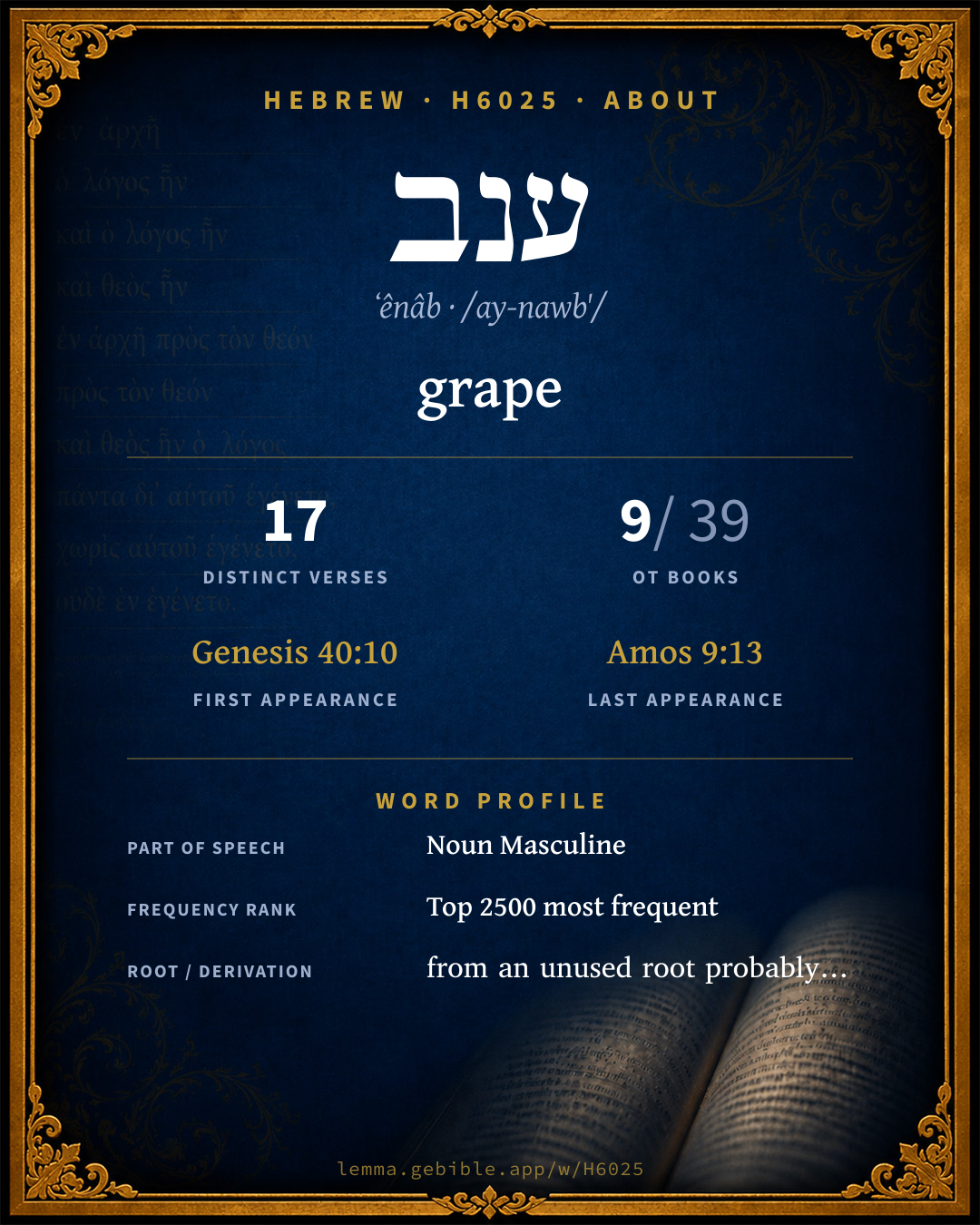
עֵנָב
grape
Full lexicon entry — Brown-Driver-Briggs (BDB)
From Brown-Driver-Briggs (BDB)
Where this word appears
See every Absolute-state word in the Hebrew Bible →
Grammar key — what these labels mean
Part of speech
- Noun
- A naming word — a person, place, thing, or idea.
Noun type
- Common
- A common noun — a general class of person, place, or thing (“king,” “city,” “water”), not a specific name.
State
- Absolute
- The independent form of a noun, not bound to a following word.
- Construct
- A noun bound to a following noun in a possessive / “of” relationship (the construct chain).
Gender
- Masculine
- Grammatically masculine.
Number
- Plural
- More than one (in Hebrew, generally three or more).
- Singular
- One.
Grammatical forms
- Noun, Common, Masculine, Plural, Absolute 15 times (79%)
- Noun, Common, Masculine, Plural, Construct 3 times (16%)
- Noun, Common, Masculine, Singular, Absolute 1 time (5%)
Parsed forms decoded from the imported morphology (morphhb / Westminster Leningrad Codex — WLC text public domain, morphhb tagging CC BY 4.0), counted across 19 parsed occurrences — not distinct verses.
Every verse where H6025 appears — 17 distinct verses across 9 books. Click any verse to open its interlinear word-by-word view. Verse text shown in the World English Bible for context — . Each verse’s Hebrew form is shown with its reference; the English is not keyword-highlighted, since the data carries no word-level English alignment. Use “Compare translations” on any verse to read it across multiple English versions. This concordance covers the Hebrew Bible; Septuagint (Greek Old Testament) occurrences are not indexed here.
Genesis 3 verses
- Genesis 40:10 עֲנָבִֽים n c mp and in the vine were three branches. It was as though it budded, its blossoms shot forth, and the clusters of it brought forth ripe grapes.
- Genesis 40:11 הָֽ/עֲנָבִ֗ים ptcl def.art + n c mp Pharaoh's cup was in my hand; and I took the grapes, and pressed them into Pharaoh's cup, and I gave the cup into Pharaoh's hand."
- Genesis 49:11 עֲנָבִ֖ים n c mp Binding his foal to the vine, His donkey's colt to the choice vine; He has washed his garments in wine, His robes in the blood of grapes:
Leviticus 1 verse
Numbers 3 verses
- Numbers 6:3 עֲנָבִים֙ וַ/עֲנָבִ֛ים n c mp conj + n c mp he shall separate himself from wine and strong drink. He shall drink no vinegar of wine, or vinegar of fermented drink, neither shall he drink any juice of grapes, nor eat fresh grapes or dried.
- Numbers 13:20 עֲנָבִֽים n c mp and what the land is, whether it is fat or lean, whether there is wood therein, or not. Be of good courage, and bring of the fruit of the land. Now the time was the time of the first-ripe grapes.
- Numbers 13:23 עֲנָבִים֙ n c mp They came to the valley of Eshcol, and cut down from there a branch with one cluster of grapes, and they bore it on a staff between two; [they brought] also of the pomegranates, and of the figs.
Deuteronomy 3 verses
- Deuteronomy 23:24 עֲנָבִ֛ים n c mp When you come into your neighbor's vineyard, then you may eat of grapes your fill at your own pleasure; but you shall not put any in your vessel.
- Deuteronomy 32:14 עֵנָ֖ב n c ms Butter of the herd, and milk of the flock, With fat of lambs, Rams of the breed of Bashan, and goats, With the finest of the wheat; Of the blood of the grape you drank wine.
- Deuteronomy 32:32 עֲנָבֵ֨/מוֹ֙ עִנְּבֵי n c mp cs + sfx pers 3mp n c mp cs For their vine is of the vine of Sodom, Of the fields of Gomorrah: Their grapes are grapes of gall, Their clusters are bitter:
Nehemiah 1 verse
Isaiah 2 verses
- Isaiah 5:2 עֲנָבִ֖ים n c mp He dug it up, Gathered out its stones, Planted it with the choicest vine, Built a tower in its midst, And also cut out a winepress therein. He looked for it to yield grapes, But it yielded wild grapes.
- Isaiah 5:4 עֲנָבִ֖ים n c mp What could have been done more to my vineyard, that I have not done in it? Why, when I looked for it to yield grapes, did it yield wild grapes?
Jeremiah 1 verse
Hosea 2 verses
- Hosea 3:1 עֲנָבִֽים n c mp Yahweh said to me, "Go again, love a woman loved by another, and an adulteress, even as Yahweh loves the children of Israel, though they turn to other gods, and love cakes of raisins."
- Hosea 9:10 כַּ/עֲנָבִ֣ים prep + n c mp I found Israel like grapes in the wilderness. I saw your fathers as the first ripe in the fig tree at its first season; But they came to Baal Peor, and consecrated themselves to the shameful thing, And became abominable like that which they loved.
Amos 1 verse
About this entry
At a glance — auto-summarized from this page’s data, not written by a person. Every figure links to its source below. This summary describes the numbers; it doesn’t interpret them.
The Hebrew noun ענב centers on the idea of “grape.” Debuting at Genesis 40:10, it then recurs through the corpus. Spanning 17 verses in 9 books, it ranks among the uncommon words of the Hebrew Bible. Sharing its root, it stands alongside ענב and ענוב. For the data behind this summary, explore the sense tree and the renderings breakdown below.
Gloss history
Strong's 1890 vs modern scholarship
About this word
Strong's H6025 catalogs a Hebrew word from the Hebrew Old Testament.
These counts are not copied from any lexicon or concordance. They are computed here, from the morphology-tagged Hebrew Old Testament. What Lemma adds →
- 17
- distinct verses
- The word appears in 17 distinct verses.
- 9 / 39
- OT books
- The word appears in 9 of 39 Old Testament books.
- #1,563
- by frequency
- Top 2500 most frequent Hebrew words (rank 1,563 of 8,640 Hebrew words by occurrence).
View all 17 occurrences in the concordance →
Most concentrated in
- Genesis 3 verses 18%
- Numbers 3 verses 18%
- Deuteronomy 3 verses 18%
By section of the Old Testament
By traditional corpus
Conventional, traditional groupings — biblical authorship is debated, so this is a traditional corpus grouping, not an authorship claim. Each share is this word’s portion of its verses in that division of the Hebrew canon. Each figure is a share of the word’s 17 distinct verses.
- Torah (Pentateuch) 10 verses · 59%
- Prophets (Nevi'im) 6 verses · 35%
- Writings (Ketuvim) 1 verse · 6%
How translations render this word
Counts come from each version’s own published word-to-Strong’s tagging or interlinear alignment — an approximate guide to how each version renders this word, not a word-level alignment the data otherwise carries. Because each total is that version’s own tagged count, the per-version totals vary from one another and need not match the appearance or distinct-verse counts above. These counts may also differ from a printed concordance because Lemma counts each distinctly tagged rendering and does not collapse phrase taggings into a single head-word total. This is a fixed set of word-tagged versions (KJV, ASV, BSB, ULT) and does not change with the reading translation you choose elsewhere. Each version’s license is shown beside its name below (and on Sources).
- King James Version: Grapes 14×
- American Standard Version: Grapes 13×
- Berean Standard Bible: Grapes 13×
- unfoldingWord Literal Text: Grapes 16×
King James Version Public Domain
Renders H6025 across 19 tagged occurrences — most commonly:
Plus 5 renderings that appear only once — usually multi-word phrases or single function words the recovered tagging swept in, not distinct renderings.
American Standard Version Public Domain
Renders H6025 across 19 tagged occurrences — most commonly:
Plus 6 renderings that appear only once — usually multi-word phrases or single function words the recovered tagging swept in, not distinct renderings.
Berean Standard Bible Public Domain
Renders H6025 across 17 tagged occurrences — most commonly:
Plus 4 renderings that appear only once — usually multi-word phrases or single function words the recovered tagging swept in, not distinct renderings. Not rendered by a distinct English word in 2 further occurrences.
unfoldingWord Literal Text CC BY-SA 4.0
Renders H6025 across 20 tagged occurrences — most commonly:
Plus 4 renderings that appear only once — usually multi-word phrases or single function words the recovered tagging swept in, not distinct renderings.
Senses in BDB
The 1 sense BDB distinguishes for this word, in lexicon order (not ranked by frequency or importance). The full entry — with sub-senses — is in the Lexicon Entry tab.
- grape(s)
Word origin
n.m. Gn 40:11 grape(s) (on formation cf. LagBN 153);—ע׳ abs. Dt 32:14 (coll.); elsewhere pl. עֲנָבִים Gn 40:10 +; cstr. עִנְּבֵי (Ges§ 20 h) Lv 25:5; Dt 32:32; sf. עֲנָבֵמוֹ v 32;—grapes Gn 40:10, 11 (E), Am 9:13 (all as yielding juice for drink), Ho 9:10 (sim.), Is 5:2, 4 (parable), Je 8:13; Ne 13:15; Lv 25:5 (H); מִשְׁרַת ע׳ Nu 6:3 (P), poet. דַּם־ע׳ Gn 49:11; Dt 32:14; בִּכּוּרֵי ע׳ Nu 13:20, אֶשְׁכּוֹל ע׳ v 23 (JE); eaten Dt 23:25 so ע׳ לַחִים וִיבֵשִׁים Nu 6:3; אֲשִׁישֵׁי ע׳ Ho 3:1 raisin-cakes; ע׳ רוֹשׁ Dt 32:12 grapes of poison.
— Brown-Driver-Briggs (Oxford 1906, public domain), digitized via Sefaria, supplemented by the OpenScriptures HebrewLexicon (CC BY 4.0). See Sources.
Origin: from an unused root probably meaning to bear fruit
Jastrow Dictionary
A second Hebrew/Aramaic lexicon for comparison, covering Aramaic and post-biblical (Talmudic, Targumic, Midrashic) usage that the biblical-Hebrew BDB does not. Matched by lemma rather than by Strong’s number, so a lemma may carry more than one Jastrow headword (shown separately below), and the entries cover usage well beyond the Bible.
עָנַב
- (cmp. ענף) to intertwine, fasten by means of a loop, contrad. to קָשַׁר. Sabb. 113ᵃ לא יהא קושרו אלא עוֹנְבוֹ he must not knot (the broken rope) but loop it; Tosef. ib. XII (XIII), 16 עוֹנְבִין אותו. Sabb. l. c. ובלבד שלא יַעַנְבֶנּוּ provided he does not fasten it with a loop. Tosef. Erub. XI (VIII), 19; Y. ib. X, 26ᶜ bot. משלשל מלמעלן ועוֹנֵב וכ׳ he pulls the cord down and makes the loop at the bottom; Bab. ib. 102ᵇ עוֹנְבָהּ; a. fr.—Part. pass. עָנוּב; f. עֲנוּבָה; pl. עֲנוּבִים &c. Tosef. Kel. B. Mets. V, 6 קשור וע׳ if the handle is tied to the vessel with a knot or loop. Mekh. Yithro, Baḥod., s. 3 הרי אתם קשורים ע׳ תפוסים you are now tied, looped, held fast (by the covenant); a. e.
עֲנַב
- Targ. Y. Ex. XXVIII, 28 Ar. (ed. ויטכס׳; h. text וירכסו).—Erub. 97ᵃ לִיעַנְבִינְהוּ מִיעֲנַב let him fasten them with a loop. Succ. 33ᵇ לִיעַנְבֵיה מיענב let him tie it (the Lulab) &c. Men. 38ᵇ לעַנְבָן כולהו בהדדי (v. Rabb. D. S. a. l. note 40) to make a loop of all of them together; a. e.
- to be looped. Ib. אלימי דלא מִיעַנְבֵי ואי הוו קטיני מיענבי if the threads are too thick to allow a loop, but long enough to be looped if they were thinner; a. e.
עֵנָב
- c. (b. h.; preced.)
- 1. grapes with the tendrils, also berry. Y. Ned. XI, 42ᵈ קונם תאנה … ועוד ע׳ I swear that I will not taste figs and furthermore (after thirty days) grapes.—Pl. עֲנָבִים, עֲנָבִין; const. עִנְּבֵי, עִי׳. Ib. Gen. R. s. 19 סחטה ע׳ וכ׳ she (Eve) pressed grapes and gave him the juice to drink. Pes. 49ᵃ משל לע׳ הגפן בע׳ הגפן (a marriage between a scholar and a scholar’s daughter is) like bunches of grapes combined with bunches of grapes; לע׳ הגפן בע׳ הסנה (a scholar married to an ignorant man’s daughter is) like a bunch of grapes with berries of thorns. Snh. 99ᵃ יין המשומר בעֲנָבָיו מששת וכ׳ wine preserved in its grapes from the six days of creation (future reward of scholars); Ber. 34ᵇ.—Succ. III, 2 ענביו מרובות מעליו if the berries on the myrtle exceed its leaves; a. fr.
- 2. (cmp. σταφύλωμα) a growth on the eye. Bekh. VI, 2 ועֵינָב (Ar. וענב; Bab. ed. 38ᵃ עצב, corr. acc.); ib.ᵇ עצב (corr. acc.); Sifra Emor, ch. II, Par. 3 עֵינָיו (Rab. ענב); v. אֵינָב.
A Dictionary of the Targumim, the Talmud Babli and Yerushalmi, and the Midrashic Literature (Marcus Jastrow; London, Luzac, 1903) — Public Domain. Digitized via Sefaria. Digitized via Sefaria. Full attribution on Sources.
Forms in the corpus
The 13 distinct written forms H6025 takes in the Hebrew Bible, most frequent first — each parse links to that state’s occurrences in the concordance. Hebrew forms include their vowel points and cantillation, so a single lemma takes many written forms.
| Form | Parsing | Example | Uses |
|---|---|---|---|
| עֲנָבִ֖ים | Noun, Common, Masculine, Plural, Absolute | Amos 9:13 | 4 |
| עֲנָבִֽים | Noun, Common, Masculine, Plural, Absolute | Genesis 40:10 | 3 |
| עֲנָבִים֙ | Noun, Common, Masculine, Plural, Absolute | Numbers 6:3 | 2 |
| הָֽ/עֲנָבִ֗ים | Noun, Common, Masculine, Plural, Absolute | Genesis 40:11 | 1 |
| וַ/עֲנָבִ֛ים | Noun, Common, Masculine, Plural, Absolute | Numbers 6:3 | 1 |
| כַּ/עֲנָבִ֣ים | Noun, Common, Masculine, Plural, Absolute | Hosea 9:10 | 1 |
| עֲנָבִ֛ים | Noun, Common, Masculine, Plural, Absolute | Deuteronomy 23:24 | 1 |
| עֲנָבִ֤ים | Noun, Common, Masculine, Plural, Absolute | Nehemiah 13:15 | 1 |
| עֲנָבִ֨ים | Noun, Common, Masculine, Plural, Absolute | Jeremiah 8:13 | 1 |
| עֲנָבֵ֨/מוֹ֙ | Noun, Common, Masculine, Plural, Construct | Deuteronomy 32:32 | 1 |
| עִנְּבֵ֥י | Noun, Common, Masculine, Plural, Construct | Leviticus 25:5 | 1 |
| עִנְּבֵי | Noun, Common, Masculine, Plural, Construct | Deuteronomy 32:32 | 1 |
| עֵנָ֖ב | Noun, Common, Masculine, Singular, Absolute | Deuteronomy 32:14 | 1 |
Same root — word family
Other BDB entries built from the same root as H6025, grouped by Strong’s listed origin. These share a root / origin per the lexicon — not necessarily a shared meaning. Each links to that word’s own entry.
Proper names from this root
People and places named from this root — a name, not an additional meaning of the word.
Compare all same-root words → 2 of the same-root words are proper names (people or places). They share a root, not necessarily a meaning.
Septuagint verse parallels
This word appears in 16 verses that also exist in the Greek Old Testament (Septuagint), out of the 17 Hebrew verses it occurs in. You can read those verses in Greek by switching the Old Testament edition to the Septuagint.
Read these verses in the Septuagint
- Genesis 40:10
- Leviticus 25:5
- Numbers 6:3
- Deuteronomy 23:24
- Isaiah 5:2
- Jeremiah 8:13
- Hosea 3:1
- Amos 9:13
This is a verse-level parallel only — the same verses exist in both the Hebrew and Greek Old Testaments. No word-level Hebrew↔Greek correspondence is claimed: the data carries no such alignment, so no Greek word is shown as this Hebrew word’s translation. Coverage is not total — the Septuagint omits the deuterocanon and renumbers the Psalms, so some Hebrew verses have no direct Greek parallel.