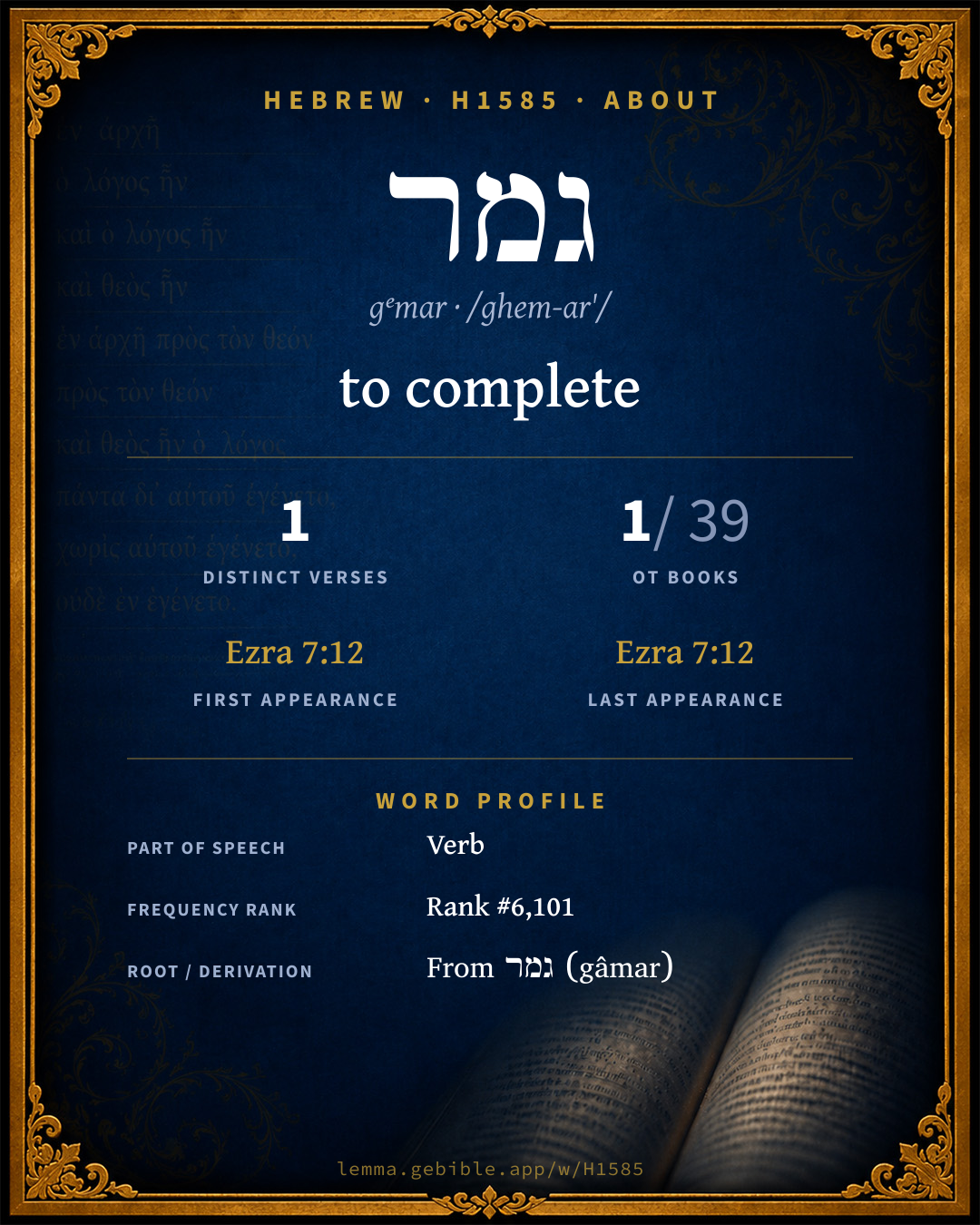
גְּמַר
to complete
‘to complete’ is one of 2 main senses fuller range ↓
Full lexicon entry — Brown-Driver-Briggs (BDB)
From Brown-Driver-Briggs (BDB)
Where this word appears
Grammar key — what these labels mean
Part of speech
- Verb
- An action or state-of-being word.
Stem
- Qal Passive
- An archaic passive of the Qal, preserved in a few forms.
Form
- Participle Passive
- A verbal adjective expressing action received (“written”).
State
- Absolute
- The independent form of a noun, not bound to a following word.
Gender
- Masculine
- Grammatically masculine.
Number
- Singular
- One.
Every verse where H1585 appears — 1 distinct verse across 1 book. Click any verse to open its interlinear word-by-word view. Verse text shown in the World English Bible for context — . Each verse’s Hebrew form is shown with its reference; the English is not keyword-highlighted, since the data carries no word-level English alignment. Use “Compare translations” on any verse to read it across multiple English versions. This concordance covers the Hebrew Bible; Septuagint (Greek Old Testament) occurrences are not indexed here.
Ezra 1 verse
About this entry
At a glance — auto-summarized from this page’s data, not written by a person. Every figure links to its source below. This summary describes the numbers; it doesn’t interpret them.
גמר (gᵉmar) is a Hebrew verb most often rendered “to complete.” It occurs a mere 1 verse across Scripture. Ezra dominates its distribution — 1 of 1 verses. Found nowhere else but Ezra 7:12. Its lexical range runs to 2 senses. The sections below give every sense, occurrence, and version rendering.
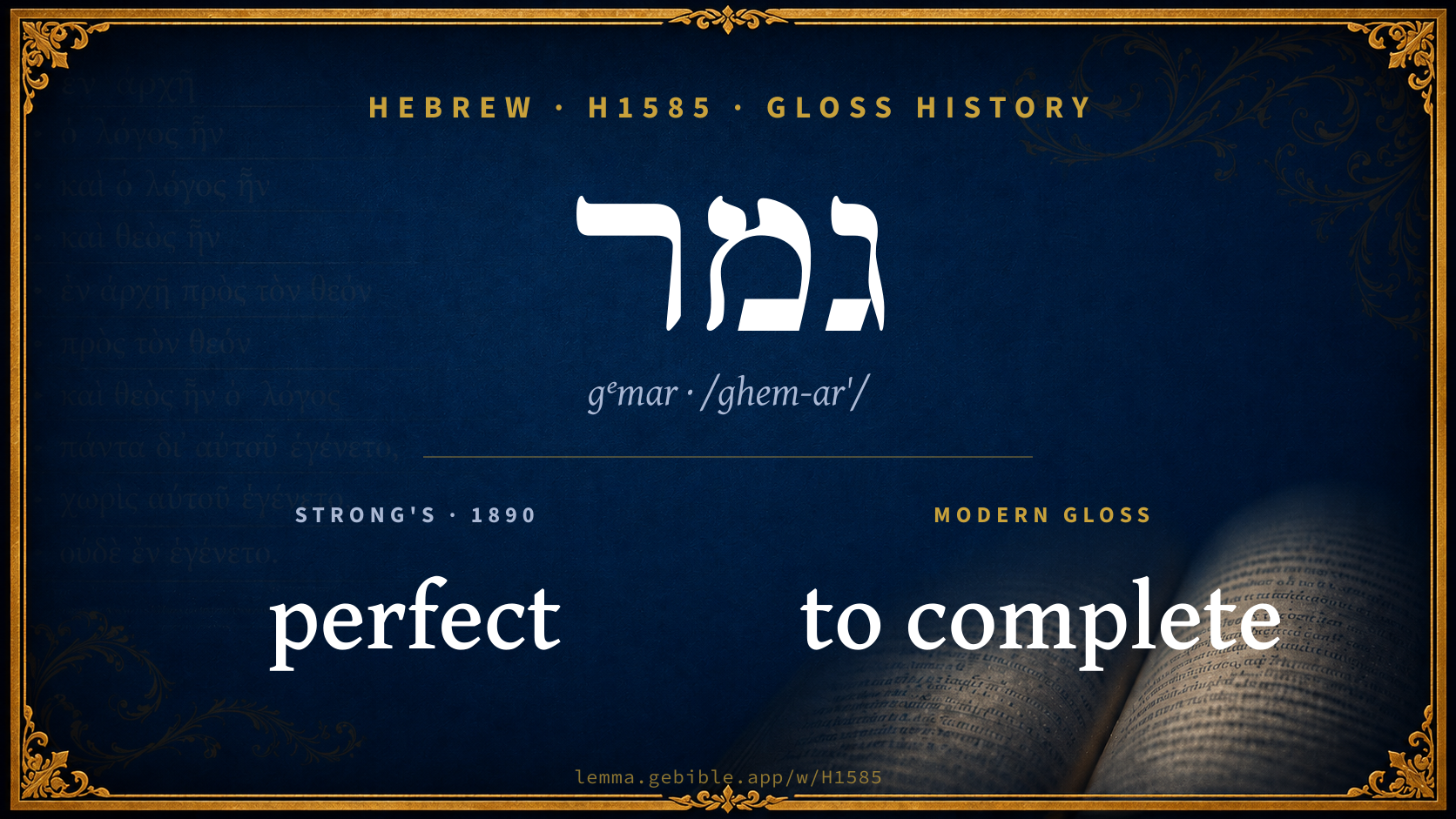
Gloss history
Strong's 1890 vs modern scholarship
About this word
Strong's H1585 catalogs a Hebrew word from the Hebrew Old Testament.
These counts are not copied from any lexicon or concordance. They are computed here, from the morphology-tagged Hebrew Old Testament. What Lemma adds →
- 1
- distinct verses
- The word appears in 1 distinct verse.
- 1 / 39
- OT books
- The word appears in 1 of 39 Old Testament books.
- #6,101
- by frequency
- Rank #6,101 (rank 6,101 of 8,640 Hebrew words by occurrence).
View all 1 occurrence in the concordance →
Most concentrated in
- Ezra 1 verse 100%
By section of the Old Testament
By traditional corpus
Conventional, traditional groupings — biblical authorship is debated, so this is a traditional corpus grouping, not an authorship claim. Each share is this word’s portion of its verses in that division of the Hebrew canon. Each figure is a share of the word’s 1 distinct verse.
- Writings (Ketuvim) 1 verse · 100%
How translations render this word
Counts come from each version’s own published word-to-Strong’s tagging or interlinear alignment — an approximate guide to how each version renders this word, not a word-level alignment the data otherwise carries. Because each total is that version’s own tagged count, the per-version totals vary from one another and need not match the appearance or distinct-verse counts above. These counts may also differ from a printed concordance because Lemma counts each distinctly tagged rendering and does not collapse phrase taggings into a single head-word total. This is a fixed set of word-tagged versions (KJV, ASV, BSB, ULT) and does not change with the reading translation you choose elsewhere. Each version’s license is shown beside its name below (and on Sources).
- King James Version: Perfect 1×
- American Standard Version: Perfect 1×
- Berean Standard Bible: Greetings 1×
- unfoldingWord Literal Text: Peace 1×
King James Version Public Domain
Renders H1585 across 1 tagged occurrence — most commonly:
American Standard Version Public Domain
Renders H1585 across 1 tagged occurrence — most commonly:
Berean Standard Bible Public Domain
Renders H1585 across 1 tagged occurrence — most commonly:
unfoldingWord Literal Text CC BY-SA 4.0
Renders H1585 across 1 tagged occurrence — most commonly:
Senses in BDB
The 2 senses BDB distinguishes for this word, in lexicon order (not ranked by frequency or importance). The full entry — with sub-senses — is in the Lexicon Entry tab.
- to complete
- (Peal) perfect (passive participle)
Word origin
[ גְּמַר ] vb. complete;— Pe. Ezr 7:12
— Brown-Driver-Briggs (Oxford 1906, public domain), digitized via Sefaria, supplemented by the OpenScriptures HebrewLexicon (CC BY 4.0). See Sources.
Derived from גמר (gâmar) (H1584) — to complete.
Jastrow Dictionary
A second Hebrew/Aramaic lexicon for comparison, covering Aramaic and post-biblical (Talmudic, Targumic, Midrashic) usage that the biblical-Hebrew BDB does not. Matched by lemma rather than by Strong’s number, so a lemma may carry more than one Jastrow headword (shown separately below), and the entries cover usage well beyond the Bible.
גָּמַר I
- , Pi. גִּמֵּר (denom. of מוּגְמָר, v. גּוּמְרָא) to perfume (clothes) with burned spices. Bets. 22ᵇ לְגַמֵּר for the purpose of perfuming clothes. Ber. 53ᵃ
- to be perfumed, soaked with perfume. Sabb. 18ᵃ you may put mugmar under the clothes on the eve of Sabbath, ומִתְגַּמְּרִין והולכין וכ׳ and the process of soaking is continued during the entire Sabbath day. Bets. l. c. הבית מִתְגַּמֵּר מאליו the room is perfumed of itself.
גְּמַר I
- Ithpe. אִתְגְּמַר as preced. Hithpa. Targ. Cant. III, 6. Targ. Ps. XLV, 9.
גָּמַר II
- cmp. v. גמם)
- 1. to polish, touch up, finish. Y. Sabb. VII, 10ᵃ bot. ג׳ מלאכתו when he gives to his work the finishing touch; a. fr.
- 2. (in gen.) to complete, end. Pes. X, 7 גּוֹמֵר עליו את ההלל he reads over it (the fourth cup) the Hallel to the end, v. הַלֵּל.—Tosef. Succ. III, 2 גּוֹמְרִין בהן וכ׳ on those occasions the entire Hallel is read; Ber. 14ᵃ; Arakh. 10ᵃ; Taan. 28ᵇ. Ber. 13ᵇ חוזר וגוֹמְרָהּ (after the disciples left) did he take it up again and read the whole of the Sh’ma?—Y. Yeb. II, beg. 3ᶜ הביאה גוֹמֶרֶת בה coition consummates the levir’s marriage (Bab. ib. 18ᵃ קונה קניין גמור), v. מַאֲמַר.—Y. Ber. VI, 10ᵈ top ג׳ מלאכול after he has finished eating; a. fr.—Euphem. to gratify the sexual appetite. Kerith. II, 4. Pes. 87ᵃ (play on Gomer, Hos. I,
- 3. שהכל גּוֹמְרִים בה all people could gratify their lust on her.—וְגוֹמֵר (abbr. וגו׳, וג׳) and one finishes (the sentence quoted) = and so forth, &c., a clerical term used in Bible citations to save the writing out of the entire quotation. Ḥull. 98ᵃ. Gen. R. s. 51, beg.; a. fr.—*Part. pass. גָּמוּר, f. גְּמוּרָה finished, complete, real, valid. Kidd. 40ᵇ, a. fr. צדיק ג׳ a perfectly righteous man (without faults); רשע ג׳ a wicked man throughout (without any good quality). Yeb. 18ᵇ, a. fr. קניין ג׳ real (legal) possession.—Pl. גְּמוּרִים, גְּמוּרוֹת. Ḥull. 89ᵃ; a. fr.—Bets. 2ᵇ, a. e. בצים ג׳ perfectly developed eggs (with shells), v. infra.—3) to destroy. Pes. 87ᵇ (play on Gomer, v. supra) בזזו וגָמְרוּ (Ms. M. גמרו וגמרו) they plundered and destroyed (they destroyed thoroughly).
- 4. to conclude, determine, decide. Kel. XVI, 1. Ber. 17ᵃ גְּמוֹר בכל לבבך וכ׳ be determined with all thy heart &c. Shebu. 26ᵇ ג׳ בלבו he resolved (vowed) in his heart, opp. הוציא בשפתיו; Ḥag. 10ᵃ.—Erub. 13ᵇ, a. fr. נמנו וגמרו they were counted (their votes were taken) and they decided.—Snh. III, 7 (42ᵃ) גמרו את הדבר when they had closed the case (being ready for publishing the sentence); a. fr.
- 5. to draw a conclusion by analogy. Sabb. 96ᵇ ג׳ העברה העברה מיוה"כ one forms an analogy between the expressions heĕbir &c.; a. fr.
- 6. to be fully developed. Tosef. Par. XI, 7, v. גָּמַל.—בצים גמורות, v. supra.
- 1. to destroy. Pes. 87ᵇ בקשו לגַמֵּר וכ׳ they intented to destroy the possessions of Israel in her (Gomer’s) days, v. supra.
- 2. to develop, mature, ripen. Y. Shebi. V, beg. 35ᵈ אין פירותיה׳ מְגַמְּרִין וכ׳ their fruits ripen only every three years.
- to be finished, completed. Snh. VI, 1 נ׳ הדין when proceedings are finished (sentence pronounced). Gen. R. s. 12 נִגְמְרָה מלאכתן they were finished; a. fr.
גְּמַר II
- 1. to finish. Targ. Ps. LVII, 3 דְּיִגְמַר (ed. Lag. די גמר, corr. acc.); a. fr.—Pes. 55ᵃ גַּמְרִינָן we dare finish a work commenced. Ib. מִיגְמַר אין אתחולי לא to finish is permitted, but not to begin; a. fr.
- 2. to consume, destroy. Targ. Job I, 16. Ib. XXII, 20; a. fr. (also Pa.).
- 3. to end, cease. Targ. Ps. XII, 2 גְּמִירוּ they are gone. Targ. Prov. V, 11. Ib. XXII, 8; a. e.
- 4. to conclude, derive. Ḥull. 98ᵇ ולִיגְמַר מיניה now let one draw a conclusion from this (by analogy)! Ib. מחידוש לא גַבְרִינָן from an exception we draw no conclusions; a. fr.
- 5. to be perfect, ready to answer, to know well. [Targ. Y. Deut. VI, 7 ותִגְמְרִינוּן וכ׳, read ותַגְ׳, v. infra.]—Part. גָּמֵיר. Sabb. 63ᵃ והוה גְמִירְנָא וכ׳ and I knew well the whole Talmud (v. Rabh. D. S. a. l.). Taan. 7ᵃ bot. דגְמִירֵי who are learned; ib. 7ᵇ top טפי הוו ג׳ they would be more learned; a. fr.—Whence: to learn by heart, esp. to learn traditional law (cmp. גְּרַס II). Targ. Job XXII, 22 (h. text קח, cmp. לֶקַח).—Sabb. l. c. לִיגְמַר איניש והדר ליסבר one must first learn traditions, and then he may reason; Ab. Zar. 19ᵃ, v. גְּרַס II.—Ber. 43ᵃ וברכת … גַּמְרִינָן and we are not sufficiently familiar with the laws concerning grace at meals. Yoma 29ᵃ מִיגְמַר בעתיקא וכ׳ to remember well something old (to refresh the memory) is more difficult than to commit to memory a fresh thing. Sabb. l. c. למיגמר מיניה from whom to receive traditions. Sot. 36ᵇ לא הוה קגמר he could not remember; a. fr.—Sabb. 96ᵇ גמרא גְמִירֵי לה they (the scholars) know it by tradition; ib. 97ᵃ הילכתא ג׳ לה.—גְּמִירֵי they have a tradition, it is a well-known maxim. Snh. 37ᵇ bot. Sot. 34ᵃ. Gitt. 47ᵃ; a. fr.
- to finish; to consume. Targ. Job XXI, 13 ed. (Ms. גַּמְרִין Part. Pe.). Ib. XIII, 28; a. fr.
- to teach verbally. Targ. Y. Deut. VI, 7 [read:] ותַגְמְרִינוּן and thou shalt teach them (v. Ber. 13ᵇ).—Sot. 36ᵇ אַגְמְרֵיה ולא גמר he taught him (the Hebrew language), but he (Pharaoh) could not remember it. Ḥull. 45ᵇ אַגְמְרָךְ גמרא I will teach thee a tradition. B. Kam. 17ᵃ לאַגְמוּרֵי as to teaching. Ber. 13ᵇ, v. גְּרַס II.
- to be finished; to be destroyed. Targ. Job XXIII, 17. Targ. Ps. CIX, 23.—Targ. Y. Num. XVIII, 14 דמִגְּמַר (h. text חֵרֶם). Targ. Y. Ex. XXII, 19 יִתְגַּמְרוּן (h. text יָחֳרָם).
גָּמָר
- (preced.) finishing, last touch; consummation. Sabb. 103ᵃ, a. fr. ג׳ מלאכה the finishing work.—Snh. 6ᵇ; a. fr. ג׳ דין close of legal proceedings.
גְּמַר III
- 1. same, finish, perfection, beauty. Snh. 8ᵇ, a. e. ג׳ דינא, v. preced. Targ. Ez. XXVII, 24 ג׳ מיני וכ׳ the perfection of all valuable things (h. text מכללים). Ib. XXIII, 6 ed. Lag. (ed. גמיר, h. text תכלת). Ib. 12 (h. text מכלול).
- 2. (cmp. גּוּמְרָא) carbuncle, a precious stone. Targ. Is. LIV, 12 (h. text אקדח).
A Dictionary of the Targumim, the Talmud Babli and Yerushalmi, and the Midrashic Literature (Marcus Jastrow; London, Luzac, 1903) — Public Domain. Digitized via Sefaria. Digitized via Sefaria. Full attribution on Sources.
Same root — word family
Other BDB entries built from the same root as H1585, grouped by Strong’s listed origin. These share a root / origin per the lexicon — not necessarily a shared meaning. Each links to that word’s own entry.
Derives from
Proper names from this root
People and places named from this root — a name, not an additional meaning of the word.
Compare all same-root words → 2 of the same-root words are proper names (people or places). They share a root, not necessarily a meaning.
Septuagint verse parallels
This word appears in 1 verse that also exists in the Greek Old Testament (Septuagint), out of the 1 Hebrew verse it occurs in. You can read those verses in Greek by switching the Old Testament edition to the Septuagint.
Read these verses in the Septuagint
This is a verse-level parallel only — the same verses exist in both the Hebrew and Greek Old Testaments. No word-level Hebrew↔Greek correspondence is claimed: the data carries no such alignment, so no Greek word is shown as this Hebrew word’s translation. Coverage is not total — the Septuagint omits the deuterocanon and renumbers the Psalms, so some Hebrew verses have no direct Greek parallel.