
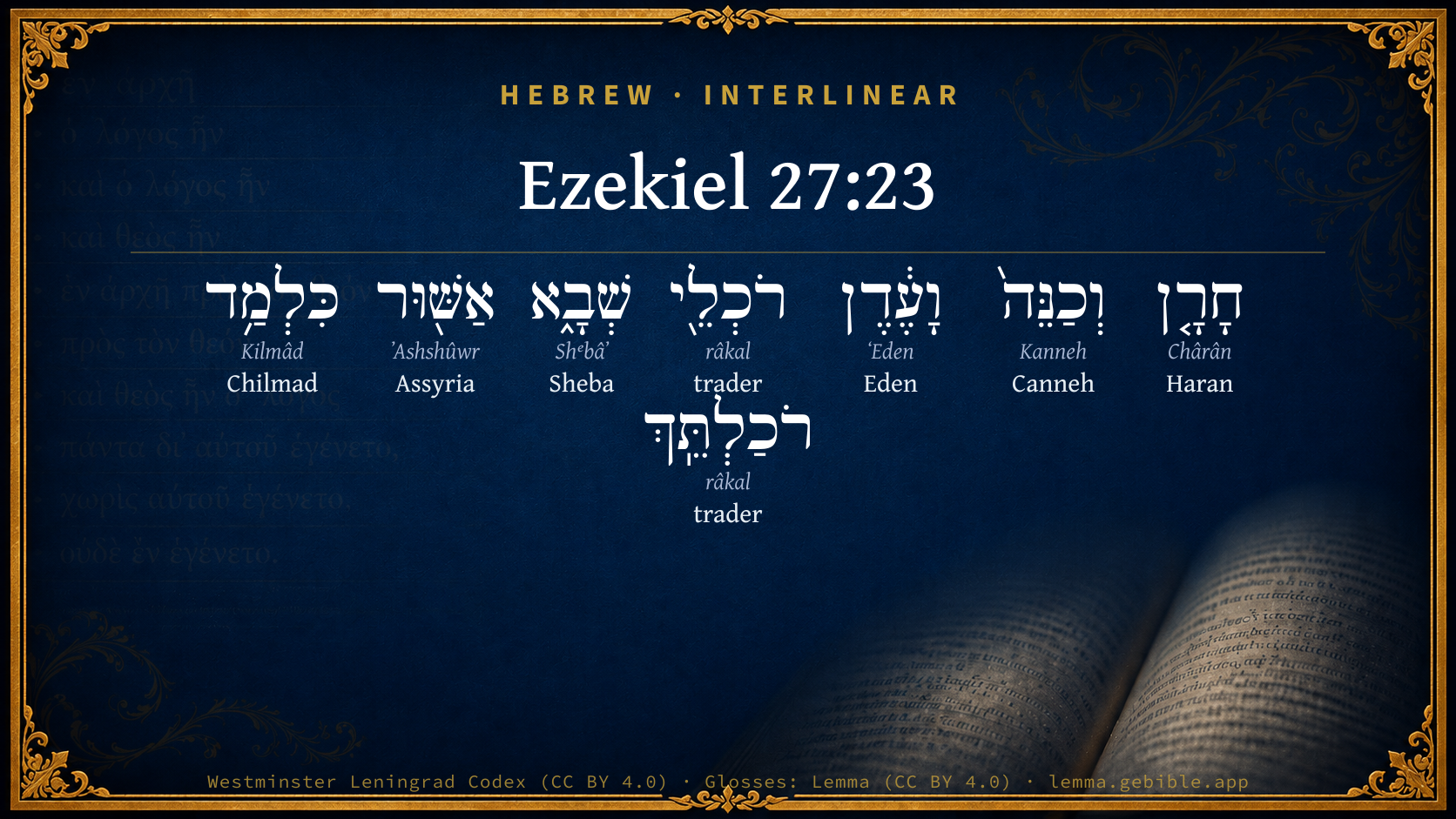
Ezekiel 27:23

Hebrew (Westminster Leningrad Codex) Ezekiel 27:23 appears in the Hebrew Old Testament. The text above is from the Westminster Leningrad Codex. Each word links to its Strong’s number, a concise gloss, and parsing drawn from the Open Scriptures Hebrew Bible morphology. Click any word for its full Brown-Driver-Briggs (BDB) entry.
Download image
Cite this verse

Ezekiel 27:23 (World English Bible). Public Domain. Lemma interlinear Bible study tool, https://lemma.gebible.app/v/ezekiel/27/23.

Show BibTeX & RIS
BibTeX
RIS
English Translation
Haran and Canneh and Eden, the traffickers of Sheba, Asshur [and] Chilmad, were your traffickers.
World English Bible · Public Domain
Highlights
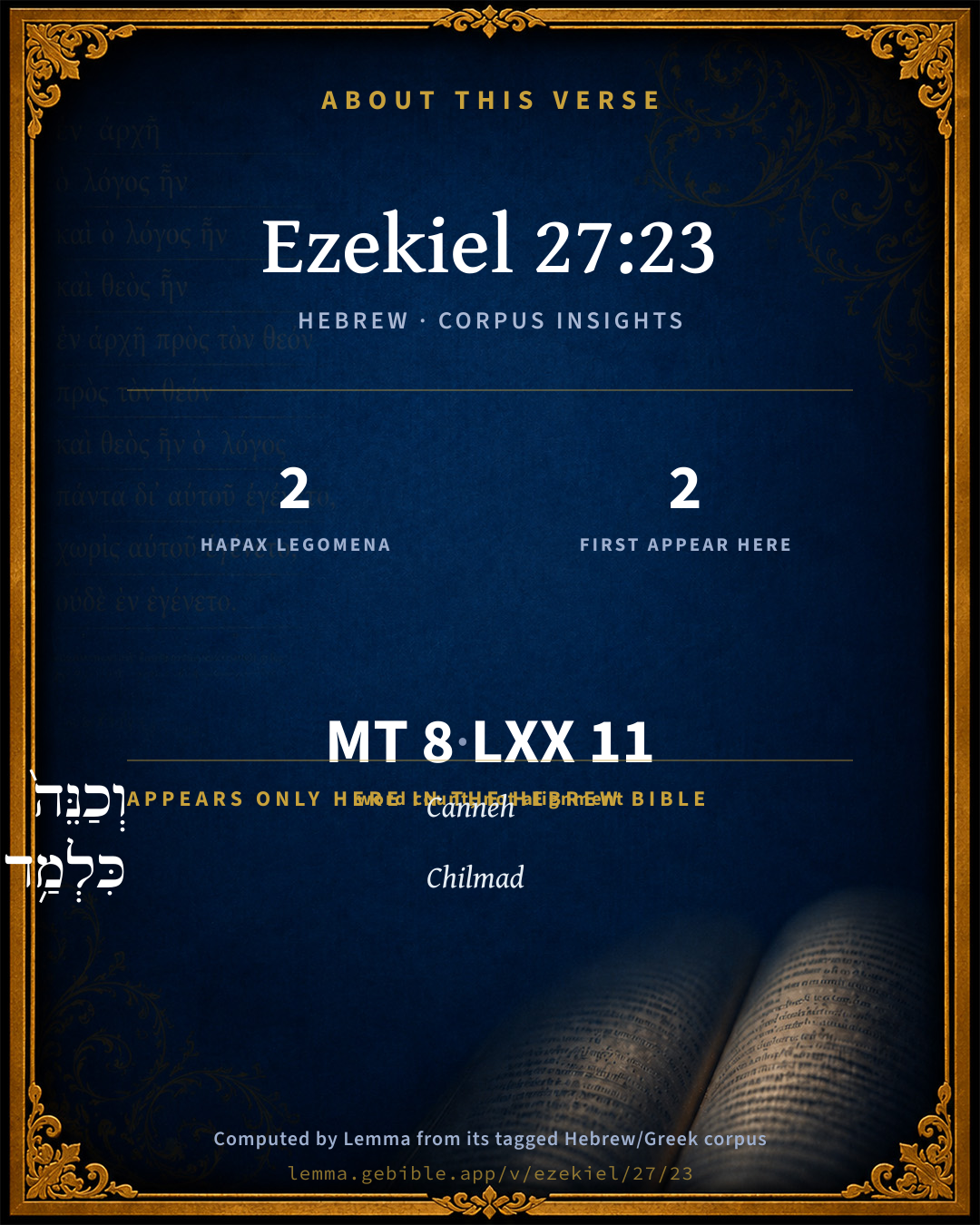
  • 2 hapax legomena — only here in the Hebrew Bible
  • 2 first appearances in the Hebrew Bible
Full analysis ↓
Download a study sheet

One document with this verse’s original text, its word-by-word gloss line, the meaning frame, cross-references with their text, attributed commentary, and full source and license credits — printable, and it pastes into notes with its structure intact.

This verse Autodidact and up

Study sheet (.html) Plain text (.txt)

A passage Seminary Student

Up to 50 verses in one chapter. A passage sheet keeps up to 6 commentary sources and 12 cross-references per verse, in the order this page ranks them, and says so on the sheet whenever that leaves anything out. Ask for a single verse and you get the Autodidact verse sheet above.

Everything on this page stays free to read, with no account — the sheet is a download of what is already on screen, not access to it.

Want to remove ads? Support Godless Engineer
Compare translations 3

The same verse in 3 English versions, stacked beneath the original-language interlinear above. Click any original word for its lexicon entry.

Each is an independent rendering of the whole verse — the interlinear is not word-aligned to these translations.

Highlighted words mark where these versions differ — a whole-verse word diff, not a word-by-word alignment.

  • World English Bible Public Domain
    Haran and Canneh and Eden, the traffickers of Sheba, Asshur [and] Chilmad, were your traffickers.
  • King James Version Public Domain
    Haran, and Canneh, and Eden, the merchants of Sheba, Asshur, and Chilmad, were thy merchants.
  • unfoldingWord Literal Text CC BY-SA 4.0
    Haran, Canneh, and Eden were traders with you, along with Sheba, Ashur, and Chilmad.

unfoldingWord Literal Text — © unfoldingWord, licensed CC BY-SA 4.0. Word-aligned USFM3 via Door43 (git.door43.org/unfoldingWord/en_ult).

Versions to compare (up to 4)

3 of 4 selected

Show all 18 translations

Every available English version of this verse, each an independent rendering of the whole verse.

  • World English Bible Public Domain
    Haran and Canneh and Eden, the traffickers of Sheba, Asshur [and] Chilmad, were your traffickers.
  • Berean Standard Bible Public Domain
    Haran, Canneh, and Eden traded with you, and so did the merchants of Sheba, Asshur, and Chilmad.
  • Majority Standard Bible Public Domain
    Haran, Canneh, and Eden traded with you, and so did the merchants of Sheba, Asshur, and Chilmad.
  • King James Version Public Domain
    Haran, and Canneh, and Eden, the merchants of Sheba, Asshur, and Chilmad, were thy merchants.
  • American Standard Version (1901) Public Domain
    Haran and Canneh and Eden, the traffickers of Sheba, Asshur `and' Chilmad, were thy traffickers.
  • Revised Version (1885) Public Domain
    Haran and Canneh and Eden, the traffickers of Sheba, Asshur and Chilmad were they traffickers.
  • Geneva Bible (1599) Public Domain
    They of Haram and Canneh and Eden, the marchants of Sheba, Asshur and Chilmad were thy marchants.
  • Douay-Rheims (1899) Public Domain
    Haran, and Chene, and Eden were thy merchants; Saba, Assur, and Chelmad sold to thee.
  • Young's Literal Translation Public Domain
    Haran, and Canneh, and Eden, merchants of Sheba, Asshur -- Chilmad -- `are' thy merchants,
  • Literal Standard Version CC BY-SA 4.0
    Haran, and Canneh, and Eden, merchants of Sheba, Asshur—Chilmad—[are] your merchants,
  • Unlocked Literal Bible CC BY-SA 4.0
    Haran, Kanneh, and Eden were traders with you, along with Sheba, Ashur, and Kilmad.
  • unfoldingWord Literal Text CC BY-SA 4.0
    Haran, Canneh, and Eden were traders with you, along with Sheba, Ashur, and Chilmad.
  • Darby Bible Public Domain
    Haran, and Canneh, and Eden, the merchants of Sheba, Asshur, and Chilmad traded with thee:
  • World Messianic Bible Public Domain
    “‘“Haran, Canneh, Eden, the traders of Sheba, Asshur and Chilmad, were your traders.
  • Webster's Bible Public Domain
    Haran, and Canneh, and Eden, the merchants of Sheba, Asshur, and Chilmad, were thy merchants.
  • Free Bible Version CC BY-SA 4.0
    Haran, Canneh, and Eden traded with you, as did Sheba, Asshur, and Chilmad.
  • Bible in Basic English Public Domain
    Haran and Canneh and Eden, the traders of Asshur and all the Medes:
  • JPS Tanakh (1917) Public Domain
    Haran and Canneh and Eden, the traffickers of Sheba, Asshur was as thine apprentice in traffic.

Literal Standard Version (2020), Covenant Press — licensed CC BY-SA 4.0. Text via the HelloAO Bible API (eBible.org). Unlocked Literal Bible (unfoldingWord) — licensed CC BY-SA 4.0. Text via the HelloAO Bible API (eBible.org). unfoldingWord Literal Text — © unfoldingWord, licensed CC BY-SA 4.0. Word-aligned USFM3 via Door43 (git.door43.org/unfoldingWord/en_ult). Free Bible Version, Dr. Jonathan Gallagher — licensed CC BY-SA 4.0. Text via the HelloAO Bible API (eBible.org).

Word by word

More ways to search: Search by grammar → Find every occurrence → Compare this word →

Practice this passage: Drill this verse → Learn its vocabulary →

About this verse

These counts appear in no published source. They are computed here, from the morphology-tagged text and Lemma’s own curated glosses. What Lemma adds →

8
words
7
distinct lemmas
Prophets
section

Notable vocabulary

2 hapax legomena — words that appear only here in the entire Hebrew Bible:

  • וְכַנֵּה֙ Canneh H3656
  • כִּלְמַ֥ד Chilmad H3638

First appearance in Scripture

These words make their first canonical appearance in the Hebrew Bible here:

  • וְכַנֵּה֙ Canneh H3656
  • כִּלְמַ֥ד Chilmad H3638

Shared distinctive vocabulary

וָעֶ֔דֶן Eden H5729 occurs in 3 verses of the Hebrew Bible. Also found in:

Grammatical profile

  • 2 verbs
  • 6 nouns

Verb forms

  • רֹכְלֵ֖י Qal · Participle Active
  • רֹכַלְתֵּֽךְ Qal · Participle Active

Repetition

A word recurs within this verse — often emphatic in Hebrew:

  • רֹכְלֵ֖י trader H7402 ×2

Hebrew & Septuagint length

In English translation the verse runs 15 words from the Hebrew and 13 from the Septuagint (LXX English) — closely comparable.

A rough comparison of the two English renderings, which tokenize alike — not a word-level alignment.

Word counts can differ between the Hebrew and the Greek without any difference in meaning — e.g. the Hebrew direct-object marker אֵת has no separate Greek word, and Greek often adds the article ὁ.

In the original languages it is 8 Hebrew tokens and 11 Greek tokens — but the two are counted differently (Hebrew bundles its prefixes and suffixes into one token; the Greek is in lemma form), so that isn’t a like-for-like length.

Cross-references

18

Topical passages linked to Ezekiel 27:23 in the Treasury of Scripture Knowledge — connected by theme and wording, ordered by reader-vote popularity; previews shown in the World English Bible.

  • 2 Kings 19:12 Have the gods of the nations delivered them, which my fathers have destroyed, Gozan, and Haran, and Rezeph, and the children of Eden that were in Telassar?
  • Isaiah 37:12 Have the gods of the nations delivered them, which my fathers have destroyed, Gozan, and Haran, and Rezeph, and the children of Eden who were in Telassar?
  • Genesis 10:22 The sons of Shem: Elam, Asshur, Arpachshad, Lud, and Aram.
  • Amos 1:5 I will break the bar of Damascus, And cut off the inhabitant from the valley of Aven, And him who holds the scepter from the house of Eden; And the people of Syria shall go into captivity to Kir," says Yahweh.
  • Genesis 2:8 Yahweh God planted a garden eastward, in Eden, and there he put the man whom he had formed.
  • Genesis 10:10 The beginning of his kingdom was Babel, Erech, Accad, and Calneh, in the land of Shinar.
  • Genesis 11:31–32 Terah took Abram his son, Lot the son of Haran, his son's son, and Sarai his daughter-in-law, his son Abram's wife. They went forth from Ur of the Chaldees, to go into the land of Canaan. They came to Haran, and lived there.
  • Genesis 12:4 So Abram went, as Yahweh had spoken to him. Lot went with him. Abram was seventy-five years old when he departed out of Haran.
  • Genesis 25:3 Jokshan became the father of Sheba, and Dedan. The sons of Dedan were Asshurim, Letushim, and Leummim.
  • Genesis 32:22 He rose up that night, and took his two wives, and his two handmaids, and his eleven sons, and passed over the ford of the Jabbok.
  • Numbers 24:22 Nevertheless Kain shall be wasted, Until Asshur shall carry you away captive.
  • Job 1:15 and the Sabeans attacked, and took them away. Yes, they have killed the servants with the edge of the sword, and I alone have escaped to tell you."
  • Psalms 83:8 Assyria also is joined with them. They have helped the children of Lot. Selah.
  • Isaiah 7:18 It will happen in that day that Yahweh will whistle for the fly that is in the uttermost part of the rivers of Egypt, and for the bee that is in the land of Assyria.
  • Isaiah 7:20 In that day the Lord will shave with a razor that is hired in the parts beyond the River, even with the king of Assyria, the head and the hair of the feet; and it shall also consume the beard.
  • Isaiah 10:9 Isn't Calno as Carchemish? Isn't Hamath as Arpad? Isn't Samaria as Damascus?
  • Amos 6:2 Go to Calneh, and see; And from there go to Hamath the great; Then go down to Gath of the Philistines. Are they better than these kingdoms? Or is their border greater than your border?
  • Acts 7:4 Then he came out of the land of the Chaldaeans, and lived in Haran. From there, when his father was dead, God moved him into this land, where you are now living.

Cross-references courtesy of OpenBible.info (CC BY 4.0).

Hebrew and Greek witnesses Masoretic Hebrew ↔ Greek Septuagint

The same verse in the two great witnesses to the Old Testament, shown verse-for-verse.

These are two independent witnesses, not word-aligned to each other, and the Septuagint is shown in lemma (dictionary) form.

Hebrew Ezekiel 27:23 Masoretic · Westminster Leningrad Codex

חָרָ֤ן וְכַנֵּה֙ וָעֶ֔דֶן רֹכְלֵ֖י שְׁבָ֑א אַשּׁ֖וּר כִּלְמַ֥ד רֹכַלְתֵּֽךְ

Haran and Canneh and Eden, the traffickers of Sheba, Asshur [and] Chilmad, were your traffickers.

World English Bible · Public Domain

Greek LXX Ezekiel 27:23 Septuagint · lemma form

χαρραν καί χαννα οὗτος ἔμπορος σύ ασσουρ καί χαρμαν ἔμπορος σύ

Charra, and Chanaa, these were your merchants: Assur, and Charman, were your merchants:

LXX2012 (modern English Septuagint) · Public Domain

On this verse, The Cambridge Bible for Schools and Colleges discusses the Septuagint’s reading. Read the note in Commentary ↓

Hebrew: Westminster Leningrad Codex (CC BY 4.0). Greek: Septuagint (public domain); English from LXX2012 (modern English Septuagint) (Public Domain). How the Septuagint differs from the Hebrew →

Targum (Aramaic paraphrase)

1

The Targum is the ancient Jewish Aramaic paraphrase of the Hebrew Scriptures — an interpretive translation, not the Hebrew text itself. Onkelos (literal) and Pseudo-Jonathan (expansive) render the Torah, and Jonathan the Prophets. Coverage is partial: where no permissively-licensed English translation exists for a verse, only the Aramaic is shown. This is verse-level text, not a word-by-word alignment to the Hebrew.

  1. Targum Jonathan Prophets (Joshua–Malachi)
    חַרְוָן וּנְצִיבִין וְהַדְיֵב תַּגְרֵי שְׁבָא מְדִינַן אַתּוּר וּמָדַי אִינוּן תַּגָרֵיךְ:

    (no public-domain English translation for this verse)

    Targum Jonathan — Aramaic: “Mikraot Gedolot” (public domain). English: “Sefaria Community Translation” (CC0 1.0 (public-domain dedication)); “London "Chaldee Paraphrase," 1871” (public domain). Text via Sefaria.

Commentary

Notes on Ezekiel 27:23 from classic Christian and Jewish commentators (each source and its license shown beneath its notes). The classic Christian expositions comment on the surrounding passage and are grouped to its opening verse, so a note may address several verses; the Jewish commentaries on the Tanakh (Rashi and others) are per-verse, so they appear only where the commentator wrote on this verse.

Lemma curates 59 commentaries, every one of them public domain or Creative Commons licensed, each selected and text-cleaned for this edition rather than reprinted as found. About our sources →

Trapp's Complete Commentary

John Trapp

Eze 27:23 Haran, and Canneh, and Eden, the merchants of Sheba, Asshur, [and] Chilmad, [were] thy merchants.

Ver. 23. Haran.] In Mesopotamia, or Charrae, in Parthia, where Crassus was slain.

And Channeh,] Or, Chalne, where the tower of Babel was built nine miles high. {a}

And Eden.] Where paradise once was: sed periit rosa, mansit spina.

Chelmad,] i.e., Medea, saith the paraphrast.

{a} The tower of Babel was 9164 paces from the ground.

John Trapp, A Commentary or Exposition upon All the Books of the Old and New Testament (1647–1656) — public domain. Text from a community e-Sword module.

Tyndale Open Study Notes

Tyndale Open Resources

27:23 Haran, Canneh, Eden, and Asshur were all located in Mesopotamia (modern Iraq). Kilmad is otherwise unattested in ancient sources and may be a scribal error for “all Media” (the region northeast of Mesopotamia).

Tyndale Open Study Notes — © Tyndale Open Resources, licensed CC BY-SA 4.0. Text via the HelloAO Bible API.

Jamieson, Fausset & Brown

Robert Jamieson, A. R. Fausset & David Brown

Haran--the dwelling-place of Abraham in Mesopotamia, after he moved from Ur (Gen 11:31).

Canneh--Calneh, an Assyrian city on the Tigris; the Ctesiphon of the Greeks (Gen 10:10).

Eden--probably a region in Babylonia (see Gen 2:8).

Chilmad--a compound; the place designated by PTOLEMY "Gaala of Media." The Chaldee version interprets it of Media. HENDERSON refers it to Carmanda, which XENOPHON describes as a large city beyond the Euphrates.

Jamieson, Fausset & Brown — Commentary Critical and Explanatory on the Whole Bible (1871) — public domain (CC PDM 1.0). Text via the HelloAO Bible API.

Adam Clarke's Commentary

Verse 23. Haran] In Mesopotamia; well known in Scripture.

Canneh] Or Chalane; see Ge 10:10. It is supposed to be a cape or port of Arabia Felix, on the Indian Sea.

Eden] Equally famous: supposed to have been situated near the confluence of the Tygris and Euphrates.

Sheba] Different from that in Eze 27:22. This was probably near the country of the Edomites.

Asshur] Perhaps the Assyrians.

Chilmad] Possibly Cholmadora, on the Euphrates. Ptol. lib. v.. cap. 15. For several of these places, and the persons from whom they derived their names, see Ge 10:1-32, and the notes there; and see Calmet.

Adam Clarke's Commentary on the Bible (1810–1826) — public domain. Text from a community e-Sword/MySword module.

Ellicott's Commentary for English Readers

(23) Haran, and Canneh, and Eden.—The description now turns from Arabia to the Tyrian trade with Mesopotamia. Haran, important in the story of Abraham (Gen_11:31-32; Gen_12:4), the Charræ of the Romans, was in north-western Mesopotamia, at the junction of two great caravan routes, the one along the Tigris, the other along the Euphrates. Canneh, a contraction for the Calneh of Gen_10:10, was the most important commercial city on the former, and was later known as Ctesiphon. Eden was an unknown town on the Euphrates (2Ki_19:12; Isa_37:12), and is to be distinguished from the Syrian Eden.

Sheba, Asshur, and Chilmad.—Sheba is still the same Sheba before mentioned; for Pliny (Hist. Nat., xii. 40) says that the Sabœans brought their goods from the spice country to Carrhæ, where they held markets, and went thence to Syria and Phœnicia. They were, therefore, traders between Mesopotamia and Phœnicia. Asshur is here not the country of Assyria, but the commercial city Sura (modern Essurieh), on the banks of the Euphrates, above Thapsacus. Chilmad is supposed to be the Charmande of Xenophon (Anab., i. 5, 10), “a great city beyond the Euphrates, in the neighbourhood of the desert.” Others identify it with Kalwada, near Bagdad. It is mentioned only here.

A Bible Commentary for English Readers, edited by Charles John Ellicott (1878–1897) — public domain. Text from a community e-Sword module.

The Cambridge Bible for Schools and Colleges

gen. ed. J. J. S. Perowne

23. The places named may be regarded as an extension of the line from S. to N. in Eze_27:19-22, though the names are given rather in the order W. to E. Harran in Mesopotamia, two days’ journey S.E. of Edessa, on a branch of the Euphrates, was a sacred city and place of pilgrimage, and also an emporium of trade. The defeat of Crassus by the Parthians took place there. Canneh may be Calneh (Gen_10:10; Amo_6:2), otherwise Calno (Isa_10:9), a city in Babylonia. Its site has not been identified. Von Gutschmidt (Ency. Brit., art. Phœnicia) identifies Canneh with Cænæ. Eden, spelled somewhat differently from the Eden of Paradise, is elsewhere named in connexion with Haran, Isa_37:12 (2Ki_19:12), and said to be in Telassar (Tel Asshur).

the merchants of Sheba] It is strange that these should be mentioned again (Eze_27:22). For “Eden … Sheba” LXX. reads: these were thy merchants, i.e. Haran and Canneh. It has been supposed that the merchants of Sheba frequented the fairs of Haran and thence made their way westward along the trade route to Phenicia.

Asshur and Chilmad] LXX. reads and between the words. Asshur if taken in its usual sense would be Assyria. Others think of Sura, or Essurieh, on the Euphrates. G. Smith conjectured that Chilmad was Kalwâdha near Bagdad. LXX. renders Charman, which suggests Caramania. The rendering: “Asshur was as thine apprentice in traffic” (Hitz. Corn.), besides being a conceit, misses the whole idea of the chapter.

The Cambridge Bible for Schools and Colleges (gen. ed. J. J. S. Perowne; Cambridge University Press, 1878–1918) — public domain. Text from a community e-Sword module.

John Gill's Exposition

These were thy merchants in all sorts of things,.... Either all before mentioned throughout the chapter, or rather those only in the preceding verse; also these were merchants in various things after mentioned, and which were the best and most perfect of the kind, as the word (d) used signifies:

in blue cloths, and broidered work; these the Assyrians took of them, a colour in which they much delighted; see Eze 23:6,

and in chests of rich apparel bound with cords, and made of cedar, among thy merchandise; rich apparel, such as scarlet cloaks, as the Targum, and blue cloths as before; these were well packed up in chests made of "cedar", which they had from Lebanon, and so fit to be put on board a ship, and carried into any part of the world. The Targum adds,

"and sealed with a signet;''

as things well packed up and bound sometimes are, being of worth and value. Some render it, "in chains"; or, "chains were among thy merchandise" (e); such as chains of gold, wore about the neck; and take the word to be of the sam meaning with that in Sol 1:10.

(d) "rebus perfectissimis", Junius & Tremellius, Polanus, Cocceius, Starckius. (e) "et torquibus in negotiatione tua", Pagninus; "et torques fuerunt in nundinis tuis", Vatablus. So R. Sol. Urbin. Ohel Moed, fol. 71. 2.

John Gill's Exposition of the Whole Bible (1746–1763) — public domain (CC PDM 1.0). Text via the HelloAO Bible API.

Haydock's Catholic Bible Commentary

Haran, or Charæ, famous for the residence of Abraham and the defeat of Crassus. --- Eden, the province where Paradise was situated.

George Leo Haydock (1774–1849), Haydock's Catholic Family Bible and Commentary, 1859 edition — public domain. Excludes Psalms (Douay-Rheims chapter numbering differs from Protestant) and Deuterocanonical books (Catholic canon only).

Matthew Poole's English Annotations

Haran; Haran or Charran in Mesopotamia, where Abraham dwelt.

Canneh; no where else mentioned, supposed to be the same with Calneh, Gen 10:10, afterwards Ctesiphon, a pleasant city on Tigris, some three miles from Seleucia. It was built by the Parthians, whose king resided there in the winter, because of the mildness of the air.

Eden; a pleasant country, part of Babylonia. The Chaldee paraphrase calls it Hadiab, and leads us to Adiabene, which Trajan conquered in his expedition against Babylon.

Sheba; whether the same mentioned Eze 27:22, (which see,) or some other, is not certain; perhaps it may be Saba, whence Sabeans.

Asshur; Asshur, the name of the father of the nation, for Assyria.

Chilmad; a country or part of Media, between Assyria and Parthia, most likely to be Gaala of Media.

Matthew Poole's English Annotations on the Holy Bible (1683–1685) — public domain. Text from a community e-Sword/MySword module.

Whedon's Commentary on the Bible

Daniel D. Whedon

23. Haran, etc. — Was this a swift glance at far-away districts: Haran (Gen_11:31; Gen_24:10; Gen_29:4) standing for Mesopotamia; Canneh (Calneh or Calno, Gen_10:10; Amo_6:2; Isa_10:9), located near Eridu (Eden); Babylonia and Asshur for Assyria? Or were these localities lying near Arabia; Eden being the modern Aden, and Asshur referring, as often in the Old Testament, to the wilderness of Shur; the other places being so far not identified? (Hommel.) Further light is needed. Mez reads, “Haran and the Edenites, Asshur and all the Medes were thy merchants” (Polychrome Bible).

The merchants of Sheba — LXX., they were thy dealers.

Daniel D. Whedon (gen. ed.), Commentary on the Old and New Testaments (1874–1909) — public domain. Text from a community e-Sword module.

The Pulpit Commentary

Haran and Canaeh, etc. From Arabia we pass to Mesopotamia. Haran (Gen_11:31) stands for the Carrhae of the Romans, situated at the point where the old military and commercial roads bifurcated Cowards Babylon and the Delta of the Persian Gulf in the one direction, and Canaan in the other. It appears in Gen_24:10 and Gen_29:4 as the city of Nahor, in Mesopotamia (Aram-Naharaim, equivalent to "Syria of the two rivers"), or, more definitely, in Parian-Atom, which lies below Mount Masius, between the Khabour and the Euphrates. It is famous in Roman history for the defeat of Crassus by the Parthians. Caaneh. The eastern of the two roads just mentioned ran on to Calneh (of which Cauneh is a variant), named in Gen_10:10 as one of the cities built by Nimrod. It is probably represented by the modern Niffer, about sixty miles southeast of Babylon. It is named in Isa_10:9 inconnection with Carehemish, in Amo_6:2 with Hamath the great, as conquered by the Assyrians. It has been conjecturally identified by the Targum and other ancient writers with Ctesiphon, but(?) Eden; spelt differently in the Hebrew from the Eden of Gen_2:8. It is probably identical with the Eden near Thelassar (Td. Assar) of Isa_37:12 and 2Ki_19:12, where, as here, it is connected with Haran as among the Assyrian conquests. Its site has not been determined, and it has been placed by some geographers in the hill-country above the Upper Mesopetamian plains; by others near the confluence of the Tigris and Euphrates. The position of the Eden of Amo_1:5, near Damascus, points to a Syrian town of the same name. The merchants of Sheba. The recurrence of the name after the full mention of the people in Ver. 22 arises probably from the fact that they were the carriers in the commerce between the Mesopotamian cities just named and Tyre. Asshur. The name may stand (Smend), as it commonly does, for Assyria as a country; but its juxtaposition with the names of cities has led some geographers (Movers, p. 252, in Keil) to identify with a city Sum (Essurieh) on the west bank of the Euphrates, above Thapsacus, (the Tiphsah of 1Ki_4:24) and on the caravanroute which runs from Palmyra (the Tadmor of 2Ch_8:4) to Haran. Chilmad. The name is not found elsewhere. The LXX gives Charman, a town near the Euphrates, mentioned in Xenophon, "Anab.," 1:5. 10, as Charmaude. It can scarcely have been a place of much general note, but may have had some special reputation which made it prominent in Tyrian commerce.

The Pulpit Commentary (1880–1919), ed. H.D.M. Spence-Jones & Joseph S. Exell — public domain. Text from a community e-Sword module.

John Wesley's Explanatory Notes

Haran - In Mesopotamia, where Abraham dwelt. Canneh - This is supposed to be the same with Calneh, Gen. x, 10, afterwards Ctesiphon, a pleasant city on Tigris. Ashur - Assyria. Chilmad - A country between Assyria and Parthia.

John Wesley, Explanatory Notes Upon the Whole Bible (1754–1765) — public domain. Text via the GEBible commentary corpus.

Rashi

Rabbi Shlomo Yitzchaki (Rashi)

Assyria and Media [Heb. אַשּׁוּר כִּלְמַד.] Jonathan renders: the states of Assyria and Media.

Rashi on the Tanakh — English translations: “The Judaica Press complete Tanach with Rashi, translated by A. J. Rosenberg” (CC BY 4.0); “Pentateuch with Rashi's commentary by M. Rosenbaum and A.M. Silbermann, 1929-1934” (public domain); “The Metsudah Tanach series, Lakewood, N.J” (CC BY 4.0); and “The Book of Joshua, Metsudah Publications, 1997” (CC BY 4.0). Text via Sefaria.

Lesson kit

Teaching starters — assembled from the data on this page, not authored interpretation. Every prompt links to the verse data it draws on. Edit before teaching.

Ezekiel, in the Prophets, opens this verse with 8 words (7 distinct Hebrew lemmas). Its most distinctive word is Kanneh (“Canneh”). A historical commentator’s framing appears above. Read the whole chapter for the surrounding context.

Discussion questions

  1. How does “Canneh” (Kanneh) shape what this verse is saying?
  2. 2 words here appear nowhere else in the Hebrew Bible. Why might the author reach for such rare wording?
  3. 2 words make their first appearance in Scripture here. What does this debut establish?
  4. How does 2 Kings 19:12, which shares the word «Eden», read alongside this verse?
  5. What does the repetition of “trader” (2× in this one verse) do in this verse?
  6. The translations on this page render this verse differently — a whole-verse word diff, not a word-by-word alignment. What might account for the different wordings?
  7. «רֹכְלֵ֖י» is a Qal Participle Active verb. How does that grammatical form shape the action described?
  8. Compare how Trapp's Complete Commentary and Tyndale Open Study Notes read this verse. Where do they agree or differ?

Things to notice

  • 2 words in this verse appear nowhere else in the Hebrew Bible.
  • 2 words make their first canonical appearance in Scripture here.
  • This verse counts 8 Hebrew ↔ 11 Greek words.
  • These translations choose different wording for 7 words in this verse.
  • “trader” occurs 2× in this single verse.

Reading settings

Reading text

Shown beneath each verse's original-language words.

Old Testament
Old Testament edition

Read the OT as the Masoretic Hebrew (MT) or the Greek Septuagint (LXX).

English shown for the Greek Septuagint (in the Hebrew ↔ Greek comparison).

Comparing translations? Open the Compare panel on any verse page to stack up to four side by side.