
Ezekiel 22:17

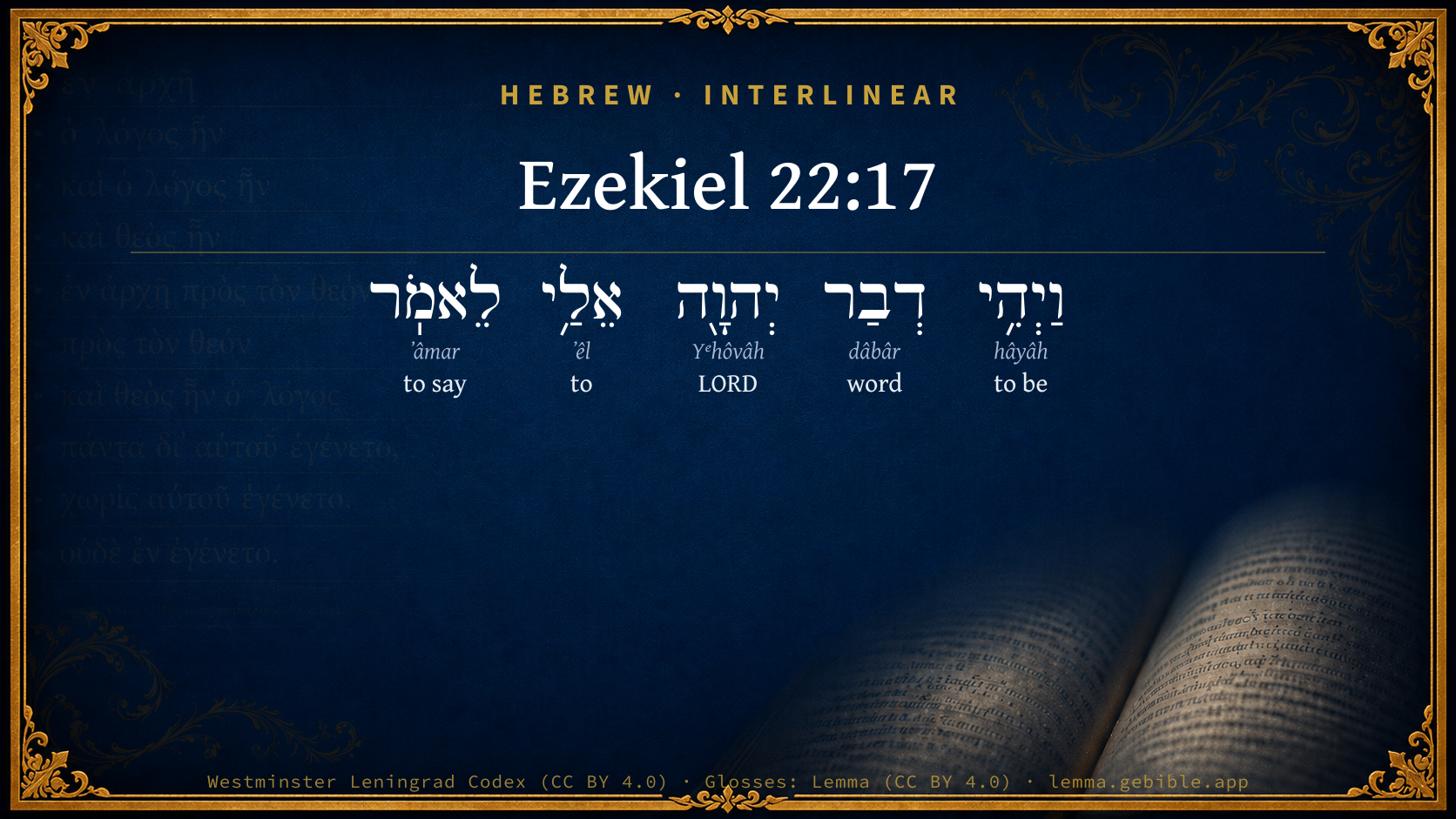
Hebrew (Westminster Leningrad Codex) Ezekiel 22:17 appears in the Hebrew Old Testament. The text above is from the Westminster Leningrad Codex. Each word links to its Strong’s number, a concise gloss, and parsing drawn from the Open Scriptures Hebrew Bible morphology. Click any word for its full Brown-Driver-Briggs (BDB) entry.
Download image
Cite this verse

Ezekiel 22:17 (World English Bible). Public Domain. Lemma interlinear Bible study tool, https://lemma.gebible.app/v/ezekiel/22/17.

Show BibTeX & RIS
BibTeX
RIS
English Translation
The word of Yahweh came to me, saying,
World English Bible · Public Domain
Download a study sheet

One document with this verse’s original text, its word-by-word gloss line, the meaning frame, cross-references with their text, attributed commentary, and full source and license credits — printable, and it pastes into notes with its structure intact.

This verse Autodidact and up

Study sheet (.html) Plain text (.txt)

A passage Seminary Student

Up to 50 verses in one chapter. A passage sheet keeps up to 6 commentary sources and 12 cross-references per verse, in the order this page ranks them, and says so on the sheet whenever that leaves anything out. Ask for a single verse and you get the Autodidact verse sheet above.

Everything on this page stays free to read, with no account — the sheet is a download of what is already on screen, not access to it.

Want to remove ads? Support Godless Engineer
Compare translations 3

The same verse in 3 English versions, stacked beneath the original-language interlinear above. Click any original word for its lexicon entry.

Each is an independent rendering of the whole verse — the interlinear is not word-aligned to these translations.

Highlighted words mark where these versions differ — a whole-verse word diff, not a word-by-word alignment.

  • World English Bible Public Domain
    The word of Yahweh came to me, saying,
  • King James Version Public Domain
    And the word of the LORD came unto me, saying,
  • unfoldingWord Literal Text CC BY-SA 4.0
    Next the word of Yahweh came to me, saying,

unfoldingWord Literal Text — © unfoldingWord, licensed CC BY-SA 4.0. Word-aligned USFM3 via Door43 (git.door43.org/unfoldingWord/en_ult).

Versions to compare (up to 4)

3 of 4 selected

Show all 18 translations

Every available English version of this verse, each an independent rendering of the whole verse.

  • World English Bible Public Domain
    The word of Yahweh came to me, saying,
  • Berean Standard Bible Public Domain
    Then the word of the LORD came to me, saying,
  • Majority Standard Bible Public Domain
    Then the word of the LORD came to me, saying,
  • King James Version Public Domain
    And the word of the LORD came unto me, saying,
  • American Standard Version (1901) Public Domain
    And the word of Jehovah came unto me, saying,
  • Revised Version (1885) Public Domain
    And the word of the LORD came unto me, saying,
  • Geneva Bible (1599) Public Domain
    And the worde of the Lord came vnto me, saying,
  • Douay-Rheims (1899) Public Domain
    And the word of the Lord came to me, saying:
  • Young's Literal Translation Public Domain
    And there is a word of Jehovah unto me, saying, `Son of man,
  • Literal Standard Version CC BY-SA 4.0
    And there is a word of YHWH to me, saying,
  • Unlocked Literal Bible CC BY-SA 4.0
    Next the word of Yahweh came to me, saying,
  • unfoldingWord Literal Text CC BY-SA 4.0
    Next the word of Yahweh came to me, saying,
  • Darby Bible Public Domain
    And the word of Jehovah came unto me, saying,
  • World Messianic Bible Public Domain
    The LORD’s word came to me, saying,
  • Webster's Bible Public Domain
    And the word of the LORD came to me, saying,
  • Free Bible Version CC BY-SA 4.0
    A message from the Lord came to me, saying,
  • Bible in Basic English Public Domain
    And the word of the Lord came to me, saying,
  • JPS Tanakh (1917) Public Domain
    And the word of the LORD came unto me, saying:

Literal Standard Version (2020), Covenant Press — licensed CC BY-SA 4.0. Text via the HelloAO Bible API (eBible.org). Unlocked Literal Bible (unfoldingWord) — licensed CC BY-SA 4.0. Text via the HelloAO Bible API (eBible.org). unfoldingWord Literal Text — © unfoldingWord, licensed CC BY-SA 4.0. Word-aligned USFM3 via Door43 (git.door43.org/unfoldingWord/en_ult). Free Bible Version, Dr. Jonathan Gallagher — licensed CC BY-SA 4.0. Text via the HelloAO Bible API (eBible.org).

Word by word

More ways to search: Search by grammar → Find every occurrence → Compare this word →

Practice this passage: Drill this verse → Learn its vocabulary →

About this verse

These counts appear in no published source. They are computed here, from the morphology-tagged text and Lemma’s own curated glosses. What Lemma adds →

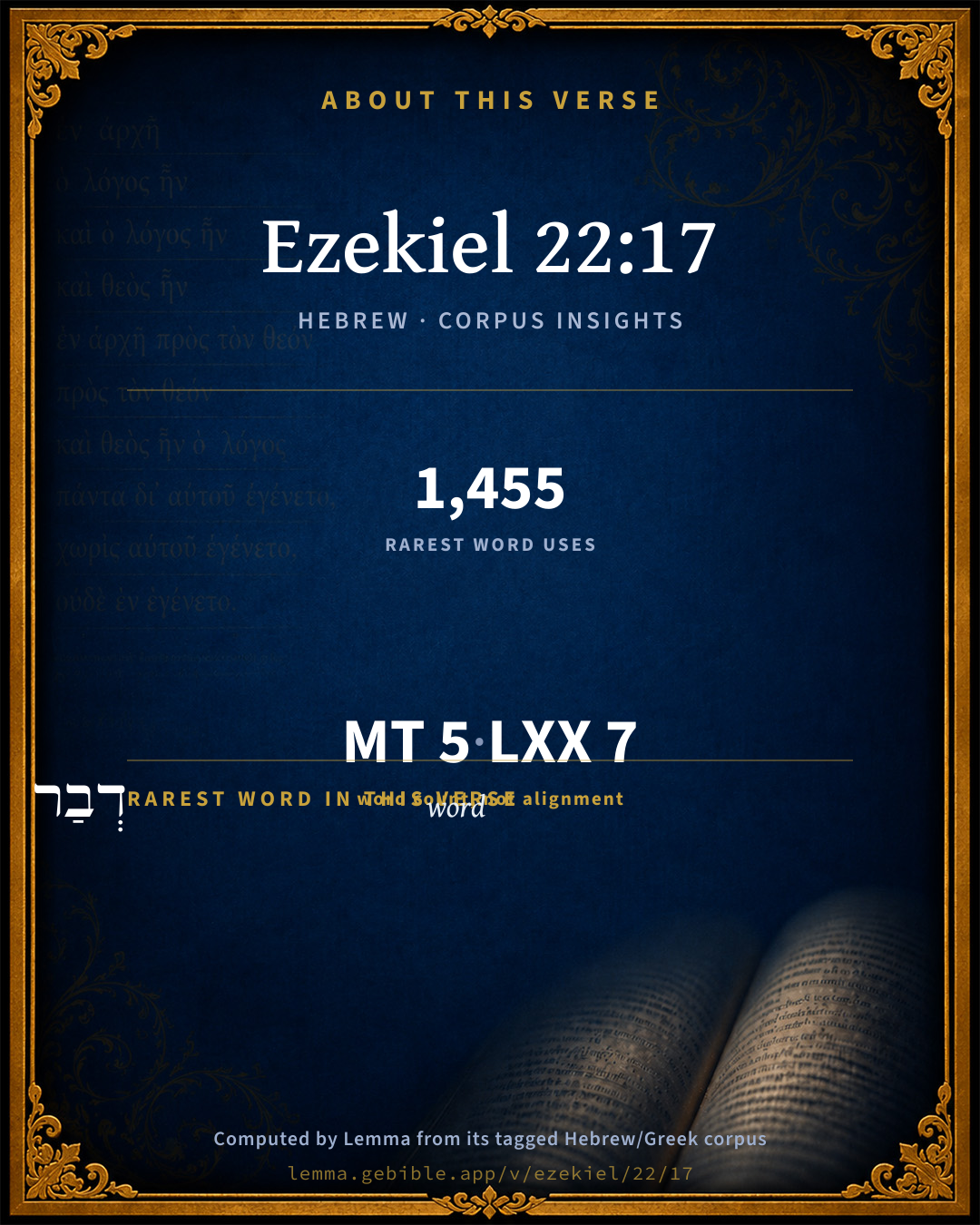
5
words
5
distinct lemmas
Prophets
section

Grammatical profile

  • 2 verbs
  • 2 nouns
  • 1 preposition

Verb forms

  • וַיְהִ֥י Qal · Sequential Imperfect
  • לֵאמֹֽר Qal · Infinitive Construct

Hebrew & Septuagint length

In English translation the verse runs 8 words from the Hebrew and 10 from the Septuagint (LXX English) — closely comparable.

A rough comparison of the two English renderings, which tokenize alike — not a word-level alignment.

Word counts can differ between the Hebrew and the Greek without any difference in meaning — e.g. the Hebrew direct-object marker אֵת has no separate Greek word, and Greek often adds the article ὁ.

In the original languages it is 5 Hebrew tokens and 7 Greek tokens — but the two are counted differently (Hebrew bundles its prefixes and suffixes into one token; the Greek is in lemma form), so that isn’t a like-for-like length.

Hebrew and Greek witnesses Masoretic Hebrew ↔ Greek Septuagint

The same verse in the two great witnesses to the Old Testament, shown verse-for-verse.

These are two independent witnesses, not word-aligned to each other, and the Septuagint is shown in lemma (dictionary) form.

Hebrew Ezekiel 22:17 Masoretic · Westminster Leningrad Codex

וַיְהִ֥י דְבַר יְהוָ֖ה אֵלַ֥י לֵאמֹֽר

The word of Yahweh came to me, saying,

World English Bible · Public Domain

Greek LXX Ezekiel 22:17 Septuagint · lemma form

καί γίγνομαι λόγος κύριος πρός ἐγώ λέγω

And the word of the Lord came to me, saying,

LXX2012 (modern English Septuagint) · Public Domain

Hebrew: Westminster Leningrad Codex (CC BY 4.0). Greek: Septuagint (public domain); English from LXX2012 (modern English Septuagint) (Public Domain). How the Septuagint differs from the Hebrew →

Targum (Aramaic paraphrase)

1

The Targum is the ancient Jewish Aramaic paraphrase of the Hebrew Scriptures — an interpretive translation, not the Hebrew text itself. Onkelos (literal) and Pseudo-Jonathan (expansive) render the Torah, and Jonathan the Prophets. Coverage is partial: where no permissively-licensed English translation exists for a verse, only the Aramaic is shown. This is verse-level text, not a word-by-word alignment to the Hebrew.

  1. Targum Jonathan Prophets (Joshua–Malachi)
    וַהֲוָה פִּתְגַם נְבוּאָה מִן קֳדָם יְיָ עִמִי לְמֵימָר:

    (no public-domain English translation for this verse)

    Targum Jonathan — Aramaic: “Mikraot Gedolot” (public domain). English: “Sefaria Community Translation” (CC0 1.0 (public-domain dedication)); “London "Chaldee Paraphrase," 1871” (public domain). Text via Sefaria.

Commentary

Notes on Ezekiel 22:17 from classic Christian and Jewish commentators (each source and its license shown beneath its notes). The classic Christian expositions comment on the surrounding passage and are grouped to its opening verse, so a note may address several verses; the Jewish commentaries on the Tanakh (Rashi and others) are per-verse, so they appear only where the commentator wrote on this verse.

Lemma curates 59 commentaries, every one of them public domain or Creative Commons licensed, each selected and text-cleaned for this edition rather than reprinted as found. About our sources →

Trapp's Complete Commentary

John Trapp

Eze 22:17 And the word of the LORD came unto me, saying,

Ver. 17. And the word of the Lord] See Eze 18:1.

John Trapp, A Commentary or Exposition upon All the Books of the Old and New Testament (1647–1656) — public domain. Text from a community e-Sword module.

The Preacher's Complete Homiletical Commentary

Joseph S. Exell (gen. ed.)

(Eze_22:17-22.)

EXEGETICAL NOTES.—Jerusalem besieged by her enemies is the furnace in which God will refine His people Israel.

Eze_22:17. “The word of the Lord came unto me.” “This second word of God rests, no doubt, upon the figure in Eze_22:15, of the uncleanness or dirt of sin; but it is not an exposition of the removal of the dirt as predicted there. For that was to be effected through the dispersion of Israel among the nations, whereas the word of God, from Eze_22:17 onwards, represents the siege awaiting Jerusalem as a melting process, through which God will separate the ‘silver ore contained in Israel from the baser metals mingled with it.”—(Keil.)

Eze_22:18. “The house of Israel is to Me become dross; all they are brass, and tin, and iron, and lead, in the midst of the furnace; they are even the dross of silver.” Some kinds of silver ore contain a large amount of copper, iron, and lead, with other impurities. The inhabitants of Judea are described as a mass of the baser metals intermixed with the impure residue of silver. The good silver had been drained out of Judah by death or exile, and those who remained had altogether become a compound of wickedness.

Eze_22:20. “So will I gather you in Mine anger and in My fury, and I will leave you there, and melt you.” “The smelting is treated here simply as a figurative representation of punishment, and consequently the result of the smelting, namely, the refining of the silver by the removal of the baser ingredients, is not referred to any further, as is the case in Isa_1:22; Isa_1:25; Jer_6:27-30; Mal_3:2-3. This smelting process was experienced by Israel in the last siege of Jerusalem by the Chaldeans.”—(Keil). “In the spiritual department, the silver may become altogether dross. The furnace is Jerusalem, according to its destination to serve for a smelting pot. Dross of silver is silver that has become dross. They are all gathered into Jerusalem (Eze_22:19), as the people far and wide, under the pressure of the foe, seek refuge in the fortified city. In the whole section the judgment is regarded not in the light of purification, but in that of destruction, as Ezekiel usually considers the population of Jerusalem as an ungodly multitude doomed to be extirpated.”—(Hengstenberg).

Eze_22:22. “As silver is melted in the midst of the furnace.” “In modern metallurgy, lead is employed for the purpose of purifying silver from other mineral products. The alloy is mixed with lead exposed to fusion upon an earthen vessel, and submitted to a blast of air. By this means the dross is consumed. This process is called the cupelling operation, with which the description in Eze_22:18-22 accurately coincides. The vessel containing the alloy is surrounded by the fire, or placed in the midst of it, and the blowing is not applied to the fire but to the fused metals. And when this is done, nothing but the perfect metals, gold and silver, can resist the scorifying influence. In Jer_6:28-30, we have a perfect description of this process. If we take silver having the impurities in it described in the text, namely, iron, copper and tin, and mix it with lead, and place it in the fire upon a cupell, it soon melts; the lead will oxidize and form a thick, coarse crust upon the surface and thus consume away, but effecting no purifying influence. The alloy remains, if anything, worse than before. The silver is not refined because ‘the bellows were burned,’ there existed nothing to blow upon it.”—(Smith’s Dict. of the Bicle, art. “Lead”).

HOMILETICS

God has a threefold smelting furnace.

1. Of sin. In which one can become dross.

2. Of trial. In which furnace the silver is tested.

3. Of judgment. In which even the dross is consumed.—Lange.

1. Churches and states may degenerate from their preciousness and purity, into vileness and profaneness. “It was full of judgment, and righteousness lodged in it” (Isa_1:21-23), but instead of these, now there was oppression and murder. “Thy silver is become dross, thy wine is mixed with water.” Thy money is counterfeit, and thy wine corrupt. Whatever was pure in thee is now corrupted, the law is corrupted with false expositions, the worship is corrupted with idols and human traditions, justice is corrupted with bribery and cruel oppressions, chastity and sobriety are corrupted with lewd and unclean practices. Rome was once a golden city for her faith and holiness (Rom_1:8; Rom_16:19); but now is so corrupt in doctrine, worship, and manners, that she is become “the mother of harlots and abominations” (Rev_17:5). The Seven Churches were once golden candlesticks, but through their corruptions and weaknesses, they soon degenerated into dross.

2. Men professing godliness, and living ungodlily, are not acceptable to God, nor fit materials of a church. “The house of Israel is to Me become dross;” they profess My name, and so judge themselves good silver; but they live wickedly, and to Me they are no better than dross, than brass, tin, iron and lead, too base materials to make a temple for Me to dwell in, or a candlestick for Me to set a prophetical light in. Whatever profession they make, whatever parts or privileges they have, they are no silver, but the dross, the excrements of silver, which defile, disgrace the name, the Church, the ordinances of God, and must be separated from the gold and silver (2Co_6:17). Many that appear silver unto men will be found dross unto God. Hypocrites and wicked ones are dross; only hypocrites are the “dross of silver.”

3. The greatest part of professors, when they come to the trial, will be found corrupt and naught. “All they are brass, and tin, and iron, and lead, in the midst of the furnace.” The furnace discovered them to be base metal. The number of sincere and silver-like Christians will be few.

4. Those who degenerate from God and His ways shall meet with fury and fire from the Lord (Eze_22:21). When the church of Ephesus decayed in her first love, that of Pergamos turned aside to the doctrines of Balaam and the Nicolaitanes, that of Thyatira to the teachings and seductions of Jezebel; when Sardis abated in her zeal, and Laodicea became lukewarm, the Lord threatened them severely, and at last brake the candlesticks, and put out the lights (Rev_2:3). God will put away all the wicked of the earth from Him like dross (Psa_119:119).

5. Melting and consuming judgments upon a people are the wrath of God, whoever be the executioners thereof. Nebuchadnezzar should besiege Jerusalem, and make it like a furnace to melt and consume the Jews, and this the Lord owns to be His doing (Eze_22:22). The enemies of Jerusalem were but the vials or vessels by which the fury of God was poured out.—(Greenhill.)

The Preacher's Complete Homiletical Commentary (gen. ed. Joseph S. Exell; Funk & Wagnalls, c. 1892) — public domain (pre-1929). A full-Bible homiletical/sermon-outline anthology covering 65 of 66 books (2 John is absent from the source module). Text from a community e-Sword module.

Keil & Delitzsch

C. F. Keil & F. Delitzsch

Refining of Israel in the Furnace of Besieged Jerusalem

Eze 22:17. And the word of Jehovah came to me, saying, Eze 22:18. Son of man, the house of Israel has become to me as dross; they are all brass, and tin, and iron, and lead in the furnace; dross of silver have they become. Eze 22:19. Therefore thus saith the Lord Jehovah, Because ye have all become dross, therefore, behold, I gather you together in Jerusalem. Eze 22:20. As men gather together silver, and brass, and iron, and lead, and tin into the furnace, to blow the fire upon it for melting, so will I gather (you) together in my anger and my wrath, and put you in and melt you. Eze 22:21. And I will collect you together, and blow the fire of my wrath upon you, that ye may be melted therein. Eze 22:22. As silver is melted in the furnace, so shall ye be melted therein (viz., in Jerusalem), and shall learn that I Jehovah have poured out my wrath upon you. - This second word of God rests no doubt upon the figure in Eze 22:15, of the uncleanness or dirt of sin; but it is not an exposition of the removal of the dirt, as predicted there. For that was to be effected through the dispersion of Israel among the nations, whereas the word of God, from Eze 22:17 onwards, represents the siege awaiting Jerusalem as a melting process, through which God will separate the silver ore contained in Israel from the baser metals mingled with it. In Eze 22:18 it commences with a description of the existing condition of Israel. It has turned to dross. היוּ is clearly a perfect, and is not to be taken as a prophetical future, as Kliefoth proposes. Such a rendering is not only precluded by the clause 'יען היות in Eze 22:19, cut could only be made to yield an admissible sense by taking the middle clause of the verse, "all of them brass and tin," etc., as a statement of what Israel had become, or as a preterite in opposition to all the rules of Hebrew syntax, inasmuch as this clause merely furnishes an explanation of היוּ־לסוּג. סוּג, which only occurs here, for סיג signifies dross, not smelting-ore (Kliefoth), literally, recedanea, the baser ingredients which are mixed with the silver, and separated from it by smelting. This is the meaning here, where it is directly afterwards interpreted as consisting of brass, tin, iron, and lead, and then still further defined as סגּים כּסף, dross of silver, i.e., brass, tin, iron, and lead, with a mixture of silver. Because Israel had turned into silver-dross of this kind, the Lord would gather it together in Jerusalem, to smelt it there as in a smelting furnace; just as men gather together brass, iron, lead, and tin in a furnace to smelt them, or rather to separate the silver contained thereon. קבצת כּסף, literally, a collection of silver, etc., for "like a collection." The כ simil. is probably omitted for the sake of euphony, to avoid the discord occasioned by prefixing it to קבצת. Ezekiel mentions the silver as well, because there is some silver contained in the brass, iron, etc., or the dross is silver-dross. התּוּך, nomen verbale, from נתך in the Hiphil, smelting; literally, as the smelting of silver takes place in the furnace. The smelting is treated here simply as a figurative representation of punishment, and consequently the result of the smelting, namely, the refining of the silver by the removal of the baser ingredients, is not referred to any further, as in the case in Isa 1:22, Isa 1:25; Jer 6:27-30; Mal 3:2-3. This smelting process was experienced by Israel in the last siege of Jerusalem by the Chaldeans.

Keil & Delitzsch — Biblical Commentary on the Old Testament (1861–1891) — public domain (CC PDM 1.0). Text via the HelloAO Bible API. (Old Testament only.)

Tyndale Open Study Notes

Tyndale Open Resources

22:17-22 Scattering was not the only aspect of judgment. God would also gather Judah into Jerusalem for judgment as metal is gathered into a smelter’s furnace. This refining fire would not yield a purified remnant. Since only worthless slag would go in, only worthless molten slag would come out. The judgment would not cleanse the people but would destroy everything in its path.

Tyndale Open Study Notes — © Tyndale Open Resources, licensed CC BY-SA 4.0. Text via the HelloAO Bible API.

Matthew Henry's Commentary

The same melancholy string is still harped upon, and various turns are given it, to make it affecting, that it may be influencing. The prophet must here show, or at least it is here shown him, that the whole house of Israel has become as dross and that as dross they shall be consumed. What David has said concerning the wicked ones of the world is here said concerning the wicked ones of the church, now that it is corrupt and degenerate (Psa 119:119): Thou puttest away all the wicked of the earth like dross.

I. See here how the wretched degeneracy of the house of Israel is described. That state, in David's and Solomon's time, had been a head of gold; when the kingdoms were divided it was as the arms of silver. But now, 1. It has degenerated into baser metal, of no value in comparison with what it formerly was: They are all brass, and tin, and iron, and lead, which some make to signify divers sorts of sinners among them. Their being brass denotes the impudence of some in their wickedness; they are brazen-faced, and cannot blush; their shoes had been iron and brass (Deu 33:25), but now their brow is so, Isa 48:4. Their being tin denotes the hypocritical profession of piety with which many of them cover their iniquity; they have a specious show, but no intrinsic worth. Their being iron denotes the cruel disposition of some, and their delight in war, according to the character of the iron age. Their being lead denotes their dulness, sottishness, and stupidity: though soft and pliable to evil, yet heavy and not movable to good. How has the gold become dross! How has the most fine gold changed! So is Jerusalem's degeneracy bewailed, Lam 4:1. Yet this is not the worst; these metals, though of less value, are yet of good use. But, 2. The house of Israel has become dross to me. So she is in God's account, whatever she is in her own and her neighbours' account. They were silver, but now they are even the dross of silver; the word signifies all the dirt, and rubbish, and worthless stuff, that are separated from the silver in the washing, melting, and refining of it. Note, Sinners, and especially degenerate professors, are in God's account as dross, vile, and contemptible, and of no account, as the evil figs which could not be eaten, they were so evil. They are useless and fit for nothing; of no consistency with themselves and no service to man.

II. How the woeful destruction of this degenerate house of Israel is foretold. They are all gathered together in Jerusalem; thither people fled from all parts of the country as to a city of refuge, not only because it was a strong city, but because it was the holy city. Now God tells them that their flocking into Jerusalem, which they intended for their security, should be as the gathering of various sorts of metal into the furnace or crucible, to be melted down, and to have the dross separated from them. They are in the midst of Jerusalem, surrounded by the forces of the enemy; and, being thus enclosed, 1. The fire of God's wrath shall be kindled upon this furnace, and it shall be blown, to make it burn fiercely and strongly, Eze 22:20, Eze 22:21. God will gather them in his anger and fury. The blowing of the fire makes a great noise, so will the judgments of God upon Jerusalem. When God stirs up himself to execute judgments upon a provoking people, from the consideration of his own glory and the necessity of making some examples, then he may be said to blow the fire of his wrath against sin and sinners, to heat the furnace seven times hotter. 2. The several sorts of metal gathered in it shall be melted; by a complication of judgments, as by a raging fire, their constitution shall be dissolved, they shall lose all their former shape and strength, and shall be utterly unable to stand before the wrath of God. The various sorts of sinners shall be melted down together, and united in a common overthrow, as brass and lead in the same furnace, as trees are bound in bundles for the fire. They came together into Jerusalem as a place of defence, but God brought them together there as unto a place of execution. 3. God will leave them in the furnace (Eze 22:20): I will gather you into the furnace and will leave you there. When God brings his own people into the furnace he sits by them, as the refiner by his gold, to see that they be not continued there any longer than is fitting and needful; but he will bring these people into the furnace, as men throw dross into it, which they design shall be consumed, and therefore are in no care about it, but leave it there. Compare with this Hos 5:14, I will tear and go away. 4. Hereby the dross shall be wholly separated and the good metal purified, the impenitent shall be destroyed and the penitent reformed and fitted for deliverance. Take away the dross from the silver, and there shall come forth a vessel for the finer, Pro 25:4. This judgment shall do that in the house of Israel for the doing of which other methods had been tried in vain, and reprobate silver shall they no more be called, Jer 6:30.

Matthew Henry's Commentary on the Whole Bible (1708–1710) — public domain (CC PDM 1.0). Text via the HelloAO Bible API.

The Cambridge Bible for Schools and Colleges

gen. ed. J. J. S. Perowne

17–22. Judgment on Israel under the figure of a smelting furnace. Israel is dross and base metal, which must be flung into the furnace.

The Cambridge Bible for Schools and Colleges (gen. ed. J. J. S. Perowne; Cambridge University Press, 1878–1918) — public domain. Text from a community e-Sword module.

John Gill's Exposition

And the word of the Lord came unto me,.... The word of prophecy from the Lord, as the Targum:

saying; as follows:

John Gill's Exposition of the Whole Bible (1746–1763) — public domain (CC PDM 1.0). Text via the HelloAO Bible API.

Albert Barnes' Notes on the Bible

The fifth word of judgment. The furnace. In the besieged city the people shall be tried and purged.

Eze 22:18

Dross - A frequent metaphor which denotes not only the corruption of the people, who have become like base metal, but also a future purification whereby, the “dross” being burned away, the remnant of good may appear.

Albert Barnes' Notes on the Bible (1834–1885) — public domain. Text from a community e-Sword/MySword module.

The Pulpit Commentary

Vers. 17-22. The smelting furnace.

For every material thing there is a test. We may know metals by their action under chemical agents, or by the furnace-flame. We can test gases by their power to sustain life or to sustain flame. We can test dynamical forces by electricity or by their power to create motion. So for human character there is a crucial test.

I ADULTERATED METAL. The seed of Israel had sadly degenerated. They had been, compared with other people, as silver and gold. Now they were, in God"s esteem, only as dross, and his judgment is according to truth." What virgin gold is in a human kingdom, true righteousness is in the kingdom of God. Loyalty and love are the coins current in God"s empire. A good man is worth more than argosies of gold and rubies. Wisdom, righteousness, and love, these are the only durable riches. They exalt and enrich men for time and for eternity. Selfishness, disobedience, and rebellion are the dross and rust which eat out the very life of the soul. Real riches become part and parcel of the man.

II THE FURNACE-FIRE. What the material flame of the furnace is to metals, God"s anger is to human character. It tests the qualities of mind and heart. As metals have no power to resist being cast into the furnace, neither has any man power to exempt himself from Divine chastisement. It comes upon all in some form or other. In some, humility, submission, resignation, appear. These are precious metals the gold and silver of moral excellence. In others, fretfulness, remorse, defiance, are the effect. These are base dross, destitute of any worth. A myriad of men know nothing about their characters until trial, in some sort, comes upon them. If milder forms of chastisement will not melt the hardened metal, the anger of Jehovah will wax hot. There shall be, sooner or later, self-revelation the sooner the better.

III SEPARATION. The furnace is not merely a test of metal and alloy; it further separates the one from the other. Among men this separation, resulting from God"s visitations, is twofold.

1. This separation is seen as one between man and man. The precious and the vile become more distinguishable one from the other.

2. The separation is internal. In those who turn the affliction to good account there follows self-inspection, self-denial, pruning. The idol is dethroned. The vice is abandoned. The evil is withstood and fought. Refinement goes on within. The darkness and the light separate. The man comes out of the process as gold that is purified.

IV DESTRUCTION. The residuum of alloy is cast out as base and worthless. God will not tolerate falsehood, hypocrisy, or any iniquity in his kingdom. "Every liar shall have his portion in the lake that burneth with fire and brimstone." The liar is not only the man who speaks with intention to deceive; he is the man who has preferred to deceive himself rather than face the truth. Unquestionably, separation, accomplished in the furnace, is with a view to refinement, but also with a view of destruction to the worthless dross. Every man has his face either toward purity or toward perdition. The processes of God"s furnace are going on among us every day. Are we getting better or worse? D.

Vers. 17-22. Deplorable deterioration and deserved destruction.

the word of the Lord came unto me, saying, Son of man, the house of Israel is to me become dross," etc. Notice

I THE DEPLORABLE DETERIORATION OF THE HOUSE OF ISRAEL.

1. Here are several varieties of sinful character. We will notice them as they are here adduced.

(1) Dross. "The house of Israel is to me become dross; they are the dross of silver." This does not mean ore, which contains silver, but dross which has been separated from the silver the refuse of dirt and rubbish which is removed from the precious metal in the cleansing, melting, and refining of it. The people of Judah and Jerusalem had become "the ignoble dross of noble silver." "The metaphor denotes the corruption of the people, who had become like base metal.

(2) "Brass" probably indicates the hardihood of the people in sin; that they had become impudent in wickedness. (cf. Isa_48:4)

(3) "Tin" is suggestive of hypocrisy, being brilliant in appearance, but inferior in substance and value. So there were those in Jerusalem who made great profession of true religion, but whose moral character and conduct were base.

(4) "Iron" may denote harshness and cruelty. That such was a characteristic of some of their great men and rulers is clear from Ver. 27; Eze_34:2-4; and Zep_3:3.

(5) "Lead," pliable, yet not precious as compared with silver and gold, indicates the moral dullness and stupidity of the house of Israel. They were pliable to evil, yet not available for any high or holy uses. (cf. Jer_4:22) Thus in Jerusalem there were various types of evil character; and these types are reproduced in our own age and country.

2. Here is one characteristic which marks each of these varieties of sinful character. They were each and all marked by degeneracy. In every one of these classes of evil character there had been a lamentable deterioration. "Thy silver is become dross, thy wine mixed with water." "How is the gold become dim! How is the most pure gold changed!" Thus the prophets Isaiah and Jeremiah lamented this deterioration.

(1) There was degeneracy of moral character. Their affections were corrupted; their principles were degraded; their conscience, having been often set at naught, was debased. So in the sight of him to whom all hearts are open they had become as dross. "The house of Israel is become dross unto me." Beware of the beginnings of sin, the initial stages of this degeneration of moral character.

(2) Degeneracy of religious services. This deterioration is forcibly set forth and sternly rebuked in Isa_1:11-17. Moreover, they had become idolaters: how, then, could their worship of the true God be genuine and acceptable? When personal character degenerates, the quality of the religious service rendered must decline.

(3) Degeneracy of national position and power. The might and majesty of their kingdom were almost entirely departed. Their national independence was quite gone. When moral deterioration once powerfully sets in amongst any people, deterioration in all other forms quickly follows. Says Robertson, "The destiny of a nation is decided by its morals.

II THE DETERMINED DESTRUCTION OF THE HOUSE OF ISRAEL.

1. The gathering of the doomed people for destruction. "Thus saith the Lord God; because ye are all become dross, behold, therefore I will gather you into the midst of Jerusalem," etc. (Vers. 19, 20). When pressed by their Chaldean enemies the people from far and wide took refuge in Jerusalem, trusting to its forces and fortifications for safety. So that city became as it were the furnace in which they were consumed by the triple fire of famine, pestilence, and sword. Mark, how naturally and easily God effects his purposes. He has not to build the furnace for their destruction: it is already built. He has not to force them into that furnace by supernatural means: in their approaching troubles they will hasten into it of their own accord. He controls all things for the execution of his deep and righteous designs.

2. The infliction of destruction upon the doomed people.

(1) It was by the hand of God. "Thus saith the Lord God I will gather you into the midst of Jerusalem," etc. The Chaldeans were the instruments by which he effected his purpose; but God himself was the great Agent in the work.

(2) It was an expression of the anger of God. "So will I gather you in mine anger and in my fury," etc. (Vers. 20, 21). The wrath of God burns with awful intensity against sin. "Our God is a consuming fire.

(3) It leads to the recognition of the hand of God.

3. Ye shall know that I the Lord have poured out my fury upon you." These words do not point to their reformation or purification As Hengstenberg observes "In the whole section the judgment is regarded, not in the light of purification, but in that of destruction; as Ezekiel usually considers the population of Jerusalem as an ungodly multitude doomed to be extirpated." Moreover, dross cannot be benefited by fire. It cannot be purified. After all burnings it remains dross refuse. The fire was not to purify, but to punish them; not to cleanse, but to consume them. And in its fierce heat they would recognize the dread power of the God whom they had forsaken for idols, and whose word they had set at naught.

CONCLUSION. Guard against the beginnings of the deterioration of character. Seek the growth and progress of character in the true and good. W.J.

The Pulpit Commentary (1880–1919), ed. H.D.M. Spence-Jones & Joseph S. Exell — public domain. Text from a community e-Sword module.

Kretzmann's Popular Commentary

Paul E. Kretzmann

The Corruption of Judah inviting Destruction

v. 17. And the word of the Lord came unto me, saying,

v. 18. Son of man, the house of Israel is to Me become dross, the refuse of the purer metals, thrown out as unfit for fine use; all they are brass, and tin, and iron, and lead in the midst of the furnace, all the baser metals, unfit for the divine Refiner’s purpose; they are even the dross of silver, full of impurity.

v. 19. Therefore, thus saith the Lord God, Because ye are all become dross, impure with idolatry and other wickedness, behold, therefore I will gather you into the midst of Jerusalem, heaped together like quartz in a furnace.

v. 20. As they gather silver, and brass, and iron, and lead, and tin into the midst of the furnace, the baser metals being mixed with the precious and the object being to separate them, to blow the fire upon it, to melt it, the process resulting in an almost pure extraction of the nobler metal, so will I gather you in Mine anger and in My fury, in carrying out the contemplated judgment upon Jerusalem and Judah, and I will leave you there and melt you. Note that the process of refining is not used in the figure, the smelting as such being a picture of the avenging wrath of God.

v. 21. Yea, I will gather you and blow upon you in the fire of My wrath, as silver alloyed with baser metals is submitted to a blast of air in the so-called cupeling process, and ye shall be melted in the midst thereof.

v. 22. As silver is melted in the midst of the furnace, so shall ye be melted in the midst thereof, Judah experiencing this operation during the last siege of the city; and ye shall know that I, the Lord, have poured out My fury upon you. Having thus set forth the punishment upon Jerusalem, the Lord proceeds to show the corruptness of all classes of people in Judah.

v. 23. And the word of the Lord came unto me, saying,

v. 24. Son of man, say unto her, namely, to Jerusalem and Judah, Thou art the land that is not cleansed, namely, from the weeds, briars, and thorns with which it is overgrown, or upon which the sun does not shine in due season, nor rained upon in the day of indignation, that is, from which the Lord withholds fruitfulness on account of its wickedness.

v. 25. There is a conspiracy of her prophets in the midst thereof, self-appointed teachers and leaders as these false prophets were, like a roaring lion ravening the prey they have devoured souls, the fierceness and cruelty of their actions being in evidence throughout; they have taken the treasure and precious things, property and jewels in possession of the people; they have made her many widows in the midst thereof, for pious men were put to death by them.

v. 26. Her priests, who held the office of keepers and protectors of the Law, have violated My Law, since they did the very things from which they were supposed to keep the people by their warnings, and have profaned Mine holy things, by not observing them with the proper respect, Cf Zep 3:4; they have put no difference between the holy and profane, neither have they showed difference between the unclean and the clean, Lev 10:10-11, that is, they calmly disregarded the ordinances of the Lord concerning these distinctions, and have hid their eyes from My Sabbaths, by neglecting the law of the Sabbath, and I am profaned among them, for all these acts detracted from the Lord’s glory.

v. 27. Her princes in the midst thereof, the leaders and chief protectors of the people, are like wolves ravening the prey, to shed blood, and to destroy souls, to get dishonest gain, the civil rulers thus siding with the church powers in performing deeds of wickedness.

v. 28. And her prophets have daubed them with untempered mortar, Cf.Ezekiel 13:10, by flattering the people with false assurances of peace and safety, seeing vanity, unfounded promises of good, and divining lies unto them, saying, Thus saith the Lord God, when the Lord hath not spoken.

v. 29. The people of the land, following the bad example of their leaders, have used oppression, practicing extortion and violence in every form, and exercised robbery, either open or hidden, and have vexed the poor and needy, Cf.Ezekiel 18:7; yea, they have oppressed the stranger wrongfully, in spite of the earnest warnings of the Lord concerning this practice, Exo 22:20-21; Deu 24:17.

v. 30. And I sought for a man among them that should make up the hedge, building up a wall against these various acts of wickedness, and stand in the gap before Me for the land, to close up the breach and make intercession for Judah, that I should not destroy it; but I found none, the moral degeneration was such as to leave even the few righteous without the power to do anything.

v. 31. Therefore have I poured out Mine indignation upon them, as explained above; I have consumed them with the fire of My wrath, in melting them in the furnace of His punishment; their own way have I recompensed upon their heads, saith the Lord God, punishing them in exact agreement with their wicked deeds. It is this fact, that they themselves have brought the evil fate upon them, which will cause many wicked the greatest torment in the last great punishment.

Paul E. Kretzmann, Popular Commentary of the Bible (1921–1924) — public domain. Text from a community e-Sword module.

unfoldingWord translationNotes

Door43 World Missions Community

the word of Yahweh came

This is an idiom that is used to introduce something that God told his prophets or his people. See how you translated this in Ezekiel 3:16. AT: "Yahweh spoke this message" or "Yahweh spoke these words" (See: Idiom)

the house of Israel has

The word "house" is a metonym for the family that lives in the house, in this case the Israelites, the descendants of Jacob over many years. See how you translated this in Ezekiel 3:1. AT: "the Israelites have" or "the Israelite people group has" (See: Metonymy)

has become dross to me

Dross is the impurities that are left over after silver or gold has been purified in a furnace. Here Yahweh speaks of the people being worthless to him as if they were dross. AT: "has become as worthless to me as dross" (See: Metaphor)

All of them are the leftovers of bronze and tin ... like the dross of silver in your furnace

Yahweh continues to speaks about how the people have become worthless to him as if they were dross. AT: "All of them are as worthless as the leftover of bronze and tin, and iron and lead that remain after you melt silver in the furnace" (See: Metaphor)

behold

"look" or "listen" or "pay attention to what I am about to tell you"

translationWords

house

bronze

Lord Yahweh

Jerusalem

unfoldingWord translationNotes — © Distant Shores Media and the Door43 World Missions Community, licensed CC BY-SA 4.0. Source: git.door43.org/Door43/en_tn.

Lesson kit

Teaching starters — assembled from the data on this page, not authored interpretation. Every prompt links to the verse data it draws on. Edit before teaching.

Ezekiel, in the Prophets, opens this verse with 5 words (5 distinct Hebrew lemmas). Its most distinctive word is dâbâr (“word”). A historical commentator’s framing appears above. Read the whole chapter for the surrounding context.

Discussion questions

  1. The word dâbâr carries the sense “word.” How does it shape the verse?
  2. The translations on this page render this verse differently — a whole-verse word diff, not a word-by-word alignment. What might account for the different wordings?
  3. «וַיְהִ֥י» is a Qal Sequential Imperfect verb. How does that grammatical form shape the action described?
  4. Compare how Trapp's Complete Commentary and The Preacher's Complete Homiletical Commentary read this verse. Where do they agree or differ?

Things to notice

Reading settings

Reading text

Shown beneath each verse's original-language words.

Old Testament
Old Testament edition

Read the OT as the Masoretic Hebrew (MT) or the Greek Septuagint (LXX).

English shown for the Greek Septuagint (in the Hebrew ↔ Greek comparison).

Comparing translations? Open the Compare panel on any verse page to stack up to four side by side.