
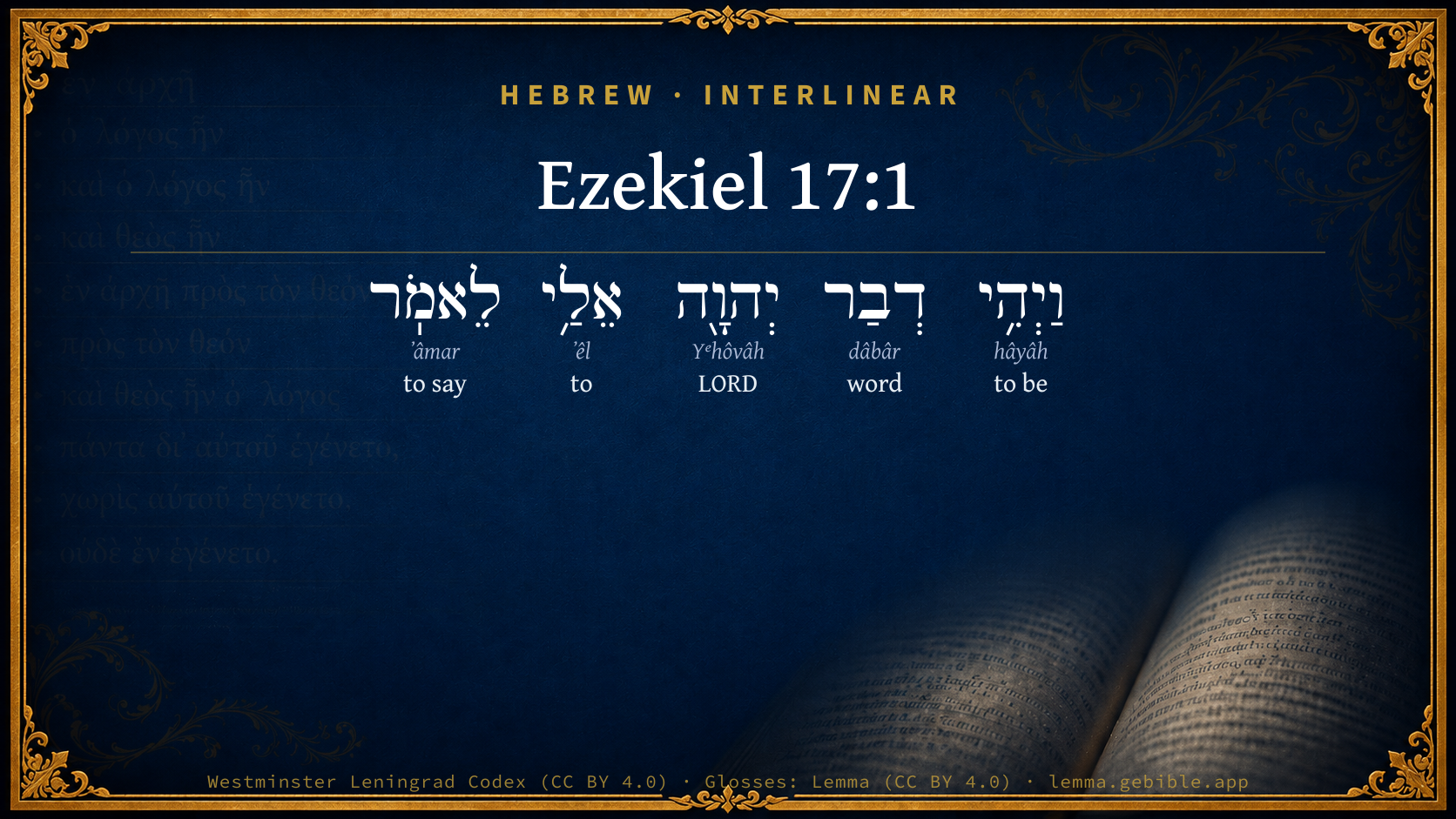
Ezekiel 17:1

Hebrew (Westminster Leningrad Codex) Ezekiel 17:1 appears in the Hebrew Old Testament. The text above is from the Westminster Leningrad Codex. Each word links to its Strong’s number, a concise gloss, and parsing drawn from the Open Scriptures Hebrew Bible morphology. Click any word for its full Brown-Driver-Briggs (BDB) entry.
Download image
Cite this verse

Ezekiel 17:1 (World English Bible). Public Domain. Lemma interlinear Bible study tool, https://lemma.gebible.app/v/ezekiel/17/1.

Show BibTeX & RIS
BibTeX
RIS
English Translation
The word of Yahweh came to me, saying,
World English Bible · Public Domain
Download a study sheet

One document with this verse’s original text, its word-by-word gloss line, the meaning frame, cross-references with their text, attributed commentary, and full source and license credits — printable, and it pastes into notes with its structure intact.

This verse Autodidact and up

Study sheet (.html) Plain text (.txt)

A passage Seminary Student

Up to 50 verses in one chapter. A passage sheet keeps up to 6 commentary sources and 12 cross-references per verse, in the order this page ranks them, and says so on the sheet whenever that leaves anything out. Ask for a single verse and you get the Autodidact verse sheet above.

Everything on this page stays free to read, with no account — the sheet is a download of what is already on screen, not access to it.

Want to remove ads? Support Godless Engineer
Compare translations 3

The same verse in 3 English versions, stacked beneath the original-language interlinear above. Click any original word for its lexicon entry.

Each is an independent rendering of the whole verse — the interlinear is not word-aligned to these translations.

Highlighted words mark where these versions differ — a whole-verse word diff, not a word-by-word alignment.

  • World English Bible Public Domain
    The word of Yahweh came to me, saying,
  • King James Version Public Domain
    And the word of the LORD came unto me, saying,
  • unfoldingWord Literal Text CC BY-SA 4.0
    The word of Yahweh came to me, saying,

unfoldingWord Literal Text — © unfoldingWord, licensed CC BY-SA 4.0. Word-aligned USFM3 via Door43 (git.door43.org/unfoldingWord/en_ult).

Versions to compare (up to 4)

3 of 4 selected

Show all 18 translations

Every available English version of this verse, each an independent rendering of the whole verse.

  • World English Bible Public Domain
    The word of Yahweh came to me, saying,
  • Berean Standard Bible Public Domain
    Now the word of the LORD came to me, saying,
  • Majority Standard Bible Public Domain
    Now the word of the LORD came to me, saying,
  • King James Version Public Domain
    And the word of the LORD came unto me, saying,
  • American Standard Version (1901) Public Domain
    And the word of Jehovah came unto me, saying,
  • Revised Version (1885) Public Domain
    And the word of the LORD came unto me, saying,
  • Geneva Bible (1599) Public Domain
    And the worde of the Lord came vnto mee, saying,
  • Douay-Rheims (1899) Public Domain
    And the word of the Lord came to me, saying:
  • Young's Literal Translation Public Domain
    And there is a word of Jehovah unto me, saying,
  • Literal Standard Version CC BY-SA 4.0
    And there is a word of YHWH to me, saying,
  • Unlocked Literal Bible CC BY-SA 4.0
    The word of Yahweh came to me, saying,
  • unfoldingWord Literal Text CC BY-SA 4.0
    The word of Yahweh came to me, saying,
  • Darby Bible Public Domain
    And the word of Jehovah came unto me, saying,
  • World Messianic Bible Public Domain
    The LORD’s word came to me, saying,
  • Webster's Bible Public Domain
    And the word of the LORD came to me, saying,
  • Free Bible Version CC BY-SA 4.0
    A message from the Lord came to me, saying,
  • Bible in Basic English Public Domain
    And the word of the Lord came to me, saying,
  • JPS Tanakh (1917) Public Domain
    And the word of the LORD came unto me, saying:

Literal Standard Version (2020), Covenant Press — licensed CC BY-SA 4.0. Text via the HelloAO Bible API (eBible.org). Unlocked Literal Bible (unfoldingWord) — licensed CC BY-SA 4.0. Text via the HelloAO Bible API (eBible.org). unfoldingWord Literal Text — © unfoldingWord, licensed CC BY-SA 4.0. Word-aligned USFM3 via Door43 (git.door43.org/unfoldingWord/en_ult). Free Bible Version, Dr. Jonathan Gallagher — licensed CC BY-SA 4.0. Text via the HelloAO Bible API (eBible.org).

Word by word

More ways to search: Search by grammar → Find every occurrence → Compare this word →

Practice this passage: Drill this verse → Learn its vocabulary →

About this verse

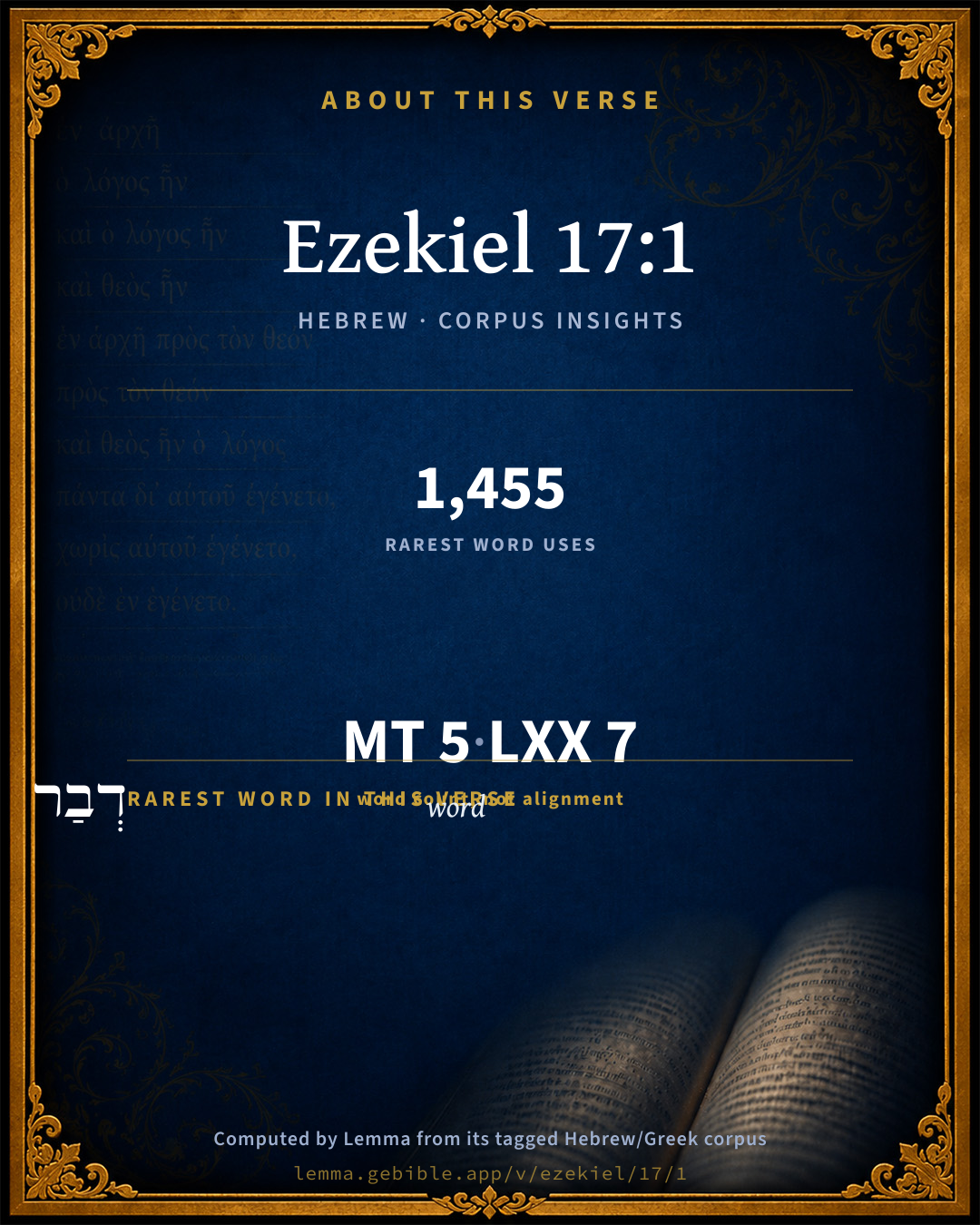
These counts appear in no published source. They are computed here, from the morphology-tagged text and Lemma’s own curated glosses. What Lemma adds →

5
words
5
distinct lemmas
Prophets
section

Grammatical profile

  • 2 verbs
  • 2 nouns
  • 1 preposition

Verb forms

  • וַיְהִ֥י Qal · Sequential Imperfect
  • לֵאמֹֽר Qal · Infinitive Construct

Hebrew & Septuagint length

In English translation the verse runs 8 words from the Hebrew and 10 from the Septuagint (LXX English) — closely comparable.

A rough comparison of the two English renderings, which tokenize alike — not a word-level alignment.

Word counts can differ between the Hebrew and the Greek without any difference in meaning — e.g. the Hebrew direct-object marker אֵת has no separate Greek word, and Greek often adds the article ὁ.

In the original languages it is 5 Hebrew tokens and 7 Greek tokens — but the two are counted differently (Hebrew bundles its prefixes and suffixes into one token; the Greek is in lemma form), so that isn’t a like-for-like length.

Hebrew and Greek witnesses Masoretic Hebrew ↔ Greek Septuagint

The same verse in the two great witnesses to the Old Testament, shown verse-for-verse.

These are two independent witnesses, not word-aligned to each other, and the Septuagint is shown in lemma (dictionary) form.

Hebrew Ezekiel 17:1 Masoretic · Westminster Leningrad Codex

וַיְהִ֥י דְבַר יְהוָ֖ה אֵלַ֥י לֵאמֹֽר

The word of Yahweh came to me, saying,

World English Bible · Public Domain

Greek LXX Ezekiel 17:1 Septuagint · lemma form

καί γίγνομαι λόγος κύριος πρός ἐγώ λέγω

And the word of the Lord came to me, saying,

LXX2012 (modern English Septuagint) · Public Domain

On this verse, Lange's Commentary on the Holy Scriptures discusses the Septuagint’s reading. Read the note in Commentary ↓

Hebrew: Westminster Leningrad Codex (CC BY 4.0). Greek: Septuagint (public domain); English from LXX2012 (modern English Septuagint) (Public Domain). How the Septuagint differs from the Hebrew →

Targum (Aramaic paraphrase)

1

The Targum is the ancient Jewish Aramaic paraphrase of the Hebrew Scriptures — an interpretive translation, not the Hebrew text itself. Onkelos (literal) and Pseudo-Jonathan (expansive) render the Torah, and Jonathan the Prophets. Coverage is partial: where no permissively-licensed English translation exists for a verse, only the Aramaic is shown. This is verse-level text, not a word-by-word alignment to the Hebrew.

  1. Targum Jonathan Prophets (Joshua–Malachi)
    וַהֲוָה פִּתְגַם נְבוּאָה מִן קֳדָם יְיָ עִמִי לְמֵימַר:

    (no public-domain English translation for this verse)

    Targum Jonathan — Aramaic: “Mikraot Gedolot” (public domain). English: “Sefaria Community Translation” (CC0 1.0 (public-domain dedication)); “London "Chaldee Paraphrase," 1871” (public domain). Text via Sefaria.

Commentary

Notes on Ezekiel 17:1 from classic Christian and Jewish commentators (each source and its license shown beneath its notes). The classic Christian expositions comment on the surrounding passage and are grouped to its opening verse, so a note may address several verses; the Jewish commentaries on the Tanakh (Rashi and others) are per-verse, so they appear only where the commentator wrote on this verse.

Lemma curates 59 commentaries, every one of them public domain or Creative Commons licensed, each selected and text-cleaned for this edition rather than reprinted as found. About our sources →

The Cambridge Bible for Schools and Colleges

gen. ed. J. J. S. Perowne

1–10. The riddle of the great eagle

(1) Eze_17:1-4 introduction. The great, broadwinged, speckled eagle came to Lebanon, and broke off the top of the cedar, carrying it to the merchant-land, Babylon—the captivity of Jehoiachin by Nebuchadnezzar.

(2) Eze_17:5-6. He took also of the seed of the land and planted it beside the waters that it might be a spreading vine, and might turn its branches towards him who had planted it—the elevation to the throne by Nebuchadnezzar of Zedekiah as a feudatory monarch.

(3) Eze_17:7-8. There was another great eagle, and the vine bent its roots and sent out its branches towards him—Zedekiah sought the alliance and protection of the king of Egypt.

(4) Eze_17:9-10. Denunciation of the vine for its treachery. The east wind shall blow on it and it shall wither.

The Cambridge Bible for Schools and Colleges (gen. ed. J. J. S. Perowne; Cambridge University Press, 1878–1918) — public domain. Text from a community e-Sword module.

Trapp's Complete Commentary

John Trapp

Eze 17:1 And the word of the LORD came unto me, saying,

Ver. 1. And the word of the Lord came.] In the foregoing chapter God had threatened the inhabitants of Jerusalem for violating their covenant with him; and here he threateneth them no less for breach of covenant with men. In case of disobedience to himself, he showeth much patience many times; but in case of disloyalty to a lawful sovereign, against oath especially, he is quick and severe in his executions.

John Trapp, A Commentary or Exposition upon All the Books of the Old and New Testament (1647–1656) — public domain. Text from a community e-Sword module.

The Biblical Illustrator

Joseph S. Exell

Eze_17:1-10

Son of man, put forth a riddle, and speak a parable unto the house of Israel.

Prophecy in parable

The word riddle may in this connection mean parable, picture, symbol; whatever will excite and interest the imagination. If the zephyr has not voice enough to arrest us, God will employ the thunder; if the little silvery streamlet, hurrying through its green banks, has nothing to say to us, the great floods shall lift up their voices and compel us to attend. Who will say there is only one way of preaching, teaching, educating young men? There are a thousand ways: what we want is that a young man shall say when his way is not being adopted. This will suit a good many: God bless the teacher in this effort; he is not now speaking to me, but to persons who can understand that way alone; let heavens grace make hearts tender as he unravels his parable, as he takes up his harp and discourses upon its sweet, mysterious music. When a preacher is setting forth riddle and parable, the man who falsely thinks himself a logician--for there can only be a logician once in a generation--should pray that the parable may be blessed. When the preacher or teacher is seeking by hard, strong argument to force home a truth, those who live on wings should carry themselves as high as possible that they may bring down a larger, riper blessing upon the teacher and his method. This is Gods administration: this is the many-coloured robe of providence with which He would clothe our naked shoulders. What has come to us--a riddle, a parable, a dream, a process of logic, a historical induction? Take Gods gift, and through it find the Giver. (J. Parker, D. D.)

Truth taught through the imagination

The imagination is the grand organ whereby truth can make successful approaches to the mind. Some preachers deal much with the passions: they attack the hopes and fears of men; but this is a very different thing from the right use of the imagination, as the medium of impressing truth. Jesus Christ has left perfect patterns of this way of managing men; but it is a distinct talent, and a talent committed to very few. It is an easy thing to move the passions: a rude, blunt, illiterate attack may do this; but to form one new figure for the conveyance of truth to the mind is a difficult thing. The world is under no small obligation to the man who forms such a figure . . . The figure of Jesus Christ (the Parables) sink into the mind, and leave there the indelible impress of the truth which they convey. (Cecils Remains.)

Illustrating the truth

The subject matter of Christian teaching preeminently requires illustration. The barrister has, in a new case, that which stimulates attention, while the preacher has an oft-told tale to set before his people. (Andrew Fuller.)

The Biblical Illustrator, edited by Joseph S. Exell (c. 1880s–1900s) — public domain. Text from a community e-Sword module.

Dummelow's Commentary on the Holy Bible

J. R. Dummelow

Zedekiah's Perfidy and its Punishment

Zedekiah had been placed on the throne of Judah as a vassal of Babylon, but was led by his nobles to intrigue with Egypt and to throw off the Babylonian yoke. The revolt actually took place in 588 b.c., but it had been contemplated much earlier: see Jer_27:1-11, where 'Zedekiah' should be read for 'Jehoiakim' in Jer_27:1. Jer_27:15 of this chapter refers to an embassy to Egypt, of which Ezekiel had heard in BabyIonia. The prophet exposes this rebellious policy in an allegory, condemns it, and prediets its failure and punishment. The royal house of Judah is a cedar of Lebanon. BabyIon (or Nebuchadrezzar) is an eagle, which crops off the highest twig of the cedar (Jehoiachin) and carries it to a land and city of commerce (Babylon). The eagle takes of the seed of the land (Zedekiah) and plants it so that it becomes a dwarf vine bending towards the eagle (subordinate to Babylon). There is another eagle (Egypt, or Pharaoh-Hophra) towards which the vine (Zedekiah) turns (seeking Egyptian instead of Babylonian overlordship). God will not allow such treachery to prosper. The vine will be uprooted. Egyptian help will fail. Zedekiah will be taken captive and will die in Babylon (Eze_17:1-21).

But God Himself will take another twig of the cedar, and will plant it on a high mountain of Israel, where it will become a great, spreading, and fruitful tree. All the trees (nations) will learn that God directs the destinies of every one of them (Eze_17:22-24). This is a prophecy of the restoration of the Jewish kingdom which was never literally fulfilled, but which contains a promise of the Messiah—the ideal future king.

5, 6. A willow.. a vine of low stature] indicating the dependent position of Zedekiah's kingdom: see Eze_17:14.

12, 13. These vv. describe the captivity of Jehoiachin (597 b.c.) and the appointment of Zedekiah as king under a solemn oath of allegiance to Babylon.

17. The Egyptians succeeded in raising the siege of Jerusalem (Jer_37:11), but the relief was only temporary, as Jeremiah foretold that it would be (Eze_37:6-10).

19. Zedekiah had sworn allegiance to Nebuchadrezzar in God's name. His revolt against Babylon, therefore, did dishonour to God. For another example of Zedekiah's perfidy see Jer_34:8-11.

20, 21. A repetition of Eze_12:13, Eze_12:14.

22-24. Ezekiel expected that the restored kingdom of God would have a prince (Eze_45:7-8; Eze_46:1-18; Eze_47:21-22). This was only fulfilled in a Messianic sense.

J. R. Dummelow, A Commentary on the Holy Bible (Macmillan, 1909) — public domain. Text from a community e-Sword module.

The Preacher's Complete Homiletical Commentary

Joseph S. Exell (gen. ed.)

THE HUMILIATION AND EXALTATION OF THE HOUSE OF DAVID (Chap 17)

EXEGETICAL NOTES.—The word of prophecy in this chapter is introduced in the way of a riddle and a parable (Eze_17:2). The parable itself is told in Eze_17:1-10. In Eze_17:11-21, we have the interpretation of it and its application to King Zedekiah. In Eze_17:22-24, we have the prophecy of the exaltation of David’s house and its necessary connection with the glory of Messiah’s kingdom. By the alliance of Zedekiah with Egypt, the people hoped to regain the ancient glory of Israel. The prophet shows that these hopes are vain. They thought that God could not fail towards the king without reversing the promises which He had made to the house of David. The prophet announces that Zedekiah will meet with the due reward of his deeds; and yet, in a wonderful manner, God will fulfil His ancient promise to the chosen people, though to human observation all seems to be lost. The kingdom of David will assuredly be exalted in the latter days.

THE PARABLE, REPRESENTING THE EMPTINESS OF ALL THE NATION’S EARTHLY HOPES OF THE FUTURE (Eze_17:1-10)

Eze_17:1-2. “Put forth a riddle, and speak a parable unto the house of Israel.” “The parable mâshâl, corresponding exactly to the N.T. παραβολή is called chîdhâh, a riddle, because of the deeper meaning lying beneath the parabolic shell.—(Keil.) As far as it described the future of the house of Israel, it was teaching by analogy, and may, therefore, be regarded in the light of a parable. In its immediate bearing upon the fate of Zedekiah, it may be regarded as a riddle.

Eze_17:3. “A great eagle with great wings.” “The symbolism of this parable has been traced by some to Babylonian influences working upon the prophet’s mind, but without any tenable ground. The figure of the eagle, or bird of prey, applied to a conqueror making a rapid descent upon a country, has as little in it of a specifically Babylonian character as the comparison of the royal family to a cedar or vine. Not only is Nebuchadnezzar compared to an eagle in Jer_48:40; Jer_49:22, as Cyrus is to a bird of prey in Isa_46:11; but even Moses has described the paternal watchfulness of God over His own people as bearing them upon eagle’s wings (Exo_19:4; Deu_32:11). The cedar of Lebanon and the vine are genuine Israelitish figures. The great eagle is the King Nebuchadnezzar (compare Eze_17:12)”—(Keil.) The “great wings” are a symbol of the vastness of Nebuchadnezzar’s dominion. “Long-winged, full of feathers, which had divers colours.” The long pinions signify his large and well-disciplined armies; the abundant “feathers “the numerous populations over which he reigned, and the “divers colours” the variety of races, languages, etc., which were found in his empire. “Come unto Lebanon.” This is not a symbol of the Israelitish land, but of Jerusalem, with its royal palace so rich in cedar wood. This was the place where the cedar was planted (Eze_17:12). “And took the highest branch of the cedar.” The cedar is the Davidic family, and the “highest branch” of it is King Jehoiachin (2Ki_24:12).

Eze_17:4. “The top of his young twigs.” “The youngest and most tender member of that family. Jehoiachin, to whom reference is here symbolically made, was only eighteen years of age when he assumed the reins of government” (2Ki_24:8).—(Henderson.) “Carried it into a land of traffick; he set it in a city of merchants.” “Not only was the country of Babylon famous for its transport traffic by means of the Euphrates, but the city itself was famous for its manufacturing and mercantile establishments. From the connection of Babylon with the Persian Gulf, the commerce carried on between that city and India must have been immense.”—(Henderson.) “That which is intended is rather the Chaldean diplomacy, the policy of the interests that were thus pursued, just as we speak of political negotiations and international intrigues. From this policy originated the removal of Jehoiachin to Babylon. Self-interest is the point of comparison between politics and trade. This community of principle also explains how both politics and trade are represented in Scripture under the figure of adultery, the self-seeking, that conceals itself under the appearance of love (Rev_14:8; Rev_17:2); the self-seeking policy (Nah_3:4); the trade (Isa_23:15, etc.). It was, as it were, a profitable stroke of business, that Jehoiachin, who was favourable to Egypt, should be removed to Babylon, and a creature of the King of Babylon set up in his stead, whose fidelity he might count upon, because he had the legitimate sovereign in his custody, and could make use of him according to circumstances.—(Hengstenberg.)

Eze_17:5. “The seed of the land. This expression signifies what we mean by “a son of the soil,” as distinguished from a foreigner. The Chaldeans appointed Zedekiah, who was of the old native royal family (2Ki_24:17). “He placed it by great waters.” Heb. “Many waters.” The idea is that of a fertile situation. Though, politically, Zedekiah was in a dependent position, yet he had abundant opportunity for exercising his gifts and power as a ruler. “Set it as a willow tree.” This tree is low, and grows near streams (Isa_44:4). “This means, that he treated it as a willow tree, inasmuch as he took it to many waters, set it in a well-watered soil, i.e. in a suitable place.”—(Keil).

Eze_17:6. “A spreading vine of low stature, whose branches turned towards him, and the roots thereof were under him.” “This figure of the vine is not here in contradiction with that of the willow. The two figures present different aspects. The new king is a vine, not a cedar, as the earlier independent family of David. ‘Spreading,’ so that it grew luxuriantly indeed, but in breadth, not in height, which is still more definitely shown by the addition ‘of low stature.’ Its (Zedekiah’s) roots should be under him—should not be withdrawn from dependence on the king of Babylon.”—(Hengstenberg). “The subjection of Zedekiah to Nebuchadnezzar is significantly expressed by his being turned towards him; while he continued faithful as his vassal, though he never rose to any elevation, yet the affairs of the kingdom went on peaceably, and the subjects increased rather than diminished.”—(Henderson.)

Eze_17:7. “Another great eagle with great wings and many feathers.” This second eagle lacks the long pinions and divers colours of the first. It represents the King of Egypt, who, though he ruled over a widely-spread and powerful kingdom, was yet inferior to the King of Babylon in imperial grandeur and disciplined armies. “This vine did bend her roots toward him, and shot forth her branches toward him, that he might water it by the furrows of her plantation.” This vine had water enough already, so that there was no occasion for her to stretch out her branches towards the other eagle. Hereby the conduct of Zedekiah is condemned, who, wearied with subjection to the King of Babylon, applied to the King of Egypt for help, hoping that by this means he might establish the independence of his throne.

Eze_17:8. “It was planted in a good soil by great waters, that it might bring forth branches, and that it might bear fruit, that it might be a goodly vine.” “If Zedekiah had remained quiet under Nebuchadnezzar, as a hanging vine, his government might have continued and prospered.”—(Keil.)

Eze_17:9. “Thus saith the Lord God, shall it prosper?” “The subject is the King of Babylon. The roots signify the national existence, the fruit the produce of the land, or the collective gain. The vine becomes dry in all its sprouting leaves. These signify all that by which a prosperous national life is displayed. ‘Not by a great arm or many people will it be taken away with its roots.’ According to Jeremiah 34., Nebuchadnezzar led a numerous army to Jerusalem, but there was no need of so great preparations. If a nation have God for its enemy, one can chase a thousand of them, and two can put ten thousand to flight (Deu_32:30). The Egyptians were quite passive (comp. Eze_17:17). The taking away with the roots signified the total abolition of the national existence.”—(Hengstenberg.)

Eze_17:10. “Shall it not utterly wither when the east wind toucheth it?” “The east wind proving noxious to vegetation in Palestine, is here fitly employed as a symbol of the Chaldean army, which came from that quarter. It was only necessary to bring that army into contact with the Jewish state in order to effect its ruin.”—(Henderson.) The east wind is the searching wind of God’s anger (Jon_4:8)

HOMILETICS

TEACHING BY PARABLES

1. The form of the discourse here, just as in the case of our Lord, who has developed the parable into one of His ordinary modes of teaching, is to be explained chiefly from the object in view,—partly as it was designed for a circle of hearers, or rather of readers, which, although mixed up in all sorts of ways with higher interests, is yet to be thought of as living mainly in the world of sense, and especially as bound fast in the misery of the exile, and sympathising in the false and faithless policy prevailing at the time in Jerusalem; partly as it might recommend itself to the prophet in the political circumstances by which he was surrounded. The mashal before us in Ezekiel goes, therefore, far beyond mere popular illustration. Still less is it to be explained away from the æsthetic stand point, as merely another rhetorical garb for the thought.

2. As in the parable the emblematic form preponderates over the thought, so also here. What the prophet is to say to Israel is said by the whole of that mighty array of figurative expression, for which the animal and vegetable worlds furnish the figures. But the eagle does what eagles otherwise never do; and what is planted as a willow grows into a vine; and the vine “is represented as falling in love with the other eagle.”—(J. D. Mich.) The contradictory character of such a representation, and the fact that in the difficulties to be solved (Eze_17:9-10 etc.) the comparison comes to a stand, and the closing Messianic portion in which the whole culminates, convert the parable into a “riddle.” A trace of irony and the moral tendency, such as belong to the fable, are not wanting.—(Lange.)

The Preacher's Complete Homiletical Commentary (gen. ed. Joseph S. Exell; Funk & Wagnalls, c. 1892) — public domain (pre-1929). A full-Bible homiletical/sermon-outline anthology covering 65 of 66 books (2 John is absent from the source module). Text from a community e-Sword module.

Keil & Delitzsch

C. F. Keil & F. Delitzsch

The Parable

Eze 17:1. And the word of Jehovah came to me, saying, Eze 17:2. Son of man, give a riddle, and relate a parable to the house of Israel; Eze 17:3. And say, Thus saith the Lord Jehovah, A great eagle, with great wings and long pinions, full of feathers of variegated colours, came to Lebanon and took the top of the cedar: Eze 17:4. He plucked off the topmost of its shoots, and brought it into Canaan's land; in a merchant-city he set it. Eze 17:5. And he took of the seed of the land, and put it into seed-land; took it away to many waters, set it as a willow. Eze 17:6. And it grew, and became an overhanging vine of low stature, that its branches might turn towards him, and its roots might be under him; and it became a vine, and produced shoots, and sent out foliage. Eze 17:7. There was another great eagle with great wings and many feathers; and, behold, this vine stretched its roots languishingly towards him, and extended its branches towards him, that he might water it from the beds of its planting. Eze 17:8. It was planted in a good field by many waters, to send out roots and bear fruit, to become a glorious vine. Eze 17:9. Say, Thus saith the Lord Jehovah, Will it thrive? will they not pull up its roots, and cut off its fruit, so that it withereth? all the fresh leaves of its sprouting will wither, and not with strong arm and with much people will it be possible to raise it up from its roots. Eze 17:10. And, behold, although it is planted, will it thrive? will it not wither when the east wind touches it? upon the beds in which it grew it will wither.

The parable (mâshâl, corresponding exactly to the New Testament παραβολή) is called chīdhâh, a riddle, because of the deeper meaning lying beneath the parabolic shell. The symbolism of this parable has been traced by many commentators to Babylonian influences working upon the prophet's mind; but without any tenable ground. The figure of the eagle, or bird of prey, applied to a conqueror making a rapid descent upon a country, has as little in it of a specifically Babylonian character as the comparison of the royal family to a cedar or a vine. Not only is Nebuchadnezzar compared to an eagle in Jer 48:40; Jer 49:22, as Cyrus is to a bird of prey in Isa 46:11; but even Moses has described the paternal watchfulness of God over His own people as bearing them upon eagle's wings (Exo 19:4; Deu 32:11). The cedar of Lebanon and the vine are genuine Israelitish figures. The great eagle in Eze 17:3 is the great King Nebuchadnezzar (compare Eze 17:12). The article is simply used to indicate the species, for which we should use the indefinite article. In Eze 17:7, instead of the article, we have אחד in the sense of "another." This first eagle has large wings and long pinions; he has already flown victoriously over wide-spread countries. אשׁר־לו , literally, which is to him the variegated ornament, i.e., which he has as such an ornament. The feathers of variegated ornamental colours point to the many peoples, differing in language, manners, and customs, which were united under the sceptre of Nebuchadnezzar (Hitzig, etc.); not to the wealth and splendour of the conqueror, as such an allusion is altogether remote from the tendency of the parable. He came to Lebanon. This is not a symbol of the Israelitish land, or of the kingdom of Judah; but, as in Jer 22:23, of Jerusalem, or Mount Zion, with its royal palace so rich in cedar wood (see the comm. on Hab 2:17 and Zac 11:1), as being the place where the cedar was planted (compare the remarks on Eze 17:12). The cedar is the royal house of David, and the top of it is King Jehoiachin. The word tzammereth is only met with in Ezekiel, and there only for the top of a cedar (compare Eze 31:3.). The primary meaning is doubtful. Some derive it from the curly, or, as it were, woolly top of the older cedars, in which the small twigs that constitute their foliage are only found at the top of the tree. Others suppose it to be connected with the Arabic dmr, to conceal, and understand it as an epithet applied to the foliage, as the veil or covering of the tree. In v. 4, tzammereth is explained to be ראשׁ רניקותיו, the topmost of its shoots. This the eagle plucked off and carried אל־ארץ כּנען, an epithet applied to Babylonia here and in Eze 16:29, as being a land whose trading spirit had turned it into a Canaan. This is evident from the parallel עיר רכלים, city of traders, i.e., Babylon (compare Eze 17:12). The seed of the land, according to Eze 16:13, is King Zedekiah, because he was of the land, the native king, in contrast to a foreign, Babylonian governor.

קח, for לקח, after the analogy of קחם in Hos 11:3, and pointed with Kametz to distinguish it from the imperative. לקח אל is used as in Num 23:27. The ἁπ. λεγ.צפצפה signifies, in Arabic and the Talmud, the willow, probably so called because it grows in well-watered places; according to Gesenius, it is derived from צוּף, to overflow, literally, the inundated tree. This meaning is perfectly appropriate here. "He set it as a willow" means he treated it as one, inasmuch as he took it to many waters, set it in a well-watered soil, i.e., in a suitable place. The cutting grew into an overhanging vine, i.e., to a vine spreading out its branches in all directions, though not growing very high, as the following expression שׁפלת קומה more clearly shows. The object of this growth was, that its branches might turn to him (the eagle), and its roots might be under him (the eagle). The suffixes attached to אליו and תּחתּיו refer to נשׁר. This allusion is required not only by the explanation in Eze 17:14 (? Eze 17:14, Eze 17:15), but also by Eze 17:7, where the roots and branches of the vine stretch to the (other) eagle. In Eze 17:6, what has already been affirmed concerning the growth is briefly summed up again. The form פּארה is peculiar to Ezekiel. Isaiah has פּארה sah h = פּארה in Ezekiel 10:33. The word signifies branch and foliage, or a branch covered with foliage, as the ornament of a tree. - The other eagle mentioned in Eze 17:7 is the king of Egypt, according to Eze 17:15. He had also large wings and many feathers, i.e., a widely spread and powerful kingdom; but there is nothing said about pinions and variegated colours, for Pharaoh had not spread out his kingdom over many countries and peoples, or subjugated a variegated medley of peoples and tribes. כּפן, as a verb ἁπ. λεγ.., signifies to yearn or pine after a thing; in Chaldee, to hunger. להשׁקות, that he (the eagle-Pharaoh) might give it to drink, or water it. The words מערגות מטּעהּ are not connected with להשׁקות, but with שׁלחה and כּנפה, form the beds of its planting, i.e., in which it was planted; it stretched out roots and branches to the other eagle, that he might give it to drink. The interpretation is given in Eze 17:15. The words להשׁקות אותהּ, which are added by way of explanation, do not interrupt the train of thought; nor are they superfluous, as Hitzig supposes, because the vine had water enough already (Eze 17:5 and Eze 17:8). For this is precisely what the passage is intended to show, namely, that there was no occasion for this pining and stretching out of the branches towards the other eagle, inasmuch as it could thrive very well in the place where it was planted. The latter is expressly stated once more in Eze 17:8, the meaning of which is perfectly clear, - namely, that if Zedekiah had remained quiet under Nebuchadnezzar, as a hanging vine, his government might have continued and prospered. But, asks Ezekiel in the name of the Lord, will it prosper? תּצלח is a question, and the third person, neuter gender. This question is answered in the negative by the following question, which is introduced with an affirmative הלוא. The subject to ינתּק and יקוסס dna is not the first eagle (Nebuchadnezzar), but the indefinite "one" (man, they). In the last clause of v. 9 משׂאות is a substantive formation, used instead of the simple form of the infinitive, after the form משּׂא in Ch2 19:7, with the termination ות, borrowed from the verb ה'ל (compare Ewald, 160b and 239a), and the construction is the same as in Amo 6:10 : it will not be to raise up = it will not be possible to raise it up (compare Ges. 132, 3, Anm. 1). To raise it up from its root does not mean to tear it up by the root (Hvernick), but to rear the withered vine from its roots again, to cause it to sprout again. This rendering of the words corresponds to the interpretation given in Eze 17:17. - In Eze 17:10 the leading thought is repeated with emphasis, and rounded off. The east wind is peculiarly dangerous to plants on account of its dryness (compare Gen 41:6, and Wetstein on Job 27:21 in Delitzsch's Commentary); and it is used very appropriately here, as the Chaldeans came from the east.

Keil & Delitzsch — Biblical Commentary on the Old Testament (1861–1891) — public domain (CC PDM 1.0). Text via the HelloAO Bible API. (Old Testament only.)

Lange's Commentary on the Holy Scriptures

6. The Riddle about the Royal House of David (Ezekiel 17.)

1And the word of Jehovah came unto me, saying, 2Son of man, put forth a riddle, and speak a parable unto [for] the house of Israel. 3And say, Thus saith the Lord Jehovah, The great eagle, with great wings, with long wing-feathers, full of feathers, which had divers colours, came unto Lebanon, and 4took the topmost branch [leafy crown] of the cedar. The topmost of its shoots he cropt off, and brought it to the land of Canaan; in a city of merchants he 5set it. And he took of the seed of the land, and put it in a seed field; took 6it to many waters, set it as a willow. And it sprouted, and became a spreading vine, of low stature, so that its branches might turn toward him [the eagle], and its roots should be under him; and it became a vine, and produced 7branches, and shot out leafy twigs. And there was another great eagle with great wings and many feathers; and, behold, this vine turned languishingly in its roots toward him [the other eagle], and shot forth its branches toward him, 8that he might water it, from the beds of its planting. In a good field by many waters was it planted, to produce leaves and to bear fruit, to become a 9splendid vine. Say, Thus saith the Lord Jehovah: Will it thrive? will he not pull up the roots thereof, and cut off the fruit thereof, that it wither? In all the leaves of its shoots it shall wither; and not by a great arm or by 10many people will it have to be lifted up from its roots. And [yea], behold, it is planted, will it thrive? will it not utterly wither as soon as the east wind 11touches it?—And the word of Jehovah came unto me, saying, 12Say now to the house of rebelliousness, Know ye not what this is? Say, Behold, the king of Babylon came to Jerusalem, and he took its king and its princes, and 13he brought them to himself to Babylon. And he took of the royal seed, and made a covenant with him, and caused him to enter into an oath; and the 14rams [strong ones] of the land he took: That it might be a kingdom of low condition, that it might not lift itself up; that his covenant might be kept, 15that it might stand. And he rebelled against him, so that he sent his messengers to Egypt, to give him horses and much people—Shall he prosper? shall he escape that doeth this? And he broke the covenant, and should he escape? 16As I live—sentence of the Lord Jehovah—surely in the place of the king that made him king, whose oath he despised, and whose covenant 17he broke, with him in the midst of Babylon he shall die. And not with great power and much people shall Pharaoh act with him in the war [battle], in casting 18up a mount and in building a siege-tower, to cut off many souls. And [yea] he despised the oath, to break the covenant; and, behold, he gave his hand: and all this he did; he shall not escape. 19Therefore thus saith the Lord Jehovah, As I live, surely My oath which he despised, and My covenant 20which he broke, I give upon his head. And I spread My net upon him, and he is taken in My snare, and I bring him to Babylon, and I contend with him there because of his treachery which he hath committed against Me. 21And all his fugitives in all his squadrons, they shall fall by the sword, and those that remain shall be scattered to every wind; and ye know that I, Jehovah, have spoken.

22Thus saith the Lord Jehovah, And I take of the topmost branch [of the leafy crown] of the high cedar, and set [give]; from the topmost of its shoots will I 23crop off a tender one, and I plant it upon a mountain high and exalted. On the elevated mountain of Israel will I plant it, and it bears leaves and produces fruit, and becomes a glorious cedar: and under it there dwell all birds of every wing; in the shadow of its branches shall they dwell. 24And all the trees of the field know that I, Jehovah, brought down the high tree, exalted the low tree, made the green tree wither, and made the dry tree to flourish; I, Jehovah, spake and did.

Eze_17:3. Sept.: ... ὁς ἐχει το ἡγημα εἰσελθειν εἰς τ.Λιβανον—

Eze_17:4. ... εἰς πολιν τετειχισμενην—Vulg.: … in urbe negotiatorum—

Eze_17:5. ... ἐπιβλεπομενον ἐταξεν αὐτο. Vulg: … et posuit illud in terra pro semine … in superficie posuit illud.

Eze_17:7. ... ποτισαι αὐτην συν τω βωλω της φυτειας αὐτης. (Another reading: כנפה, alarum instar produxit. מערנת, ab areola. Syr. and Arab.; see Eze_17:10.)

Eze_17:9. Another reading: חתעלח, interrog.

Eze_17:10. ... συν τω βωλω ἀνατολης αὐτης ξηρανθησεται.

Eze_17:17. ... ποιησει προς αὐτον Φκραω πολεμον—

Ver 20. ... κ. ἀλωσεται ἐν τη περιοχη αὐτου.—(Another reading: במעלו, propter scelus efus. על מעלי Syr.)

Eze_17:22. ... καρδοιας αὐτων ἀποκνιω κ. καταφυτιυσω... ὑψηλον,

Eze_17:23. Κ. κρεμασω αὐτου ἐν ὀρει μετεωρω του Ἰσρ. κ. καταφυτευσω … κ. ἀναπαυσεται ὑποκατω αὐτου παν θηριον, κ τα πιτεινα ὑπο την σκιαν αὐτου ἀναπαυσεται κ. τ. κληματα αὐτου ἀποκατασταθησεται.

EXEGETICAL REMARKS

After the preparatory hints in the preceding chapter, e.g. Eze_17:13, the discourse, as in Ezekiel 12., turns specially to the subject of kingdom.

Eze_17:1-10. The Riddle

Eze_17:2. חוּד חִידָה, always in this connection (Jdg_14:12-13; Jdg_14:16) means: to tie a knot of speech, which is to he loosed; according to others: from חָדַד, a sharp saying; but in how far sharp? (Comp. Doct. Reflec. 1.) What requires sharpened wits to understand it, is certainly too remote from the connection. חִידָה is in general the figurative speech, and therefore used in parallel with מָשָׁל (comp. Eze_12:22); which may be, and for the most part is, in this form, especially as contrasted with the plain, literal statement. Designedly veiled, it is meant to rouse us to remove the veil, and thus with the process of reflection so much the deeper an impression is made. As the discourse is to be addressed to the house of Israel (Eze_17:12), there is no need for quoting, as Hitz. does, Eze_16:44.

Eze_17:3. The great eagle is Nebuchadnezzar, as Eze_17:12 shows; and the same figure is employed in Jer_48:40; Jer_49:22, so majestic and powerful as well as strikingly appropriate, without for that reason being a specially Babylonian title, or an animal form appearing in the armorial bearings of the Babylonian rulers. The points of comparison are the royal character, the robber-conqueror element, the power of rapid flight, the sharp vision from which nothing can be concealed, the power of stroke; perhaps also Mat_24:28. With great wings, points to the extent of dominion; with long wing-feathers, to the energy, especially of the military power; full of feathers, to the multitude of subjects; the divers colours, to the diversity of the subjugated nations in speech, customs, dress.—Lebanon, if it stands for Judah, does so because the latter represents the whole of Israel, and in this case, according to Hengst., “because the mountains in Scripture language mean kingdoms;” but rather, perhaps, inasmuch as for the king of Babylon Lebanon is the boundary of the land, the first sign of the Jewish land. More correctly, however, in connection with what follows, and in accordance with Eze_17:12, it is taken as a symbol of Jerusalem; and that not so much because of the temple and the other palaces, as because of the king’s house, constructed of cedar beams, on Mount Zion, for which comp. 1Ki_7:2; 1Ki_10:17; 1Ki_10:21; Jer_22:23.—צַמֶּרֶת, a word peculiar to Ezekiel for the topmost foliage of the cedar, by which is meant in general what stands out prominently, namely, what stands out prominently in the house of David; so that from the generality of the expression we may include in the exposition “the princes” of Eze_17:12-13. Hengst. happily: “the then royal court.” The more special statement follows in Eze_17:4 : the topmost of its shoots, etc. The tip, the highest of the shoots which together form the topmost branch, with an allusion at the same time to his youthful years, means king Jehoiachin. Canaan, here the same is in Eze_16:29. Comp. there. Ironically: yea, into a new Canaan! a low land as contrasted with the lofty Lebanon! Similarly Häv. The city of merchants does not necessitate our interpreting the “land of Canaan” as a land of merchandise, as most expositors take it, but side by side with the ironically so-called “Canaan” = Babylonia, there is placed in addition a special feature, for which comp. Introd. p. 19. The market of commerce in contrast with the king’s house! As in Babylon all possible products of commerce were huddled together, so in a manner also were huddled together the most diverse crowns and princes. Hengst. supposes that the Chaldean diplomacy is meant as being a policy of interests, as we also speak of international intrigues. “Self-interest is the point of comparison between politics and trade” (Revelation 18.).

Eze_17:5. The seed of the land denotes, as contrasted with a foreign ruler, and specially with a Babylonian viceroy, one of the native royal family (Eze_17:13), namely, Zedekiah (Introd. p. 6). But in the difference between the “top of its shoots” (Eze_17:4) and the “seed of the land,” there is set forth prominently a difference between Zedekiah and Jehoiachin (Mat_1:12). It is not so much, perhaps, the policy of Nebuchadnezzar, as Hengst. puts it, “in order to secure for him the sympathies of the people,” as rather the considerateness, the clemency of the procedure, that is meant to be brought out.—בִּשְׂדֵה זֶרָע, in a seed field, which is described more particularly in what follows. What is meant is the as yet favourable circumstances, as Judah was neither a “sterile land,” nor even an exhausted soil.—קָח with kametz (Hos_11:3), see Häv. on the passage, a resuming of the preceding וַיִּקַּת. The many waters portray the fertile situation, in harmony with צַפְצָפָה, a word peculiar to Ezekiel, which Gesenius derives from the inundated, well-watered soil which the willow loves. There is no need for supplying a comparative כְּ, as the accusative is an apposition. The LXX. derive it from צָפָה: he caused it to be watched over. So also the Syriac Version.

Eze_17:6. If a humiliation is implied in the illustration used: “as a willow,” the statement that it became a vine may possibly be meant to make up for this. But however luxuriantly the vine stretched out, yet it was no longer the Davidic cedar, as is specially indicated by the low stature (Eze_17:14); which at the same time forms the transition to the intentional לִפְנוֹת׳, that it was to continue turned toward the Babylonian ruler, and subject to him with all its growth and with the roots of its existence and vigour. (Klief.: it was not to stretch out its branches toward its own post, etc.) וַתְּי לְנֶפֶן, a short repetition, to prepare for what now follows (Eze_17:7), as being the opposite of what was intended. The “carefully selected” (Häv.) form of expression (בַּדִּים and פּארֹת) brings out in strong colours the overweening self-conceit.

Eze_17:7. נֶשֶׁר־אֶתָד, another, as distinguished from the one pointed out emphatically in Eze_17:3. Comp. Eze_17:15. The description is similar to that in Eze_17:3, but more meagre, corresponding to the inferior position of the Egyptian king in respect of power. In כָּפַן there is a certain play upon the word נֶּפֶן. The meaning is (comp. Eze_17:6) plainly to turn strongly in some particular direction,—is it to wind because of hindrance from the soil in which it had been planted? or is it to languish, to thirst after, portraying the vehement self-willed longing?—The “watering” is probably not without allusion to the process of irrigation peculiar to Egypt by means of the overflow of the Nile.—From the beds, etc., i.e. from the spot where it had been planted by Babylon, went forth its leaning toward Egypt, which marks already the discontent, the ingratitude, the unfaithfulness, and thus paves the way for Eze_17:8. Comp. besides Eze_17:5.—אַדָּרֶת, according to some, from a root “to be wide” (to have it comfortable); according to others, from a root “to be strong.”

Eze_17:9. The difficulty of the riddle is presented for solution; the consequence to be foreseen from such conduct is put as a question. According to Häv., with an expression of displeasure; according to others, ironically. But the prophet does not in this case utter his own sentiment, but what the Eternal says. The divine sentence may be learned from the riddle. From the additional question annexed to it, it follows that the first question is to be answered in the negative. (Comp. Mat_21:40 sq.; Eze_20:15 sq.) צָלַת is: to force a way in, to force a way through, to come forward. Keil in his exposition takes it as a neuter: will it succeed, prosper? and what follows, in his translation also, indefinitely: will they not pull up? etc., instead of referring it to Nebuchadnezzar. The roots have respect to his existence as king; the fruit is the produce, the result of this royal existence by Nebuchadnezzar’s grace; there is no special allusion to Zedekiah’s children (2Ki_25:7). All the leaves of its shoots = the whole productive energy and vital force which such a kingship in any way showed. The subject is the vine, as also in Eze_17:10. The common interpretation is, Nebuchadnezzar will not need for this purpose his whole power, specially his whole military forces. But לְמַשְּׂאוֹת (a feminine infinitive form), in accordance with the interpretation of Eze_17:17, is rather to be understood of the lifting up again from the roots, into which it has sunk down withered. [Häv.: And without great power and without much people, scil. it will parch up (?), when one pulls it up from ts root, that is to say, without the expected help of Egypt he will sink. Hengst.: Nebuchadnezzar, who did indeed, according to Jeremiah 34., lead a numerous army against Jerusalem, did not require to make so great preparations (Deu_32:30; Lev_26:8). The taking away with the roots = the total annihilation of the national existence, Mar_11:20; Mat_3:10; Luk_3:9.]

Eze_17:10. A strengthening repetition (Eze_17:9) to produce greater attention. Comp. besides Eze_17:8. The east wind

Very appropriate for the Babylonians, dwelling in the east, as well as in the figure, because it is dangerous for plants—is employed in conclusion to disguise for the second time, quite after the manner of a riddle, the instrument of punishment.—With a mere touch, and on the spot of his ungrateful oride, he will find his judgment.

Eze_17:11-21. The Interpretation

Eze_17:12. Because now “the house of Israel,” to whom the riddle was proposed, are to know the meaning, are in any case to have the riddle interpreted to them by the prophet, although they are called a house of rebelliousness (Eze_2:5-6), the case before us is a different one from that in Mat_13:10 sq., and from that in Isaiah, to which Jesus there refers back. We are to think of the exiles as favourably distinguished from those at Jerusalem.—For the interpretation, comp. Eze_17:3, and 2Ki_24:11 sq.; Jer_24:1; Jer_29:2.—The princes of Jerusalem along with the king, the “topmost branch” in the riddle of which Jehoiachin is the top-shoot (Eze_17:4).

Eze_17:13. Comp. Eze_17:5; Jer_41:1; 1Ki_11:14; 2Ki_24:17 (Introd. p. 6). In reference to the vassal’s oath of fidelity, see 2Ch_36:13.—The אֵלֵי׳ cannot perhaps be taken as a simple resumption of the “princes” of the preceding verse, yet they may be understood as included. But the expression is to be interpreted especially from 2Ki_24:14; 2Ki_24:16. Hitz.: the owners of property, rich proprietors, artisans, and warriors. The intention (Eze_17:6) is clearly expressed in Eze_17:14; the parties in question were not so much meant to be hostages.—Keil: “that he might keep his covenant, that it might stand.”

Eze_17:15. Comp. Eze_17:7; likewise 2Ki_24:20. The Egyptian was to support him with that which was peculiar to Egypt (Deu_17:16), and which Zedekiah needed. Did the latter wish to appoint the riders for the horses?—The much people refers back to Eze_17:9, and likewise to the question of Eze_17:10, which is at the same time explained.—The answer is given in Eze_17:16 in a divine utterance, such as we have in Eze_17:9, only that the terms are still stronger, taking the well-known form of an oath.—Comp. Eze_12:13-17. And not with great power, etc., refers back to the “horses and much people” of Eze_17:15, and is meant to explain the statement in Eze_17:9. Pharaoh is the subject. The meaning is, either that he will not be willing to render Zedekiah the expected help, or that he will not be able. Comp. Jer_37:5; Jer_37:7. The “acting,” on which it depends, turns out insignificant—nothing more than a feeble demonstration on the part of Egypt. [Hengst.: Pharaoh will leave his protegé in the lurch, when he is hard pressed by his enemies. That the Chaldean needs no great military force against Jerusalem (Eze_17:9), finds its explanation here in the circumstance that the Egyptians, against whom alone such a force was necessary, do not come to its help with such a force.]—The march of the Egyptian auxiliary army took place when Jerusalem was besieged by the Chaldeans. Comp. in this connection on Eze_4:2. To cut off, etc., draws attention to the fact of how necessary powerful help would be in such a situation.

Eze_17:18. The riddle is interpreted, but the divine discourse lingers still over the breach of oath and covenant, because such acting on Zedekiah’s part, with what is implied in it, is still to be judged and to have sentence pronounced upon it by Jehovah.

Eze_17:19, just like Eze_17:16. It is not only that every oath, and hence also this oath, is of a religious character, and that the despising of it necessarily compromised the God of Israel in the eyes of the heathen; but still farther, considering the clemency of Nebuchadnezzar in making such a covenant, as Jehovah’s instrument, Jehovah’s goodness was turned into lasciviousness.—Comp. besides Eze_11:21; Eze_9:10.

Eze_17:20. See on Eze_12:13. The “contending,” the going into court with him, involves the punishment.—Eze_15:8-8. Instead of מִבְרָתָו (Qeri: מִבְרָחָיו), fugitives, the Chaldee reads: מִבחרָיו, “chosen ones” (Eze_12:14). So also Hitzig. He who thinks to save himself by flight—hence the whole military forces of Israel are driven into flight—shall be slain by the sword. But for the people left over, for all the remnant generally, the fate in store is the same as in Eze_5:10; Eze_5:12. Bitter experience brings them to know and understand, although, alas! too late, that God had spoken by the mouth of His prophet.

Eze_17:22-24. The Prediction

With a very beautiful variation the close of our chapter, which follows, takes the form of the theme of the riddle at the beginning. The threatening colours there are exchanged here for those rich in promise.

Eze_17:22. וְ, marking a continuation; but as the לָקַח is that of Nebuchadnezzar, there is rather an antithesis. Ingeniously Hitzig: “Jehovah, who is Himself in Deu_32:11 and Exo_19:4 compared to an eagle, appears upon the scene, confronting the former one (Eze_17:3).” And He who asserts His dignity in opposition to him, whom neither Jerusalem nor Egypt is able to oppose, can really do so: אָנִי, with emphasis. He does as Nebuchadnezzar does, and yet He does so quite differently! He brings low that which would fain be high; He exalts that which is apparently reduced to nothing (Eze_17:24). Of the topmost branch, etc. Thus the illustrious original house of David (the cedar) is still in existence; and not only the royal family, but its royal position as well (the topmost branch). And thus the statement is modified, that (Eze_17:3) the great eagle took the topmost branch of the cedar. The הָרָמה here, which is wanting in the former case, is not without significance. Thus the matter presents itself to God s eye. His taking is really “giving” (וְנָתָתִּי).—In Eze_17:4 we have אֵת־ראֹשׁ, here מֵרא̇שׁ; so that in spite of the taking away of Jehoiachin, his kingdom is still supposed to continue. The definition added: a tender one, may be interpreted of the planting, shoots of this kind being generally used; still better, perhaps, of a child (Luk_2:12). The Chaldee paraphrases: of his children’s children a little child. At all events, it cannot here mean a thing small and insignificant, as Hengst. supposes, nor something weak. [Hitzig takes “tender” as = youthful; but this idea lies already in the word “shoot.” Comp. on Eze_17:4. Tender youth, which is just childhood, is indicated by the stronger expression.]—אֶקטֹף, decisio significant mortem, Isa_53:8; Dan_9:26 (Cocc.).—The contrast lying at the foundation is a twofold one,—to Jehoiachin too (Eze_17:4), but much more to Zedekiah (Eze_17:5), in whose case “planting” is spoken of. In the same direction chiefly the contrast of the mountain also is kept. It is the contrast to the low country generally,—on the one hand to the Canaan of Babylon, on the other to the Canaan of Jerusalem (Eze_16:3). The partic. pass., תָּלוּל (only here), adds to the natural height an extraordinary exaltation besides, whether it be to serve as a powerful counteractive to the depression that has taken place, or whether it be to hint already at the approaching glory of Eze_17:23. A farther designation of the mountain is given in Eze_17:23. The elevated mountain of Israel is not Zion directly as such, nor Zion in the wider sense, as embracing also Mount Moriah, as must of course be the view taken if appeal is made to Eze_20:40 (Isa_2:2; Mic_4:1); but Jerusalem is here meant, in the same way as in Eze_17:3 it was spoken of as “Lebanon.” Comp. there. (Eze_34:13-14.) Hence restoration (in accordance with Ezekiel 16.), and that with increased splendour. Because such restoration of Jerusalem, of Judah, is brought about by means of the royal child of David’s line, in thought the reference to Zion may predominate, Psa_48:3 [Psa_48:2], Psa_2:6, Psa_68:17 [Psa_68:16]. That the kingdom of God, the kingdom of heaven, springs from the Jews for the whole world, is aptly symbolized by the planting of the royal shoot in the royal city, and by what now follows. It is to be observed that the mountain is a mere foil, the typical substratum, and that it neither “comes into view as the seat and centre of the kingdom of God,” nor does it even “denote this kingdom itself;” but the kingdom and all its glory are conceived of as in the shoot of David, and represented as proceeding from him, behind whom all else steps into the background. Klief. alone correctly: “the person of the Messiah will grow into His kingdom, which becomes the spiritual home of all the nations of the world.” However historical, yet the promised personality is in this respect kept in an ideal shape. Fulfilling what is typical, becoming the full embodiment of what was shadowed forth by Israel, he attains to what he is meant to be; he realizes completely his idea, which has to do with mankind generally. The foliage is in order to the shadow. The fruit, as being a tree, as it must be, perhaps also one which yields nourishment to those to whom it gives shelter (Isa_11:1). As in Eze_17:8 we had אַדָּרֶת, so here אַדִּיר: what Zedekiah had not become as a “vine,” that He who is here meant is as a “cedar,” so as to fulfil the promise given to David regarding his posterity. For the clause: and under it there dwell, etc., comp. Eze_31:6; Dan_4:9 [12]; Mat_13:32. An emblem of the universal sovereignty, to which all submit themselves, but in which also they rejoice and put their confidence (in the shadow, etc.).—The expression: all birds of every wing, points to Noah s ark of safety, Gen_7:14. The meaning is: all the different nations and families of men upon earth, Eze_31:6; Eze_31:12; see also Psa_8:7; Psa_8:9 [Psa_8:6; Psa_8:8], Psa_84:4 [Psa_84:3]. A contrast alike to Eze_17:6 and Eze_17:7!

Eze_17:24. All trees, etc., are the collective ruling powers of this world, the princes and kings of the earth.—הַשְּׂרֶה looks back perhaps to Eze_17:5 (8); other than mere earthly kingdoms Nebuchadnezzar and his compeers are able neither to found nor to rule.—The bringing low of the high tree, just as correspondingly the exalting of the low tree, refers specially to Jehoiachin; while the making the green tree to wither, and the making the dry tree to flourish, in accordance with Eze_17:9 sq., point back to Zedekiah, inasmuch as through him the kingdom in Judah came to ruin. The revivification of this kingdom, the sending forth of shoots from that which withered with Zedekiah, and the raising up again of the seed of David from the humiliation of Jehoiachin,—all this is accomplished by Jehovah through the Promised One (I, Jehovah, spake and did). Hitzig, like most, takes the sentence as a general thought (1Sa_2:7). In form it is kept general, but its import is certainly special, referring to what lies before us. Only the thing to be considered is the right interpretation. According to Hengst., of course, the high tree is the worldly sovereignty; the low tree, David or his family; the green tree, Nebuchadnezzar’s sovereignty of the world at the time.

DOCTRINAL REFLECTIONS

1. The form of the discourse here, just as in the case of our Lord, who has developed the parable into one of His ordinary modes of teaching, is to be explained chiefly from the object in view,—partly as it was designed for a circle of hearers, or rather or readers, which, although mixed up in all sorts of ways with higher interests, is yet to be thought of as living mainly in the world of sense, and especially as bound fast in the misery of the exile, and sympathizing in the false and faithless policy prevailing at the time in Jerusalem; partly as it might recommend itself to the prophet in the political circumstances by which he was surrounded. The mashal before us in Ezekiel goes, therefore, far beyond mere popular illustration. Still less is it to be explained away from the æsthetic standpoint, as merely another rhetorical garb for the thought.

2. As in the parable the emblematic form preponderates over the thought, so also here. What the prophet is to say to Israel is said by the whole of that mighty array of figurative expression, for which the animal and vegetable worlds furnish the figures. But the eagle does what eagles otherwise never do; and what is planted as a willow grows into a vine; and the vine “is represented as falling in love with the other eagle” (J. D. Mich.). The contradictory character of such a representation, and the fact that in the difficulties to be solved (Eze_17:9 sq.) the comparison comes to a stand, and the closing Messianic portion in which the whole culminates, convert the parable into a “riddle.” A trace of irony and the moral tendency, such as belong to the fable, are not wanting.

3. As to the predictions in this chapter, see what is said on Ezekiel 12, Doct. Reflec. 4, pp. 136, 137. As respects the time, Ezekiel 17 stands between the 6th month of the 6th year and the 5th month of the 7th year of Jehoiachin’s captivity; and its contents, therefore, would probably be spoken from four to five years before the destruction of Jerusalem.

4. Not only does Ewald call Eze_17:22-24 “a short and beautiful picture of Messianic times,” but Hitzig gives a still more definite exposition: “the passage is an actual prediction, and in fact a Messianic one.” Bunsen makes our prediction be “partly fulfilled” in Zerubbabel (“the prince of the Jews after their return from the captivity, Ezr_1:8; 1Ch_3:19; Mat_1:12; Luk_3:27”), adding, however, that the glory of the new king as here described “goes far beyond that of Zerubbabel.” Similar is the view of Hengst., viz. that as Zerubbabel “in a certain sense did everything which God did generally for the re-establishment and maintenance of the civil government in Israel,” he also might be regarded as included under the terms of the prediction, because Ezekiel has before his eye, “not the Messiah as an individual,” but “the whole family of David.” As against this view, Hävernick points (1) to the image of the cedar-shoot as a descendant of the house of David; and (2) to the context, where only personalities are spoken of (Jehoiachin, Zedekiah, Nebuchadnezzar). The oldest Jewish exposition understood the passage of King Messiah.

5. The kingdom of Judah, even although it had become idolatrous, yet could not (as Ziegler remarks) all at once be cast off—for David’s sake. The house and family of David appear like a stay and support in Judah. “For David, Jehovah cherishes an unceasing and solicitous regard throughout the whole history of this kingdom, just because this kingdom itself was to be nothing else than the link of connection between David and his Son κατʼ ἐξοχήν. David is the point always referred to in the history of this kingdom; he is the factor ever present and ever working in that history, just as the Son of David is the factor at work beyond.”

6. Hävernick has already pointed out the inner connection between the Messianic announcement here and that in the preceding Eze_16:53-63. What is to be understood there by the turning of the misery and the restitutio in pristinum becomes quite clear to us by means of the prediction as to Messiah in our chapter.

7. The Church of God is not destined to disappear in the kingdoms of this world: but all the kingdoms of this world shall become the kingdoms of God and of His Anointed.

8. “Among the manifold predictions of the Lord’s Anointed and of His kingdom in the world, this of our prophet stands forth like a cedar; in this similitude, so grand, and yet so simple, he has most strikingly portrayed. the future salvation in its most universal significance and verity” (Umbreit).

9. Hengst. draws attention to the fact that at the close the interpretation of the symbol is not added,—“for the same reason that in Ezekiel there is no prophecy against Babylon, while the whole of the prophecies of Jeremiah find their close in such a prophecy. The prophet prophesied in the land of the Chaldeans, and had to exercise caution in view of the surrounding heathen.”

HOMILETIC HINTS

Eze_17:1 sq. “Formerly, how they have broken God’s covenant; here, how they have not kept faith with men” (Luther).

Eze_17:3 sq. “Princes also have no security against misfortune; those who are nearer the clouds are nearer the lightning also. They should not forget that they also are men, and that God alone is the King of kings” (Stck.).—“The eagle is an emblem of empire and dominion: he is called the king of birds. Pyrrhus, when saluted as an eagle by his soldiers, was much pleased, telling them that they had raised him on high with their weapons, as it were with wings” (à Lap.).—The important eagles in the history of Israel: Nebuchadnezzar, Pharaoh, Rome.

Eze_17:4. “Thus many a one suffers in a strange land for the sin he has committed in his own” (Stck.).

Eze_17:5. The soil is often better than the seed which is sown in it.

Eze_17:6. Prosperity turns out for the advantage of but few men. Most grow on all sides and produce leaves, but bear no fruit, or bad fruit.

Eze_17:7. Ingratitude makes no situation better, does not render dependent circumstances more pleasant, and brings to shame every one who is guilty of it, let the object of it be who he may.—It is not easy to rest contented with God’s ordering and leading; the discipline of the Spirit of God is needed for it: let my ways be pleasing in Thine eyes. We must give up our heart to the Lord, and keep it directed toward Him—our heart, with all the thoughts which come out of it, and which would fain be as God, yea, wiser than God.—Keep me in Thy paths, in the way which Thou Thyself showest me.

Eze_17:8. Discontentment has driven many a one from a snug spot.

Eze_17:9 sq. “When God wishes to punish the wickedness of men, He needs no great warlike host for the purpose” (O.).—Unfaithfulness beats its own master.—Those who have not God on their side, who have only their own wits, can be driven to flight in thousands by one.—“It is a bad thing to trust in man’s wisdom; take thou counsel with God, open His word, look to thy calling, ponder thy duty, and think of the end” (Stck.).

Eze_17:10. The east wind of divine judgments.—Thus the place of fortune becomes the place of misfortune; the scene of wickedness, the scene of punishment; the theatre of ingratitude (toward God also), the theatre of ruin.

Eze_17:11 sq. It is not all riddles that are interpreted to us; we are guessing away at many during our whole life; but we also make far too little use of the key of self-knowledge.—Misfortune it is said to be, while it is only crime.

Eze_17:15 sq. The oath is to be kept to every one and by every one. Even by the emperor Sigismund to the “heretic” Huss!—“Kings, and those in high position generally, ought to be a good example to others. How much their example can build up as well as pull down!” (Stck.)—“If the Lord humbles one, he must bear the tribulation with patience, and not seek by forbidden means to extricate himself from it, Heb_12:7”(Tüb. Bib.).—“God avenges and punishes perjury with the greatest earnestness” (O.).—“For God is the truth, and will see to it that fidelity is upheld among men, and hence abhors all deceit and perjury. Even if we have promised anything by constraint which is in other respects unjust, we are not to break our word, because the name of God is to be dearer to us than all earthly advantages, Psa_15:4” (Heim-Hoff.).—“The humiliations as well as the exaltations of earthly kingdoms are certainly foreseen and appointed by God” (Stck.).—How many a one is the architect of his own misfortune at least!—“The chariot of Israel, and the horsemen thereof!” said Elisha of Elijah.—Psa_33:17.—“Think not to whom, but remember by whom, thou hast sworn an oath” (Jer.).—Why is there so much oath-breaking and perjury in Christendom itself even yet!?

Eze_17:16. God lets man’s righteousness too get its rights, just because it means to be righteousness.—What Babylon has made, Babylon also destroys.—This is security, to be a plant of the heavenly Father’s planting, Mat_15:13.—“The earth is everywhere the Lord’s, but to be laid with one’s fathers is certainly more pleasant.”

Eze_17:17. The help of man is of no avail when God means to destroy. God’s help, on the other hand, avails even against man’s help. Zedekiah with Egypt, Nebuchadnezzar with Jehovah. Look at the copartneries for thyself, and bestow thy confidence accordingly. The latter firm is the more reliable.—Cursed is the man that trusteth in man, Jeremiah 17.—Men promise, and break their promise; God promises, and does not break His.

Eze_17:19. God’s oath as against Zedekiah’s perjury.—God does not swear, and then fail to keep His oath: that shall be learned by experience by those who swear falsely, or who do not keep their oath.—If thou appealest to God as a witness, thou summonest Him also as a judge, as an avenger!—We have never to do with men alone.

Eze_17:20 sq. No one can escape God.—“The enemy’s sword is sharp; God’s sword is sharper still” (Stck.).—Comp. what is said to the Hebrews of the word of God.—God’s judgments are always meant to lead to the knowledge of Himself as well, and not merely of ourselves.

Eze_17:22 sq. The riddle of Israel is the riddle alike of the human heart in its perversity, and of the heart of God in Christ.—The omnipotence and love of God join hands, and the result is the grace of God.—“Whosoever laid up this promise thoroughly in his heart would thereby be delivered from the region of vain political hopes and intrigues. The saying of Augustine applies here: ‘That which thou seekest is, but it is not where thou seekest it’ ” (Hengst.).—“Because the Church of Christ has been planted by God Himself, it shall certainly remain” (Cr.).—“The planting on Golgotha” (Witsius).

Eze_17:23. “Babylon, and with it the whole series of the old world-powers, are dried up; David flourishes and bears fruit, and under the shadow of his offshoot the fowls of heaven dwell” (Hengst.).

Eze_17:24. The history of the world is to be recognised as God’s government.—The divine government of the world culminates in Christ.—Everything turns out in the end according to God’s word.—(Fr. W. Krummacher preached in 1852 on Eze_17:22-24 : “The Tree Christ, which God has prepared for us, (1) as to its nature, (2) as to its destiny.—Summer and winter the cedar is green, and never loses its leaves nor its verdure. The everlastingly green Tree of Life is Christ. No wood is more durable; so Christ is the indestructible foundation for our hopes, etc.—We are the branches in the Cedar of God. Our fruits are Christ’s, who produces them in us and by us. John and Peter, Paul and James, what boughs in that Cedar! and the Fathers and the Reformers, and all believers since, what a Tree! What a green, flourishing, fruit-laden array of branches that which sways around it! What a mighty, densely-foliaged, far-shadowing crown! and in the crown what gales, and zephyrs, and rustlings of holy life and divine love! Here there is promised to Christ and His cause nothing less than final triumph over the whole world.—The pompous glory of Babylon, Egypt, Rome, and Athens, where is it to be found?”)

Lange's Commentary on the Holy Scriptures (Critical, Doctrinal, and Homiletical), ed. John Peter Lange, English translation edited by Philip Schaff (1864–1880) — public domain. Text from a community e-Sword module.

Fairbairn on Ezekiel, Jonah & the Pastoral Epistles

Patrick Fairbairn

CHAPTER 17.

THE PARABLE OF THE TWO GREAT EAGLES, AND THE CROPPING OF THE CEDAR OF LEBANON.

Eze 17:1. And the word of Jehovah came to me, saying,

Eze 17:2. Son of man, put forth a riddle, and utter a parable (or similitude) to the house of Israel.

Eze 17:3. And say, Thus saith the Lord Jehovah, The great eagle, large of wing, with long pinions and full plumage, having many colours, came to Lebanon, and pluckt the topmost branch (The term צַמֶרֶת is peculiar to Ezekiel, but from the use of it here, and in Eze 31:3-14, there can be no doubt that it means the summit, or top most branch the woolly part of the tree at the farthest extremity.) of the cedar.

Eze 17:4. The top of his young twigs he cropt off, and brought it to a land of traffic; in a city of merchants he set it.

Eze 17:5. And he took of the seed of the land, and committed it to a fruitful field; took (it) beside great waters, set it (as) a willow. (We have here also another word peculiar to Ezekiel, צַפְצָפָה, which is usually rendered willow, and in that sense has the support of Jewish authority. Indeed, this is the only Rabbinical meaning of the term. If any modification whatever were allowable, it might be supposed, with Hitzig, to denote generally a water-plant, a shrub or tree naturally growing in or be side waters. It was probably applied as a designation of the willow on this account, being derived from צוּף, to flood or overflow. Set where it was, the cedar-twig became a willow for growth, and a spreading luxuriant vine for fruitfulness.)

Eze 17:6. And it grew, and became a spreading vine of low stature, for turning (i.e. of a kind naturally fitted for turning from its need of support) its branches toward him (viz. the eagle that planted it), and its roots were under him: and it became a vine, and brought forth branches, and shot out twigs.

Eze 17:7. And there was another great eagle, large of wing and with full plumage; and, behold, this vine bent her roots toward him, and sent forth her branches to him, that he might water it out of the garden bed in which it was planted.

Eze 17:8. Upon a good field, beside copious streams was it planted, that it might bring forth branches, and might bear fruit, so as to become a goodly vine.

Eze 17:9. Say, Thus saith the Lord Jehovah, Shall it flourish? will he not pull up its roots, and cut off its fruit that it may wither? All its sprouting leaves shall wither, and without great strength or many people to lift it up by the roots.

Eze 17:10. And, behold, though planted, shall it nourish? Shall it not utterly wither as soon as the east wind touches it? Upon the plot where it grew shall it wither.

11. And the word of Jehovah came to me, saying,

Eze 17:12. Say now to the rebellious house, Know ye not what these things be? say, Behold, the king of Babylon came to Jerusalem, and took her king and her princes, and brought them along with him to Babylon.

Eze 17:13. And he took of the royal seed, and made a covenant with it, and brought it under an oath; and the mighty of the land he also took.

Eze 17:14. That the kingdom might be in a low condition, that it might not lift itself up, that it might keep his covenant and establish it.

Eze 17:15. But he rebelled against him, in sending his ambassadors to Egypt, that they might give him horses and much people. Shall he flourish? Shall he escape who does this? And shall he break the covenant and escape?

Eze 17:16. As I live, saith the Lord Jehovah, surely in the place of the king that made him king, whose oath he despised, and whose covenant he broke, in the midst of Babylon shall he die.

Eze 17:17. Neither shall Pharaoh, with mighty power and a great host, accomplish for him by war, by casting up mounds, and by building towers, to cut off many souls.

Eze 17:18. And he despised the oath, to break the covenant, and lo! he gave his hand; yea, he did all these things; he shall not escape.

Eze 17:19. Therefore thus saith the Lord Jehovah, As I live, surely my oath which he despised, and my covenant which he broke, that will I bring upon his own head.

Eze 17:20. And I will spread my net upon him, and he shall be taken in my snare, and I will bring him to Babylon, and I will reckon with him there for his treacherous dealing toward me.

Eze 17:21. And all his fugitives with all his bands shall fall by the sword, and those that are left of them shall be scattered to every wind; and ye shall know that I, Jehovah, have spoken.

22. Thus saith the Lord Jehovah, And I take (namely, when those things have come to pass) of the topmost branch of the high cedar, and set—from the top of its shoots, I pluck off a slender one, and I plant it upon a mountain high and elevated.

Eze 17:23. Upon the mountain-height of Israel I will plant it; and it shall raise aloft its branch, and bring forth fruit, and become a glorious cedar: and under it shall dwell all birds of every kind (literally, every bird of every wing, as at Gen 7:14), in the shade of its branches shall they dwell.

Eze 17:24. And all the trees of the field shall know that I, Jehovah, bring down the high tree, exalt the low tree, dry up the green tree, and make the dry tree to nourish: I, Jehovah, speak and do.

THE prophet is here commanded to put forth to the house of Israel a parable or similitude; which is also denominated a riddle, because it was to be fraught with a meaning that should by no means discover itself at first sight, and, even with the aid of an accompanying explanation, would require the most careful thought and consideration to be understood in its profound and wide-reaching import. A great eagle first presents itself in vision to the eyes of the prophet (literally, the great eagle, emblem of the well-known, pre-eminently great king), large and long of wing, very full and variegated in its plumage the noblest of its kind. He sees it directing its course to Lebanon, and when there, plucking off the topmost shoot of the cedar, and the summit of its young branches, which it thence carried away to a land of traffic, and placed in a city of merchants. He sees the same eagle taking of the seed of the land—not a foreign production, but one native to the region—and planting it in a fruitful field, in the immediate vicinity of great waters, where it possessed every natural advantage for growth and fruitfulness. Yet still only within certain limits. Its growth was not to be like that of the strong and lofty cedar, but such merely as belonged to the low and spreading vine,—and a vine whose branches were instinctively turned toward the eagle that planted it, and whose roots shot under him, as if doing fealty to the power to which it owed its separate existence and its flourishing condition.

But another eagle now comes on the field of vision, also of great bulk, with large wings and many feathers, though not of such long pinions and richly-coloured plumage as the former. Yet the vine, as if it descried an attractive beauty in this bird, which the other had not, presently begins to bend its roots, and turn its branches toward him, that he might water it out of the garden-bed in which it was planted. It was ambitious of getting a larger growth, and reaching a greater altitude than it was likely to attain as it stood; and, with this view, sought the agency of a new power to supply it more abundantly with the means of refreshment. An extravagant and vain imagination! For it was already planted in a good soil, on the banks of a copious river, and with everything necessary to render it healthful and flourishing. Therefore, going against nature in this new attempt after enlargement, so far from succeeding according to its wishes, it should be made to feel the withering blast of the east wind, nay, should be plucked up by the roots, and left to perish and die; and that not as a matter of arduous achievement, but without great power, or multitudes of people, as a thing of easy accomplishment.

Such is the parabolical delineation contained in the first section of the chapter, Eze 17:1-10; and in the next, Eze 17:11-21, the interpretation is given. The first eagle, is the king of Babylon, who had come to Jerusalem, the seat of civil honour and dignity in Canaan, as Lebanon was of external elevation and forest grandeur. Like the eagle, in plucking off and carrying away the tops of the highest branch, and of the young shoots of the cedar, so the king of Babylon had taken away the head of the royal house, Jehoiachin, to Babylon, a place renowned from the earliest times for its merchandise; and, along with him, many of the younger members of the seed-royal, the princes of Jerusalem. But while he thus humbled the house of David, he did not entirely overthrow it; he still conceded to it a certain degree of honour; and with one of the king’s seed, his uncle Zedekiah, he made a covenant, and set him on the throne. The kingdom was now unquestionably in a comparatively enfeebled and dependent state,—no longer like a tall and stately cedar, king of the forest; but rather as a low and creeping vine, incapable of rising high, or standing altogether alone. Yet still it was capable of such strength and prosperity as is characteristic of the vine,—if only they had been content with the measure of good allotted them by God,—if they had but seen the overruling Providence of his hand in their depressed condition, and had bowed with chastened hearts to his will. In that case they had resembled a vine-tree planted beside flowing streams, and in a fertile soil. But they acted in an entirely different spirit. Fretting under the thought of their dependence on Babylon, they eagerly grasped at the proffered alliance of the king of Egypt,—represented by the other eagle, less strong in pinion and rich in plumage; and so provoked their former master to visit them with a severe and merciless retaliation. By acting thus, the house of David gave, in its earthly relations, a new manifestation of that treacherous and deceitful spirit which it had already so often and so perversely displayed in regard to the covenant of God. Indeed, as the covenant with Babylon had been sworn to in the Lord’s name, it also was virtually his covenant (Eze 17:19); and he must himself revenge the breach of it, and prevent the infatuated policy from succeeding. “And I will spread my net upon him,”—it is now future time, for the prophecy dates upwards of three years at least before the final downfall of Jerusalem; (The time lies between the two dates, that of the 6th month of the 6th year of Zedekiah’s reign, or Jehoiachin’s captivity, in chap. 8, and that of the 5th month of the 7th year, in chap. 20.) “and he shall be taken in my snare, and I will bring him to Babylon, and will reckon with him there for his treacherous dealing toward me. And all his fugitives, with all his bands, shall fall by the sword, and those that are left of them shall be scattered to every wind; and ye shall know that I, Jehovah, have spoken.”

In the charge that is here brought against the house of David, the radical error evidently stood, first, in their not humbling themselves sufficiently on account of the chastisement they had received, in being subjected to the yoke of Babylon; and then, in what was the natural consequence of this, their resorting to deceitful courses and wretched contrivances of their own to recover their lost standing. Destitute of the true fear of God, they looked upon the disasters that had taken place as the result merely of untoward circumstances, and as such, capable of being retrieved by some more skilful manœuvre, or more propitious turn of the world’s affairs. God, therefore, must keep a jealous and watchful eye upon their movements, and utterly defeat their crooked policy. He must constrain them in deep prostration and abasement of spirit to feel, that as his hand had brought them down, so his hand alone could lift them up again; and that never should the lost glory return to the house of David, or to the people of God through it, till they had effectually learned to cease from man, and had come to put their trust wholly in the grace and power of Jehovah.

But it is from this point of depression that the new and better turn of affairs takes its rise. When the execution of deserved judgment should have accomplished the utter prostration of the house of David, and scattered all their false confidences and hopes to the wind,—when matters should have been reduced so low, that to the eye of man everything would seem finally and irretrievably gone, the Lord himself re-appears upon the scene, to rectify the evil, and in the concluding portion (Eze 17:22-24) gives the assurance of a restoration to the greatest honour and prosperity. “Thus saith the Lord Jehovah, And I take (or, I too take) of the topmost branch of the high cedar, and set—from the top of its shoots I pluck off a slender one, and I plant it upon a mountain high and elevated. Upon the mountain- height of Israel I will plant it; and it shall raise aloft its branch and bring forth fruit, and become a glorious cedar: and under it shall dwell all birds of every kind, in the shade of its branches shall they dwell. And all the trees of the field shall know that I, Jehovah, bring down the high tree, exalt the low tree, dry up the green tree, and make the dry tree to flourish: I, Jehovah, speak and do.”

Here the Lord presents himself as the rival of the king of Babylon, and the doer of a work precisely opposite in its character and effects to that which the earthly potentate had accomplished. Nebuchadnezzar had been allowed for a time to wield a magisterial power and authority regarding the house of David, which, in the nature of things, could yield nothing more than an inferior and temporary good, and in reality issued in a complete prostration. Now, however, the Lord manifests himself for the gracious purpose of reviving the house of David from the state of apparent hopelessness to which it had been reduced, and even of raising it to a degree of power and glory hitherto unknown. But in doing this he would not infuse new vigour into that particular branch of it which Nebuchadnezzar was seeking to protect and foster, the native seed he had planted in a fruitful field—Zedekiah; this was doomed to certain perdition. He would neither revive that, nor take an altogether new seed, but would pluck a slender twig from the summit of the same lofty cedar, which had previously been pluckt by the king of Babylon; that is, a scion of the house of David, to which the kingdom belonged by an everlasting covenant, and of no new or secondary formation, but in the old, direct, and proper line. This slender twig Jehovah would plant upon Mount Zion—by pre-eminence the high and elevated mountain, because morally the grand centre of grace and glory to the world. (“There can be no doubt,” says Calvin, “that God means Mount Zion, which in itself was a little hill. But Isaiah gives us the reason of its being lofty, when he shows it should surpass every elevation in the world in dignity and excellence. The supereminence, indeed, was not to be patent to the eye, for the prophet declares, at the same time, it should consist in this, that the law should go forth from Zion and the word of God from Jerusalem. Accordingly we see Mount Zion, though little among the hills, yet raised aloft above the highest mountains; because from it shone forth the glory of God, which has been seen even to the farthest bounds of the earth.”) And there it springs and rises aloft, and becomes a tree so magnificent in stature, and so ample in foliage, that it commands the admiration and homage of the world; every tree of the field owns its superiority, every fowl of heaven seeks its shelter; in other words, all rival powers, and all intelligent creatures, unite in regarding this as the wonderful impersonation of Divine power and glory in the earth.

It is vain to seek the realization of this prophetic image anywhere but in the Messiah. In no other individual do the lines meet of the prophet’s delineation; but in him they meet with the greatest possible exactness—and in him, as the whole tenor of the representation might have led us to expect, primarily as an individual, though not without respect also to his character as the head and representative of the Divine kingdom. The earlier features in the description had each pointed to individuals,—to Jehoiachin, Zedekiah, and through them also to Nebuchadnezzar and Pharaoh,—but to these as individuals, in whose outward state and condition were reflected those of the whole commonwealth of Israel. So, certainly, it is Messiah as an individual that is here indicated; first, as a tender scion of the house of David, in the direct and proper line, then grown into a stately tree, and, finally, risen to the highest place of honour, and power, and glory. But the Messiah, who was to appear on earth only for the sake of the Divine kingdom, could not be regarded as apart from the kingdom itself; its fortunes must stand inseparably bound up with his history, and partake along with it of evil or of good. So that here, as in our Lord’s own parable of the mustard-seed, the smallness of the promised beginning tells at once of the lowliness of his appearance, and the depressed condition of the kingdom at the time; and the surpassing greatness afterwards to be reached, while it announces his personal elevation to the highest rank of honour and glory in the heavenly places, makes promise also of the world-wide extension of his kingdom, and the prolific fulness of its blessings to all who might seek shelter in its bosom. But when it is said so emphatically, that God himself should do all this, and that all the trees of the field (the other nations or powers of the earth) should thereby be constrained to own that he exalts the humble and abases the high, what could this import? Certainly, that the whole should be effected in a way different from that of nature, and superior to it,—not by fleshly weapons, or any means and appliances of a worldly kind, but by the peculiar operation of the power of God, securing for his own kingdom a gradual and growing ascendancy over everything earthly and human. Whatever glory should come from the accomplishment of the Divine plan, must redound to God, not to man; the pride of all flesh should be stained by it.

Such is the vision here presented to us of God’s future purposes in respect to his kingdom among men—how truly the vision of a Divine seer! What a sublime reach and elevation of soul must have been attained by him who could appear thus at home with the far distant future, and, with such clear foresight and firm assurance, could tell of things that were not as if they were! It is greatness of spirit, too, the more surprising, that it was possessed by one whose outward condition seemed so deeply marred with depression and gloom. Himself but a poor exile on the banks of the Chebar, with the cry perpetually sounding in his ears of shattered fortunes and ruined expectations; yet, like the royal bird, of which he here serves himself as an image, he wings his flight aloft, and in the bright radiance of heaven’s own light looks afar upon the field of Providence, and brings up to view the very shape and aspect of its yet undeveloped movements. If we look to the unerring skill and precision with which he drew so long beforehand the pattern of what was to come, we might have supposed him a mere automaton, unconsciously obeying the impulse of a higher hand; but if we regard the manner in which he does it, never did a poet’s fancy seem to move with more natural and unconstrained freedom in framing its conceptions, or selecting the most appropriate imagery for their expression. And then how divinely strong the faith which could pierce through the dark and portentous cloud of evils that then overhung the spiritual firmament, which could still hold its confidence in the Divine faithfulness, and, instead of being staggered with the signs of approaching desolation, could descry in these but the necessary condition and presage of ultimate good? What a noble superiority does it show him to have reached above that weakness of nature, which is ever apt in times of trouble to raise doubt and despondency in our minds! May such an example of the higher gifts of grace not pass before us in vain! And especially, may the conviction settle itself in our minds, as an abiding ground of consolation, that the word of God is unfailingly true, even in its most peculiar announcements, and that none who trust in it ever can be disappointed!

Patrick Fairbairn — An Exposition of Ezekiel (1851), Jonah (1849), and The Pastoral Epistles (1874) — public domain. Text from a community e-Sword module.

The Annotated Bible

Arno C. Gaebelein

Eze 17:1-24. The great eagle mentioned first is Nebuchadnezzar. (See Jer 48:40; Jer 49:22). He came to Lebanon and took the highest branch of the cedar, the symbol of the house of David, which was conquered by this eagle. Nebuchadnezzar made the youngest son of Josiah king over Judah and called him Zedekiah. This action is described in verse 5. The other great eagle is Hophra, the king of Egypt. To him Zedekiah turned for help. The interpretation and application of this parable is given in Eze 17:11-21. The following passages should be read as helpful to the understanding of these verses: 2Ch 36:13; Jer 27:1-22; Jer 37:5-21; Jer 52:11.

Israel’s hope and Israel’s future come once more into view in Eze 17:22-24. The cedar is the royal house of David. God in His sovereignty promises to take “of its young shoots a tender one and I will plant it upon a high and eminent mountain.” This tender one is the Messiah, the Son of David. It is the same promise as given in the book of Isaiah. “And there shall come forth a rod out of the stem of Jesse, and a Branch shall grow out of his roots” Isa 11:11. “For He shall grow up before Him as a tender plant and as a root out of a dry ground” Isa 53:2. The high and eminent mountain typifies Mount Zion, and the kingdom of Messiah is pictured in the closing verses of the chapter. The high tree which is brought low, the green tree which is dried up, is the symbol of Gentile world-power. The low tree which is exalted and the dry tree which is made to flourish stands for the restoration of the kingdom to Israel when the Son of David, our Lord, comes again. Then the high tree will be cut down and the now flourishing Gentile dominion will dry up; Israel the low tree will be exalted, and the long, dry and barren nation will bring its blessed fruit.

Arno C. Gaebelein, The Annotated Bible (1913–1922) — public domain. Text from a community e-Sword module.

F. W. Grant's Numerical Bible

Section 4 (Eze 17:1-24).

The mercy to an abased kingdom; yet its failure.

Having thus seen Israel in her relation to God, and in what comes from this on her side, and on God’s side -the judgment, and the grace which follows the judgment -we return now to what is more simply history, but which has of necessity, as ever, its spiritual lesson, as all history will have if it be read aright. We have, here, the mercy which had been shown to the abased kingdom, in the long days of its latter declension, when God yet waited upon it in patient long-suffering. But this mercy failed to effect recovery, as we see here; and it must be reserved to a future day, in which it will manifest itself at last in triumph. This brings in, of course, a prophecy of Messiah, the future King; for in all this part, in which judgment is assured and imminent, the promise of future dawn is held out for faith, to deliver from a hopelessness which is not of Him who is "the God of all encouragement."

1. We have first a parable put forth, of which the interpretation is given afterwards. It is significant, as to the use of a parable, that it should be given with its interpretation alongside of it; which one might think to be the whole matter. It is evident that in pictures such as these we have what strikes the mind and fastens upon the imagination in a peculiar way; and God does not disdain to use these helps for men’s attention. Certainly everything is full of parables, if we had only skill to read them; parables which are not mere chance applications, but everywhere rooted in the very nature of things. God’s wisdom is everywhere seen in that with which He has surrounded man in all his history. It needed no apology therefore that Ezekiel should be, what they in fact accused him of being, "a speaker of parables." It showed that he was in the line of that universal teaching which divine wisdom has appointed for us, which connects itself with what is before our eyes, that we might never lose sight of it. How good it would be if our minds were spiritually trained in the interpretation of parables! When the Lord asked His disciples the question: "How then will ye know all parables?" did it not imply that He intended them to know what was thus set before them for their exercise? Yet we are not ashamed to own our want of skill in such things, and so far despise what Scripture calls "the deep things of God."

The parable here, as all true parables are, is from God Himself: "Thus saith the Lord Jehovah: A great eagle with great wings, long-pinioned, full of feathers, which had divers colors, came unto Lebanon, and took the topmost branch of the cedar. He cropped off the topmost of the young shoots thereof, and carried it into a land of merchants. In a city of traders he set it. And he took of the seed of the land and planted it in a fruitful soil. He placed it beside many waters; he set it as a willow, and it sprouted, and became a spreading vine of low stature; so that its branches might turn towards him and its roots might be under him. And it became a vine, and produced branches and shot forth sprigs." Here is plainly a story of humiliation, and yet of mercy mingling with the humiliation. He had once reminded them of a deliverance from Egyptian bondage, and how He had borne them on eagles, wings and brought them to Himself (Exo 19:4). This, however, is not what we have here. It is not in Egypt or the wilderness that the scene is laid; nor is it the beginning of a nation that is spoken of; but of the Cedar of Lebanon, which in fact Israel was, with the sign of its former glory. The interpretation leaves no doubt of this: "Behold, the king of Babylon came to Jerusalem and took its king and its princes, and brought them to him to Babylon; and he took one of the seed royal and made a covenant with him, and brought him under an oath. He took away the mighty of the land, that the kingdom might be abased, that it might not lift itself up, that it might keep his covenant in order to stand." It is, plainly, the history of Zedekiah that is thus before us. Jehoiachin had been plucked off and carried away in the captivity from which, as we have seen, Ezekiel dates his own prophecies. Jehoiachin never returned, and the captivity of Judah was already begun. Daniel himself belonged to the beginning of this transportation to Babylon.

Thus the great eagle is Nebuchadnezzar, a royal bird, his royalty being derived from God Himself; yet a bird of prey, whose great wings show the extent of his dominion, as well, perhaps, as the rapidity with which he acquired power. The feathers of divers colors are the heterogeneous multitudes which followed him; yet he is plainly under divine control, and his acts towards Israel are at first gentleness itself, as far as a king of Babylon could show this. If he crops off the topmost shoots of the cedar, it is to carry them to a land of merchants, a city of traders. We see in Daniel himself an illustration of this conduct; in the captives of Tel-abib we see how they could find their hope in it. But Israel as a whole was not yet rooted out of the land. He took of the seed of it and planted it in a fruitful soil. Nebuchadnezzar placed it beside many waters, set it as a willow that its branches might turn towards himself. This was everywhere, and necessarily, the policy of the empire, whose interest was to encourage in a subjective way the growth of various powers under it, independent of one another while dependent upon himself. Thus one might be used against another, and the empire sustained by these divided interests. Here we find the beginning of Zedekiah’s history. His significant name, "Jehovah’s righteousness," was soon to be the illustration of it against himself. The kingdom, under Nebuchadnezzar’s policy, was reviving hopefully. It was indeed but as a vine of low stature; it could be nothing else, but it produced branches and shot forth sprigs. But soon the spirit of independence arose which was to work the total downfall of the nation.

Another great eagle is seen with great wings and many feathers; it is the king of Egypt, but in no wise with the power of the king of Babylon; yet for this very reason more capable of being made use of, while having sufficient power, as they hoped, to enable them to stand by his help against Babylon’s rising power, which was much more to be feared. Thus did this vine bend its roots towards him, and shot forth its branches toward him, that he might water it from the beds of its plantation. There was nothing to be pleaded for this on the ground of any oppression by Nebuchadnezzar. On the contrary, Israel might still have prospered in bowing to Jehovah’s will. It was still, according to the language of the prophet, in a good field, by many waters, and had been planted to be a noble vine. God had declared His purpose as to Babylon, so that rebellion against it was rebellion against Him. It was resistance to the chastening which the Lord had appointed for blessing, if they had received it as such.* But all was forfeited by this resistance. The question then is capable of but one answer: "Shall it prosper? Shall he not pull up its roots and cut off its fruit, that it may wither?" This, surely, would be the result, if God’s word and His power counted for anything. What was the power of Egypt that it should be opposed to Him? "Shall it not utterly wither," the Lord asks, "when the east wind toucheth it?" -but "toucheth" it! and of course it did.

{*This is clearly seen in the closing part of Jeremiah,where the whole situation is the same, both in the exhortations of the prophet, and the disastrous consequences of their going down into Egypt (Jer 34:1-22; Jer 35:1-19; Jer 36:1-32; Jer 37:1-21; Jer 38:1-28; Jer 39:1-18; Jer 40:1-16; Jer 41:1-18; Jer 42:1-22; Jer 43:1-13; Jer 44:1-30; Jer 45:1-5; Jer 46:1-28; Jer 47:1-7; Jer 48:1-47; Jer 49:1-39; Jer 50:1-46; Jer 51:1-64; Jer 52:1-34). -S. Ridout.}

2. The people are not left to interpret this parable for themselves. That they may be without excuse, God Himself will give them the interpretation. They are to be plainly told the issue of this breach of a covenant which had solemnly been made in the name of the Lord with Nebuchadnezzar; the breach of which could only make heavier the chastisement which had already come, and thoroughly arm God as well as man against them. Thus the royal power in Israel, which was to have been for the deliverance of the people, was now to involve them completely in its doom: "As I live," says the Lord, of Zedekiah, "Verily in the place of the king that made him king, whose oath he despised and whose covenant he brake, even with him in the midst of Babylon shall he die. I will spread my net over him, and he shall be taken in my snare; and I will bring him to Babylon, and will enter into judgment with him there for his unfaithfulness in which he hath been unfaithful to Me." Plainly, the whole character of Israel as the people of the Lord was gone, and nothing remained for them but complete scattering, which would assure them at last what their unbelief had refused to own, that Jehovah had spoken!

3. Such then, for many centuries, was the end of the throne of David; yet God had guaranteed that throne with a promise which no failure of man could possibly set aside. Nay, in giving it, God had contemplated the failure, and declared what He would do: "I will establish his seed forever, and his throne as the days of heaven. If his children forsake my law, and walk not in mine ordinances; if they profane my statutes and keep not my commandments, then will I visit their transgression with the rod, and their iniquity with stripes. Nevertheless, my loving-kindness will I not utterly take from him, nor suffer my faithfulness to fail. My covenant will I not break, nor alter that which has gone out of my lips. Once have I sworn by my holiness, I will not lie unto David. His seed shall endure forever, and his throne shall be as the sun before Me" (Psa 89:29-36).

Therefore, while avenging their breaking of the covenant, God will surely not forget His own; and while the rod is upon David’s house for its unfaithfulness, the assurance is at once given that God is not as man to repent, and that He will be to Israel at last, what the Babylonian eagle could only be by contrast, representing as it did, God’s tender hand in their present discipline: "Thus, saith the Lord Jehovah, I will also take of the topmost branch of the high cedar, and will set it. I will crop off from the top of its young shoots a tender one, and will plant it upon a mountain high and exalted."

For God, the cedar remains therefore, though He seem now to be calling that which is not as though it were. But this cedar of David’s house rises up only to fuller stature, as it were, out of its degradation, when Christ of whom the Spirit speaks here becomes the Head of it; humbled, and accepting the deepest possible humiliation, when every promise of blessing to the people who refused Him will seem to have come to an end forever. What blessing can there be, we might ask, for those who have refused the Deliverer when He came and, in a way beyond all that Zedekiah could possibly do, hurled defiance against Him who sent His Son for man’s salvation? Yet, in the resurrection of Him who went down thus to death for man, is the assurance of the fulfilment of every promise: "Thus saith the Lord Jehovah: I also will take of the highest branch of the lofty cedar, and will set it; I will crop off from the top of its young shoots a tender one, and I will plant it upon a mountain high and exalted. Upon the mountain height of Israel will I plant it." There is here no question of legal conditions at all, nor breach of covenant, which we see all through Israel’s history, to affect Jehovah’s promise in grace when He takes up her cause. It is a new beginning, as we see. It is the branch cropped off by Jehovah which now becomes a noble cedar, and all birds of every wing shall dwell in the shadow of its branches. Here comes at last the universal refuge from the oppressor, the beneficent power in which the weakest shall rejoice. All the music of heaven shall be heard amid its branches. Here at last is One in whom God shall fully display Himself, and in whom will be revealed the secret of all God’s former dealings with the nation, and with men at large. Man’s pride is brought down that thus abased he may be rightly exalted. The tree, once so green to man’s eye, is dried up that it may flourish again after God’s mind. Ezekiel’s wheel, and the Preacher’s, has made now its final revolution! Thank God, it will need to revolve no more; for here is One come who, having been abased, is now exalted, and shall never again be abased. By His abasement all has been secured. It was "overturn, overturn, overturn," till He should come whose right it was, and now it is given Him. God has put His seal upon this: "I, Jehovah, have spoken, and will do it."*

{*Let it be borne in mind that the prophet refers, not to the first coming of our Lord, but to His final revelation as the King of His people, which introduces the millennial reign. He is seen indeed at His first coming as "a root out of a dry ground" -ready to be the Deliverer. But "His own received Him not;" Messiah was cut off and had nothing. The true Vine was refused, save by the remnant of His people, who became the nucleus of a new order, the Church. "We have no king but Caesar," shows how the people still leaned upon the arm of flesh, and their house remained desolate. It will be so until (after the close of the present day of grace) the remnant will turn in faith to the One whom they have previously disregarded. "Return, we beseech Thee, O God of hosts: look down from heaven, and behold, and visit this vine; and the vineyard which Thy right hand hath planted, and the BRANCH that Thou madest strong for Thyself . . . Let Thy hand be upon the Man of Thy right hand, upon the Son of Man whom Thou madest strong for Thyself" (Psa 80:14-17). Then will this tender Shoot spread abroad its branches, and redeemed Israel will dwell under the shadow of the Vine of the Lord. "Israel shall blossom and bud, and fill the face of the earth with fruit" (Isa 27:6). But it will be through Him whose voice they shall at last hear saying "From ME is thy fruit found." "His branches shall spread, and His beauty shall be as the olive tree, and His smell as Lebanon. They that dwell under ins shadow shall return; they shall revive as the corn, and grow as the vine" (Hos 14:6-8). -S. Ridout.}

F. W. Grant, The Numerical Bible (4th ed., 1903) — public domain. Text from a community e-Sword module.

Tyndale Open Study Notes

Tyndale Open Resources

17:1-24 This chapter uses a riddle, a form of metaphorical speech that both conceals and reveals. It is also a fable, a story that communicates a moral message about humans by transposing it into the world of plants and animals. The imaginative context creates a distance between the story and the reality and thus disarms the hearer’s defenses against an unpalatable message.

Tyndale Open Study Notes — © Tyndale Open Resources, licensed CC BY-SA 4.0. Text via the HelloAO Bible API.

Matthew Henry's Commentary

We must take all these verses together, that we may have the parable and the explanation of it at one view before us, because they will illustrate one another. 1. The prophet is appointed to put forth a riddle to the house of Israel (Eze 17:2), not to puzzle them, as Samson's riddle was put forth to the Philistines, not to hide the mind of God from them in obscurity, or to leave them in uncertainty about it, one advancing one conjecture and another another, as is usual in expounding riddles; no, he is immediately to tell them the meaning of it. Let him that speaks in an unknown tongue pray that he may interpret, Co1 14:13. But he must deliver this message in a riddle or parable that they might take the more notice of it, might be the more affected with it themselves, and might the better remember it and tell it to others. For these reasons God often used similitudes by his servants the prophets, and Christ himself opened his mouth in parables. Riddles and parables are used for an amusement to ourselves and an entertainment to our friends. The prophet must make use of these to see if in this dress the things of God might find acceptance, and insinuate themselves into the minds of a careless people. Note, Ministers should study to find out acceptable words, and try various methods to do good; and, as far as they have reason to think will be for edification, should both bring that which is familiar into their preaching and their preaching too into their familiar discourse, that there may not be so vast a dissimilitude as with some there is between what they say in the pulpit and what they say out. 2. He is appointed to expound this riddle to the rebellious house, Eze 17:12. Though being rebellious they might justly have been left in ignorance, to see and hear and not perceive, yet the thing shall be explained to them: Know you not what these things mean? Those that knew the story, and what was now in agitation, might make a shrewd guess at the meaning of this riddle, but, that they might be left without excuse, he is to give it to them in plain terms, stripped of the metaphor. But the enigma was first propounded for them to study on awhile, and to send to their friends at Jerusalem, that they might enquire after and expect the solution of it some time after.

Let us now see what the matter of this message is.

I. Nebuchadnezzar had some time ago carried off Jehoiachin, the same that was called Jeconiah, when he was but eighteen years of age and had reigned in Jerusalem but three months, him and his princes and great men, and had brought them captives to Babylon, Kg2 24:12. This in the parable is represented by an eagle's cropping the top and tender branch of a cedar, and carrying it into a land of traffic, a city of merchants (Eze 17:3, Eze 17:4), which is explained Eze 17:12. The king of Babylon took the king of Jerusalem, who was no more able to resist him than a young twig of a tree is to contend with the strongest bird of prey, that easily crops it off, perhaps towards the making of her nest. Nebuchadnezzar, in Daniel's vision, is a lion, the king of beasts (Dan 7:4); there he has eagle's wings, so swift were his motions, so speedy were his conquests. Here, in this parable, he is an eagle, the king of birds, a great eagle, that lives upon spoil and rapine, whose young ones suck up blood, Job 39:30. His dominion extends itself far and wide, like the great and long wings of an eagle; the people are numerous, for it is full of feathers; the court is splendid, for it has divers colours, which look like embroidering, as the word is. Jerusalem is Lebanon, a forest of houses, and very pleasant. The royal family is the cedar; Jehoiachin is the top branch, the top of the young twigs, which he crops off. Babylon is the land of traffic and city of merchants where it is set. And the king of Judah, being of the house of David, will think himself much degraded and disgraced to be lodged among tradesmen; but he must make the best of it.

II. When he carried him to Babylon he made his uncle Zedekiah king in his room, Eze 17:5, Eze 17:6. His name was Mattaniah - the gift of the Lord, which Nebuchadnezzar changed into Zedekiah - the justice of the Lord, to remind him to be just like the God he called his, for fear of his justice. This was one of the seed of the land, a native, not a foreigner, not one of his Babylonian princes; he was planted in a fruitful field, for so Jerusalem as yet was; he placed it by great waters, where it would be likely to grow, like a willow-tree, which grows quickly, and grows best in moist ground, but is never designed nor expected to be a stately tree. He set it with care and circumspection (so some read it); he wisely provided that it might grow, but that it might not grow too big. He took of the king's seed (so it is explained, Eze 17:13) and made a covenant with him that he should have the kingdom, and enjoy the regal power and dignity, provided he held it as his vassal, dependent on him and accountable to him. He took an oath of him, made him swear allegiance to him, swear by his own God, the God of Israel, that he would be a faithful tributary to him, Ch2 36:13. He also took away the mighty of the land, the chief of the men of war, partly as hostages for the performance of the covenant, and partly that, the land being thereby weakened, the king might be the less able, and therefore the less in temptation, to break his league. What he designed we are told (Eze 17:14): That the kingdom might be base, in respect both of honour and strength, might neither be a rival with its powerful neighbours, nor a terror to its feeble ones, as it had been, that it might not left up itself to vie with the kingdom of Babylon, or to bear down any of the petty states that were in subjection to it. But yet he designed that by the keeping of this covenant it might stand, and continue a kingdom. Hereby the pride and ambition of that haughty potentate would be gratified, who aimed to be like the Most High (Isa 14:14), to have all about him subject to him. Now see here, 1. How sad a change sin made with the royal family of Judah. Time was when all the nations about were tributaries to that; now that has not only lost its dominion over other nations, but has itself become a tributary. How has the gold become dim! Nations by sin sell their liberty, and princes their dignity, and profane their crowns by casting them to the ground. 2. How wisely Zedekiah did for himself in accepting these terms, though they were dishonourable, when necessity brought him to it. A man may live very comfortably and contentedly, though he cannot bear a part, and make a figure, as formerly. A kingdom may stand firmly and safely, though it do not stand so high as it has sometimes done; and so may a family.

III. Zedekiah, while he continued faithful to the king of Babylon, did very well, and, if he would but have reformed his kingdom, and returned to God and his duty, he would have done better, and by that means might soon have recovered his former dignity, Eze 17:6. This plant grew, and though it was set as a willow-tree, and little account was made of it, yet it became a spreading vine of low stature, a great blessing to his own country, and his fruits made glad their hearts; and it is better to be a spreading vine of low stature than a lofty cedar of no use. Nebuchadnezzar was pleased, for the branches turned towards him, and rested on him as the vine on the wall, and he had his share of the fruits of this vine; the roots thereof too were under him, and at his disposal. The Jews had reason to be pleased, for they sat under their own vine, which brought forth branches, and shot forth sprigs, and looked pleasant and promising. See how gradually the judgments of God came upon this provoking people, how God gave them respite and so gave them space to repent. He made their kingdom base, to try if that would humble them, before he made it no kingdom; yet left it easy for them, to try if that would win upon them to return to him, that the troubles threatened might be prevented.

IV. Zedekiah knew not when he was well off, but grew impatient of the disgrace of being a tributary to the king of Babylon, and, to get clear of it, entered into a private league with the king of Egypt. He had no reason to complain that the king of Babylon put any new hardships upon him or improved his advantages against him, that he oppressed or impoverished his country, for, as the prophet had said before (Eze 17:6) to aggravate his treachery, he shows again (Eze 17:8) what a fair way he was in to be considerable: He was planted in a good soil by great waters; his family was likely enough to be built up, and his exchequer to be filled, in a little time, so that, if he had dealt faithfully, he might have been a goodly vine. But there was another great eagle that he had an affection for, and put a confidence in, and that was the king of Egypt, Eze 17:7. Those two great potentates, the kings of Babylon and Egypt, were but two great eagles, birds of prey. This great eagle of Egypt is said to have great wings, but not to be long-winged as the king of Babylon, because, though the kingdom of Egypt was strong, yet it was not of such a vast extent as that of Babylon was. The great eagle is said to have many feathers, much wealth and many soldiers, which he depended upon as a substantial defence, but which really were no more than so may feathers. Zedekiah, promising himself liberty, made himself a vassal to the king of Egypt, foolishly expecting ease by changing his master. Now this vine did secretly and under-hand bend her roots towards the king of Egypt, that great eagle, and after awhile did openly shoot forth her branches towards him, give him an intimation how much she coveted an alliance with him, that he might water it by the furrows of her plantation, whereas it was planted by great waters, and did not need any assistance from him. This is expounded, Eze 17:15. Zedekiah rebelled against the king of Babylon in sending his ambassadors into Egypt, that they might give him horses and much people, to enable him to contend with the king of Babylon. See what a change sin had made with the people of God! God promised that they should be a numerous people, as the sand of the sea; yet now, if their king had occasion for much people, he must send to Egypt for them, they being for sin diminished and brought low, Psa 107:39. See also the folly of fretful discontented spirits, that ruin themselves by striving to better themselves, whereas they might be easy and happy enough if they would but make the best of that which is.

V. God here threatens Zedekiah with the utter destruction of him and his kingdom, and, in displeasure against him, passes that doom upon him for his treacherous revolt from the king of Babylon. This is represented in the parable (Eze 17:9, Eze 17:19) by the plucking up of this vine by the roots, the cutting off of the fruit, and the withering of the leaves, the leaves of her spring, when they are in their greenness (Job 8:12), before they begin in autumn to wither of themselves. The project shall be blasted; it shall utterly wither. The affairs of this perfidious prince shall be ruined past retrieve; as a vine when the east wind blasts it, so that it shall be fit for nothing but the fire (as we had it in that parable, Eze 15:4), it shall wither even in the furrows where it grew, though they were ever so well watered. It shall be destroyed without great power or many people to pluck it up; for what need is there of raising the militia to pluck up a vine? Note, God can bring great things to pass without much ado. He needs not great power and many people to effect his purposes; a handful will serve if he pleases. He can without any difficulty ruin a sinful king and kingdom, and make no more of it than we do of rooting up a tree that cumbers the ground. In the explanation of the parable the sentence is very largely recorded: Shall be prosper? Eze 17:15. Can he expect to do ill and fare well? Nay, shall he that does such wicked things escape? Shall he break the covenant, and be delivered from that vengeance which is the just punishment of his treachery? No; can he expect to do ill and not suffer ill? Let him hear his doom.

1. It is ratified by the oath of God (Eze 17:16): As I live, saith the Lord God, he shall die for it. This intimates how highly God resented the crime, and how sure and severe the punishment of it would be. God swears in his wrath, as he did Psa 95:11. Note, As God's promises are confirmed with an oath, for comfort to the saints, so are his threatenings, for terror to the wicked. As sure as God lives and is happy (I may add, and as long), so sure, so long, shall impenitent sinners die and be miserable.

2. It is justified by the heinousness of the crime he had been guilty of. (1.) He had been very ungrateful to his benefactor, who had made him king, and undertook to protect him, had made him a prince when he might as easily have made him a prisoner. Note, It is a sin against God to be unkind to our friends and to lift up the heel against those that have helped to raise us. (2.) He had been very false to him whom he had covenanted with. This is mostly insisted on: He despised the oath. When his conscience or friends reminded him of it he made a jest of it, put on a daring resolution, and broke it, Eze 17:15, Eze 17:16, Eze 17:18, Eze 17:19. He broke through it, and took a pride in making nothing of it, as a great tyrant in our own day, whose maxim (they say) it is, That princes ought not to be slaves to their word any further than it is for their interest. That which aggravated Zedekiah's perfidiousness was that the oath by which he had bound himself to the king of Babylon was, [1.] A solemn oath. An emphasis is laid upon this (Eze 17:18): When, lo, he had given his hand, as a confederate with the king of Babylon, not only as his subject, but as his friend, the joining of hands being a token of the joining of hearts. [2.] As sacred oath. God says (Eze 17:19): It is my oath that he has despised and my covenant that he has broken. In every solemn oath God is appealed to as a witness of the sincerity of him that swears, and invocated as a judge and revenger of his treachery if he now swear falsely or at any time hereafter break his oath. But the oath of allegiance to a prince is particularly called the oath of God (Ecc 8:2), as if that had something in it more sacred than another oath; for princes are ministers of God to us for good, Rom 13:4. Now Zedekiah's breaking this oath and covenant is the sin which God will recompense upon his own head (Eze 17:19), the trespass which he has trespassed against God, for which God will plead with him, Eze 17:20. Note, Perjury is a heinous sin and highly provoking to the God of heaven. It would not serve for an excuse, First, That he who took this oath was a king, a king of the house of David, whose liberty and dignity might surely set him above the obligation of oaths. No; though kings are gods to us, they are men to God, and not exempt from his law and judgment. The prince is doubtless as firmly bound before God to the people by his coronation-oath as the people are to the princes by the oath of allegiance. Secondly, Nor that this oath was sworn to the king of Babylon, a heathen prince, worse than a heretic, with whom the church of Rome says, No faith is to be kept. No; though Nebuchadnezzar was a worshipper of false gods, yet the true God will avenge this quarrel when one of his worshippers breaks his league with him; for truth is a debt due to all men; and, if the professors of the true religion deal perfidiously with those of a false religion, their profession will be so far from excusing, much less justifying them, that it aggravates their sin, and God will the more surely and severely punish it, because by it they give occasion to the enemies of the Lord to blaspheme; as that Mahometan prince, who, when the Christians broke their league with him, cried out, O Jesus! are these thy Christians? Thirdly, Nor would it justify him that the oath was extorted from him by a conqueror, for the covenant was made upon a valuable consideration. He held his life and crown upon this condition, that he should be faithful and bear true allegiance to the king of Babylon; and, if he enjoy the benefit of his bargain, it is very unjust if he do not observe the terms. Let him know then that, having despised the oath, and broken the covenant, he shall not escape. And if the contempt and violation of such an oath, such a covenant as this, would be so punished, of how much sorer punishment shall those be thought worthy who break covenant with God (when, lo, they had given their hand upon it that they would be faithful), who tread under foot the blood of that covenant as an unholy thing? Between the covenants there is no comparison.

3. It is particularized in divers instances, wherein the punishment is made to answer the sin. (1.) He had rebelled against the king of Babylon, and the king of Babylon should be his effectual conqueror. In the place where that king dwells whose covenant he broke, even with him in the midst of Babylon he shall die, Eze 17:16. He thinks to get out of his hands, but he shall fall, more than before, into his hands. God himself will now take part with the king of Babylon against him: I will spread my net upon him, Eze 17:20. God has a net for those who deal perfidiously and think to escape his righteous judgments, in which those shall be taken and held who would not be held by the bond of an oath and covenant. Zedekiah dreaded Babylon: "Thither I will bring him," says God, "and plead with him there." Men will justly be forced upon that calamity which they endeavour by sin to flee from. (2.) He had relied upon the king of Egypt, and the king of Egypt should be his ineffectual helper: Pharaoh with his mighty army shall not make for him in the war (Eze 17:17), shall to him no service, nor give any check to the progress of the Chaldean forces; he shall not assist him in the siege by casting up mounts and building forts, nor in battle by cutting off many person. Note, Every creature is that to us which God makes it to be; and he commonly weakens and withers that arm of flesh which we trust in and stay ourselves upon. Now was again fulfilled what was spoken on a former similar occasion (Isa 30:7), The Egyptians shall help in vain. They did so; for though, upon the approach of the Egyptian army, the Chaldeans withdrew from the siege of Jerusalem, upon their retreat they returned to it again and took it. It should seem, the Egyptians were not hearty, had strength enough, but no good-will, to help Zedekiah. Note, Those who deal treacherously with those who put a confidence in them will justly be dealt treacherously with by those they put a confidence in. Yet the Egyptians were not the only states Zedekiah stayed himself upon; he had bands of his own to stand by him, but those bands, though we may suppose they were veteran troops and the best soldiers his kingdom afforded, shall become fugitives, shall quit their posts, and make the best of their way, and shall fall by the sword of the enemy, and the remains of them shall be scattered, Eze 17:21. This was fulfilled when the city was broken up and all the men of war fled, Jer 52:7. This you shall now that I the Lord have spoken it. Note, Sooner or later God's word will prove itself; and those who will not believe shall find by experience the reality and weight of it.

Matthew Henry's Commentary on the Whole Bible (1708–1710) — public domain (CC PDM 1.0). Text via the HelloAO Bible API.

Adam Clarke's Commentary

CHAPTER XVII

This chapter begins with a new allegory or parable, 1-10;

to which an explanation is immediately subjoined, 11-21.

In the remaining verses the prophet, by a beautiful metaphor,

makes an easy and natural transition to the Messiah, and

predicts the security, increasing prosperity, and ultimate

universality of his kingdom, 22-24.

From the beauty of its images, the elegance of its composition,

the perspicuity of its language, the rich variety of its

matter, and the easy transition from one part of the subject to

another, this chapter forms one of the most beautiful and

perfect pieces of its kind that can possibly be conceived in so

small a compass; and then the unexpected change from objects

that presented nothing to the view but gloom and horror, to a

prospect of ineffable glory and beauty, has a most happy

effect. Every lowering cloud is dispelled, and the fields again

smile in the beams of midday. The traveller, who this moment

trembled as he looked around for shelter, now proceeds on his

way rejoicing.

NOTES ON CHAP. XVII

Adam Clarke's Commentary on the Bible (1810–1826) — public domain. Text from a community e-Sword/MySword module.

John Calvin's Commentaries

In this chapter the Prophet shows that the Jews were utterly foolish in thinking themselves safe, since they had God as their adversary. At the end of the chapter he promises indeed the restoration of the Church, and heralds the kingdom of Christ: but the principal part of the chapter is consumed with this teaching, that the Jews were utterly foolish in promising themselves safety for the city, the temple, and their kingdom: for, as it now appeared, they had violated the covenant of God and he had rejected them. When deprived of God’s help, what could they do? This was egregious folly to hope for a prosperous state of their kingdom when their power was diminished and cut off, and they were reduced almost to the very last straits. But since the Prophet’s discourse came be understood without a knowledge of the history, I shall therefore make a beginning: When Nebuchadnezzar appointed Zedekiah king, he also made him tributary to himself. He was made king at the will or rather by the lust of the king of Babylon, when Jeconiah was led captive. (2 Kings 24:15-17; 2 Chronicles 36:10; Jeremiah 37:1.) Jeconiah had not sinned greatly, but when he saw himself unable to resist, he surrendered himself with his mother and children; he was carried away to Babylon, and there was treated humanely and even splendidly, although not royally. Nebuchadnezzar, foreseeing much trouble if he set any of his satraps over Judea, and fearing daily tumults, appointed Mattaniah king, to whom he gave the name Zedekiah; this was the last king: already, as I have said, the royal dignity was greatly diminished: it was tributary to Nebuchadnezzar, and Zedekiah’s sway was but precarious. His position depended on the will of his conqueror, and he who placed him on the throne could remove him as often as he pleased. A little while afterwards, when he saw that Nebuchadnezzar was at a distance, he made an agreement with the king of Egypt, and thought he should have sufficient help if Nebuchadnezzar were to return again with an army. And the Egyptians, as we have elsewhere said, were sufficiently desirous of this treaty. For they saw the Babylonian monarchy gradually increasing, and it was probable that, when the Jews were utterly subdued, Nebuchadnezzar would not be content with those boundaries, but would attack Egypt in like manner, and absorb that kingdom, as he had done others. Hence a reason for their entering into the treaty was at hand, since the king of Egypt thought that Judea would be a defense if Nebuchadnezzar should come down with his army: and certainly the Jews must receive the assault first. Whatever be the meaning, Zedekiah, through despising his oath, as we shall see, revolted to the Egyptians, and when Nebuchadnezzar afterwards demanded tribute, Zedekiah refused, through reliance on that covenant which he had made with the Egyptians. We now see how foolish the Jews were in sleeping carelessly in that miserable state to which they had been reduced. For when their power was unbroken they could not sustain the attack of the king of Babylon: their king was then a mere dead image, and nothing but a shadow: yet they indulged in pride not only against Nebuchadnezzar but also against the Prophets and God himself, just as if they were flourishing in wealth and power and complete prosperity. Hence Ezekiel now refutes and rebukes this arrogance. He shows how easy it was for the Babylonians to overthrow them again, since when they attacked them before they were subdued, they easily compelled them to surrender.

John Calvin's Commentaries (1540-1563) — public domain. Text from the Calvin Translation Society English edition (1840s-50s) via the Christian Classics Ethereal Library (ccel.org). Calvin's coverage is partial (roughly two-thirds of the Bible); uncommented books and verses are honest gaps, never fabricated. The 19th-century editor's footnotes and remarks are omitted so the notes are faithfully Calvin's own voice.

John Gill's Exposition

And the word of the Lord came unto me, saying. After the prophet had been sent to charge the Jews with breaking the covenant with God, he is sent to rebuke and threaten them for breaking covenant with men, even with the king of Babylon; by whom they were in part carried into captivity, and another part remained in the land, as will be hereafter seen.

And the word of the Lord came unto me, saying. After the prophet had been sent to charge the Jews with breaking the covenant with God, he is sent to rebuke and threaten them for breaking covenant with men, even with the king of Babylon; by whom they were in part carried into captivity, and another part remained in the land, as will be hereafter seen.

Ezekiel 17:2

eze 17:2

eze 17:2

eze 17:2Son of man, put forth a riddle,.... A dark saying, but a smart one: "whet a whetting" (k), as in the Hebrew; something at first sight difficult to be understood, yet amusing and entertaining; and, when solved, very useful and instructive:

and speak a parable unto the house of Israel; or, "concerning the house of Israel" (l); as the Targum and Syriac version; something relating to them, and what would aptly describe and represent their case; for the prophet was bid to take such a method, not to hide things from them, but rather the more strongly to represent them to them; seeing hereby their attention would be excited, and things would be more fixed in their memories, and they would be put upon studying the meaning of them; and when explained to them, and understood, which was quickly done, they might be the more affected with them.

(k) , Heb. "acue acumen", Piscator. (l) "de domo Israelis", Junius & Tremellius, Polanus.

John Gill's Exposition of the Whole Bible (1746–1763) — public domain (CC PDM 1.0). Text via the HelloAO Bible API.

Albert Barnes' Notes on the Bible

Ezekiel, after describing by a figure the circumstances and conditions of the Jews and Zedekiah, the vassal of the Assyrian monarch, warns them of the delusive character of their hopes of help from Egypt, protests against the perfidy which must accompany such alliance, and points out that the restoration of the people of God will be effected by a very different son of David. The close of this chapter is a striking prediction of the kingdom of the Messiah.

Albert Barnes' Notes on the Bible (1834–1885) — public domain. Text from a community e-Sword/MySword module.

Whedon's Commentary on the Bible

Daniel D. Whedon

2. A riddle… a parable — It was a riddle because it was couched in dark language; it was a parable because of the comparison drawn between the material and the spiritual.

Daniel D. Whedon (gen. ed.), Commentary on the Old and New Testaments (1874–1909) — public domain. Text from a community e-Sword module.

The Pulpit Commentary

HOMILIES BY J.D. DAVIES Vers. 1-21. The parable of the vine.

Sin of every sort has a baneful power of blinding the mind of the transgressor. The thief does not perceive the criminality of his act. He complains only of the law which is so severe. The drunkard does not perceive the culpability of his course. May he not order his life as he pleases? So is it in every case even in the case of secret sin. The moral sense is blinded, infatuated, indurated. In all such instances some ingenious method is required to convince the judgment of its wrong doing. This can often be done by means of a parable. The persons addressed perceive the incongruity or the folly set forth in the picture, before they perceive that it applies to themselves condemn their own conduct. This is Ezekiel"s purpose in this chapter.

I THE YOUNG SHOOT PLANTED. In this chapter we have both parable and interpretation; hence there is no scope for conjecture touching the meaning. The tender twig is said to have been plucked from a cedar in Lebanon. For what Lebanon was to Palestine in natural fertility and glory, Jerusalem was in political eminence. What the cedar is among trees, royal princes are among the population. The most promising young men of the royal house had been transplanted to Babylon. (see Dan_1:1, Dan_1:2) Every endeavour was made to train them for usefulness and eminence.

II A FERTILE SITUATION. It was planted in "a fruitful field placed "by great waters." All that could minister to the growth of the tree was provided. The outward advantages conferred upon Israel were exceptionally favourable. God had dealt with them as he had not dealt with any other nation. Even when the wave of invasion swept over them, he did not allow it at the first to overthrow them completely. The conqueror still made terms with them, which, if honourably maintained on their part, might have led to a recovery of independence and honour. The God of heaven was still their Friend, and it was in his heart to show them every possible favour. No enemy was so formidable as their own selves.

III ROBUST GROWTH. "It grew and became a spreading vine." "It brought forth branches, and shot forth sprigs." It had within itself abundance of life. Interpreted politically, this must mean that Israel had statesmen and warriors competent for the administration of her national affairs. She had men of intellectual gifts far-sighted prophets young men of courage and energy. As a nation, Israel had not sunk into the weakness and decrepitude of old age. It was not from any process of natural decay that calamity had overtaken her. The secret of her downfall must be sought in her moral delinquencies in her want of loyalty to God.

IV HER INDEBTEDNESS. For this fresh trial of her integrity and fruitfulness, the King of Israel was under obligation to the King of Babylon, here symbolized by the first eagle. Israel had acknowledged this obligation. It had become a matter of international treaty and compact. That Israel"s nationality and existence had not, at once, been terminated by the Eastern conqueror was due solely to his clemency. The defeated kingdom had allotted to it another lease of existence, another chance of meriting renown. "It was planted in a good soil, by great waters," and the enjoyment of this privilege was a pure favour. Hence arose a new and distinct obligation an obligation admitted and defined.

V FLAGRANT TREACHERY. It is not consistent with the rules of literary composition to speak of a vine as guilty of treachery. But a teacher of religion is more concerned with the substance of his communication than with the form. If only Ezekiel could bring home to Israel"s conscience the greatness of her sin he would easily forgive himself mere literary blemish. Earthly metaphors were incompetent to express all the truth. The violation of a positive covenant was a flagrant offence. We can conceive of none greater, especially as it was a covenant made in the name of God. And it was as foolish as it was flagrant. Did he suppose that Nebuchadnezzar would not resent the insult and avenge his outraged honour? Wrong doing is always bad policy, as inexpedient as immoral. If man cannot trust the oath and compact of a fellow man, all the bands of society would be loosed, and this globe would be a perpetual scene of anarchy, war, and misery. Mere might would always reign, and violence would be the only sceptre.

VI DIVINE INDIGNATION. God himself appears upon the scene, and arms himself against the offender. Since the King of Israel had sworn, in God"s name, to observe the covenant, the honour of God was involved.

Therefore he will vindicate his own majesty. "As I live, saith the Lord God, surely mine oath that he hath despised, and my covenant that he hath broken, even it will I recompense upon iris own head." As the interests of a nation are greater than those of a private person, so the violation of a national compact is a sin of blackest hue. It was not simply his own pleasure and advantage Zedekiah was imperilling, but the interests and the lives of all his subjects. Therefore God himself was constrained to leave his secret habitation, and appear as the Avenger of crime.

VII COMPLETE DESTRUCTION "All his fugitives with all his bands shall fall by the sword, and they that remain shall be scattered toward all winds." A series of lesser chastisements had been employed, but had proved unavailing to subdue the pride of Israel. Loss, defeat, public humiliation, dismemberment of empire, had in succession been tried. But the medicine had not taken effect. A more drastic measure must now be employed. The kindness, patience, and long suffering of God are signally displayed; and it ought to impress our hearts most deeply to observe with what reluctance he unsheathes the avenging sword. But Justice must have her due. Our God cannot be trifled with, for he is Judge of all. D.

HOMILIES BY W. JONES Vers. 1-21A parabolic setting forth of the relations of Judah to Babylon and Egypt.

the word of the Lord came unto me, saying, Son of man, put forth a riddle, and speak a parable," etc. Let us notice

I THE PARABLE AND ITS INTERPRETATION. It would be unwise to attempt to fix a definite meaning to every minute feature of the parable; and its chief features are interpreted for us by Ezekiel. The great eagle is intended to represent the King of Babylon, and, being a royal bird. it is fitly chosen for that purpose. Its "great wings and long pinions" indicate the wide extent of Nebuchadnezzar"s dominions. And the fulness of its feathers and their divers colours denote the great number of his subjects and their various races and tongues. Lebanon sets forth Jerusalem, and is perhaps chosen for that purpose because it is the proper home of the cedar. The top or lofty crown, of the cedar (ver. 4) represents the princes of the royal house (ver. 12); the topmost of the young twigs, Jehoiachia, the youthful and rightful King of Judah; and the "land of traffic" into which they were carried by Nebuchadnezzar was Babylon. By "the seed of the land" (ver. 5) is meant Zedekiah, the uncle of Jehoiachin, whom the Chaldean monarch set upon the throne at Jerusalem, and who was to be, not as a great and stately cedar, but as a vitae needing support, yet flourishing and fruitful. But another eagle, great, yet inferior to the former one, is introduced, and this represents Egypt. Babylon is the great eagle, Egypt is only a great eagle. Now, Zedekiah had taken an oath of fealty to Nebuchadnezzar, but notwithstanding that, he turned to Egypt, seeking an alliance in order that he might become independent of the Babylonian power. Such an alliance was actually formed; and by reason thereof Zedekiah was to be brought to ruin as a vine plucked up by the roots.

II THE LESSONS WHICH IT ADDRESSED TO THE JEWS OF THE PROPHET"S DAY.

1. The folly of entering into alliance with Egypt. The great aim of this prophecy was to keep the Jews from forming such an alliance. It was communicated between the sixth month of the sixth year (Eze_8:1) and the fifth month of the seventh year (Eze_20:1) of Jehoiachin"s captivity, or of Zedekiah"s reign. The alliance with Egypt was not actually formed until the close of the eighth or the beginning of the ninth year of his reign (Josephus, "Ant.," 10:7, 3). To prevent the formation of that alliance, Ezekiel exhibits the folly thereof. Nebuchadnezzar had not treated the conquered Jews with rigour or severity. He had rather dealt with them with marked moderation. He did not attempt to destroy their nationality, but simply to keep them a subject kingdom (ver. 14). They might have grown and prospered in the conditions and circumstances in which they were placed (vers. 5, 6, 8). Prudence would have dictated the maintenance of their fealty to the Chaldean monarch. "Jerusalem might have remained the bead of the Babylonian province of Judah, and the temple o( Jehovah continued standing, had Zedekiah possessed wisdom and firmness enough to remain true to his allegiance to Babylon." And no insignificant measure of strength and prosperity might have been theirs. But what real benefit could they reasonably hope for by an alliance with Egypt, which would bring down upon them the hostility of the Chaldeans?

2. The sin of entering into alliance with Egypt. It involved base treachery towards Nebuchadnezzar. The prophet speaks of it as despising the oath and breaking the covenant which Zedekiah had made with that monarch. Speaking in the spirit of that alliance as an accomplished thing, he says, "He hath despised the oath by breaking the covenant; and behold, he had given his hand, and yet hath done all these things." Covenant breaking is classed by St. Paul amongst the very worst of sins; (Rom_1:31) while one of the features in the inspired portrait of a saint is that "he sweareth to his own hurt, and changeth not". (Psa_15:4) How base, then, would be the treachery of Zedekiah, who had sworn to his own advantage, if he should violate that covenant! Moreover, an alliance with Egypt would involve profane disregard of God, in whose Name the oath had been made. "Nebuchadnezzar had made him swear by God"; (2Ch_36:13) and to break that oath would be to despise the Divine Being. "It is not only that every oath," as Schroder says, "and hence also this oath, is of a religions character, and that the despising of it necessarily compromised the God of Israel in the eyes of the heathen; but still further, considering the clemency of Nebuchadnezzar in making such a covenant, as Jehovah"s instrument, Jehovah"s goodness was turned into lasciviousness.

3. The ruinousness of entering into alliance with Egypt. As a consequence, the kingdom should be destroyed as a vine plucked up by the roots (vers. 9, 10). Zedekiah himself should die in the mid-t of Babylon (ver. 16). Egypt would prove powerless to help them in the time of their sore distress (ver. 17). And God himself would go forth against them to avenge his oath that Zedekiah had despised, and his covenant that he had broken (vers. 1921). Yet, notwithstanding these earnest remonstrances and solemn warnings, and those of the Prophet Jeremiah also, Zedekiah entered into the forbidden alliance with Egypt, and despised the sacred oath which he had sworn unto Nebuchadnezzar. And yet "Zedekiah," to quote the words of Mr. Aldis Wright, "was a man not so much bad at heart as weak in will. He was one of those unfortunate characters, frequent in history, like our own Charles I and Louis XVI of France, who find themselves at the head of affairs during a great crisis, without having the strength of character to enable them to do what they know to be right, and whose infirmity becomes moral guilt. The princes of his court, as he himself pathetically admits in his interview with Jeremiah, described in ch. 38., had him completely under their influence. "Against them," he complains, "it is not the king that can do anything (Dr. Smith"s "Bible Dictionary," art. "Zedekiah"). So he violated his oath of allegiance to Nebuchadnezzar, and entered into league with Egypt. And the dread consequences of such conduct announced in our text were terribly accomplished. (cf. 2Ki_25:1-21; Jer_52:4-30)

III THE UNIVERSAL AND PERMANENT TEACHING OF THE HISTORY.

1. The instability of earthly pomp and power, greatness, and graudeur. Mighty kings have often passed from the throne into exile or the dungeon. And kingdoms once strong and stately as a cedar of Lebanon have been completely rooted up or cut down. Such was the case with the kingdom of Judah. Abounding in vigour and prosperity in the days of David and of Solomon, it was much weakened by different causes and on various occasions, and at this time was fast hastening to its complete overthrow.

Thus changing empires wane and wax, Are founded, flourish, and decay.

1. The chief cause of the decline and fall of kings and kingdoms is moral. Sin had already made an end of the kingdom of Israel, and sent her people into exile. Sin had deprived the kingdom of Judah of most of its ancient prestige and power. And it and its king were ruined through the base treachery of that king towards Nebuchadnezzar, to which treachery he was incited by the princes of the court. "It is an abomination to kings to commit wickedness: for the throne is established by righteousness;" "Take away the wicked from before the king, and his throne shall be established in righteousness;" "Righteousness exalteth a nation: but sin is a reproach to any people." The luxurious self-indulgence of the rich, the cruel oppression of the poor, the greed of territory, the delight in war, the prevalence of vice, these are the causes of the overthrow of nations.

2. The heinousness of the sin of disregarding solemn oaths and covenants. This is frequently done in international relations, as though it were quite justifiable. "Princes and politicians are apt to trifle with solemn oaths and treaties," says Scott," and to devise specious pretences for violating them. but the Lord will not hold them guiltless who thus take his Name in vain; and few of them will be able to plead more plausibly for perfidy and prying than Zedekiah might have done, against whom these awful threatenings were denounced for breaking his covenant with the King of Babylon, and despising the oath sworn to him." "Think not to whom, but remember by whom, thou hast sworn an oath.

3. The mutations in the kingdoms of this world are all subordinated in the providence of God for the promotion of the progress of the kingdom of Jesus Christ. As soon as Jehovah by his prophet has announced the overthrow of Zedekiah and the destruction of the kingdom of Judah, he at once proceeds to announce the establishment of the kingdom of the Lord Jesus (vers. 22-24). Before the setting up of that kingdom in our world all events were made to contribute to its inauguration. And since then all human history has been controlled by God for its growth and increase. And it is destined to advance and extend until it universally prevails. "The kingdoms of the world shall become the kingdoms of our Lord and of his Christ: and he shall reign forever and ever.

His Name shall endure forever; His Name shall be continued as long as the sun: And men shall be blessed in him; All nations shall call him blessed. W.J.

The Pulpit Commentary (1880–1919), ed. H.D.M. Spence-Jones & Joseph S. Exell — public domain. Text from a community e-Sword module.

John Wesley's Explanatory Notes

The parable of two eagles and a vine, ver. 1-10. The application of it, ver. 11-21. A promise to raise the house of David again, ver. 22-24.

John Wesley, Explanatory Notes Upon the Whole Bible (1754–1765) — public domain. Text via the GEBible commentary corpus.

Kretzmann's Popular Commentary

Paul E. Kretzmann

The Riddle Itself

v. 1. And the word of the Lord came unto me, saying,

v. 2. Son of man, put forth a riddle, a continued allegory with a hidden deeper meaning, and speak a parable unto the house of Israel, a story of a comparison based upon facts, showing the likeness of the figure to the thing compared,

v. 3. and say, Thus saith the Lord God, A great eagle, with great wings, pointing to a very extensive dominion, long-winged, symbolical of great energy, full of feathers, with many subjects and a large army, which had divers colors, a reference to the various nationalities combined in one empire, came unto Lebanon, representative of Jerusalem with its palaces and Temple built of cedar-wood from Lebanon, and took the highest branch of the cedar, the topmost of its shoots;

v. 4. he cropped off the top of his young twigs, the uppermost one, and carried it into a land of traffic, literally, "to the land of Canaan," that is, to a land which, in both its commercial ambitions and in its idolatry, was just like the heathen Canaan of old; he set it in a city of merchants. It is evident at once that the great eagle is Nebuchadnezzar, that the city is Babylon, and the shoot taken from the cedar of Jerusalem is Jehoiachin.

v. 5. He took also of the seed of the land, one of the native royal family of Judah, in this case undoubtedly Zedekiah, and planted it in a fruitful field, in very productive soil; he placed it by great waters, in a most fertile situation, and set it as a willow-tree, the well-watered location being such as the willow loves.

v. 6. And it grew and became a spreading vine, though no longer the cedar of David, of low stature, whose branches turned toward him, namely, they were intended to turn toward the eagle in humble submission, and the roots thereof were under him, deriving their strength from Babylon’s practically exhaustless store; so it became a vine and brought forth branches and shot forth sprigs, always deriving its existence and vigor from Babylon, upon which it was dependent. If Zedekiah, so the text implies, had maintained his connection with the emperor of Babylon, his dependent position, then his kingdom might have had a steady growth. But here is where he made his mistake.

v. 7. There was also another great eagle with great wings, namely, the king of Egypt, and many feathers, with ’a large population and a mighty army; and, behold, this vine, although tributary to Babylon, did bend her roots toward him and shot forth her branches toward him, that he might water it by the furrows of her plantation, from the beds of its planting, with the assistance which Zedekiah hoped to get from the land of tine Nile.

v. 8. It was planted in a good soil, in a well-cultivated and well-watered field, by great waters that it might bring forth branches, and that it might bear fruit, that it might be a goodly vine. The thought is the same as that urged so often by Jeremiah when he admonished his countrymen and their ruler to submit to the rule of Nebuchadnezzar. It was not tyrannical oppression on the part of the Babylonian ruler which caused Zedekiah to revolt, but inordinate ambition, pride, and ingratitude.

v. 9. Say thou, namely, Ezekiel, in rebuking this spirit, Thus saith the Lord God, Shall it prosper? Shall he, the great eagle, Nebuchadnezzar, not pull up the roots thereof and cut off the fruit thereof that it wither? He would certainly punish rebellion in this manner. It shall wither in all the leaves of her spring, with its entire productive energy and vital force, even without great power or many people to pluck it up by the roots thereof, that is, the Chaldean king would not have to employ his whole military forces in bringing about the downfall of Judah.

v. 10. Yea, behold, being planted, shall it prosper? Will the southern kingdom be able to maintain itself against the Chaldean power? Shall it not utterly wither when the east wind toucheth it? very appropriately said of the Babylonians, who dwelt to the northeast of Canaan. It shall whither in the furrows where it grew, on the very spot of its ungrateful pride, in spite of the apparent chance which it had to continue its existence. It is usually the pride of the sinner which hastens his downfall, on account of his deliberately setting aside the Lord’s will.

Paul E. Kretzmann, Popular Commentary of the Bible (1921–1924) — public domain. Text from a community e-Sword module.

unfoldingWord translationNotes

Door43 World Missions Community

General Information:

Ezekiel reports a message that God gives him.

The word of Yahweh came

This is an idiom that is used to introduce something that God told his prophets or his people. See how you translated this in Ezekiel 3:16. AT: "Yahweh spoke this message" or "Yahweh spoke these words" (See: Idiom)

Son of man

"Son of a human being" or "Son of humanity." God calls Ezekiel this to emphasize that Ezekiel is only a human being. God is eternal and powerful, but humans are not. AT: "Mortal person" or "Human"

present a riddle and speak a parable

"give them a puzzle to think about" or "tell this story as an illustration"

the house of Israel

The word "house" is a metonym for the family that lives in the house, in this case the Israelites, the descendants of Jacob over many years. See how you translated this in Ezekiel 3:1. AT: "the Israelite people group" (See: Metonymy)

long pinions, full of feathers

"the ends of its wings were long and full of feathers." The word "pinion" means the outer end of the wings.

that was multicolored

The eagle's feathers were many different colors.

It broke off the tips of the branches

"It broke off the highest part of the tree"

took them

"took the top of the tree" or "took the branches"

he planted it in a city of merchants

"he planted it in a city that had many merchants." A merchant is a person who sells things.

translationWords

word of God

Son of Man

parable

house

Israel

Lord Yahweh

Lebanon

cedar

Canaan

unfoldingWord translationNotes — © Distant Shores Media and the Door43 World Missions Community, licensed CC BY-SA 4.0. Source: git.door43.org/Door43/en_tn.

Lesson kit

Teaching starters — assembled from the data on this page, not authored interpretation. Every prompt links to the verse data it draws on. Edit before teaching.

Ezekiel, in the Prophets, opens this verse with 5 words (5 distinct Hebrew lemmas). Its most distinctive word is dâbâr (“word”). A historical commentator’s framing appears above. Read the whole chapter for the surrounding context.

Discussion questions

  1. What does “word” (dâbâr) contribute to the verse as a whole?
  2. These translations render this verse differently. What is at stake in choosing one wording over another?
  3. The verb «וַיְהִ֥י» is Qal Sequential Imperfect. How does its form color the action?
  4. Reading how The Cambridge Bible for Schools and Colleges and Trapp's Complete Commentary read this verse, where do the two commentators agree and where do they part?

Things to notice

Reading settings

Reading text

Shown beneath each verse's original-language words.

Old Testament
Old Testament edition

Read the OT as the Masoretic Hebrew (MT) or the Greek Septuagint (LXX).

English shown for the Greek Septuagint (in the Hebrew ↔ Greek comparison).

Comparing translations? Open the Compare panel on any verse page to stack up to four side by side.