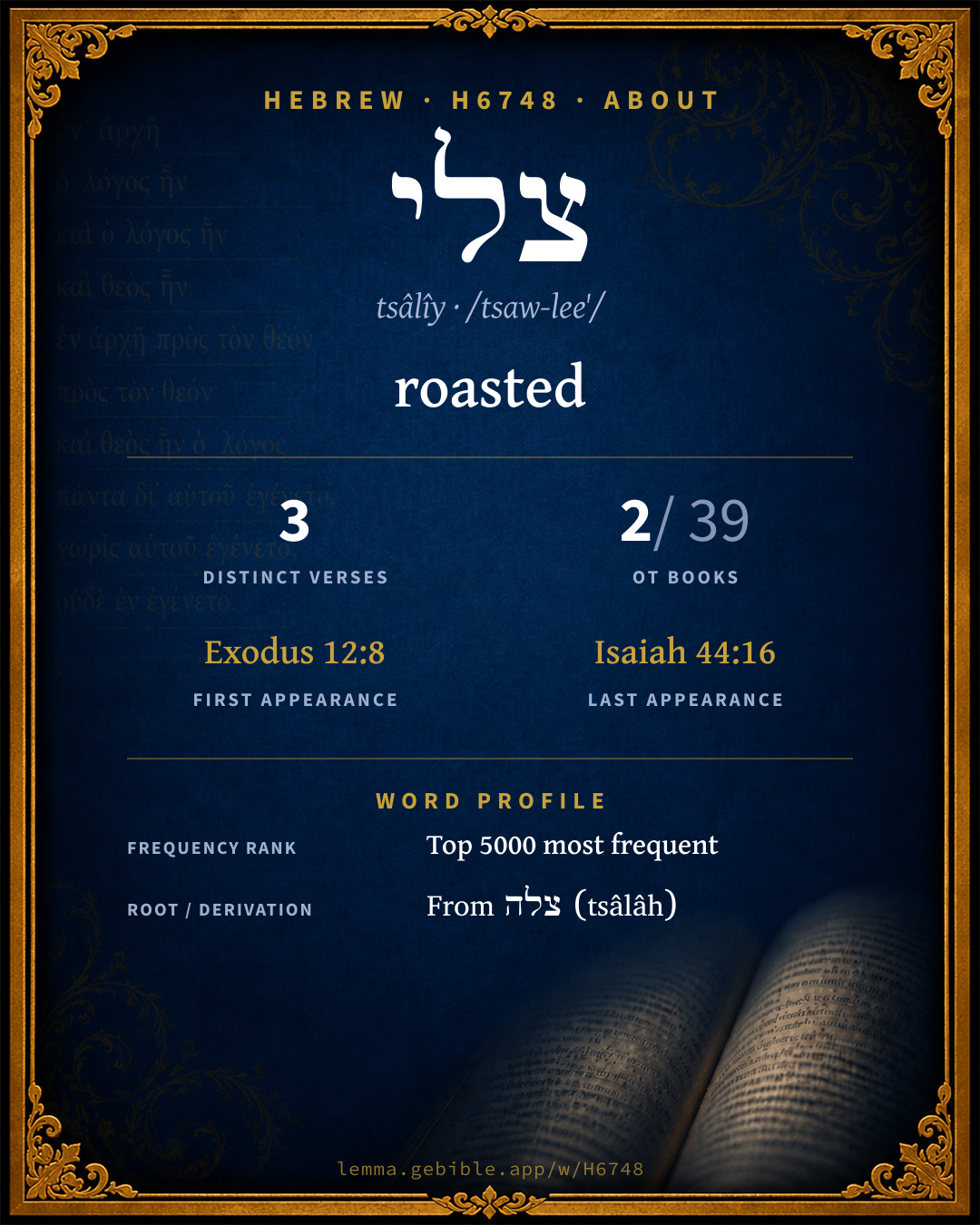
צָלִי
roasted
‘roasted’ is one of 2 main senses fuller range ↓
Full lexicon entry — Brown-Driver-Briggs (BDB)
From Brown-Driver-Briggs (BDB)
Where this word appears
See every Construct-state word in the Hebrew Bible →
Grammar key — what these labels mean
Part of speech
- Noun
- A naming word — a person, place, thing, or idea.
Noun type
- Common
- A common noun — a general class of person, place, or thing (“king,” “city,” “water”), not a specific name.
State
- Construct
- A noun bound to a following noun in a possessive / “of” relationship (the construct chain).
- Absolute
- The independent form of a noun, not bound to a following word.
Gender
- Masculine
- Grammatically masculine.
Number
- Singular
- One.
Grammatical forms
- Noun, Common, Masculine, Singular, Construct 2 times (67%)
- Noun, Common, Masculine, Singular, Absolute 1 time (33%)
Parsed forms decoded from the imported morphology (morphhb / Westminster Leningrad Codex — WLC text public domain, morphhb tagging CC BY 4.0), counted across 3 parsed occurrences — not distinct verses.
Every verse where H6748 appears — 3 distinct verses across 2 books. Click any verse to open its interlinear word-by-word view. Verse text shown in the World English Bible for context — . Each verse’s Hebrew form is shown with its reference; the English is not keyword-highlighted, since the data carries no word-level English alignment. Use “Compare translations” on any verse to read it across multiple English versions. This concordance covers the Hebrew Bible; Septuagint (Greek Old Testament) occurrences are not indexed here.
Exodus 2 verses
Isaiah 1 verse
About this entry
At a glance — auto-summarized from this page’s data, not written by a person. Every figure links to its source below. This summary describes the numbers; it doesn’t interpret them.
“roasted” is the headline sense of the Hebrew word צלי (tsâlîy). It is rare — just 3 verses in the entire Hebrew Bible. More than two-thirds of its appearances fall in Exodus. First canonically at Exodus 12:8, it enters the text early. Catalogued under 2 senses, its meaning is not single-sense. The sections below give every sense, occurrence, and version rendering.
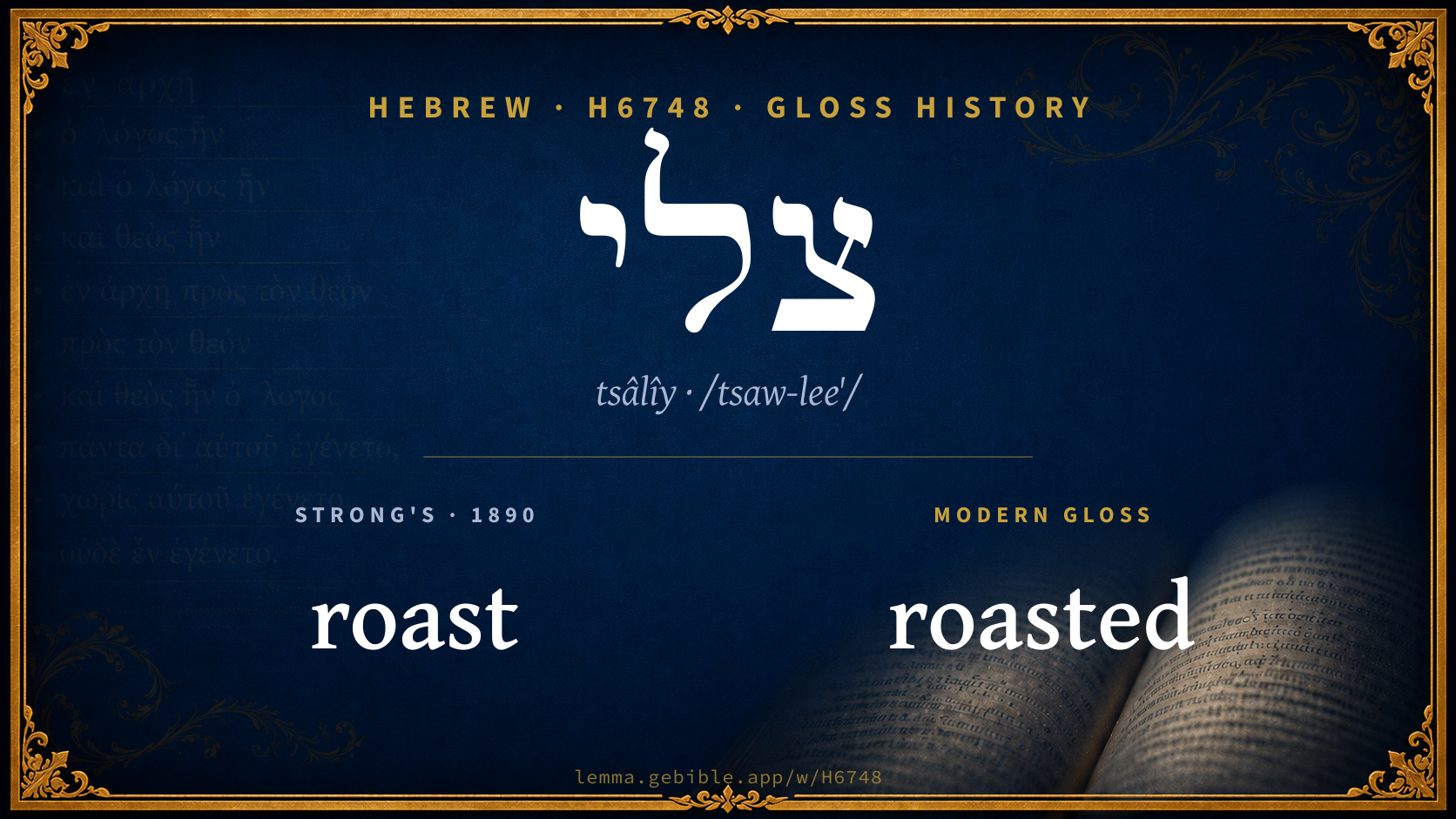
Gloss history
Strong's 1890 vs modern scholarship
About this word
Strong's H6748 catalogs a Hebrew word from the Hebrew Old Testament.
These counts are not copied from any lexicon or concordance. They are computed here, from the morphology-tagged Hebrew Old Testament. What Lemma adds →
- 3
- distinct verses
- The word appears in 3 distinct verses.
- 2 / 39
- OT books
- The word appears in 2 of 39 Old Testament books.
- #4,179
- by frequency
- Top 5000 most frequent Hebrew words (rank 4,179 of 8,640 Hebrew words by occurrence).
View all 3 occurrences in the concordance →
By traditional corpus
Conventional, traditional groupings — biblical authorship is debated, so this is a traditional corpus grouping, not an authorship claim. Each share is this word’s portion of its verses in that division of the Hebrew canon. Each figure is a share of the word’s 3 distinct verses.
- Torah (Pentateuch) 2 verses · 67%
- Prophets (Nevi'im) 1 verse · 33%
How translations render this word
Counts come from each version’s own published word-to-Strong’s tagging or interlinear alignment — an approximate guide to how each version renders this word, not a word-level alignment the data otherwise carries. Because each total is that version’s own tagged count, the per-version totals vary from one another and need not match the appearance or distinct-verse counts above. These counts may also differ from a printed concordance because Lemma counts each distinctly tagged rendering and does not collapse phrase taggings into a single head-word total. This is a fixed set of word-tagged versions (KJV, ASV, BSB, ULT) and does not change with the reading translation you choose elsewhere. Each version’s license is shown beside its name below (and on Sources).
- King James Version: Roast 3×
- American Standard Version: Roast 3×
- Berean Standard Bible: Roasted 2×
- unfoldingWord Literal Text: Roast 1×, Roast of 1×, Roasted of 1×
King James Version Public Domain
Renders H6748 across 3 tagged occurrences — most commonly:
American Standard Version Public Domain
Renders H6748 across 3 tagged occurrences — most commonly:
Berean Standard Bible Public Domain
Renders H6748 across 3 tagged occurrences — most commonly:
Plus 1 rendering that appears only once — usually multi-word phrases or single function words the recovered tagging swept in, not distinct renderings.
unfoldingWord Literal Text CC BY-SA 4.0
Renders H6748 across 3 tagged occurrences — most commonly:
Senses in BDB
The 2 senses BDB distinguishes for this word, in lexicon order (not ranked by frequency or importance). The full entry — with sub-senses — is in the Lexicon Entry tab.
- roasted, roast (noun masculine)
- (CLBL) roasted (adjective)
Word origin
adj. et n.m. roasted, roast;—cstr. (as adj.) צְלִי־אֵשׁ (P) of flesh (בָּשָׂר) Ex 12:8, 9 (opp. מְבֻשָּׁל בַּמָּ֑יִם); abs. as subst. cogn. Is 44:16 v. [צָלָה].
— Brown-Driver-Briggs (Oxford 1906, public domain), digitized via Sefaria, supplemented by the OpenScriptures HebrewLexicon (CC BY 4.0). See Sources.
Derived from צלה (tsâlâh) (H6740) — to roast.
Jastrow Dictionary
A second Hebrew/Aramaic lexicon for comparison, covering Aramaic and post-biblical (Talmudic, Targumic, Midrashic) usage that the biblical-Hebrew BDB does not. Matched by lemma rather than by Strong’s number, so a lemma may carry more than one Jastrow headword (shown separately below), and the entries cover usage well beyond the Bible.
צלי
- (b. h.) [to turn, cmp. טְוִי II,] to roast. Tosef. Pes. V, 9 בישלו … צְלָאוֹ if he cooked (the Passover lamb) and then roasted it; Pes. 41ᵃ. Ib. צלאו כל צורכו if he roasted it as much as needed (well-done, contrad. to נא). Ib. VII, 1 כיצד צוֹלִין וכ׳ how must the Passover lamb be roasted? Ib. 2 צא וצְלֵה לנו וכ׳ go out and roast the lamb for us &c. Y. ib. VII, beg. 34ᵃ צְלָייוֹ בגדי וכ׳ if he roasted it together with a secular (not sacrificial) kid. Ib. bot. בשר לִצְלוֹת meat to roast it; a. fr.—Part. pass. צָלוּי; f. צְלוּיָה, צְלוּיָיה. Ab. Zar. 29ᵃ ביצה צ׳ a roasted egg; a. e.
- to be roasted. Y. Pes. l. c. נִצְלָה מקצתו וכ׳ if it was roasted partly by the heat of the stove &c.; a. fr.—Sabb. I, 10 כדי שיִצּוֹלוּ וכ׳ (fr. צול) in time to be roasted before the Sabbath begins.
צְלֵי
- —Part. pass. צָלֵי; pl. צָלַיָּיא. Y. Naz. IX, 57ᵈ כגון אילין נוניא צ׳ וכ׳ corpses found in a position like fried fish, the head of one by the tail of the other &c.
צְלֵי ²
- (preced.; corresp. to h. נָטָה)
- 1. (neut. verb) to turn, decline; to incline. Targ. Ps. CII, 12. Targ. Job XV, 30 Ms. (ed. יעדי; h. text יסור). Ib. XXXI, 7 (some ed. חְּצַלֵי, corr. acc.). Targ. Ps. XL, 2; a. fr.
- 2. to stretch, put up. Targ. Hos. IX, 8; a. e.
- 3. (with אודנא) to bend, incline the ear, listen, heed. Targ. Prov. V, 13. Ib. II, 2 Ms. (ed. Af.). Ib. XXII, 17; a. fr.
- 4. to bend, wrest, pervert. Ib. XVII, 23. Ib. XVIII, 5; a. fr.
- 5. to pray, v. Pa.
- 1. (neut. verb) (neut. verb) to turn; to deviate. Targ. Ps. CXIX, 51; 157; a. e.—Ber. 34ᵇ; Meg. 23ᵃ דמַצְלֵי אַצְלוּיֵי that they turned sideways (in prayer, instead of prostrating themselves).
- 2. to move, turn aside; to bend; to wrest, pervert. Targ. Job XXIV, 4. Targ. Ex. XXIII, 6 (not תֵצְלוּן). Targ. Deut. XXVII, 19; a. e.—Bets. 14ᵃ אַצְלֵי אַצְלוּיֵי ודוך bend the mortar sideways and pound. Ib. ודילמא אצלויי א׳ perhaps he bent &c. Keth. 105ᵃ לאצלויי דינא to wrest judgment. Snh. 109ᵇ (name of one of the judges of Sodom) מַצְלֵי דין Ms. M. (ed. דינא; Ms. K. אצלי, v. Rabb. D. S. a. l. note) Perverter of justice; a. e.—4) to pray, v. Pa
- [to bend, turn aside,] to pray. Targ. Ps. LXXXVI, 1. Targ. Gen. XII, 8. Targ. I Kings VIII, 30; 33 (ed. Wil. יִצְלוּן Pe.). Ib. 28 (ed. Wil. מַצְלֵי Af.); a. fr.—Ber. 34ᵇ דמְצַלֵּי וכ׳, v. בִּקְתָא. Sabb. 10ᵃ לצַלּוּיֵי, v. נְגַהּ. Gen. R. s. 81 סליק לצַלָּאָה וכ׳ went up to pray in Jerusalem. Ib. ולא טב לך מִצְלֵי וכ׳ would it not be better for thee to pray on this blessed mountain (Gerizim)?; ib. s. 32 למִיצְ׳; a. e.
- to be moved; to tremble, shake. Targ. Is. XL, 20. Targ. Jer. X, 4; a. fr.
צָלִי
- roasted meat, roast. Zeb. V, 8. Pes. 75ᵃ אין זה צְלִי אש this is not called ‘roasted by fire’ (Ex. XII, 9); Y. ib. VII, 34ᵃ bot. צ׳ אש ולא צ׳ שפוד וכ׳ (the text says.) ‘roasted by fire’, but not roasted through the heat of the spit, of the pot &c.; a. fr.—Meg. 7ᵇ ובישולא … צ׳ קדר and the last dish they offered me, they called ‘roast of the pot.’ e.g. Exodus 12:9
A Dictionary of the Targumim, the Talmud Babli and Yerushalmi, and the Midrashic Literature (Marcus Jastrow; London, Luzac, 1903) — Public Domain. Digitized via Sefaria. Digitized via Sefaria. Full attribution on Sources.
Forms in the corpus
The 2 distinct written forms H6748 takes in the Hebrew Bible, most frequent first — each parse links to that state’s occurrences in the concordance. Hebrew forms include their vowel points and cantillation, so a single lemma takes many written forms.
| Form | Parsing | Example | Uses |
|---|---|---|---|
| צְלִי | Noun, Common, Masculine, Singular, Construct | Exodus 12:8 | 2 |
| צָלִ֖י | Noun, Common, Masculine, Singular, Absolute | Isaiah 44:16 | 1 |
Septuagint verse parallels
This word appears in 3 verses that also exist in the Greek Old Testament (Septuagint), out of the 3 Hebrew verses it occurs in. You can read those verses in Greek by switching the Old Testament edition to the Septuagint.
Read these verses in the Septuagint
This is a verse-level parallel only — the same verses exist in both the Hebrew and Greek Old Testaments. No word-level Hebrew↔Greek correspondence is claimed: the data carries no such alignment, so no Greek word is shown as this Hebrew word’s translation. Coverage is not total — the Septuagint omits the deuterocanon and renumbers the Psalms, so some Hebrew verses have no direct Greek parallel.