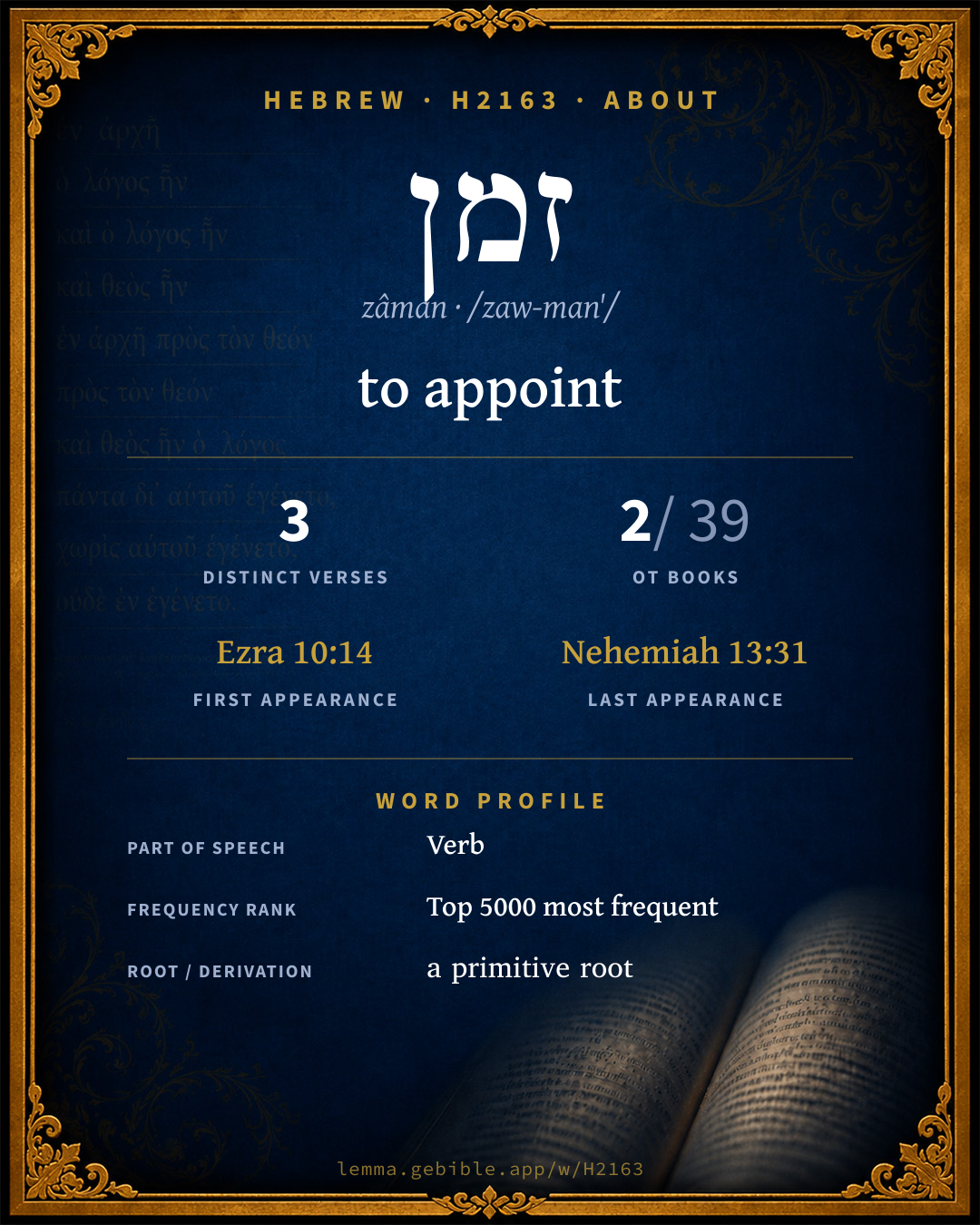
זָמַן
to appoint
‘to appoint’ is one of 3 main senses fuller range ↓
Full lexicon entry — Brown-Driver-Briggs (BDB)
From Brown-Driver-Briggs (BDB)
Where this word appears
Grammar key — what these labels mean
Part of speech
- Verb
- An action or state-of-being word.
Stem
- Pual
- The passive counterpart of the Piel.
Form
- Participle Passive
- A verbal adjective expressing action received (“written”).
State
- Absolute
- The independent form of a noun, not bound to a following word.
Gender
- Masculine
- Grammatically masculine.
- Feminine
- Grammatically feminine.
Number
- Plural
- More than one (in Hebrew, generally three or more).
Grammatical forms
- Verb, Pual, Participle Passive, Masculine, Plural, Absolute 2 times (67%)
- Verb, Pual, Participle Passive, Feminine, Plural, Absolute 1 time (33%)
Parsed forms decoded from the imported morphology (morphhb / Westminster Leningrad Codex — WLC text public domain, morphhb tagging CC BY 4.0), counted across 3 parsed occurrences — not distinct verses.
Every verse where H2163 appears — 3 distinct verses across 2 books. Click any verse to open its interlinear word-by-word view. Verse text shown in the World English Bible for context — . Each verse’s Hebrew form is shown with its reference; the English is not keyword-highlighted, since the data carries no word-level English alignment. Use “Compare translations” on any verse to read it across multiple English versions. This concordance covers the Hebrew Bible; Septuagint (Greek Old Testament) occurrences are not indexed here.
Ezra 1 verse
Nehemiah 2 verses
- Nehemiah 10:34 מְזֻמָּנִ֖ים Pual ptcp.pass mp We cast lots, the priests, the Levites, and the people, for the wood-offering, to bring it into the house of our God, according to our fathers' houses, at times appointed, year by year, to burn on the altar of Yahweh our God, as it is written in the law;
- Nehemiah 13:31 מְזֻמָּנ֖וֹת Pual ptcp.pass fp and for the wood-offering, at times appointed, and for the first fruits. Remember me, my God, for good.
About this entry
At a glance — auto-summarized from this page’s data, not written by a person. Every figure links to its source below. This summary describes the numbers; it doesn’t interpret them.
“to appoint” is the headline sense of the Hebrew verb זמן (zâman). The Hebrew Bible uses it only 3 verses. It clusters heavily in Nehemiah, which alone accounts for 67% of its uses. Scripture first uses it in Ezra 10:14. Catalogued under 3 senses, its meaning is not single-sense. The sections below give every sense, occurrence, and version rendering.
Gloss history
Strong's 1890 vs modern scholarship
About this word
Strong's H2163 catalogs a Hebrew word from the Hebrew Old Testament.
These counts are not copied from any lexicon or concordance. They are computed here, from the morphology-tagged Hebrew Old Testament. What Lemma adds →
- 3
- distinct verses
- The word appears in 3 distinct verses.
- 2 / 39
- OT books
- The word appears in 2 of 39 Old Testament books.
- #4,179
- by frequency
- Top 5000 most frequent Hebrew words (rank 4,179 of 8,640 Hebrew words by occurrence).
View all 3 occurrences in the concordance →
By traditional corpus
Conventional, traditional groupings — biblical authorship is debated, so this is a traditional corpus grouping, not an authorship claim. Each share is this word’s portion of its verses in that division of the Hebrew canon. Each figure is a share of the word’s 3 distinct verses.
- Writings (Ketuvim) 3 verses · 100%
How translations render this word
Counts come from each version’s own published word-to-Strong’s tagging or interlinear alignment — an approximate guide to how each version renders this word, not a word-level alignment the data otherwise carries. Because each total is that version’s own tagged count, the per-version totals vary from one another and need not match the appearance or distinct-verse counts above. These counts may also differ from a printed concordance because Lemma counts each distinctly tagged rendering and does not collapse phrase taggings into a single head-word total. This is a fixed set of word-tagged versions (KJV, ASV, BSB, ULT) and does not change with the reading translation you choose elsewhere. Each version’s license is shown beside its name below (and on Sources).
- King James Version: Appointed 3×
- American Standard Version: Appointed 3×
- Berean Standard Bible: Appointed 3×
- unfoldingWord Literal Text: Appointed 3×
King James Version Public Domain
Renders H2163 across 3 tagged occurrences — most commonly:
American Standard Version Public Domain
Renders H2163 across 3 tagged occurrences — most commonly:
Berean Standard Bible Public Domain
Renders H2163 across 3 tagged occurrences — most commonly:
unfoldingWord Literal Text CC BY-SA 4.0
Renders H2163 across 3 tagged occurrences — most commonly:
Senses in BDB
The 3 senses BDB distinguishes for this word, in lexicon order (not ranked by frequency or importance). The full entry — with sub-senses — is in the Lexicon Entry tab.
- to appoint a time, be fixed, be appointed
(Pual)
- to be fixed, be appointed
- appointed times (participle)
Word origin
[ זָמַן ] vb. only Pu. Pt. be fixed, appointed, of time
— Brown-Driver-Briggs (Oxford 1906, public domain), digitized via Sefaria, supplemented by the OpenScriptures HebrewLexicon (CC BY 4.0). See Sources.
Origin: a primitive root
Jastrow Dictionary
A second Hebrew/Aramaic lexicon for comparison, covering Aramaic and post-biblical (Talmudic, Targumic, Midrashic) usage that the biblical-Hebrew BDB does not. Matched by lemma rather than by Strong’s number, so a lemma may carry more than one Jastrow headword (shown separately below), and the entries cover usage well beyond the Bible.
זָמַן
- to arrange, designate.
- 1. to invite, esp. to a meal. B. Kam. 79ᵇ; a. v. fr.—Part. pass. מְזוּמָּן, f. מְזוּמֶּנֶת; pl. מְזוּמָּנִים, מְזוּמָּנוֹת a) invited. Pesik. R. s. 41, end מי שהוא מ׳ לסעודה he who is invited to the feast. Ib. (expl. מקראי, Is. XLVIII, 12) מְזוּמָּנִי My invited guest (Israel); a. e.—b) designated, chosen. Ber. 43ᵃ הוא מ׳ לברכה he is the one designated (by the host) to say grace. Ab. Zar. 17ᵃ מז׳ לחיי וכ׳ chosen for the bliss of futurity.—Snh. 102ᵃ עת היא מ׳ וכ׳ there is a time designated for &c. Ib. יום מזומן (not עת היא, v. Rabb. D. S. a. l. note 8); Yalk. Is. 330; ib. Jer. 287.—c) ready at hand, in one’s possession. B. Mets. 102ᵃ; Sifré Deut. 227, a. e. כי יקרא פרט למ׳ ‘if it chance’ (Deut. XXII, 6) this excludes that which is at thy disposal (in thy court yard); a. e.—2) to appoint a meal in common, so as to say grace together; to preface the grace after meal by saying, Let us praise &c.; v. זִימּוּן. Ber. VII, 1 שלשה … חייבין לזַמֵּן if three dine together, they are bound to make an appointment for common grace. Ib. מְזַמְּנִין עליו common grace may be appointed by making him one of the party (offering him something to eat). Ib. אין מ׳ עליהן you cannot count them in (to make up the requisite number). Ib. 2 עד כמה מזמנין how much must one eat of the meal in order to be counted one of the company? Ib. 3 כיצד מ׳ how is the appeal for common grace made?; a. fr. e.g. Isaiah 48:12
- 1. to cause to prepare, to notify. Dem. VII, 1 המַזְמִין את הבירו וכ׳ if one notifies his friend that he will dine with him (on the Sabbath).
- 2. to designate for use; v. הַזְמָנָה. Ber. 26ᵃ הִזְמִינוֹ וכ׳ if he designated a building for &c.
- 3. to summon, v. next w.
- 1. to meet, to come to hand (providentially); to join one’s self to. Snh. 96ᵃ אותו מלאך שנ׳ לו וכ׳ that angel who was commissioned to accompany Abraham. Ib. נ׳ לו רגלי אחד a footman was joined to him (to meet his challenge). Ab. Zar. 25ᵇ ישראל שנ׳ לו וכ׳ (Ḥull. 91ᵃ שנטפל) an Israelite whom a gentile joins on the road. Shebi. VII, 4 שנִזְדַּמְּנוּ להם וכ׳ who accidentally caught unclean animals; a. fr.
- 2. to make an appointment for meeting one another. Pesik. R. s. 33, v. זִימּוּן.
זְמַן I
- —Part. pass. זְמִין ready, prepared. Targ. Ex. XXXIV, 2 (Y. זַמִין, זַמְיַן, incorr.).—Ib. XIX, 11; 15 זְמִינִין (Y. II מְזַמְנַן, v. infra).—V. זְמִינָא.
- 1. to invite; to appoint; to summon; to prepare. Targ. Mic. III, 5. Targ. Ex. XIX, 10; 14 (ed. Berl. זָמֵין, v. Berl. Targ. O. II, p. 25); a. fr. [Ib. XXV, 22 ואִיזַמָן, ed. Berl. ואֵיזָמֵין, Y. אֵיזְמַן, Ithpe.].—M. Kat. 16ᵃ מְזַמְּנִינָן ליה וכ׳ we summon him &c. Cant. R. to V, 13 ביומוי דזַמְּנִינָן וכ׳ (not דזמניין) in those my days when we invited two parties of scholars (for discussions).—Part. pass. מְזַמַּן (hebraism: מְזוּמָּן). Targ. Ps. LXXII, 17 (h. text ינון).—Pl. constr. מְזַמְּנֵי. Targ. Y. Num. I, 16 (h. text קריאי). [Ib. XXVI, 9 מנמנמי Ar., read מזמני; ed. מערעי).
- 2. to appoint a meal in common, to say grace in common. Ber. 45ᵇ ניהדר ונְזַמֵּן let us go back and agree (retrospectively) to make our meal a common one.
- same. Targ. Y. Gen. XXIV, 7. Targ. I Sam. XVI, 3. Targ. Ex. XIX, 10 ותַזְ׳ some ed. v. supra; a. fr.—Ber. 50ᵇ אַזְמוּן עלייהו they counted them in for common grace, v. preced. Pi.—Snh. 48ᵃ דאַזְמְנֵיה וכ׳ which one designated for &c.—B. Bath. 58ᵃ sq. אי אתי אינש מעלמא ומַזְמִין ליה לדינא Ms. M. (ed. incorr.) if any unknown man will come and sue him; a. fr.
- 1. as preced. Nithpa. Targ. Job XXXIII, 23.—Targ. Y. II, Gen. XIX, 31 למִיזְדַּמְנָא וכ׳ to join us in wedlock (cmp. זְוַג).—Targ. Am. III, 3; a. e.
- 2. to prepare one’s self. Targ. Josh. VII, 13; a. e. [Targ. Y. II, Gen. XXII, 8 יזדמן, read יְזַמֵּן.]—Contr. אִיזַּמֵּן, Ithpe. אִיזְּמִין, v. supra.
זְמָן
- preced.)
- 1. appointed time, term, time. Kidd. I, 7, a. fr. הז׳ גרמא, v. גְּרָמָא.—B. Kam. 113ᵃ קובעים ז׳ וכ׳ we appoint (in the summons to appear before court) a Monday, Thursday and Monday in succession. Gitt. 72ᵃ, a. fr. זְמַנּוֹ של שטר the date of the document.—Taan. 14ᵇ, a. fr. בז׳ הזה in our days (after the dissolution of the Jewish common-wealth). Ib. הכל לפי הז׳ all depends on the season (whether it is advanced or retarded, v. Rabb. D. S. a. l. note 400). Ib. זְמַנָּהּ של רביעה the rainy season; a. v. fr.—Pl. זְמַנִּים. Meg. 2ᵃ ז׳ הרבה various dates (for reading the Megillah).—בִּזְמַן שֶׁ־ in the case of, when, if. Erub. VI, 7 אימתי בז׳ וכ׳ in what case (is this said)? When they carry &c. Ib. 6 ומודים בז׳ וכ׳ they all agree that, if some of them &c.; a. v. fr.—בִּזְמַנּוֹ, בִּזְמַנָהּ &c. in its prescribed, due time; חוּץ לִזְמַנּוֹ &c. out of time, beyond its due time. Zeb. I, 1. Ib. II, 3; a. v. fr.
- 2. festive season (cmp. מִקְרָא, מְאַרְעָא); ‘Z’man’,that section of the benediction on the entrance of a Festival which refers to the return of the festive season (שהחיינו והגיענו לזמן הזה …). Pes. 102ᵇ מדלא אמר ז׳ since he did not mention the benediction of Z’man, v. יקנה"ז. Succ. 48ᵃ שמיני … ז׳ בפני עצמו the eighth day (of Succoth) … is a festive season for itself, requiring the insertion of Z’man; a. fr.—Pl. as above. Y. Ab. Zar. I, 39ᶜ ג׳ ז׳ בבבל there are three festive seasons (idolatrous fairs) in Babylonia. Tosef. Ber. III, 13 חותם ברוך … והז׳ you must close with ‘Blessed be He … who sanctifies the Sabbath, Israel, and the Seasons.—[Snh. 101ᵃ הקורא … שלא בזמנו he who cites a Biblical verse at a banquet out of its context (perverting its sense for lascivious purposes); Treat. Kallah beg.]
זְמַן II
- Targ. O. Gen. XVIII, 14 (Y. ז׳ חגא, h. text מועד). Ib. II, 23 הדא ז׳ this time (h. text הפעם); a. fr.—Targ. Jer. XVIII, 7; 9 ז׳ … וז׳ at one time … another time.—Ḥull. 105ᵇ ליקבע לי מר ז׳ וכ׳ set me a term, and I shall pay. M. Kat. 16ᵃ דקבעינן ז׳ that (in legal summons) a date is fixed for appearing in court. Ib. ז׳ בתר ז׳ one term after the ofther (in case of failing to appear on the first summons). Ḥag. 4ᵇ אזיל בלא זִימְנֵיה dies before his destined time; a. v. fr.—B. Bath. 73ᵇ, a. fr. ז׳ חדא once upon a time (introducing a story).—Pl. זִמְנִין, זִי׳. Targ. Ex. XXIII, 17; a. e.—Zeb. 94ᵇ, a. fr. ז׳ סגיאין many times.—ז׳—ז׳ at times … at other times. Ber. 20ᵇ, a. fr.—מַשְׁכֵּן זִימְנָא = h. אֹהֶל מוֹעֵד. Targ. Ex. XXVIII, 43; a. fr.—Targ. Ps. LXXIV, 4 זִמְנָיִךְ = משכני זי׳.—Targ. Jer. XLVII, 6 לבית ז׳ to thy destined home (the sheath; h. text הֵרָגְעִי!).—[Targ. Ps. CXLI, 4 בזמן משתיהון Ms (ed. בזמר בית מ׳) at their appointed banquets, v. preced. wds.]
A Dictionary of the Targumim, the Talmud Babli and Yerushalmi, and the Midrashic Literature (Marcus Jastrow; London, Luzac, 1903) — Public Domain. Digitized via Sefaria. Digitized via Sefaria. Full attribution on Sources.
Forms in the corpus
The 3 distinct written forms H2163 takes in the Hebrew Bible, most frequent first — each parse links to that stem’s occurrences in the concordance. Hebrew forms include their vowel points and cantillation, so a single lemma takes many written forms.
| Form | Parsing | Example | Uses |
|---|---|---|---|
| מְזֻמָּנ֖וֹת | Verb, Pual, Participle Passive, Feminine, Plural, Absolute | Nehemiah 13:31 | 1 |
| מְזֻמָּנִ֔ים | Verb, Pual, Participle Passive, Masculine, Plural, Absolute | Ezra 10:14 | 1 |
| מְזֻמָּנִ֖ים | Verb, Pual, Participle Passive, Masculine, Plural, Absolute | Nehemiah 10:34 | 1 |
Same root — word family
Other BDB entries built from the same root as H2163, grouped by Strong’s listed origin. These share a root / origin per the lexicon — not necessarily a shared meaning. Each links to that word’s own entry.
Derived from this word
Compare all same-root words → They share a root, not necessarily a meaning.
Septuagint verse parallels
This word appears in 1 verse that also exists in the Greek Old Testament (Septuagint), out of the 3 Hebrew verses it occurs in. You can read those verses in Greek by switching the Old Testament edition to the Septuagint.
Read these verses in the Septuagint
This is a verse-level parallel only — the same verses exist in both the Hebrew and Greek Old Testaments. No word-level Hebrew↔Greek correspondence is claimed: the data carries no such alignment, so no Greek word is shown as this Hebrew word’s translation. Coverage is not total — the Septuagint omits the deuterocanon and renumbers the Psalms, so some Hebrew verses have no direct Greek parallel.