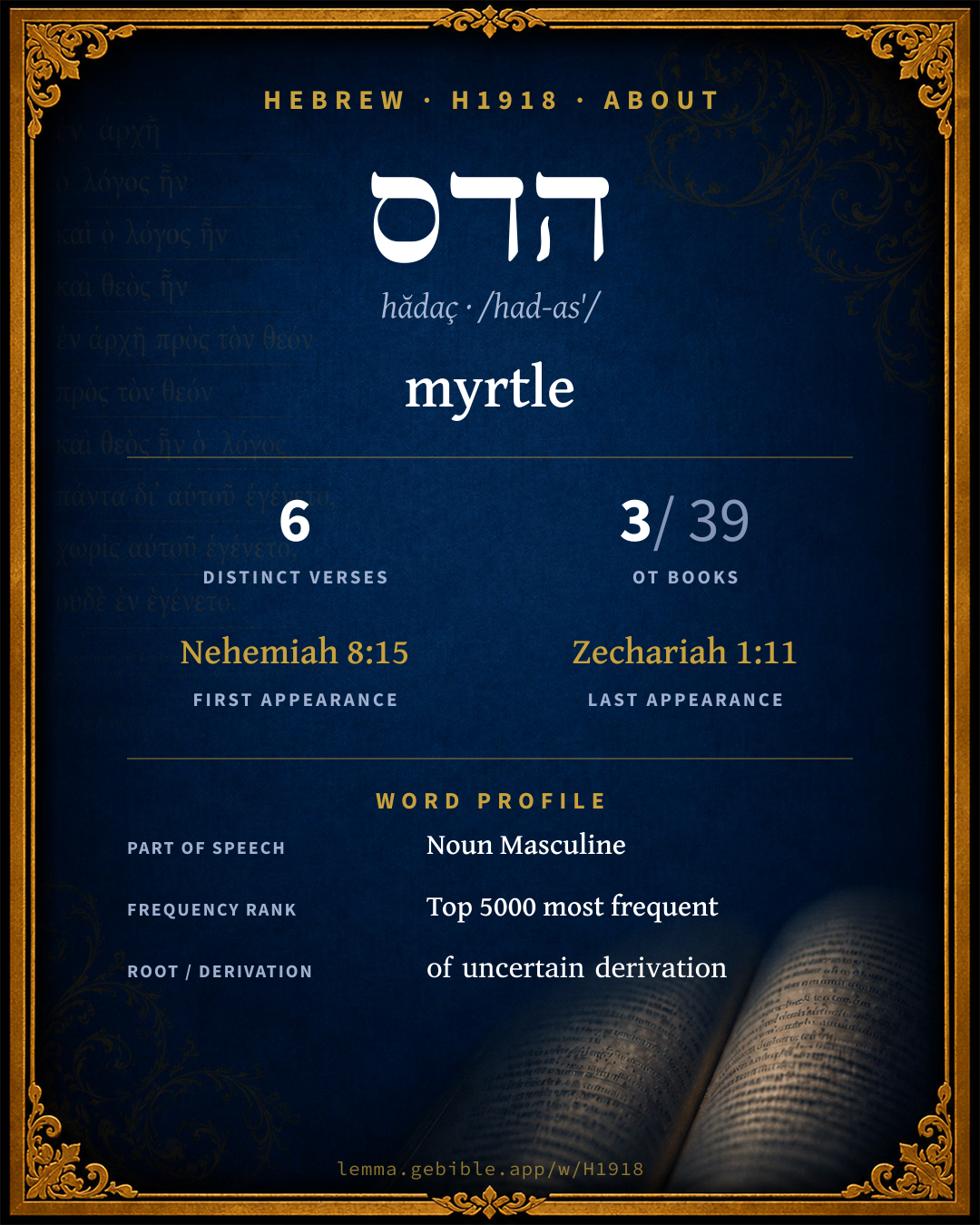
הֲדַס
myrtle
Full lexicon entry — Brown-Driver-Briggs (BDB)
From Brown-Driver-Briggs (BDB)
Where this word appears
Grammar key — what these labels mean
Part of speech
- Noun
- A naming word — a person, place, thing, or idea.
Noun type
- Common
- A common noun — a general class of person, place, or thing (“king,” “city,” “water”), not a specific name.
State
- Absolute
- The independent form of a noun, not bound to a following word.
Gender
- Masculine
- Grammatically masculine.
Number
- Plural
- More than one (in Hebrew, generally three or more).
- Singular
- One.
Grammatical forms
- Noun, Common, Masculine, Plural, Absolute 3 times (50%)
- Noun, Common, Masculine, Singular, Absolute 3 times (50%)
Parsed forms decoded from the imported morphology (morphhb / Westminster Leningrad Codex — WLC text public domain, morphhb tagging CC BY 4.0), counted across 6 parsed occurrences — not distinct verses.
Every verse where H1918 appears — 6 distinct verses across 3 books. Click any verse to open its interlinear word-by-word view. Verse text shown in the World English Bible for context — . Each verse’s Hebrew form is shown with its reference; the English is not keyword-highlighted, since the data carries no word-level English alignment. Use “Compare translations” on any verse to read it across multiple English versions. This concordance covers the Hebrew Bible; Septuagint (Greek Old Testament) occurrences are not indexed here.
Nehemiah 1 verse
Isaiah 2 verses
- Isaiah 41:19 וַ/הֲדַ֖ס conj + n c ms I will put in the wilderness the cedar, the acacia, and the myrtle, and the oil tree; I will set in the desert the fir tree, the pine, and the box tree together:
- Isaiah 55:13 הֲדַ֑ס n c ms Instead of the thorn shall come up the fir tree; and instead of the brier shall come up the myrtle tree: and it shall be to Yahweh for a name, for an everlasting sign that shall not be cut off.
Zechariah 3 verses
- Zechariah 1:8 הַ/הֲדַסִּ֖ים ptcl def.art + n c mp "I had a vision in the night, and, behold, a man riding on a red horse, and he stood among the myrtle trees that were in a ravine; and behind him there were red, brown, and white horses.
- Zechariah 1:10 הַ/הַדַסִּ֖ים ptcl def.art + n c mp The man who stood among the myrtle trees answered, "They are the ones Yahweh has sent to go back and forth through the earth."
- Zechariah 1:11 הַ/הֲדַסִּ֔ים ptcl def.art + n c mp They reported to the angel of Yahweh who stood among the myrtle trees, and said, "We have walked back and forth through the earth, and, behold, all the earth is at rest and in peace."
About this entry
At a glance — auto-summarized from this page’s data, not written by a person. Every figure links to its source below. This summary describes the numbers; it doesn’t interpret them.
At its core, הדס (hădaç) means “myrtle.” The word gravitates to Zechariah (50%), then Isaiah and Nehemiah. It appears 6 verses across 3 books of the Hebrew Bible, among its uncommon vocabulary. Scripture first uses it in Nehemiah 8:15. It clusters with הדסה under a shared root. Dig into 6-verse concordance and the renderings breakdown below.
Gloss history
Strong's 1890 vs modern scholarship
About this word
Strong's H1918 catalogs a Hebrew word from the Hebrew Old Testament.
These counts are not copied from any lexicon or concordance. They are computed here, from the morphology-tagged Hebrew Old Testament. What Lemma adds →
- 6
- distinct verses
- The word appears in 6 distinct verses.
- 3 / 39
- OT books
- The word appears in 3 of 39 Old Testament books.
- #3,040
- by frequency
- Top 5000 most frequent Hebrew words (rank 3,040 of 8,640 Hebrew words by occurrence).
View all 6 occurrences in the concordance →
By section of the Old Testament
By traditional corpus
Conventional, traditional groupings — biblical authorship is debated, so this is a traditional corpus grouping, not an authorship claim. Each share is this word’s portion of its verses in that division of the Hebrew canon. Each figure is a share of the word’s 6 distinct verses.
- Prophets (Nevi'im) 5 verses · 83%
- Writings (Ketuvim) 1 verse · 17%
How translations render this word
Counts come from each version’s own published word-to-Strong’s tagging or interlinear alignment — an approximate guide to how each version renders this word, not a word-level alignment the data otherwise carries. Because each total is that version’s own tagged count, the per-version totals vary from one another and need not match the appearance or distinct-verse counts above. These counts may also differ from a printed concordance because Lemma counts each distinctly tagged rendering and does not collapse phrase taggings into a single head-word total. This is a fixed set of word-tagged versions (KJV, ASV, BSB, ULT) and does not change with the reading translation you choose elsewhere. Each version’s license is shown beside its name below (and on Sources).
- King James Version: Among the myrtle trees 3×, Myrtle 2×
- American Standard Version: Among the myrtle-trees 3×, Myrtle 2×
- Berean Standard Bible: Myrtle trees 3×, Myrtle 2×
- unfoldingWord Literal Text: Myrtle 3×, Myrtle trees 3×
King James Version Public Domain
Renders H1918 across 6 tagged occurrences — most commonly:
Plus 1 rendering that appears only once — usually multi-word phrases or single function words the recovered tagging swept in, not distinct renderings.
American Standard Version Public Domain
Renders H1918 across 6 tagged occurrences — most commonly:
Plus 1 rendering that appears only once — usually multi-word phrases or single function words the recovered tagging swept in, not distinct renderings.
Berean Standard Bible Public Domain
Renders H1918 across 6 tagged occurrences — most commonly:
Plus 1 rendering that appears only once — usually multi-word phrases or single function words the recovered tagging swept in, not distinct renderings.
unfoldingWord Literal Text CC BY-SA 4.0
Renders H1918 across 6 tagged occurrences — most commonly:
Senses in BDB
The 1 sense BDB distinguishes for this word, in lexicon order (not ranked by frequency or importance). The full entry — with sub-senses — is in the Lexicon Entry tab.
- myrtle (tree)
Word origin
n.m. Is 55:13 myrtle (-tree), only late (NH, Aramaic id.; Arabic هَدَس (in the dialect of Yemen); also آسٌ, Aramaic אָסָה, ܐܳܣܳܐ; cf. LöwNo. 25)—abs. ה׳ Is 41:19 Ne 8:15; הֲדַ֑ס Is 55:13; pl. הַהֲדַסִּים Zc 1:8 + 2 times (on form cf. Ges§ 93, R. 4)—Is 41:19 (‖ תְּאַשּׁוּר, תִּדְהָר, בְּרוֹשׁ, עֵץ שָׁ֑מֶן, שִׁטָּה, אֶרֶז); Is 55:13 (‖ בְּרוֹשׁ; opp. הַסִּרְפַּד), עֲלֵי הֲדַס Ne 8:15 (‖ ע׳ עֵץ עָבוֹת, ע׳ תְּמָרִים, ע׳ עֵץ־שֶׁמֶן, עֲלֵי־זַיִת); pl. Zc 1:8, 10, 11.
— Brown-Driver-Briggs (Oxford 1906, public domain), digitized via Sefaria, supplemented by the OpenScriptures HebrewLexicon (CC BY 4.0). See Sources.
Origin: of uncertain derivation
Jastrow Dictionary
A second Hebrew/Aramaic lexicon for comparison, covering Aramaic and post-biblical (Talmudic, Targumic, Midrashic) usage that the biblical-Hebrew BDB does not. Matched by lemma rather than by Strong’s number, so a lemma may carry more than one Jastrow headword (shown separately below), and the entries cover usage well beyond the Bible.
הָדַס
- , Pi. (חִ׳) הִידֵּס (cmp. דחס) to make incisions, mark (cmp. הנדז) esp. (of chickens) to leave marks of the feet, to scratch. B. Kam. II, 2 היה מְהַדֵּס וכ׳ it was scratching and broke vessels; expl. ib. 17ᵇ bot. הי׳ והתיז it scratched and caused the smashing of the vessel by rolling it against a hard object. Ib. היו מְהַדְּסִין על וכ׳ left marks on dough or fruits, or soiled &c.; Y. ib. II, beg. 2ᵈ שהידסו את וכ׳. Ib. הידסו עפר על וכ׳ (Bab. ib. l. c. העלו עפר) they threw dust by scratching; a. e. [Ar. reads חדס; Syr. הדס to study.]
*הַדֵּס
- v. preced.; cmp. אִסְפֶּירֶס) to dance on tiptoe. Y. Peah I, 15ᵈ הוה מְהַדֵּס קומי כליא (ed. Krot. מקלס) used to dance before the bridal couples; (Keth. 17ᵃ מרקד).
הַדָס
- Hadas, (prob.) Edessa in Mesopotamia. Targ. Y. Gen. X, 10 (h. text אֶרֶךְ, v. אַרְכַת).
הָדָס
- (b. h.) myrtle branch (with three leaves on top), used for the festive wreath on the Feast of Booths (Lev. XXIII, 40). Succ. III, 2. Ib. 32ᵇ ה׳ שוטה wild myrtle (with one or two leaves on top); a. fr.—Pl. הֲדסִּים. Ib. III, 4 שלשה ה׳ three myrtle branches are required for the festive wreath. Meg. 13ᵃ the righteous שנקראו ה׳ who are named myrtles (Zech. I, 8); a. e. e.g. Leviticus 23:40
הֲדָס
- Targ. II Eth. II, 7.—Pl. הֲדַסִּין, הֲדַסַּיָּא. Targ. Lev. XXIII, 40. Targ. Zech. I, 8; a. e.
A Dictionary of the Targumim, the Talmud Babli and Yerushalmi, and the Midrashic Literature (Marcus Jastrow; London, Luzac, 1903) — Public Domain. Digitized via Sefaria. Digitized via Sefaria. Full attribution on Sources.
Forms in the corpus
The 6 distinct written forms H1918 takes in the Hebrew Bible, most frequent first — each parse links to that state’s occurrences in the concordance. Hebrew forms include their vowel points and cantillation, so a single lemma takes many written forms.
| Form | Parsing | Example | Uses |
|---|---|---|---|
| הֲדַ֑ס | Noun, Common, Masculine, Singular, Absolute | Isaiah 55:13 | 1 |
| הֲדַס֙ | Noun, Common, Masculine, Singular, Absolute | Nehemiah 8:15 | 1 |
| הַ/הֲדַסִּ֔ים | Noun, Common, Masculine, Plural, Absolute | Zechariah 1:11 | 1 |
| הַ/הֲדַסִּ֖ים | Noun, Common, Masculine, Plural, Absolute | Zechariah 1:8 | 1 |
| הַ/הַדַסִּ֖ים | Noun, Common, Masculine, Plural, Absolute | Zechariah 1:10 | 1 |
| וַ/הֲדַ֖ס | Noun, Common, Masculine, Singular, Absolute | Isaiah 41:19 | 1 |
Same root — word family
Other BDB entries built from the same root as H1918, grouped by Strong’s listed origin. These share a root / origin per the lexicon — not necessarily a shared meaning. Each links to that word’s own entry.
Proper names from this root
People and places named from this root — a name, not an additional meaning of the word.
Compare all same-root words → 1 of the same-root words is a proper name (a person or place). They share a root, not necessarily a meaning.
Septuagint verse parallels
This word appears in 5 verses that also exist in the Greek Old Testament (Septuagint), out of the 6 Hebrew verses it occurs in. You can read those verses in Greek by switching the Old Testament edition to the Septuagint.
Read these verses in the Septuagint
This is a verse-level parallel only — the same verses exist in both the Hebrew and Greek Old Testaments. No word-level Hebrew↔Greek correspondence is claimed: the data carries no such alignment, so no Greek word is shown as this Hebrew word’s translation. Coverage is not total — the Septuagint omits the deuterocanon and renumbers the Psalms, so some Hebrew verses have no direct Greek parallel.