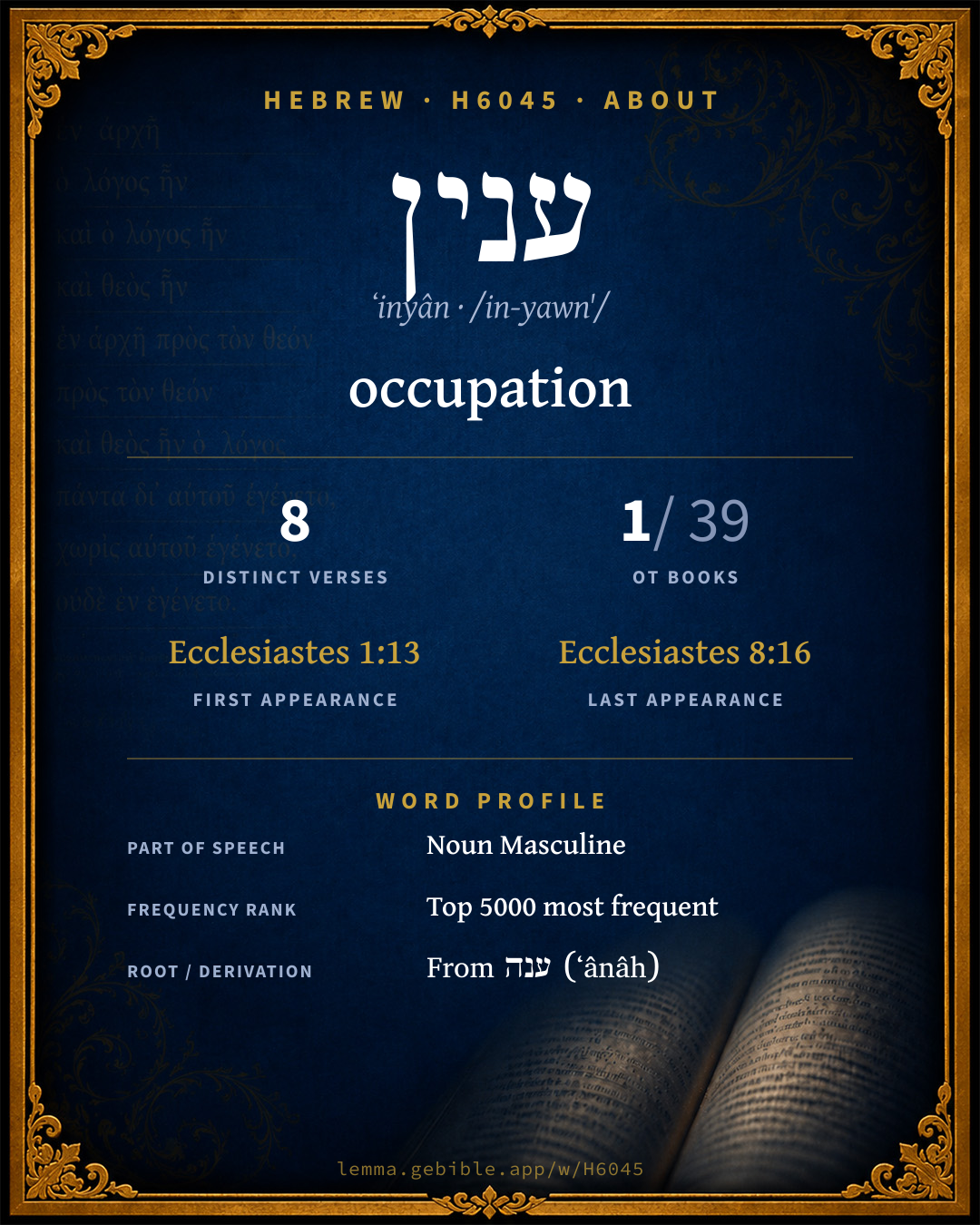
עִנְיָן
occupation
Full lexicon entry — Brown-Driver-Briggs (BDB)
From Brown-Driver-Briggs (BDB)
Where this word appears
See every Absolute-state word in the Hebrew Bible →
Grammar key — what these labels mean
Part of speech
- Noun
- A naming word — a person, place, thing, or idea.
Noun type
- Common
- A common noun — a general class of person, place, or thing (“king,” “city,” “water”), not a specific name.
State
- Absolute
- The independent form of a noun, not bound to a following word.
- Construct
- A noun bound to a following noun in a possessive / “of” relationship (the construct chain).
Gender
- Masculine
- Grammatically masculine.
Number
- Singular
- One.
Grammatical forms
- Noun, Common, Masculine, Singular, Absolute 7 times (88%)
- Noun, Common, Masculine, Singular, Construct 1 time (13%)
Parsed forms decoded from the imported morphology (morphhb / Westminster Leningrad Codex — WLC text public domain, morphhb tagging CC BY 4.0), counted across 8 parsed occurrences — not distinct verses.
Every verse where H6045 appears — 8 distinct verses across 1 book. Click any verse to open its interlinear word-by-word view. Verse text shown in the World English Bible for context — . Each verse’s Hebrew form is shown with its reference; the English is not keyword-highlighted, since the data carries no word-level English alignment. Use “Compare translations” on any verse to read it across multiple English versions. This concordance covers the Hebrew Bible; Septuagint (Greek Old Testament) occurrences are not indexed here.
Ecclesiastes 8 verses
- Ecclesiastes 1:13 עִנְיַ֣ן n c ms I applied my heart to seek and to search out by wisdom concerning all that is done under the sky. It is a heavy burden that God has given to the sons of men to be afflicted with.
- Ecclesiastes 2:23 עִנְיָנ֔/וֹ n c ms cs + sfx pers 3ms For all his days are sorrows, and his travail is grief; yes, even in the night his heart takes no rest. This also is vanity.
- Ecclesiastes 2:26 עִנְיָ֜ן n c ms For to the man who pleases him, God gives wisdom, knowledge, and joy; but to the sinner he gives travail, to gather and to heap up, that he may give to him who pleases God. This also is vanity and a chasing after wind.
- Ecclesiastes 3:10 הָֽ/עִנְיָ֗ן ptcl def.art + n c ms I have seen the burden which God has given to the sons of men to be afflicted with.
- Ecclesiastes 4:8 וְ/עִנְיַ֥ן conj + n c ms There is one who is alone, and he has neither son nor brother. There is no end to all of his labor, neither are his eyes satisfied with wealth. For whom then, do I labor, and deprive my soul of enjoyment? This also is vanity, yes, it is a miserable business.
- Ecclesiastes 5:3 עִנְיָ֑ן n c ms For as a dream comes with a multitude of cares, so a fool's speech with a multitude of words.
- Ecclesiastes 5:14 בְּ/עִנְיַ֣ן prep + n c ms Those riches perish by misfortune, and if he has fathered a son, there is nothing in his hand.
- Ecclesiastes 8:16 הָ֣/עִנְיָ֔ן ptcl def.art + n c ms When I applied my heart to know wisdom, and to see the business that is done on the earth (for also there is that neither day nor night sees sleep with his eyes),
About this entry
At a glance — auto-summarized from this page’s data, not written by a person. Every figure links to its source below. This summary describes the numbers; it doesn’t interpret them.
At its core, ענין (ʻinyân) means “occupation.” Its uses cluster heavily in Ecclesiastes (100% of all occurrences). With 8 verses in 1 book, it is an uncommon word in the Hebrew Bible. Scripture first uses it in Ecclesiastes 1:13. The King James Version usually renders it “travail,” while modern versions prefer “task” (Berean Standard Bible) — see the renderings breakdown. Dig into 8-verse concordance and the renderings breakdown below.
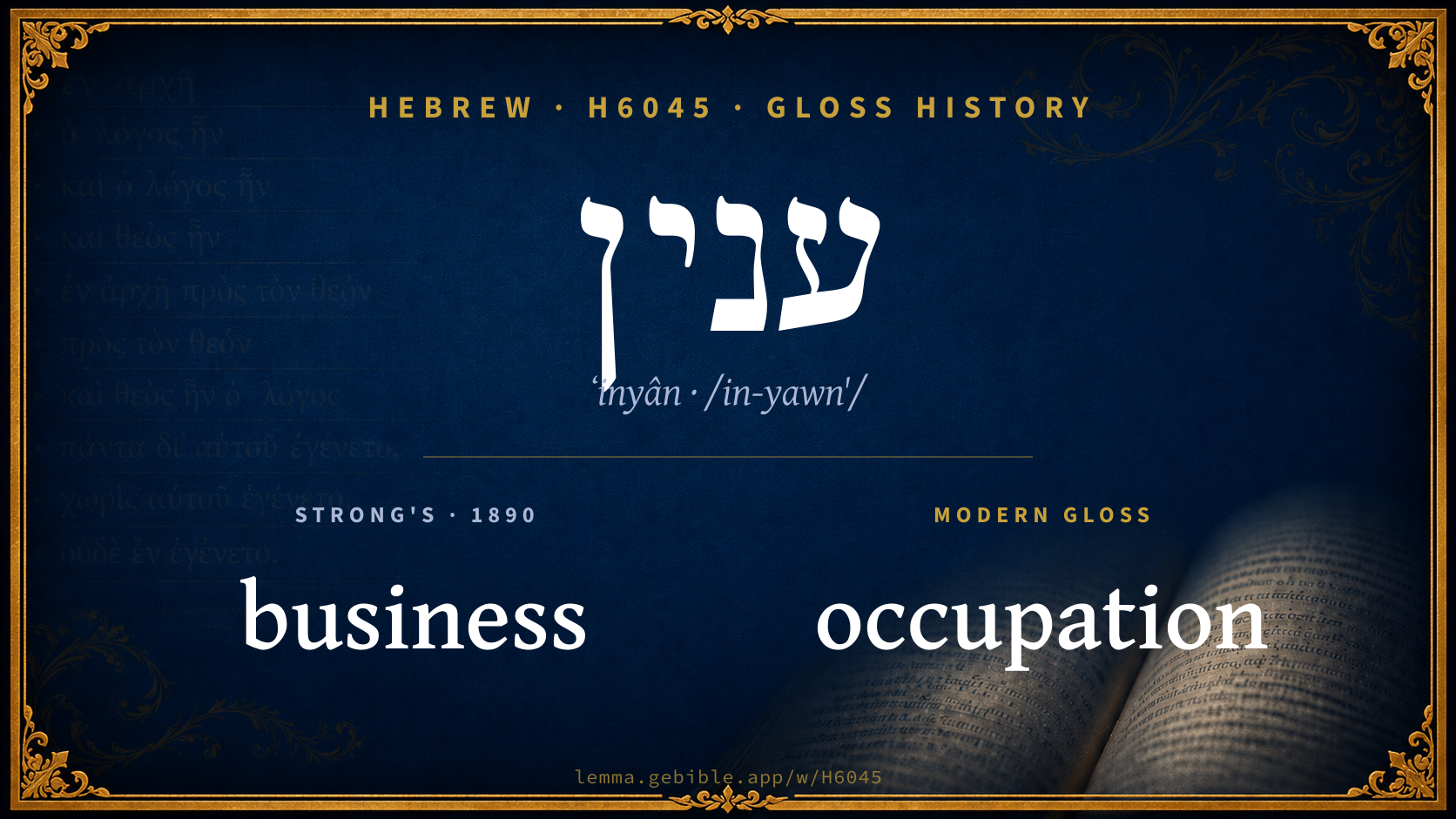
Gloss history
Strong's 1890 vs modern scholarship
About this word
Strong's H6045 catalogs a Hebrew word from the Hebrew Old Testament.
These counts are not copied from any lexicon or concordance. They are computed here, from the morphology-tagged Hebrew Old Testament. What Lemma adds →
- 8
- distinct verses
- The word appears in 8 distinct verses.
- 1 / 39
- OT books
- The word appears in 1 of 39 Old Testament books.
- #2,625
- by frequency
- Top 5000 most frequent Hebrew words (rank 2,625 of 8,640 Hebrew words by occurrence).
View all 8 occurrences in the concordance →
Most concentrated in
- Ecclesiastes 8 verses 100%
By section of the Old Testament
By traditional corpus
Conventional, traditional groupings — biblical authorship is debated, so this is a traditional corpus grouping, not an authorship claim. Each share is this word’s portion of its verses in that division of the Hebrew canon. Each figure is a share of the word’s 8 distinct verses.
- Writings (Ketuvim) 8 verses · 100%
How translations render this word
Counts come from each version’s own published word-to-Strong’s tagging or interlinear alignment — an approximate guide to how each version renders this word, not a word-level alignment the data otherwise carries. Because each total is that version’s own tagged count, the per-version totals vary from one another and need not match the appearance or distinct-verse counts above. These counts may also differ from a printed concordance because Lemma counts each distinctly tagged rendering and does not collapse phrase taggings into a single head-word total. This is a fixed set of word-tagged versions (KJV, ASV, BSB, ULT) and does not change with the reading translation you choose elsewhere. Each version’s license is shown beside its name below (and on Sources).
BDB lists this Strong’s number as 2 distinct words (homographs). Each count above pools all of them and is not split by sense — see the Senses section below. A low-frequency rendering may belong to a different one of those words, not the primary meaning.
- King James Version†: Travail 6×, Business 2×
- American Standard Version†: Travail 4×, Business 2×
- Berean Standard Bible†: Task 5×
- unfoldingWord Literal Text†: Business 7×, An 2×
King James Version Public Domain
Renders H6045 across 8† tagged occurrences — most commonly:
American Standard Version Public Domain
Renders H6045 across 8† tagged occurrences — most commonly:
Plus 2 renderings that appear only once — usually multi-word phrases or single function words the recovered tagging swept in, not distinct renderings.
Berean Standard Bible Public Domain
Renders H6045 across 8† tagged occurrences — most commonly:
Plus 3 renderings that appear only once — usually multi-word phrases or single function words the recovered tagging swept in, not distinct renderings.
unfoldingWord Literal Text CC BY-SA 4.0
Renders H6045 across 12† tagged occurrences — most commonly:
Plus 3 renderings that appear only once — usually multi-word phrases or single function words the recovered tagging swept in, not distinct renderings.
Senses in BDB
The 1 sense BDB distinguishes for this word, in lexicon order (not ranked by frequency or importance). The full entry — with sub-senses — is in the Lexicon Entry tab.
- occupation, task, job
Word origin
n.m. Ec 1:13 occupation, task, only Ec (Aramaic loan-word LagBN 205; common in NH);—ע׳ abs. Ec 2:26; 3:10; 5:2; 8:16; sf. כַּעַס עִנְיָנוֹ 2:23 his task is (sheer) vexation; עִנְיָן רָע 1:13 an evil (worthless) task, so 4:8 (Mass. עִנְיַן as if cstr., v. Baer1, 13 but Köii. 1, 99), and, in weakened sense, 5:13 a bad business, bad affair.
— Brown-Driver-Briggs (Oxford 1906, public domain), digitized via Sefaria, supplemented by the OpenScriptures HebrewLexicon (CC BY 4.0). See Sources.
Derived from ענה (ʻânâh) (H6031) — to afflict.
Jastrow Dictionary
A second Hebrew/Aramaic lexicon for comparison, covering Aramaic and post-biblical (Talmudic, Targumic, Midrashic) usage that the biblical-Hebrew BDB does not. Matched by lemma rather than by Strong’s number, so a lemma may carry more than one Jastrow headword (shown separately below), and the entries cover usage well beyond the Bible.
עִנְיָן
- [answer, corresponding affair,] correspondence, relation; subject, object, affair, idea. Sifra introd. שהוא כעִנְיָנוֹ in keeping with the general subject to which it is related, v. טָעַן I; שלא כענינו out of relation to the general subject. Kidd. 6ᵃ והוא שעסוקין באותו ע׳ provided they are engaged in conversation on that subject (of marriage). Ib. מע׳ לע׳ באותו ע׳ when their conversation changed from one point to another all, however, having relation to that subject (of marriage, e.g. about dowry, about the man’s financial condition). B. Bath. 114ᵃ כל זמן שעוסקין באותו ע׳ so long as the judges are engaged in that case (of donation), opp. כל זמן שיושבין so long as they are in session. Kidd. 43ᵃ אם אינו ע׳ לגופו תנהו ע׳ לכל וכ׳ if it (that word ההוא in the text) has no bearing on the subject itself (because a previous ההוא has already intimated the exclusion of a messenger), make it bear on all laws of the Torah (that you cannot authorize a deputy for an unlawful act). Tosef. Meg. IV (III), 5 [read:] בבית הוועד שואלין לעִנְיַין הפסח וכ׳ in the school house the subject of Passover laws is discussed thirty days (before the festival). Tosef. Sot. VI, 2, v. עָנָה I. Cant. R. to I, 10 (ref. to Num. XXVII, 1-11, a. 12-23) וכי מה ע׳ זה לזה what relation is there between these two subjects?; a. v. fr.—Pl. עִנְיָנוֹת, עִנְיָי׳, עִי׳. Tosef. Meg. l. c. מדלגין מע׳ הפסח הכתובין בתורה Var. ed. Zuck. (ed. בעניין, corr. acc.) they skip (make selections) from the Scriptural passages relating to Passover. Tosef. Sabb. XIII (XIV), 4 ברכות אע"פ וע׳ הרבה שבתורה וכ׳ … benedictions (prayers), even if there be in them some of the letters of the Divine Name and many selections from the Torah, should not be saved from fire (on the Sabbath); Y. ib. XVI, 15ᶜ; Treat. Sof’rim XV, 4. Y. Maas. Sh. IV, 55ᵃ bot. מה פליגין כשהפליגו דעתן לע׳ אחרים in what case do they differ? When they had turned their mind to other points, opp. to עסוקין באותו עניין (v. supra); Y. Gitt. VI, 47ᵈ bot. (corr. acc.). e.g. Numbers 27:1
עֲנַן I
- (preced.) to gather clouds. Targ. O. Gen. IX, 14 בעֲנָנוּתִי.
- to augur from clouds. Targ. II Kings XXI, 6. Targ. O. Lev. XIX, 26 תְעָנוֹן ed. Berl. (oth. ed. תְעַנּוּן, contr. of תְעַנְּנוּן; Ms. II תְעוֹנְנוּן, Pol. of עוּן).—V. מְעָנֵין, a. עָנְנָא.
A Dictionary of the Targumim, the Talmud Babli and Yerushalmi, and the Midrashic Literature (Marcus Jastrow; London, Luzac, 1903) — Public Domain. Digitized via Sefaria. Digitized via Sefaria. Full attribution on Sources.
Forms in the corpus
The 8 distinct written forms H6045 takes in the Hebrew Bible, most frequent first — each parse links to that state’s occurrences in the concordance. Hebrew forms include their vowel points and cantillation, so a single lemma takes many written forms.
| Form | Parsing | Example | Uses |
|---|---|---|---|
| בְּ/עִנְיַ֣ן | Noun, Common, Masculine, Singular, Absolute | Ecclesiastes 5:14 | 1 |
| הָ֣/עִנְיָ֔ן | Noun, Common, Masculine, Singular, Absolute | Ecclesiastes 8:16 | 1 |
| הָֽ/עִנְיָ֗ן | Noun, Common, Masculine, Singular, Absolute | Ecclesiastes 3:10 | 1 |
| וְ/עִנְיַ֥ן | Noun, Common, Masculine, Singular, Absolute | Ecclesiastes 4:8 | 1 |
| עִנְיַ֣ן | Noun, Common, Masculine, Singular, Absolute | Ecclesiastes 1:13 | 1 |
| עִנְיָ֑ן | Noun, Common, Masculine, Singular, Absolute | Ecclesiastes 5:3 | 1 |
| עִנְיָ֜ן | Noun, Common, Masculine, Singular, Absolute | Ecclesiastes 2:26 | 1 |
| עִנְיָנ֔/וֹ | Noun, Common, Masculine, Singular, Construct | Ecclesiastes 2:23 | 1 |
Same root — word family
Other BDB entries built from the same root as H6045, grouped by Strong’s listed origin. These share a root / origin per the lexicon — not necessarily a shared meaning. Each links to that word’s own entry.
Derives from
Shares the same root
- מענה maʻănâh H4618 ploughing ground
- ענה ʻănâh H6033 poor
- ענו ʻânâv H6035 poor
- ענות ʻĕnûwth H6039 affliction
- עני ʻŏnîy H6040 affliction
- עני ʻânîy H6041 poor
- תענית taʻănîyth H8589 fasting
Proper names from this root
People and places named from this root — a name, not an additional meaning of the word.
Compare all same-root words → Showing 4 of 11 — not the complete family. 2 of the same-root words are proper names (people or places). They share a root, not necessarily a meaning.
Septuagint verse parallels
This word appears in 8 verses that also exist in the Greek Old Testament (Septuagint), out of the 8 Hebrew verses it occurs in. You can read those verses in Greek by switching the Old Testament edition to the Septuagint.
Read these verses in the Septuagint
This is a verse-level parallel only — the same verses exist in both the Hebrew and Greek Old Testaments. No word-level Hebrew↔Greek correspondence is claimed: the data carries no such alignment, so no Greek word is shown as this Hebrew word’s translation. Coverage is not total — the Septuagint omits the deuterocanon and renumbers the Psalms, so some Hebrew verses have no direct Greek parallel.