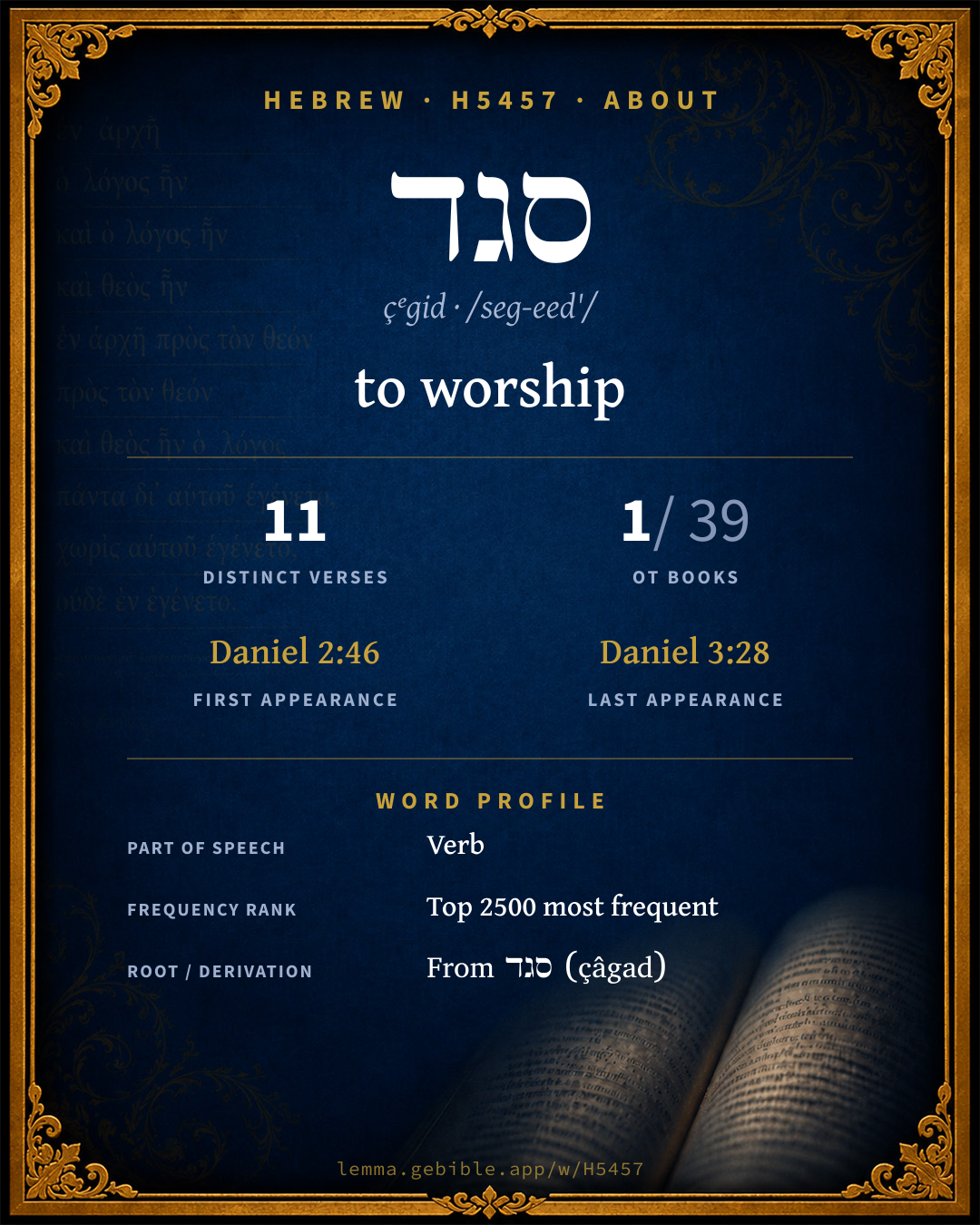
סְגִ֑ד
to worship
‘to worship’ is one of 2 main senses fuller range ↓
Full lexicon entry — Brown-Driver-Briggs (BDB)
From Brown-Driver-Briggs (BDB)
Where this word appears
Grammar key — what these labels mean
Part of speech
- Verb
- An action or state-of-being word.
Stem
- Qal
- The basic, simple active stem — the plain form of the verb (“he wrote”).
Form
- Imperfect
- An incomplete, ongoing, or future action (“he will / would write”).
- Participle Active
- A verbal adjective expressing ongoing or characteristic action (“writing / one who writes”).
- Perfect
- A completed action or state — Hebrew marks aspect (completeness) more than strict tense (“he wrote”).
State
- Absolute
- The independent form of a noun, not bound to a following word.
Person
- 3rd Person
- The one spoken about (“he / she / it / they”).
- 2nd Person
- The one addressed (“you”).
- 1st Person
- The speaker (“I / we”).
Gender
- Masculine
- Grammatically masculine.
- Common
- Either gender — not distinguished for this form.
Number
- Singular
- One.
- Plural
- More than one (in Hebrew, generally three or more).
Grammatical forms
- Verb, Qal, Imperfect, 3rd Person, Masculine, Singular 3 times (25%)
- Verb, Qal, Participle Active, Masculine, Plural, Absolute 3 times (25%)
- Verb, Qal, Imperfect, 2nd Person, Masculine, Plural 3 times (25%)
- Verb, Qal, Imperfect, 1st Person, Common, Plural 1 time (8%)
- Verb, Qal, Imperfect, 3rd Person, Masculine, Plural 1 time (8%)
- Verb, Qal, Perfect, 3rd Person, Masculine, Singular 1 time (8%)
Parsed forms decoded from the imported morphology (morphhb / Westminster Leningrad Codex — WLC text public domain, morphhb tagging CC BY 4.0), counted across 12 parsed occurrences — not distinct verses.
Every verse where H5457 appears — 11 distinct verses across 1 book. Click any verse to open its interlinear word-by-word view. Verse text shown in the World English Bible for context — . Each verse’s Hebrew form is shown with its reference; the English is not keyword-highlighted, since the data carries no word-level English alignment. Use “Compare translations” on any verse to read it across multiple English versions. This concordance covers the Hebrew Bible; Septuagint (Greek Old Testament) occurrences are not indexed here.
Daniel 11 verses
- Daniel 2:46 סְגִ֑ד Qal pf 3ms Then the king Nebuchadnezzar fell on his face, and worshiped Daniel, and commanded that they should offer an offering and sweet odors to him.
- Daniel 3:5 וְ/תִסְגְּדוּן֙ conj + Qal impf 2mp that whenever you hear the sound of the horn, flute, zither, lyre, harp, pipe, and all kinds of music, you fall down and worship the golden image that Nebuchadnezzar the king has set up;
- Daniel 3:6 וְ/יִסְגֻּ֑ד conj + Qal impf 3ms and whoever doesn't fall down and worships shall the same hour be cast into the midst of a burning fiery furnace.
- Daniel 3:7 סָֽגְדִין֙ Qal ptcp.act mp Therefore at that time, when all the peoples heard the sound of the horn, flute, zither, lyre, harp, pipe, and all kinds of music, all the peoples, the nations, and the languages, fell down and worshiped the golden image that Nebuchadnezzar the king had set up.
- Daniel 3:10 וְ/יִסְגֻּ֖ד conj + Qal impf 3ms You, O king, have made a decree, that every man that shall hear the sound of the horn, flute, zither, lyre, harp, pipe, and all kinds of music, shall fall down and worship the golden image;
- Daniel 3:11 וְ/יִסְגֻּ֑ד conj + Qal impf 3ms and whoever doesn't fall down and worship shall be cast into the midst of a burning fiery furnace.
- Daniel 3:12 סָגְדִֽין Qal ptcp.act mp There are certain Jews whom you have appointed over the affairs of the province of Babylon: Shadrach, Meshach, and Abednego; these men, O king, have not regarded you: they don't serve your gods, nor worship the golden image which you have set up.
- Daniel 3:14 סָֽגְדִֽין Qal ptcp.act mp Nebuchadnezzar answered them, Is it on purpose, Shadrach, Meshach, and Abednego, that you don't serve my god, nor worship the golden image which I have set up?
- Daniel 3:15 וְ/תִסְגְּדוּן֮ תִסְגְּד֔וּן conj + Qal impf 2mp Qal impf 2mp Now if you are ready whenever you hear the sound of the horn, flute, zither, lyre, harp, pipe, and all kinds of music to you fall down and worship the image which I have made, [well]: but if you don't worship, you shall be cast the same hour into the midst of a burning fiery furnace; and who is that god that shall deliver you out of my hands?
- Daniel 3:18 נִסְגֻּֽד Qal impf 1cp But if not, be it known to you, O king, that we will not serve your gods, nor worship the golden image which you have set up.
- Daniel 3:28 יִסְגְּדוּן֙ Qal impf 3mp Nebuchadnezzar spoke and said, Blessed be the God of Shadrach, Meshach, and Abednego, who has sent his angel, and delivered his servants who trusted in him, and have changed the king's word, and have yielded their bodies, that they might not serve nor worship any god, except their own God.
About this entry
At a glance — auto-summarized from this page’s data, not written by a person. Every figure links to its source below. This summary describes the numbers; it doesn’t interpret them.
“to worship” is the headline sense of the Hebrew verb סגד (çᵉgid). It clusters heavily in Daniel, which alone accounts for 100% of its uses. It turns up in 11 verses across 1 book, an uncommon footprint. Its earliest occurrence is Daniel 2:46. Lexicons map it across 2 senses. See the sense tree, 11-verse concordance, and the renderings breakdown below.
Gloss history
Strong's 1890 vs modern scholarship
About this word
Strong's H5457 catalogs a Hebrew word from the Hebrew Old Testament.
These counts are not copied from any lexicon or concordance. They are computed here, from the morphology-tagged Hebrew Old Testament. What Lemma adds →
- 11
- distinct verses
- The word appears in 11 distinct verses.
- 1 / 39
- OT books
- The word appears in 1 of 39 Old Testament books.
- #2,101
- by frequency
- Top 2500 most frequent Hebrew words (rank 2,101 of 8,640 Hebrew words by occurrence).
View all 11 occurrences in the concordance →
Most concentrated in
- Daniel 11 verses 100%
By section of the Old Testament
By traditional corpus
Conventional, traditional groupings — biblical authorship is debated, so this is a traditional corpus grouping, not an authorship claim. Each share is this word’s portion of its verses in that division of the Hebrew canon. Each figure is a share of the word’s 11 distinct verses.
- Writings (Ketuvim) 11 verses · 100%
How translations render this word
Counts come from each version’s own published word-to-Strong’s tagging or interlinear alignment — an approximate guide to how each version renders this word, not a word-level alignment the data otherwise carries. Because each total is that version’s own tagged count, the per-version totals vary from one another and need not match the appearance or distinct-verse counts above. These counts may also differ from a printed concordance because Lemma counts each distinctly tagged rendering and does not collapse phrase taggings into a single head-word total. This is a fixed set of word-tagged versions (KJV, ASV, BSB, ULT) and does not change with the reading translation you choose elsewhere. Each version’s license is shown beside its name below (and on Sources).
- King James Version: Worship 7×, Worshipped 2×, Worshippeth 2×
- American Standard Version: Worship 7×, Worshipped 2×, Worshippeth 2×
- Berean Standard Bible: Worship 7×, Or worship 4×
- unfoldingWord Literal Text: Worship 10×
King James Version Public Domain
Renders H5457 across 12 tagged occurrences — most commonly:
Plus 1 rendering that appears only once — usually multi-word phrases or single function words the recovered tagging swept in, not distinct renderings.
American Standard Version Public Domain
Renders H5457 across 12 tagged occurrences — most commonly:
Plus 1 rendering that appears only once — usually multi-word phrases or single function words the recovered tagging swept in, not distinct renderings.
Berean Standard Bible Public Domain
Renders H5457 across 12 tagged occurrences — most commonly:
Plus 1 rendering that appears only once — usually multi-word phrases or single function words the recovered tagging swept in, not distinct renderings.
unfoldingWord Literal Text CC BY-SA 4.0
Renders H5457 across 13 tagged occurrences — most commonly:
Plus 3 renderings that appear only once — usually multi-word phrases or single function words the recovered tagging swept in, not distinct renderings.
Senses in BDB
The 2 senses BDB distinguishes for this word, in lexicon order (not ranked by frequency or importance). The full entry — with sub-senses — is in the Lexicon Entry tab.
- to prostrate oneself, do homage, worship
- (Peal) to do homage
Word origin
סְגִ֑ד vb. do homage
— Brown-Driver-Briggs (Oxford 1906, public domain), digitized via Sefaria, supplemented by the OpenScriptures HebrewLexicon (CC BY 4.0). See Sources.
Derived from סגד (çâgad) (H5456) — to prostrate.
Jastrow Dictionary
A second Hebrew/Aramaic lexicon for comparison, covering Aramaic and post-biblical (Talmudic, Targumic, Midrashic) usage that the biblical-Hebrew BDB does not. Matched by lemma rather than by Strong’s number, so a lemma may carry more than one Jastrow headword (shown separately below), and the entries cover usage well beyond the Bible.
סְגַד
- to bend, bow; to worship. Targ. Gen. XXIV, 26. Targ. O. ib. XXVII, 7; a. fr.—Part. סָגֵיד, pl. סְגִידִין. Targ. II Esth. III, 2; a. e.—Gen. R. s. 38, end ווי ליה … ובעי למִסְגַּד לבר יומיה woe to that man who is sixty years old and wants to bow to an idol made to-day!; Yalk. ib. 62 למִסְגֹּור להדין דעביד יומא דין. Ib. נִסְגֹּוד לנורא … נסגוד וכ׳ let us worship the fire; said he to him, let us worship the water which extinguishes the fire. Cant. R. to II, 5 מִסְגֵּיד, v. פְּחִיתָא; a. fr.—Ḥull. 62ᵇ סָגֵיד, v. זָגֵיד.
A Dictionary of the Targumim, the Talmud Babli and Yerushalmi, and the Midrashic Literature (Marcus Jastrow; London, Luzac, 1903) — Public Domain. Digitized via Sefaria. Digitized via Sefaria. Full attribution on Sources.
Forms in the corpus
The 11 distinct written forms H5457 takes in the Hebrew Bible, most frequent first — each parse links to that stem’s occurrences in the concordance. Hebrew forms include their vowel points and cantillation, so a single lemma takes many written forms.
| Form | Parsing | Example | Uses |
|---|---|---|---|
| וְ/יִסְגֻּ֑ד | Verb, Qal, Imperfect, 3rd Person, Masculine, Singular | Daniel 3:6 | 2 |
| וְ/יִסְגֻּ֖ד | Verb, Qal, Imperfect, 3rd Person, Masculine, Singular | Daniel 3:10 | 1 |
| וְ/תִסְגְּדוּן֙ | Verb, Qal, Imperfect, 2nd Person, Masculine, Plural | Daniel 3:5 | 1 |
| וְ/תִסְגְּדוּן֮ | Verb, Qal, Imperfect, 2nd Person, Masculine, Plural | Daniel 3:15 | 1 |
| יִסְגְּדוּן֙ | Verb, Qal, Imperfect, 3rd Person, Masculine, Plural | Daniel 3:28 | 1 |
| נִסְגֻּֽד | Verb, Qal, Imperfect, 1st Person, Common, Plural | Daniel 3:18 | 1 |
| סְגִ֑ד | Verb, Qal, Perfect, 3rd Person, Masculine, Singular | Daniel 2:46 | 1 |
| סָֽגְדִֽין | Verb, Qal, Participle Active, Masculine, Plural, Absolute | Daniel 3:14 | 1 |
| סָֽגְדִין֙ | Verb, Qal, Participle Active, Masculine, Plural, Absolute | Daniel 3:7 | 1 |
| סָגְדִֽין | Verb, Qal, Participle Active, Masculine, Plural, Absolute | Daniel 3:12 | 1 |
| תִסְגְּד֔וּן | Verb, Qal, Imperfect, 2nd Person, Masculine, Plural | Daniel 3:15 | 1 |
Septuagint verse parallels
This word appears in 11 verses that also exist in the Greek Old Testament (Septuagint), out of the 11 Hebrew verses it occurs in. You can read those verses in Greek by switching the Old Testament edition to the Septuagint.
Read these verses in the Septuagint
This is a verse-level parallel only — the same verses exist in both the Hebrew and Greek Old Testaments. No word-level Hebrew↔Greek correspondence is claimed: the data carries no such alignment, so no Greek word is shown as this Hebrew word’s translation. Coverage is not total — the Septuagint omits the deuterocanon and renumbers the Psalms, so some Hebrew verses have no direct Greek parallel.