Acts 13:49

Greek (Tischendorf 8th ed.) Acts 13:49 appears in the Greek New Testament. The text above is from the Tischendorf 8th edition. Each word links to its Strong’s number and a concise gloss. Click any word for its full Thayer’s Greek Lexicon entry.
Download image
Cite this verse

Acts 13:49 (World English Bible). Public Domain. Lemma interlinear Bible study tool, https://lemma.gebible.app/v/acts/13/49.

Show BibTeX & RIS
BibTeX
RIS
English Translation
The Lord's word was spread abroad throughout all the region.
World English Bible · Public Domain
Download a study sheet

One document with this verse’s original text, its word-by-word gloss line, the meaning frame, cross-references with their text, attributed commentary, and full source and license credits — printable, and it pastes into notes with its structure intact.

This verse Autodidact and up

Study sheet (.html) Plain text (.txt)

A passage Seminary Student

Up to 50 verses in one chapter. A passage sheet keeps up to 6 commentary sources and 12 cross-references per verse, in the order this page ranks them, and says so on the sheet whenever that leaves anything out. Ask for a single verse and you get the Autodidact verse sheet above.

Everything on this page stays free to read, with no account — the sheet is a download of what is already on screen, not access to it.

Want to remove ads? Support Godless Engineer
Compare translations 3

The same verse in 3 English versions, stacked beneath the original-language interlinear above. Click any original word for its lexicon entry.

Each is an independent rendering of the whole verse — the interlinear is not word-aligned to these translations.

Highlighted words mark where these versions differ — a whole-verse word diff, not a word-by-word alignment.

  • World English Bible Public Domain
    The Lord's word was spread abroad throughout all the region.
  • King James Version Public Domain
    And the word of the Lord was published throughout all the region.
  • unfoldingWord Literal Text CC BY-SA 4.0
    And the word of the Lord was being spread throughout the whole region.

unfoldingWord Literal Text — © unfoldingWord, licensed CC BY-SA 4.0. Word-aligned USFM3 via Door43 (git.door43.org/unfoldingWord/en_ult).

Versions to compare (up to 4)

3 of 4 selected

Show all 19 translations

Every available English version of this verse, each an independent rendering of the whole verse.

  • World English Bible Public Domain
    The Lord's word was spread abroad throughout all the region.
  • Berean Standard Bible Public Domain
    And the word of the Lord spread throughout that region.
  • Majority Standard Bible Public Domain
    And the word of the Lord spread throughout that region.
  • King James Version Public Domain
    And the word of the Lord was published throughout all the region.
  • American Standard Version (1901) Public Domain
    And the word of the Lord was spread abroad throughout all the region.
  • Revised Version (1885) Public Domain
    And the word of the Lord was spread abroad throughout all the region.
  • Geneva Bible (1599) Public Domain
    Thus the worde of the Lord was published throughout the whole countrey.
  • Douay-Rheims (1899) Public Domain
    And the word of the Lord was published throughout the whole country.
  • Young's Literal Translation Public Domain
    and the word of the Lord was spread abroad through all the region.
  • Literal Standard Version CC BY-SA 4.0
    and the word of the LORD was spread abroad through all the region.
  • Unlocked Literal Bible CC BY-SA 4.0
    The word of the Lord was spread out through the whole region.
  • unfoldingWord Literal Text CC BY-SA 4.0
    And the word of the Lord was being spread throughout the whole region.
  • Darby Bible Public Domain
    And the word of the Lord was carried through the whole country.
  • World Messianic Bible Public Domain
    The Lord’s word was spread abroad throughout all the region.
  • Webster's Bible Public Domain
    And the word of the Lord was published throughout all the region.
  • Free Bible Version CC BY-SA 4.0
    So God's word was spread throughout the region.
  • Bible in Basic English Public Domain
    And the word of the Lord went through all the country.
  • Text-Critical English NT CC BY 4.0
    So the word of the Lord spread throughout that entire region.
  • Tyndale New Testament (1534) Public Domain
    And the worde of the Lorde was publisshed thorowe oute all the region.

Literal Standard Version (2020), Covenant Press — licensed CC BY-SA 4.0. Text via the HelloAO Bible API (eBible.org). Unlocked Literal Bible (unfoldingWord) — licensed CC BY-SA 4.0. Text via the HelloAO Bible API (eBible.org). unfoldingWord Literal Text — © unfoldingWord, licensed CC BY-SA 4.0. Word-aligned USFM3 via Door43 (git.door43.org/unfoldingWord/en_ult). Free Bible Version, Dr. Jonathan Gallagher — licensed CC BY-SA 4.0. Text via the HelloAO Bible API (eBible.org).

Word by word

More ways to search: Search by grammar → Find every occurrence → Compare this word →

Practice this passage: Drill this verse → Learn its vocabulary →

διεφέρετο
diaphérō
G1308
“to carry through”
Verb, Imperfect, Passive, Indicative, 3rd person, Singular
Part of Speech
Verb
Tense
Imperfect
Voice
Passive
Mood
Indicative
Person
3rd person
Number
Singular
Full Thayer's Definition

Origin: from G1223 and G5342

TDNT: 10:02,1

1. to bear or carry through any place 2. to carry different ways a. to carry in different directions, to different places 1. of people who are carried hither and thither in a ship, driven to and fro b. to differ, to test, prove, the good things that differ, 1. to distinguish between good and evil, lawful and unlawful, to approve of things that excel, to differ from one 2. to excel, surpass one c. impersonally, it makes a difference, it matters, is of importance
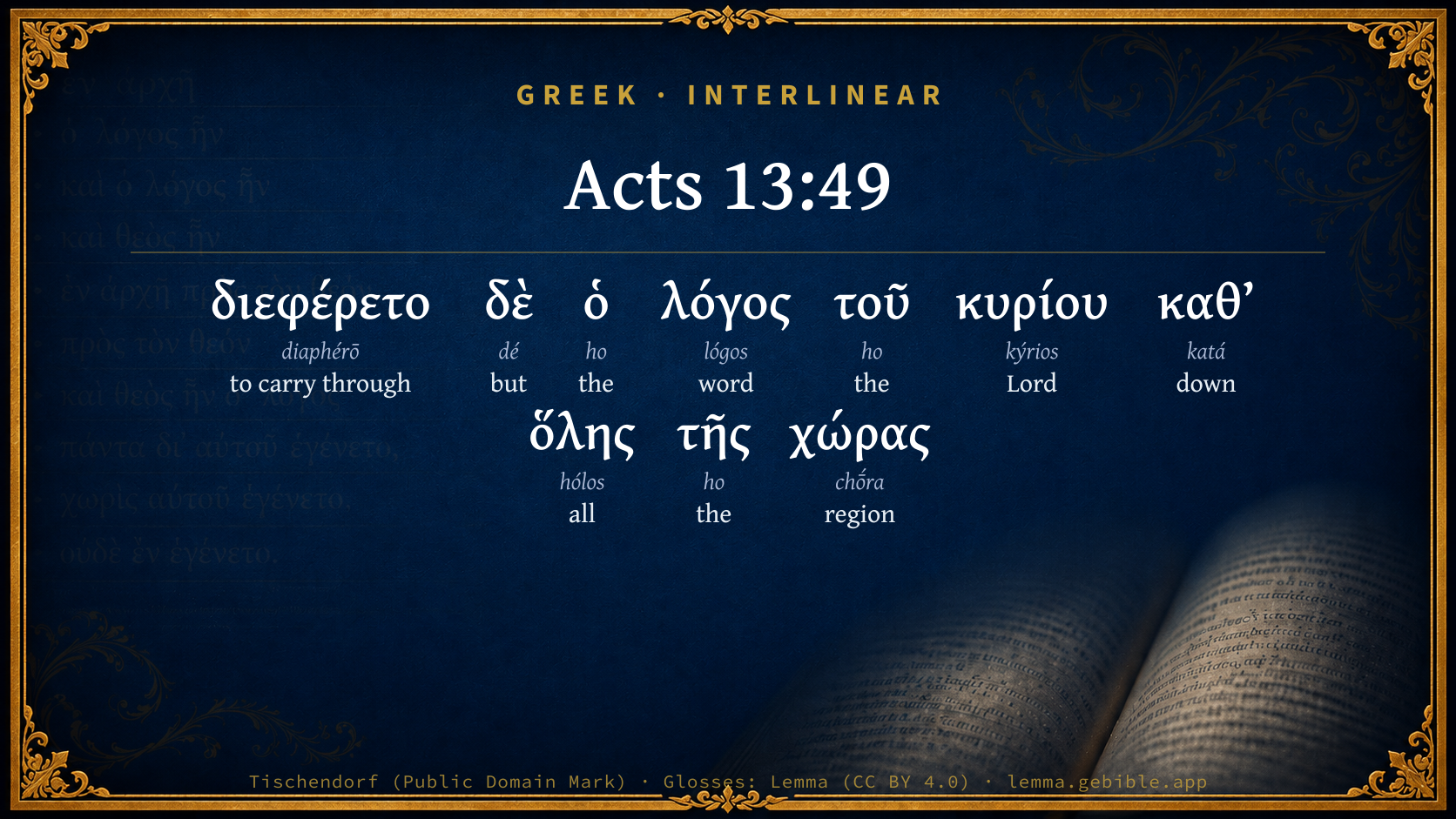
  1. δὲ dé G1161 “but” Conjunction
  2. ὁ ho G3588 “the” Article, Nominative, Singular, Masculine
  3. λόγος lógos G3056 “word” Noun, Nominative, Singular, Masculine
  4. τοῦ ho G3588 “the” Article, Genitive, Singular, Masculine
  5. κυρίου kýrios G2962 “Lord” Noun, Genitive, Singular, Masculine
  6. καθ’ katá G2596 “down” Preposition
  7. ὅλης hólos G3650 “all” Adjective, Genitive, Singular, Feminine
  8. τῆς ho G3588 “the” Article, Genitive, Singular, Feminine
  9. χώρας chṓra G5561 “region” Noun, Genitive, Singular, Feminine

About this verse

These counts appear in no published source. They are computed here, from the morphology-tagged text and Lemma’s own curated glosses. What Lemma adds →

10
words
8
distinct lemmas
Acts
section

Notable vocabulary

The rarest word here is διεφέρετο to carry through G1308 — appearing just 13 times in the whole Greek New Testament.

Shared distinctive vocabulary

διεφέρετο to carry through G1308 occurs in 13 verses of the Greek New Testament. Also found in:

Repetition

A word recurs within this verse:

Cross-references

6

Topical passages linked to Acts 13:49 in the Treasury of Scripture Knowledge — connected by theme and wording, ordered by reader-vote popularity; previews shown in the World English Bible.

  • Acts 12:24 But the word of God grew and multiplied.
  • Acts 19:10 This continued for two years, so that all those who lived in Asia heard the word of the Lord Jesus, both Jews and Greeks.
  • Acts 6:7 The word of God increased and the number of the disciples multiplied in Jerusalem exceedingly. A great company of the priests were obedient to the faith.
  • Acts 9:42 And it became known throughout all Joppa, and many believed in the Lord.
  • Acts 19:26 You see and hear, that not at Ephesus alone, but almost throughout all Asia, this Paul has persuaded and turned away many people, saying that they are no gods, that are made with hands.
  • Philippians 1:13–14 so that it became evident to the whole praetorian guard, and to all the rest, that my bonds are in Christ;

Cross-references courtesy of OpenBible.info (CC BY 4.0).

Commentary

Notes on Acts 13:49 from classic Christian and Jewish commentators (each source and its license shown beneath its notes). The classic Christian expositions comment on the surrounding passage and are grouped to its opening verse, so a note may address several verses; the Jewish commentaries on the Tanakh (Rashi and others) are per-verse, so they appear only where the commentator wrote on this verse.

Lemma curates 59 commentaries, every one of them public domain or Creative Commons licensed, each selected and text-cleaned for this edition rather than reprinted as found. About our sources →

The Biblical Illustrator

Joseph S. Exell

Act_13:49

And the Word of the Lord was published throughout all the region.

Gospel missions

We feel persuaded that all of you are of one mind in this matter, that it is the duty as well as the privilege of the Church to proclaim the gospel to the world. But we have not been successful to the extent we might have expected. What is the reason of this? Perhaps we may think we find that reason in the sovereignty of God. But still we must look at home for the cause. When Zion travails, she brings forth children; when Zion is in earnest, God is in earnest about His work. We must not, therefore, arbitrarily look for the cause of our failure in the will of God, but we must see what it is that renders our success so trifling in comparison with the tremendous results of apostolic preaching.

I. We have few apostolic men. Here and there we may have one or two. We had a Williams, we had a Knibb, but they have entered into rest. We have one or two still remaining. We say, God bless such men as Moffatt! But cast your eyes around, and where can we find many such men? They are all good men; they are better than we; but we must still say of them that they differ from the mighty apostles in many respects. I am not speaking of missionaries only, but of ministers too. We have not men with--

1. Apostolic zeal. Converted in a most singular way, by a direct interposition from heaven, Paul, from that time forward, became an earnest man. He had always been earnest, in his sin and in his persecutions; but after he had received the mighty office of an apostle you can scarcely conceive the awful earnestness which he manifested. His zeal was so burning, that he could not (as we unfortunately do) restrain himself within a little sphere; but he preached the Word everywhere. Where are the men like that man? We have no eyes now like the eyes of the Saviour, which could weep over Jerusalem. If ministers were more hearty in their work of preaching, then we might expect great success; but we cannot expect it while we go about our work in a half-hearted way.

2. Apostolic faith. What did Paul do? He went to Philippi; did he know a soul there? No. He had his Masters truth, and he believed in the power of it. He was devoid of pomp, or show, or parade; he did not go to a pulpit with a nice cushion in it to address a respectable congregation, but he walked through the streets and began to preach to the people. He went to Corinth, to Athens, alone, single-handed, to tell the people the gospel of the blessed God. Why? Because he had faith in the gospel and believed it would save souls, and throw down idols from their thrones. But nowadays we have not faith in the gospel we preach. How many there are who preach a gospel which they are afraid wont save souls; they insert little bits of their own to it in order, as they think, to win men to Christ! When I have faith in my doctrines, those doctrines will prevail, for confidence is the winner of the palm. He who hath courage enough to grasp the standard, and hold it up, will be sure enough to find followers. We want a deeper faith in our gospel; we want to be quite sure of what we preach

3. Apostolic self-denial. We are mere carpet knights and Hyde-park warriors. But I hear some whispering, You ought to make a little allowance. I make all allowance. I am not finding fault with those brethren; they are a good sort of people; but I will only say, that in comparison with Paul, we are little insignificant Lilliputian creatures, who can hardly be seen in comparison with those gigantic men of old.

II. We do not go about our work in an apostolic style.

1. There is not enough preaching by ministers and missionaries. They sit down interpreting, establishing schools, and doing this, that, and the other. It is the tendency of the times to decry preaching, but it is the foolishness of preaching which is to change the world.

2. A great mistake has been made in not affirming the divinity of our mission, always holding out this, he that believeth and is baptized shall be saved; he that believeth not shall be damned. The gospel is lowered by controversy. How did Mahommed come to have so strong a religion? He said, I have received a revelation from heaven. It was a lie, but he persuaded men to believe it. Did he prove what he said? Not he. You must, he said, believe what I say, or there is no Paradise for you. There is a power in that kind of thing.

3. We have not enough of the Divine method of itinerancy. Paul was a great itinerant; he preached in one place, and there were twelve converted there; he made a church at once; he did not stop till he had five hundred; but when be had twelve, he went off to another place. We, nowadays, go and settle in a place, make a station of it, and work around it by little and little, and think that is the way to succeed. No, no! ravage a continent; attempt great things, and great things shall be done. There should be fixed ministers and pastors, but those who are like apostles should itinerate far more than they do.

III. We have not apostolic churches.

1. Where is our prayerfulness compared with theirs?

2. We have not the apostolic mode of liberality. In the apostles days they gave all their substance. It was not demanded of them then, and it is not now; still we have run to the other extreme, and many give nothing at all.

IV. We have not the Holy Spirit in that measure which attended the apostles. (C. H. Spurgeon.)

The Biblical Illustrator, edited by Joseph S. Exell (c. 1880s–1900s) — public domain. Text from a community e-Sword module.

Joseph Benson's Commentary

Act 13:49-52. And the word of the Lord was published throughout all that region — Paul and Barnabas, it seems, during their stay at Antioch, made excursions into the neighbouring country, for the sake of preaching to the idolatrous Gentiles; or the people who came from the country to Antioch, and believed the doctrine preached by Paul and Barnabas, carried the glad tidings of salvation home with them. From this time forth it appears in all the Gentile countries. Paul, after preaching to the Jews, constantly offered salvation to the Gentiles, and by so doing fulfilled the commission which he had received from Christ, when he made him his apostle to the Gentiles. But the Jews stirred up the devout, &c. — The unbelieving Jews in Antioch, greatly enraged at the success with which Paul and Barnabas preached to the Gentiles, stirred up some women of considerable rank, who, having been proselyted to their religion, were peculiarly zealous for it; and the chief men of the city — Also, who probably were the husbands of these proselyted women; raised persecution against Paul and Barnabas — Representing them, doubtless, as exciters of sedition, and innovators in religion, who might occasion danger to the state; and expelled them out of their coasts — Out of the territory belonging to Antioch. But they shook off the dust of their feet — For a testimony against them; as Christ had commanded his apostles to do, in token of the certain ruin which should befall such despisers of his gospel. See on Mat 10:14. And came unto Iconium — Where they renewed the proclamation of those glad tidings, which many of the inhabitants of Antioch had so ungratefully rejected. This place lay on the western border of Lycaonia, and on the confines of Pisidia, Galatia, and Phrygia; to the latter of which it seems once to have belonged. See Raphelius. And the disciples — Who remained at Antioch; were filled with joy — That so blessed a message as that which Paul and Barnabas had brought them, had reached their ears, and been received by them; and with the Holy Ghost — With his enlightening, sanctifying, and comforting influences, and probably also with, at least, some of his extraordinary gifts; confirming them in the faith which they had newly embraced; and likewise qualifying them for carrying on the cause of Christ in that place, when the first planters of their church could no longer continue to cultivate and water it.

Joseph Benson's Commentary on the Old and New Testaments (1811–1818) — public domain. Text from a community e-Sword module.

Expositor's Greek Testament

ed. W. Robertson Nicoll

Act 13:49 . διεφέρετο ; divulgabatur , “was spread abroad,” R.V.; not only by the preaching of the Apostles themselves, but by small knots of Christians in other towns, see Ramsay, St. Paul , p. 105, and so Blass, in loco ; only here in N.T. in this sense, so in ( Wis 18:10 ) Plut.; Lucian; imperfect, a certain lapse of time is implied, see Ramsay, St. Paul , p. 105. ὅλης τῆς χώρας : the phrase, “the whole Region ,” indicates that Antioch was the centre of a Region , a notice which introduces us to an important fact of Roman imperial administration. Antioch, as a Roman colony, would be the natural military and administrative centre of a certain Regio , and there is evidence that in Southern Galatia there were also other distinct Regiones , χῶραι , Ramsay, St. Paul , pp. 102 104, 109, 110 112.

The Expositor's Greek Testament, edited by W. Robertson Nicoll (1897–1910) — public domain. Text from a community e-Sword module.

Jamieson, Fausset & Brown

Robert Jamieson, A. R. Fausset & David Brown

And the word of the Lord was published throughout all the region--implying some stay in Antioch and missionary activity in its vicinity.

Jamieson, Fausset & Brown — Commentary Critical and Explanatory on the Whole Bible (1871) — public domain (CC PDM 1.0). Text via the HelloAO Bible API.

Adam Clarke's Commentary

Verse 49. The word of the Lord was published, c.] Those who had come from different parts, and were converted, carried the glad tidings to their respective neighbourhoods and thus the doctrine was published throughout all the region of Pisidia, where they then were. See Clarke on Ac 13:44.

Adam Clarke's Commentary on the Bible (1810–1826) — public domain. Text from a community e-Sword/MySword module.

John Calvin's Commentaries

49. The word of the Lord was spread abroad. Luke doth in this place declare the proceeding of the gospel; wherein appeareth how true the parable of Christ is, when he saith that it is like to leaven, (Luke 13:21.) We heard before that there was great concourse of people, so that the seed of true doctrine was sown throughout the whole city. Luke saith now that it was spread farther, to wit, throughout the whole country.

John Calvin's Commentaries (1540-1563) — public domain. Text from the Calvin Translation Society English edition (1840s-50s) via the Christian Classics Ethereal Library (ccel.org). Calvin's coverage is partial (roughly two-thirds of the Bible); uncommented books and verses are honest gaps, never fabricated. The 19th-century editor's footnotes and remarks are omitted so the notes are faithfully Calvin's own voice.

Ellicott's Commentary for English Readers

(49) Throughout all the region.—This clearly involves a considerable period of active working. It was not in Antioch only, but in the “region” round about, the border district of the three provinces of Phrygia, Lycaonia, and Galatia, that the new faith was planted. Each town and village in that region presented the spectacle of at least some few men and women who no longer sacrificed to their country’s gods, who were no longer content even to worship in the synagogue of the relligio licita of the Jews, but met in small companies here and there, as the disciples of a new Master.

A Bible Commentary for English Readers, edited by Charles John Ellicott (1878–1897) — public domain. Text from a community e-Sword module.

John Gill's Exposition

And the disciples were filled with joy,.... Meaning either the "apostles", as the Ethiopic version renders it, Paul and Barnabas; who rejoiced, both at the success they had met with, and because they were counted worthy to suffer reproach and persecution for the sake of Christ and his Gospel: or rather the disciples at Antioch, and other parts of Pisidia, the new converts; who were filled with joy at the Gospel being preached unto them, and at the constancy and courage of the apostles in suffering for it:

and with the Holy Ghost; which, with the former, designs the same thing as spiritual joy, or joy in the Holy Ghost; or else the gifts and graces of the Spirit, which they had both for their own comfort, and the advantage of others.

Next: Acts Chapter 14

John Gill's Exposition of the Whole Bible (1746–1763) — public domain (CC PDM 1.0). Text via the HelloAO Bible API.

Trapp's Complete Commentary

John Trapp

49 And the word of the Lord was published throughout all the region.

Ver. 49. And the word of the Lord] It ran and was glorified, as the apostle hath it. So fitly is it compared to leaven, for its spreading property, Mat 13:33. {See Trapp on "Mat 13:33"}

John Trapp, A Commentary or Exposition upon All the Books of the Old and New Testament (1647–1656) — public domain. Text from a community e-Sword module.

Matthew Poole's English Annotations

The word of the Lord, concerning salvation to be found only by Christ, and the Gentiles to be admitted to partake of that salvation.

Was published throughout all the region; like leaven, which a woman took, and hid in three measures of meal, till the whole was leavened, Mat 13:33.

Matthew Poole's English Annotations on the Holy Bible (1683–1685) — public domain. Text from a community e-Sword/MySword module.

Whedon's Commentary on the Bible

Daniel D. Whedon

49. Word… published… all the region—This Romanized city of Antioch applied the old pagan Latin language, with all possible flexibility, to uses it had never known before, to thoughts of faith, and joy, and love new to the Roman soul.

Daniel D. Whedon (gen. ed.), Commentary on the Old and New Testaments (1874–1909) — public domain. Text from a community e-Sword module.

The Pulpit Commentary

Spread abroad for published, A.V. As the persecution after the death of Stephen led to the preaching of the Word in Judaea and Samaria and beyond, so here the contradiction and opposition of the Jews led to the free preaching of the gospel for the first time among the heathen population of Pisidia.

The Pulpit Commentary (1880–1919), ed. H.D.M. Spence-Jones & Joseph S. Exell — public domain. Text from a community e-Sword module.

McGarvey & Pendleton's Commentaries

J. W. McGarvey

49-52. The animosity of the Jews, excited by the success of the apostles, finally resulted in their expulsion from the city. The account is given in brief terms: (49) " And the word of the Lord was published throughout the whole region. (50) But the Jews stirred up the devout and honorable women, and the chief men of the city, and raised a persecution against Paul and Barnabas, and expelled them from their borders. (51) And they, shaking off the dust of their feet against them, went into Iconium. (52) But the disciples were full of joy and the Holy Spirit. " The means by which this persecution was brought about serves to illustrate the relation which the Jews who were settled in Gentile cities sustained to the surrounding society. They had no political power in their own hands, and dared not lay violent hands upon the apostles. But certain "honorable women," wives of the "chief men of the city," had come under their influence by attending the synagogue worship, and through them they gained access to their unbelieving husbands so as to induce them to expel Paul and Barnabas. It is a suggestive fact, that the women who were made instruments of a transaction so discreditable are styled " devout women." It shows that devotion in the worship of God, like zeal when not according to knowledge, may be made to do the devil's own work. The more devout one's feelings, while his mind is corrupted by false conceptions of duty, the greater mischief he is likely to do; so far is it from being true, that to make the heart right is to make the whole man right. No man is safe without a proper understanding of his duty, derived from the word of God.

Paul and Barnabas were not without indignation when they were thus ignominiously expelled from the city; but the only exhibition which they made of it was that which the Savior had directed; "they shook off the dust of their feet against them." This was not a mere idle or childish mark of resentment, as it would be in an uninspired teacher; but was designed as "a testimony against them," a solemn warning of the righteous judgment of God, whom they had rejected in rejecting his chosen messengers.

We would imagine that the young disciples, from whom their religious teachers were thus violently driven away, would have been overwhelmed with grief and fear. But we are told, as quoted above, that they were "filled with joy and with the Holy Spirit." The full assurance given by the gospel of that everlasting life which they had "determined for," and the belief that the Spirit of God dwelt in their mortal bodies, supplied them with a joy which was no longer dependent on human agency, and of which human power could not deprive them.

J. W. McGarvey (with Philip Y. Pendleton), Commentaries on the New Testament (The Fourfold Gospel, 1914; Acts; and the epistles) — public domain. Text from a community e-Sword/MySword module.

Lesson kit

Teaching starters — assembled from the data on this page, not authored interpretation. Every prompt links to the verse data it draws on. Edit before teaching.

Acts, in the Acts, opens this verse with 10 words (8 distinct Greek lemmas). Its most distinctive word is diaphérō (“to carry through”). A historical commentator’s framing appears above. Read the whole chapter for the surrounding context.

Discussion questions

  1. What does “to carry through” (diaphérō) contribute to the verse as a whole?
  2. Matthew 6:26 shares the word «to carry through» with this verse. How do the two illuminate each other?
  3. “the” occurs 3× in this one verse. What is the effect of the repetition?
  4. These translations render this verse differently; the difference is in the English rendering, not the original. What questions does that raise?
  5. Reading how The Biblical Illustrator and Joseph Benson's Commentary read this verse, where do the two commentators agree and where do they part?

Things to notice

  • These translations choose different wording for 8 words in this verse.
  • “the” occurs 3× in this single verse.
  • 8 distinct Greek lemmas span 10 words in this verse.

Reading settings

Reading text

Shown beneath each verse's original-language words.

Old Testament
Old Testament edition

Read the OT as the Masoretic Hebrew (MT) or the Greek Septuagint (LXX).

English shown for the Greek Septuagint (in the Hebrew ↔ Greek comparison).

Comparing translations? Open the Compare panel on any verse page to stack up to four side by side.