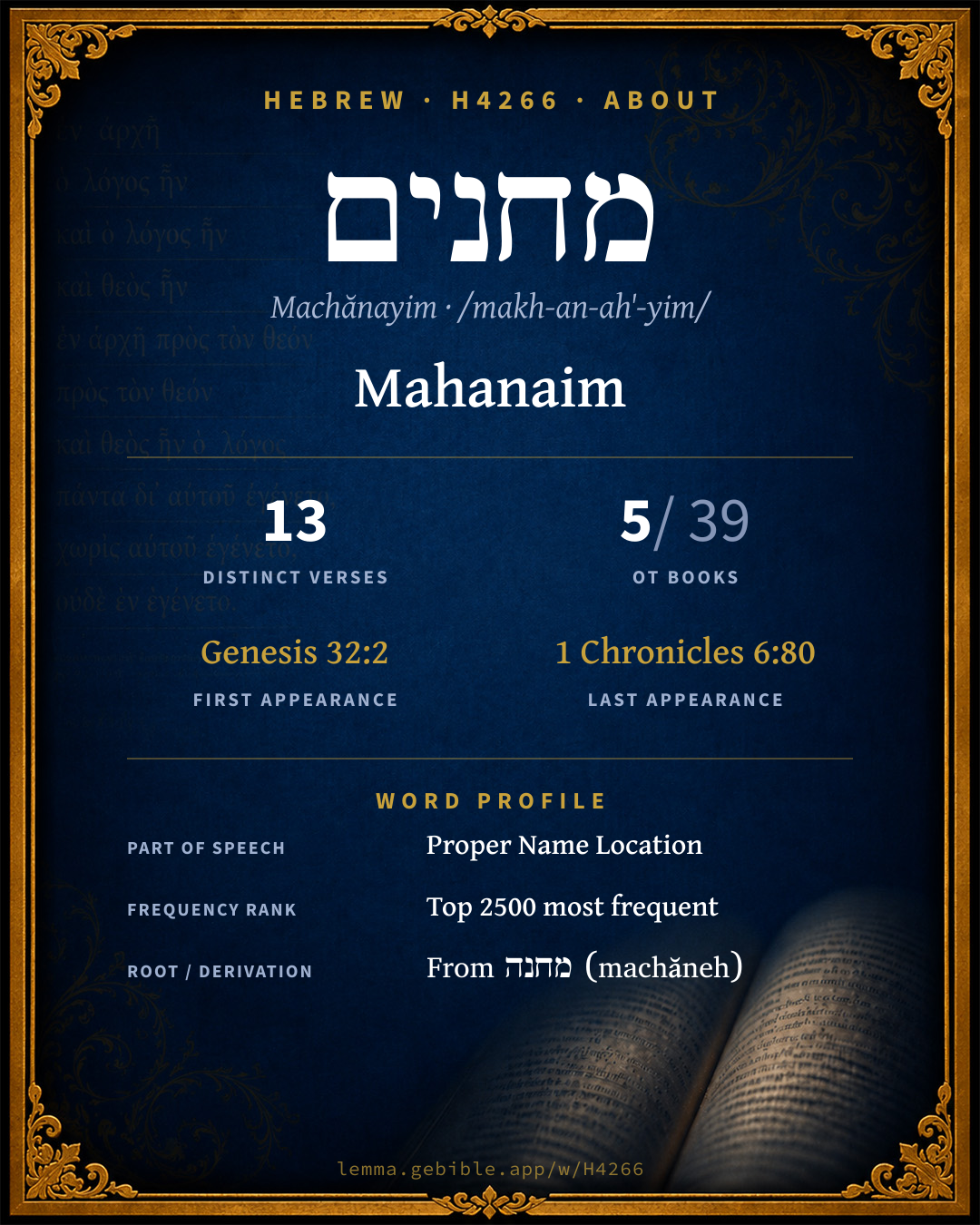
מַחֲנַיִם
Mahanaim
BDB lists 3 entries for ‘Mahanaim’ fuller range ↓
Full lexicon entry — Brown-Driver-Briggs (BDB)
From Brown-Driver-Briggs (BDB)
Where this word appears
Grammar key — what these labels mean
Part of speech
- Noun
- A naming word — a person, place, thing, or idea.
Noun type
- Proper
- A name of a specific person, place, or people (e.g. Abraham, Zion, Israel).
Every verse where H4266 appears — 13 distinct verses across 5 books. Click any verse to open its interlinear word-by-word view. Verse text shown in the World English Bible for context — . Each verse’s Hebrew form is shown with its reference; the English is not keyword-highlighted, since the data carries no word-level English alignment. Use “Compare translations” on any verse to read it across multiple English versions. This concordance covers the Hebrew Bible; Septuagint (Greek Old Testament) occurrences are not indexed here.
Genesis 1 verse
Joshua 3 verses
- Joshua 13:26 וּ/מִֽ/מַּחֲנַ֖יִם conj + prep + n Proper and from Heshbon to Ramath Mizpeh, and Betonim; and from Mahanaim to the border of Debir;
- Joshua 13:30 מִ/מַּחֲנַ֨יִם prep + n Proper Their border was from Mahanaim, all Bashan, all the kingdom of Og king of Bashan, and all the towns of Jair, which are in Bashan, sixty cities:
- Joshua 21:38 מַחֲנַ֖יִם n Proper Out of the tribe of Gad, Ramoth in Gilead with its suburbs, the city of refuge for the manslayer, and Mahanaim with its suburbs,
2 Samuel 6 verses
- 2 Samuel 2:8 מַחֲנָֽיִם n Proper Now Abner the son of Ner, captain of Saul's host, had taken Ish-bosheth the son of Saul, and brought him over to Mahanaim;
- 2 Samuel 2:12 מִֽ/מַּחֲנַ֖יִם prep + n Proper Abner the son of Ner, and the servants of Ish-bosheth the son of Saul, went out from Mahanaim to Gibeon.
- 2 Samuel 2:29 מַחֲנָֽיִם n Proper Abner and his men went all that night through the Arabah; and they passed over the Jordan, and went through all Bithron, and came to Mahanaim.
- 2 Samuel 17:24 מַחֲנָ֑יְמָ/ה n Proper + sfx dem Then David came to Mahanaim. Absalom passed over the Jordan, he and all the men of Israel with him.
- 2 Samuel 17:27 מַחֲנָ֑יְמָ/ה n Proper + sfx dem It happened, when David was come to Mahanaim, that Shobi the son of Nahash of Rabbah of the children of Ammon, and Machir the son of Ammiel of Lodebar, and Barzillai the Gileadite of Rogelim,
- 2 Samuel 19:32 בְ/מַחֲנַ֔יִם prep + n Proper Now Barzillai was a very aged man, even eighty years old: and he had provided the king with sustenance while he lay at Mahanaim; for he was a very great man.
1 Kings 2 verses
- 1 Kings 2:8 מַחֲנָ֑יִם n Proper Behold, there is with you Shimei the son of Gera, the Benjamite, of Bahurim, who cursed me with a grievous curse in the day when I went to Mahanaim; but he came down to meet me at the Jordan, and I swore to him by Yahweh, saying, I will not put you to death with the sword.
- 1 Kings 4:14 מַחֲנָֽיְמָ/ה n Proper + sfx dem Ahinadab the son of Iddo, in Mahanaim;
1 Chronicles 1 verse
About this entry
At a glance — auto-summarized from this page’s data, not written by a person. Every figure links to its source below. This summary describes the numbers; it doesn’t interpret them.
“Mahanaim” is the headline sense of the Hebrew name מחנים (Machănayim). First canonically at Genesis 32:2, it enters the text early. With 13 verses in 5 books, it is an uncommon word in the Hebrew Bible. It concentrates in 2 Samuel, which alone accounts for 46% of its uses. The sections below give every occurrence and version rendering.
Gloss history
Strong's 1890 vs modern scholarship
About this word
Strong's H4266 catalogs a Hebrew word from the Hebrew Old Testament.
These counts are not copied from any lexicon or concordance. They are computed here, from the morphology-tagged Hebrew Old Testament. What Lemma adds →
- 13
- distinct verses
- The word appears in 13 distinct verses.
- 5 / 39
- OT books
- The word appears in 5 of 39 Old Testament books.
- #2,001
- by frequency
- Top 2500 most frequent Hebrew words (rank 2,001 of 8,640 Hebrew words by occurrence).
View all 13 occurrences in the concordance →
By section of the Old Testament
By traditional corpus
Conventional, traditional groupings — biblical authorship is debated, so this is a traditional corpus grouping, not an authorship claim. Each share is this word’s portion of its verses in that division of the Hebrew canon. Each figure is a share of the word’s 13 distinct verses.
- Prophets (Nevi'im) 11 verses · 85%
- Torah (Pentateuch) 1 verse · 8%
- Writings (Ketuvim) 1 verse · 8%
How translations render this word
Counts come from each version’s own published word-to-Strong’s tagging or interlinear alignment — an approximate guide to how each version renders this word, not a word-level alignment the data otherwise carries. Because each total is that version’s own tagged count, the per-version totals vary from one another and need not match the appearance or distinct-verse counts above. These counts may also differ from a printed concordance because Lemma counts each distinctly tagged rendering and does not collapse phrase taggings into a single head-word total. This is a fixed set of word-tagged versions (KJV, ASV, BSB, ULT) and does not change with the reading translation you choose elsewhere. Each version’s license is shown beside its name below (and on Sources).
- King James Version: Mahanaim 11×
- American Standard Version: Mahanaim 12×
- Berean Standard Bible: Mahanaim 13×
- unfoldingWord Literal Text: Mahanaim 13×
King James Version Public Domain
Renders H4266 across 13 tagged occurrences — most commonly:
Plus 2 renderings that appear only once — usually multi-word phrases or single function words the recovered tagging swept in, not distinct renderings.
American Standard Version Public Domain
Renders H4266 across 13 tagged occurrences — most commonly:
Plus 1 rendering that appears only once — usually multi-word phrases or single function words the recovered tagging swept in, not distinct renderings.
Berean Standard Bible Public Domain
Renders H4266 across 13 tagged occurrences — most commonly:
unfoldingWord Literal Text CC BY-SA 4.0
Renders H4266 across 13 tagged occurrences — most commonly:
Senses in BDB
The 3 senses BDB distinguishes for this word, in lexicon order (not ranked by frequency or importance). The full entry — with sub-senses — is in the Lexicon Entry tab.
- Mahanaim = "two camps"
- a place east of the Jordan, named from Jacob's encounter with angels
- a Levitical city in Gad
Word origin
n.pr.loc. (two camps)—E. of Jordan; name from Jacob’s meeting angels according to Gn 32:3 (J), place on border of Gad Jos 13:26, of Manasseh v 30 (P); Levit. city in Gad 21:36 (P) = 1 Ch 6:65; named also 2 S 2:8 (מַהֲנָ֑יִם), v 12, 29 (-נָ֑יִם), 19:33; 1 K 2:8 (-נָ֑ים); מַחֲנָ֑יְמָה 2 S 17:24, 27 1 K 4:14; site unknown, v. Di Gn; כִּמְחֹלַת הַמַּחֲנָ֑יִם Ct 7:1 is put here Ex Hi Öt al.: as at a (the) dance of Mahanaim; dance of a double choir Gi Stickel RV.
— Brown-Driver-Briggs (Oxford 1906, public domain), digitized via Sefaria, supplemented by the OpenScriptures HebrewLexicon (CC BY 4.0). See Sources.
Derived from מחנה (machăneh) (H4264) — camp.
Forms in the corpus
The 10 distinct written forms H4266 takes in the Hebrew Bible, most frequent first — each parse links to that state’s occurrences in the concordance. Hebrew forms include their vowel points and cantillation, so a single lemma takes many written forms.
| Form | Parsing | Example | Uses |
|---|---|---|---|
| מַחֲנַ֖יִם | Noun, Proper | 1 Chronicles 6:80 | 2 |
| מַחֲנָ֑יְמָ/ה | Noun, Proper | 2 Samuel 17:24 | 2 |
| מַחֲנָֽיִם | Noun, Proper | 2 Samuel 2:8 | 2 |
| בְ/מַחֲנַ֔יִם | Noun, Proper | 2 Samuel 19:32 | 1 |
| וּ/מִֽ/מַּחֲנַ֖יִם | Noun, Proper | Joshua 13:26 | 1 |
| מִ/מַּחֲנַ֨יִם | Noun, Proper | Joshua 13:30 | 1 |
| מִֽ/מַּחֲנַ֖יִם | Noun, Proper | 2 Samuel 2:12 | 1 |
| מַחֲנָ֑יִם | Noun, Proper | 1 Kings 2:8 | 1 |
| מַחֲנָֽיְמָ/ה | Noun, Proper | 1 Kings 4:14 | 1 |
| מַֽחֲנָֽיִם | Noun, Proper | Genesis 32:2 | 1 |
Same root — word family
Other BDB entries built from the same root as H4266, grouped by Strong’s listed origin. These share a root / origin per the lexicon — not necessarily a shared meaning. Each links to that word’s own entry.
Derives from
Proper names from this root
People and places named from this root — a name, not an additional meaning of the word.
Compare all same-root words → 1 of the same-root words is a proper name (a person or place). They share a root, not necessarily a meaning.
Bible dictionary
Public-domain dictionary articles matched to this entry by name (Mahanaim). A biblical name can be shared by more than one person or place, so an article may treat several.
Easton's Bible Dictionary · M. G. Easton, 1897
Two camps, a place near the Jabbok, beyond Jordan, where Jacob was met by the "angels of God," and where he divided his retinue into "two hosts" on his return from Padan-aram (Gen. 32:2). This name was afterwards given to the town which was built at that place. It was the southern boundary of Bashan (Josh. 13:26, 30), and became a city of the Levites (21:38). Here Saul's son Ishbosheth reigned (2 Sam. 2:8, 12), while David reigned at Hebron. Here also, after a troubled reign, Ishbosheth was murdered by two of his own bodyguard (2 Sam. 4:5-7), who brought his head to David at Hebron, but were, instead of being rewarded, put to death by him for their cold-blooded murder. Many years after this, when he fled from Jerusalem on the rebellion of his son Absalom, David made Mahanaim, where Barzillai entertained him, his headquarters, and here he mustered his forces which were led against the army that had gathered around Absalom. It was while sitting at the gate of this town that tidings of the great and decisive battle between the two hosts and of the death of his son Absalom reached him, when he gave way to the most violent grief (2 Sam. 17:24-27).
The only other reference to Mahanaim is as a station of one of Solomon's purveyors (1 Kings 4:14). It has been identified with the modern Mukhumah, a ruin found in a depressed plain called el-Bukie'a, "the little vale," near Penuel, south of the Jabbok, and north-east of es-Salt.
Smith's Bible Dictionary · William Smith, 1863
a town on the east of the Jordan. The name signifies two hosts or two camps, and was given to it by Jacob, because he there met "the angels of God." (Genesis 32:1,2) We next meet with it in the records of the conquest. (Joshua 13:26,30) It was within the territory of Gad, (Joshua 21:38,39) and therefore on the south side of the torrent Jabbok. The town with its "suburbs" was allotted to the service of the Merarite Levites. (Joshua 21:39; 1 Chronicles 6:80) Mahanaim had become in the time of the monarchy a place of mark. (2 Samuel 2:8,12) David took refuge there when driven out of the western part of his kingdom by Absalom. (2 Samuel 17:24; 1 Kings 2:8) Mahanaim was the seat of one of Solomon's commissariat officers. (1 Kings 4:14) and it is alluded to in the song which bears his name. ch. (Song of Solomon 6:13) There is a place called Mahneh among the villages of the part of Jordan, through its exact position is not certain.
Hitchcock's Bible Names Dictionary · Roswell D. Hitchcock, 1869
tents; two fields; two armies
Classic public-domain reference works; full attribution on Sources.
Septuagint verse parallels
This word appears in 12 verses that also exist in the Greek Old Testament (Septuagint), out of the 13 Hebrew verses it occurs in. You can read those verses in Greek by switching the Old Testament edition to the Septuagint.
Read these verses in the Septuagint
This is a verse-level parallel only — the same verses exist in both the Hebrew and Greek Old Testaments. No word-level Hebrew↔Greek correspondence is claimed: the data carries no such alignment, so no Greek word is shown as this Hebrew word’s translation. Coverage is not total — the Septuagint omits the deuterocanon and renumbers the Psalms, so some Hebrew verses have no direct Greek parallel.