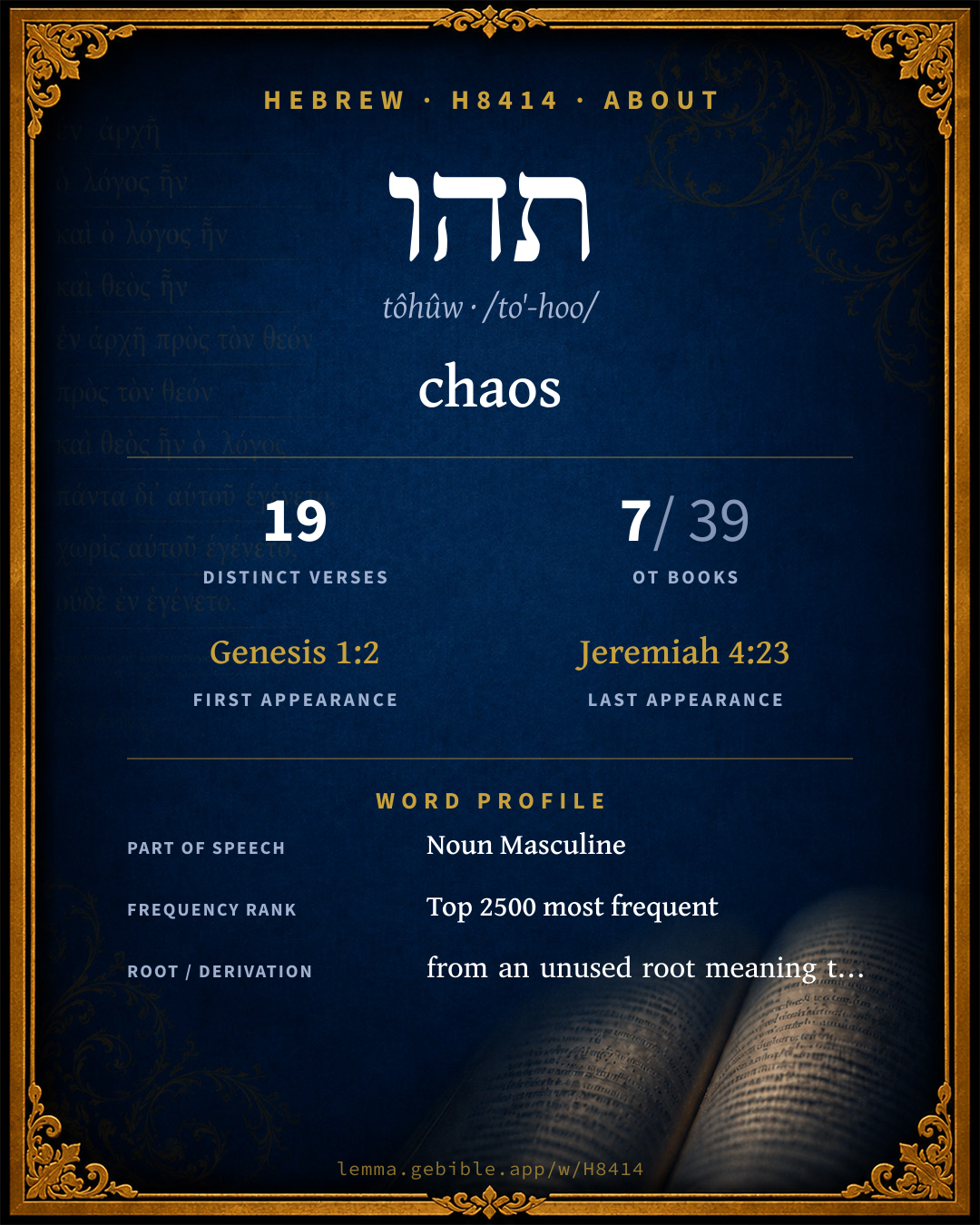
תֹּ֫הוּ
chaos
‘chaos’ is one of 6 main senses fuller range ↓
Full lexicon entry — Brown-Driver-Briggs (BDB)
From Brown-Driver-Briggs (BDB)
Where this word appears
Grammar key — what these labels mean
Part of speech
- Noun
- A naming word — a person, place, thing, or idea.
Noun type
- Common
- A common noun — a general class of person, place, or thing (“king,” “city,” “water”), not a specific name.
State
- Absolute
- The independent form of a noun, not bound to a following word.
- Construct
- A noun bound to a following noun in a possessive / “of” relationship (the construct chain).
Gender
- Masculine
- Grammatically masculine.
Number
- Singular
- One.
Every verse where H8414 appears in the Book of Isaiah — 11 distinct verses. Click any verse to open its interlinear word-by-word view. Verse text shown in the World English Bible for context — . Each verse’s Hebrew form is shown with its reference; the English is not keyword-highlighted, since the data carries no word-level English alignment. Use “Compare translations” on any verse to read it across multiple English versions. This concordance covers the Hebrew Bible; Septuagint (Greek Old Testament) occurrences are not indexed here.
Isaiah
- Isaiah 24:10 תֹּ֑הוּ n c ms The waste city is broken down; every house is shut up, that no man may come in.
- Isaiah 29:21 בַ/תֹּ֖הוּ prep det + n c ms that make a man an offender in [his] cause, and lay a snare for him who reproves in the gate, and turn aside the just with a thing of nothing.
- Isaiah 34:11 תֹ֖הוּ n c ms But the pelican and the porcupine shall possess it; and the owl and the raven shall dwell therein: and he will stretch over it the line of confusion, and the plummet of emptiness.
- Isaiah 40:17 וָ/תֹ֖הוּ conj + n c ms All the nations are as nothing before him; they are accounted by him as less than nothing, and vanity.
- Isaiah 40:23 כַּ/תֹּ֥הוּ prep det + n c ms who brings princes to nothing; who makes the judges of the earth as vanity.
- Isaiah 41:29 וָ/תֹ֖הוּ conj + n c ms Behold, all of them, their works are vanity [and] nothing; their molten images are wind and confusion.
- Isaiah 44:9 תֹּ֔הוּ n c ms Those who fashion an engraved image are all of them vanity; and the things that they delight in shall not profit; and their own witnesses don't see, nor know: that they may be disappointed.
- Isaiah 45:18 תֹ֥הוּ n c ms For thus says Yahweh who created the heavens, the God who formed the earth and made it, who established it and didn't create it a waste, who formed it to be inhabited: I am Yahweh; and there is no one else.
- Isaiah 45:19 תֹּ֣הוּ n c ms I have not spoken in secret, in a place of the land of darkness; I didn't say to the seed of Jacob, Seek you me in vain: I, Yahweh, speak righteousness, I declare things that are right.
- Isaiah 49:4 לְ/תֹ֥הוּ prep + n c ms But I said, I have labored in vain, I have spent my strength for nothing and vanity; yet surely the justice [due] to me is with Yahweh, and my recompense with my God.
- Isaiah 59:4 תֹּ֨הוּ֙ n c ms None sues in righteousness, and none pleads in truth: they trust in vanity, and speak lies; they conceive mischief, and bring forth iniquity.
About this entry
At a glance — auto-summarized from this page’s data, not written by a person. Every figure links to its source below. This summary describes the numbers; it doesn’t interpret them.
תהו (tôhûw) is a Hebrew noun most often rendered “chaos.” Isaiah dominates its distribution — 11 of 19 verses. Spanning 19 verses in 7 books, it ranks among the uncommon words of the Hebrew Bible. It first appears in Genesis 1:2. It is not a single-sense word — see its full sense range. For the data behind this summary, explore the sense tree and the renderings breakdown below.
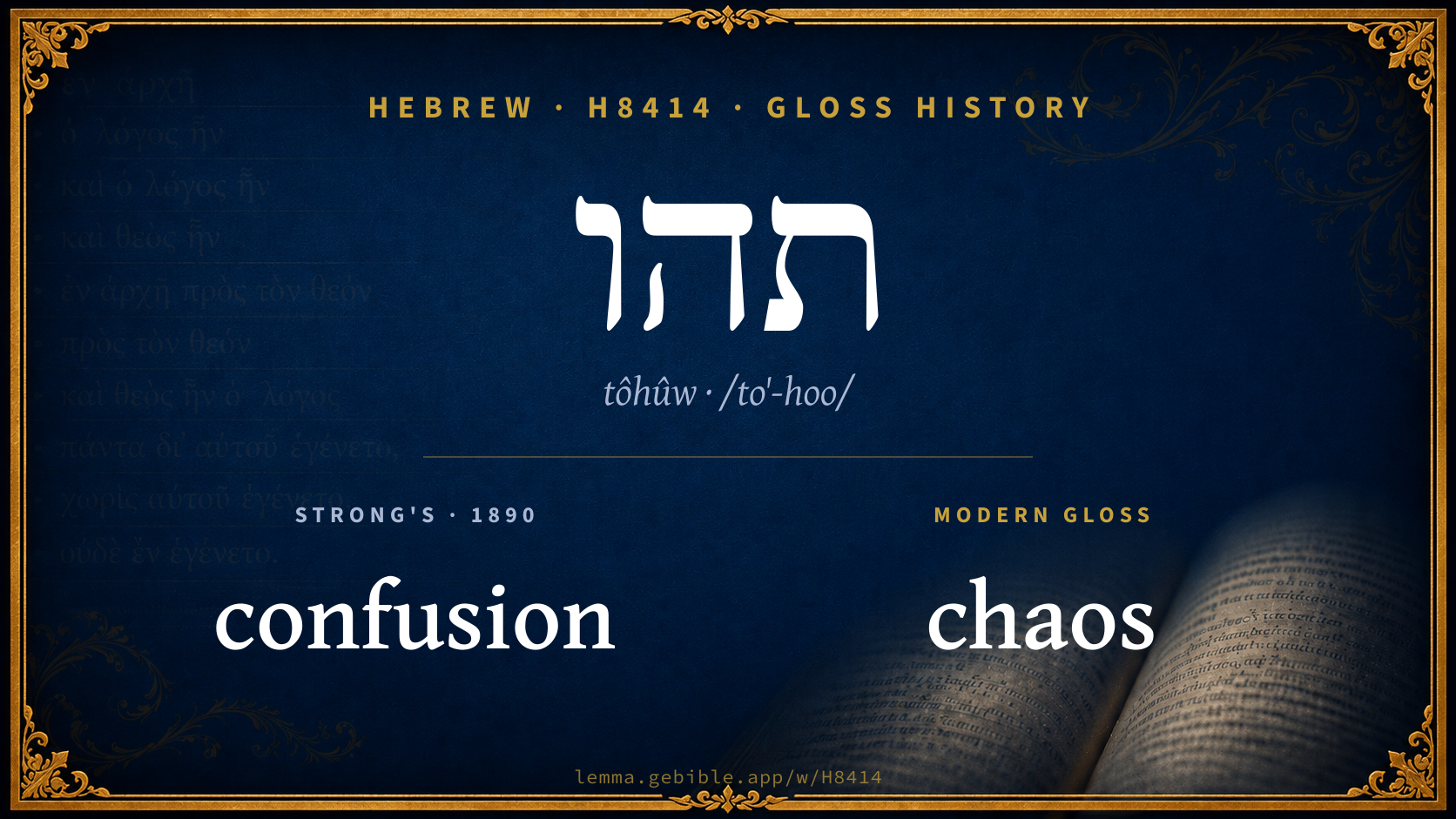
Gloss history
Strong's 1890 vs modern scholarship
About this word
Strong's H8414 catalogs a Hebrew word from the Hebrew Old Testament.
These counts are not copied from any lexicon or concordance. They are computed here, from the morphology-tagged Hebrew Old Testament. What Lemma adds →
- 19
- distinct verses
- The word appears in 19 distinct verses.
- 7 / 39
- OT books
- The word appears in 7 of 39 Old Testament books.
- #1,513
- by frequency
- Top 2500 most frequent Hebrew words (rank 1,513 of 8,640 Hebrew words by occurrence).
View all 19 occurrences in the concordance →
By section of the Old Testament
By traditional corpus
Conventional, traditional groupings — biblical authorship is debated, so this is a traditional corpus grouping, not an authorship claim. Each share is this word’s portion of its verses in that division of the Hebrew canon. Each figure is a share of the word’s 19 distinct verses.
- Prophets (Nevi'im) 13 verses · 68%
- Writings (Ketuvim) 4 verses · 21%
- Torah (Pentateuch) 2 verses · 11%
How translations render this word
Counts come from each version’s own published word-to-Strong’s tagging or interlinear alignment — an approximate guide to how each version renders this word, not a word-level alignment the data otherwise carries. Because each total is that version’s own tagged count, the per-version totals vary from one another and need not match the appearance or distinct-verse counts above. These counts may also differ from a printed concordance because Lemma counts each distinctly tagged rendering and does not collapse phrase taggings into a single head-word total. This is a fixed set of word-tagged versions (KJV, ASV, BSB, ULT) and does not change with the reading translation you choose elsewhere. Each version’s license is shown beside its name below (and on Sources).
- King James Version: Confusion 3×, Vanity 3×, Vain 2×
- American Standard Version: Waste 5×, Vanity 3×, Confusion 2×
- Berean Standard Bible: Wasteland 4×, Chaos 2×, Empty 2×
- unfoldingWord Literal Text: Emptiness 7×, Nothingness 3×, Wasteland 2×
King James Version Public Domain
Renders H8414 across 20 tagged occurrences — most commonly:
Plus 10 renderings that appear only once — usually multi-word phrases or single function words the recovered tagging swept in, not distinct renderings.
American Standard Version Public Domain
Renders H8414 across 20 tagged occurrences — most commonly:
Plus 10 renderings that appear only once — usually multi-word phrases or single function words the recovered tagging swept in, not distinct renderings.
Berean Standard Bible Public Domain
Renders H8414 across 20 tagged occurrences — most commonly:
Plus 12 renderings that appear only once — usually multi-word phrases or single function words the recovered tagging swept in, not distinct renderings.
unfoldingWord Literal Text CC BY-SA 4.0
Renders H8414 across 20 tagged occurrences — most commonly:
Plus 8 renderings that appear only once — usually multi-word phrases or single function words the recovered tagging swept in, not distinct renderings.
Senses in the full BDB
What do BDB’s symbols mean?
BDB uses these scholarly abbreviations:
| Symbol | Meaning |
|---|---|
| 𝔊 | the Septuagint (the ancient Greek translation, LXX) |
| 𝔙 | the Vulgate (the Latin translation) |
| 𝔖 | the Syriac version (the Peshitta) |
| 𝔗 | the Targum (the Aramaic translation) |
| ψ | the Psalms |
| √ | root (the underlying root or stem) |
| ‖ | parallel passage (a synonymous or contrasted parallel) |
| † | the dagger: every passage where the word occurs is cited |
The 2 senses and sub-senses the full Brown-Driver-Briggs lexicon distinguishes for this word, in lexicon order (not ranked by frequency), with BDB’s own verbatim wording and sub-sense lettering. Shown in Hebrew script with BDB’s own scholarly abbreviations. The condensed entry is in the Lexicon Entry tab. See also the Forms in the corpus table below.
- 1. formlessness, of primaeval earth Gn 1:2 (P), of land reduced to primaeval chaos Je 4:23 (both + וָבֹהוּ and voidness), Is 34:11 קַו־תֿ׳ (‖ אבְנֵי בֹהוּ), 45:18 לֹא ת׳ בְרָאָהּ (‖ לָשֶׁבֶת יְצָרָהּ); 24:10 קִרְיַת־תּ׳ city of chaos (of ruined city); = nothingness, empty space, Jb 26:7 נֹטֶה צָפן עַל־תּ׳; of empty, trackless waste Dt 32:10 (‖ מִדְבָּר), Jb 6:18; 12:24 = ψ 107:40. e.g. Genesis 1:2
- 2. fig. of what is empty, unreal, as idols 1 S 12:21 (coll.: אַחֲרֵי הַתּ׳ אֲשֶׁר לֹא יוֹעִילוּ), v 21 Is 41:29 רוּחַ וָת׳ נִסְכֵּיהֶם, 44:9 (of idol-makers), groundless arguments or considerations, Is 29:21 וַיַּטּוּ בַתּ׳ צַדִּיק, 59:4 moral unreality or falsehood בָּטוֹהַ עַל־תּ׳ (‖ וְדַבֶּר־שָׁוְא); = a thing of nought (cf. Ecclus 41:10 מתהו אל תהו), Is 40:17 (‖ אַיִן, אֶפֶס), v 23 שֹׁפְטֵי אֶרֶץ כַּתּ׳ עָשָׂה (‖ לְאַיִן), worthlessness 49:4 לְת׳ וְהֶבֶל כֹּחִי כִלֵּיתִי (‖ לְרִיק יָגַעְתִּי); as adv. acc. 45:19 I said not, תֹּהוּ בַקְּשׁוּנִי seek me emptily, to no purpose. cf. 29:13 𝔊 וְתֹהוּ for וַתֹּהִי. e.g. 1 Samuel 12:21
Senses from the full Brown-Driver-Briggs lexicon (Brown, Driver, Briggs; Oxford 1906 — public domain), digitized via Sefaria, supplemented by the OpenScriptures HebrewLexicon (CC BY 4.0). Full attribution on Sources.
Word origin
n.m. 1 S 12, 21 (AlbrZAW xvi (1896), 112) formlessness, confusion, unreality, emptiness (primary meaning difficult to seize; Vrss usually κενόν, οὐδέν, μάταιον, inane, vacuum, vanum; cf. LagOr. ii. 60; BN 144);—
— Brown-Driver-Briggs (Oxford 1906, public domain), digitized via Sefaria, supplemented by the OpenScriptures HebrewLexicon (CC BY 4.0). See Sources.
Origin: from an unused root meaning to lie waste
Jastrow Dictionary
A second Hebrew/Aramaic lexicon for comparison, covering Aramaic and post-biblical (Talmudic, Targumic, Midrashic) usage that the biblical-Hebrew BDB does not. Matched by lemma rather than by Strong’s number, so a lemma may carry more than one Jastrow headword (shown separately below), and the entries cover usage well beyond the Bible.
תֹּהוּ
- , v. תּוֹהוּ
תְּהֵו
- , v. תְּהֵי
תְּהֵי
- 1. to gaze, be astonished, be waste.—Part. תָּהֵי; f. תָּהֲיָא, תָּהֲיָה. Targ. Y. Gen. I, 2. Targ. Y. II, Ex. XII, 42; a. e.—Erub. 66ᵃ ת׳ בה ר׳ אלעזר R. El. marvelled at it. Ib. תְּהוּ בה וכ׳ the Nehardeans were astonished at it. Pes. 50ᵇ תהו ביה אינשי people gaze at him with ill-will (Ms. M. תַּוְוהוּ בהו fr. תְּוַהּ). Nidd. 66ᵃ כי היכי דתַהֲווּ עלך … נִתְהֲוִי עלך וכ׳, v. גִּיסָא III; a. e.
- 2. to pause, regret, repent. Targ. Y. Lev. V, 5; 24. Targ. Cant. V, 5. Targ. Y. Ex. XIII, 17. Targ. Prov. XX, 25 (ed. תדיא, חדיא, corr. acc.).—Y. Ḥall. II, beg. 58ᵇ מן דנפקית תְּהֵית דלא אמרית וכ׳ (not דנפקות) when I was gone, I was sorry that I had not said to him &c. Y. Sabb. I, 3ᵇ bot. שרי ת׳ ביה he began to bethink himself (of what he had done). Ned. 21ᵇ כדו תְּהֵית dost thou now regret (that thou hast vowed)? Y. ib. IX, 41ᵇ bot. ר"י פתח ות׳ R. J. offered an opening (for the purpose of absolving from a vow), and he (the vower) expressed his regret; [read:] ואילולי דו ת׳ הו אתי but if he were not sorry for his vow, would he have come (before the teacher for absolution)?; a. e.
- 3. to smell. Keth. 105ᵃ, v. אִמְבְּרָא. B. Bath. 22ᵃ פוק תְּהֵי וכ׳, v. קַנְקַנָּא.
תּוֹהוּ
- waste, desolation; vanity, idleness. Snh. 97ᵃ שני אלפים ת׳ וכ׳ two thousand years the world was waste &c. Ib. 26ᵇ, v. שָׁתַת II. Gen. R. s. 2 (ref. to Gen. I, 2) זה קין … לת׳ ובהו this refers to Cain who wanted to reduce the world to waste and desolation; a. fr. e.g. Genesis 1:2
תּוֹהוּ ²
- (v. תָּהָה
- 2. regret. Targ. Y. Ex. XXXII, 12. Ib. 14. Targ. Y. II, Gen. VI, 6 Ar. (ed. והות תְּהֵי). Targ. Y. I Deut. XXXII, 36 תְּהָן (read תהו); a. e.
A Dictionary of the Targumim, the Talmud Babli and Yerushalmi, and the Midrashic Literature (Marcus Jastrow; London, Luzac, 1903) — Public Domain. Digitized via Sefaria. Digitized via Sefaria. Full attribution on Sources.
Forms in the corpus
The 15 distinct written forms H8414 takes in the Hebrew Bible, most frequent first — each parse links to that state’s occurrences in the concordance. Hebrew forms include their vowel points and cantillation, so a single lemma takes many written forms.
Septuagint verse parallels
This word appears in 18 verses that also exist in the Greek Old Testament (Septuagint), out of the 19 Hebrew verses it occurs in. You can read those verses in Greek by switching the Old Testament edition to the Septuagint.
Read these verses in the Septuagint
This is a verse-level parallel only — the same verses exist in both the Hebrew and Greek Old Testaments. No word-level Hebrew↔Greek correspondence is claimed: the data carries no such alignment, so no Greek word is shown as this Hebrew word’s translation. Coverage is not total — the Septuagint omits the deuterocanon and renumbers the Psalms, so some Hebrew verses have no direct Greek parallel.