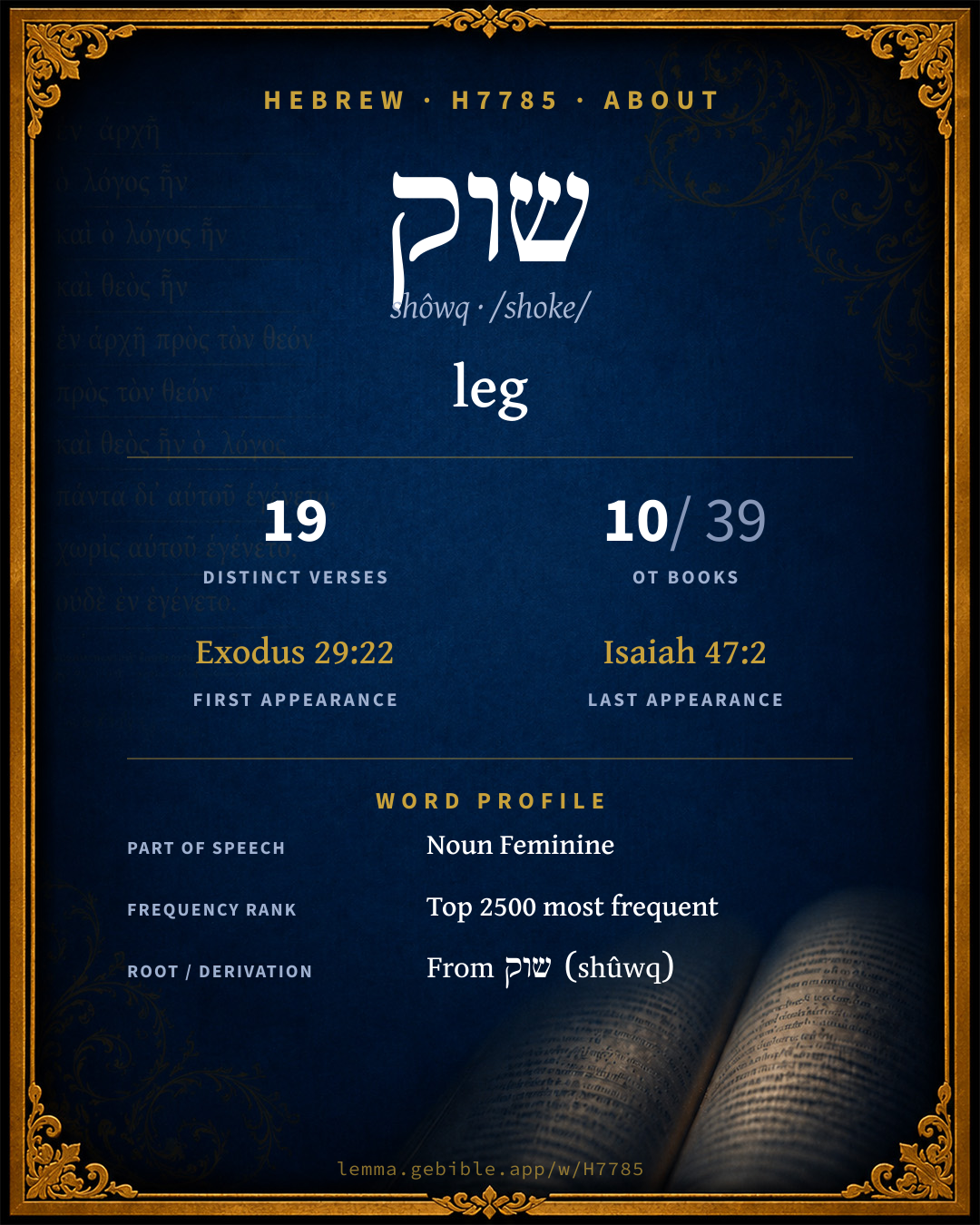
שׁוֹק
leg
‘leg’ is one of 3 main senses fuller range ↓
Full lexicon entry — Brown-Driver-Briggs (BDB)
From Brown-Driver-Briggs (BDB)
Where this word appears
See every Construct-state word in the Hebrew Bible →
Grammar key — what these labels mean
Part of speech
- Noun
- A naming word — a person, place, thing, or idea.
Noun type
- Common
- A common noun — a general class of person, place, or thing (“king,” “city,” “water”), not a specific name.
State
- Construct
- A noun bound to a following noun in a possessive / “of” relationship (the construct chain).
- Absolute
- The independent form of a noun, not bound to a following word.
Gender
- Feminine
- Grammatically feminine.
Number
- Singular
- One.
- Dual
- Exactly two — for natural pairs and some measures of time.
5 distinct verses where H7785 appears in the Absolute state, across 5 books. Filtered view — show all forms. Click any verse to open its interlinear word-by-word view. Verse text shown in the World English Bible for context — . Each verse’s Hebrew form is shown with its reference; the English is not keyword-highlighted, since the data carries no word-level English alignment. Use “Compare translations” on any verse to read it across multiple English versions. This concordance covers the Hebrew Bible; Septuagint (Greek Old Testament) occurrences are not indexed here.
Deuteronomy 1 verse
Judges 1 verse
1 Samuel 1 verse
Proverbs 1 verse
Isaiah 1 verse
About this entry
At a glance — auto-summarized from this page’s data, not written by a person. Every figure links to its source below. This summary describes the numbers; it doesn’t interpret them.
The Hebrew noun שוק centers on the idea of “leg.” Older and newer Bibles part ways — “shoulder” in the King James Version, “thigh” (Berean Standard Bible) in modern versions. See the renderings breakdown. It appears 19 verses across 10 books of the Hebrew Bible, among its uncommon vocabulary. The word gravitates to Leviticus (42%), then Exodus and Numbers. Its meaning spans more than one sense — see its full sense range. For the data behind this summary, explore the sense tree and the renderings breakdown below.
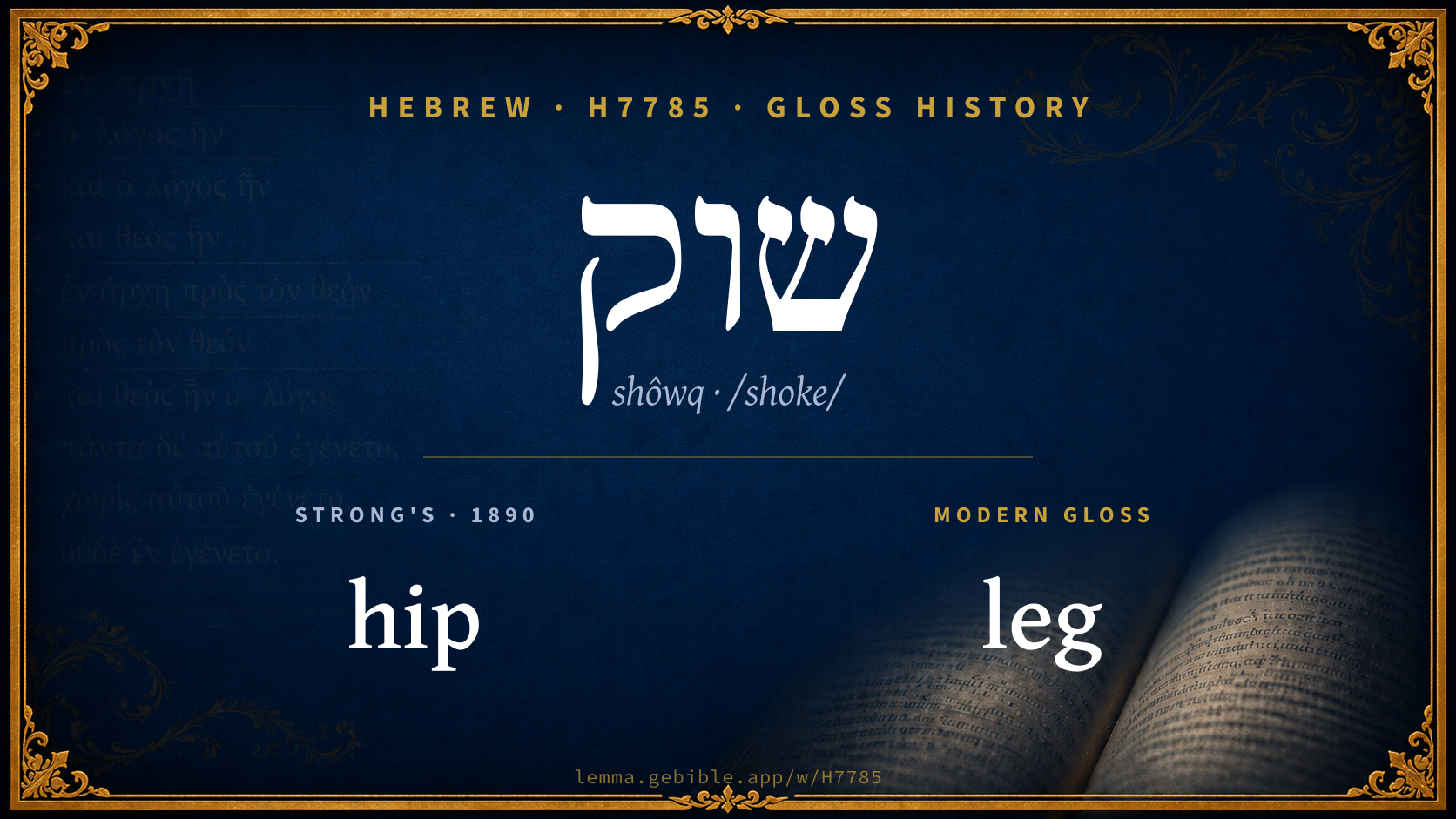
Gloss history
Strong's 1890 vs modern scholarship
About this word
Strong's H7785 catalogs a Hebrew word from the Hebrew Old Testament.
These counts are not copied from any lexicon or concordance. They are computed here, from the morphology-tagged Hebrew Old Testament. What Lemma adds →
- 19
- distinct verses
- The word appears in 19 distinct verses.
- 10 / 39
- OT books
- The word appears in 10 of 39 Old Testament books.
- #1,563
- by frequency
- Top 2500 most frequent Hebrew words (rank 1,563 of 8,640 Hebrew words by occurrence).
View all 19 occurrences in the concordance →
By section of the Old Testament
By traditional corpus
Conventional, traditional groupings — biblical authorship is debated, so this is a traditional corpus grouping, not an authorship claim. Each share is this word’s portion of its verses in that division of the Hebrew canon. Each figure is a share of the word’s 19 distinct verses.
- Torah (Pentateuch) 13 verses · 68%
- Prophets (Nevi'im) 3 verses · 16%
- Writings (Ketuvim) 3 verses · 16%
How translations render this word
Counts come from each version’s own published word-to-Strong’s tagging or interlinear alignment — an approximate guide to how each version renders this word, not a word-level alignment the data otherwise carries. Because each total is that version’s own tagged count, the per-version totals vary from one another and need not match the appearance or distinct-verse counts above. These counts may also differ from a printed concordance because Lemma counts each distinctly tagged rendering and does not collapse phrase taggings into a single head-word total. This is a fixed set of word-tagged versions (KJV, ASV, BSB, ULT) and does not change with the reading translation you choose elsewhere. Each version’s license is shown beside its name below (and on Sources).
- King James Version: Shoulder 13×, Legs 4×
- American Standard Version: Thigh 8×, Legs 4×, Heave-thigh 2×
- Berean Standard Bible: Thigh 13×, Legs 3×
- unfoldingWord Literal Text: Thigh 11×, The 5×, Thigh of 3×
King James Version Public Domain
Renders H7785 across 19 tagged occurrences — most commonly:
Plus 2 renderings that appear only once — usually multi-word phrases or single function words the recovered tagging swept in, not distinct renderings.
American Standard Version Public Domain
Renders H7785 across 18 tagged occurrences — most commonly:
Plus 4 renderings that appear only once — usually multi-word phrases or single function words the recovered tagging swept in, not distinct renderings.
Berean Standard Bible Public Domain
Renders H7785 across 19 tagged occurrences — most commonly:
Plus 3 renderings that appear only once — usually multi-word phrases or single function words the recovered tagging swept in, not distinct renderings.
unfoldingWord Literal Text CC BY-SA 4.0
Renders H7785 across 27 tagged occurrences — most commonly:
Plus 6 renderings that appear only once — usually multi-word phrases or single function words the recovered tagging swept in, not distinct renderings.
Senses in the full BDB
What do BDB’s symbols mean?
BDB uses these scholarly abbreviations:
| Symbol | Meaning |
|---|---|
| 𝔊 | the Septuagint (the ancient Greek translation, LXX) |
| 𝔙 | the Vulgate (the Latin translation) |
| 𝔖 | the Syriac version (the Peshitta) |
| 𝔗 | the Targum (the Aramaic translation) |
| ψ | the Psalms |
| √ | root (the underlying root or stem) |
| ‖ | parallel passage (a synonymous or contrasted parallel) |
| † | the dagger: every passage where the word occurs is cited |
The 2 senses and sub-senses the full Brown-Driver-Briggs lexicon distinguishes for this word, in lexicon order (not ranked by frequency), with BDB’s own verbatim wording and sub-sense lettering. Shown in Hebrew script with BDB’s own scholarly abbreviations. The condensed entry is in the Lexicon Entry tab. See also the Forms in the corpus table below.
- 1. of man, specif. lower leg, calf, disting. from thigh, in וַיַּךְ אוֹתָם שׁ׳ עַל־יָרֵךְ Ju 15:8 he smote them, leg upon thigh, i.e. utterly (cf. GFM), Dt 28:35 (‖ בִּרְכַּיִם), Pr 26:7 ψ 147:10; Ct 5:15; of woman (city personif.) Is 47:2. e.g. Judges 15:8
- 2. of sacrificial animal, specif. upper leg, thigh, hind leg, portion eaten 1 S 9:24 (cf. Klein ZPV vl (1883), 98, cited also by NesMarg. 13), שׁ׳ הַיָּמִין right thigh Ex 29:32 + 6 times P (v. יָמִין), שׁ׳ הַתְּרוּמָה Lv 7:34 + 4 times P, thigh of contribution (v. ת׳ p. 929).—𝔊 βραχίων, 𝔙 armus, hence AV al. shoulder, but v. Di Baen Dr Dt 18:3. e.g. 1 Samuel 9:24
Senses from the full Brown-Driver-Briggs lexicon (Brown, Driver, Briggs; Oxford 1906 — public domain), digitized via Sefaria, supplemented by the OpenScriptures HebrewLexicon (CC BY 4.0). Full attribution on Sources.
Word origin
n.[f. Lv 7:33 cf. AlbrZAW xvl (1896), 76 f., so Arabic, v. Lane WAG, § 290 (δ)] leg;—שׁ׳ abs. 1 S 9:24 +, cstr. Ex 29:27 +; du. שֹׁקַיִם Dt 28:35; Pr 26:7, cstr. שׁוֹקֵי ψ 147:10, sf. שׁוֹקָיו Ct 5:15;—leg:
— Brown-Driver-Briggs (Oxford 1906, public domain), digitized via Sefaria, supplemented by the OpenScriptures HebrewLexicon (CC BY 4.0). See Sources.
Derived from שוק (shûwq) (H7783) — to overflow.
Jastrow Dictionary
A second Hebrew/Aramaic lexicon for comparison, covering Aramaic and post-biblical (Talmudic, Targumic, Midrashic) usage that the biblical-Hebrew BDB does not. Matched by lemma rather than by Strong’s number, so a lemma may carry more than one Jastrow headword (shown separately below), and the entries cover usage well beyond the Bible.
שוק
- , Targ. Ps. LXXIV, 3 משווק, משוק, v. שְׁוַוח II
שׁוּק I
- Polel; cmp. נשק) to touch, join, come in contact; (cmp. חפץ) to desire.—Denom. תְּשׁוּקָה.
- , Nithpol. נִשְׁתֹּוקֵק (denom. of תשוקה = התשוקק) to long for (with על). Yeb. 62ᵇ (ref. to תשוקתך, Gen. III, 16) האשה מִשְׁתֹּוקֶקֶת על וכ׳ the wife has a desire for her husband when he is about to go on the road; Erub. 100ᵇ; Yalk. Gen. 32. Keth. 65ᵃ (ref. to שקויי, Hos. II, 7) דברים … משתוקקת עליהן וכ׳ things which a woman longs for: jewelry. Num. R. s. 10, beg. (ref. to שוקיו, Cant. V, 15) זה העולם שנ׳ הקב"ה וכ׳ that means the world, which the Lord has been longing to create; a. e. e.g. Genesis 3:16
שׁוּק II
- (preced.) = תְּשׁוּקָה, desire, longing. Cant. R. to VII, 11 (ref. to תשוקתו, ib.) שלשה שוקין הן אין שׁוּקָן של ישראל וכ׳ there are three kinds of desires: Israel longs for none but for his father in heaven; אין שׁוּקָהּ של אשה וכ׳ woman’s desire is for her husband; אין שׁוּקוֹ של יצר וכ׳ the evil temptation longs for Cain and the like of him; אין שׁוּקָן של גשמים וכ׳ the rains desire the earth (ref. to ותשקקה, Ps. LXV, 10); v. תְּשׁוּקָה. Midr. Till. to Ps. CXVII (expl. ותשקקה, v. supra) תן לה שׁוּקָהּ ed. Bub. (oth. ed. תשוקתה) grant to her that for which she (the earth) longs.—Pl. שׁוּקִין, v. supra. e.g. Psalms 65:10
שׁוּק III
- v. שׁוּק I) [meeting place,] market, street. Gen. R. s. 91 ש׳ של זונות the place where harlots meet. Pes. 110ᵃ בזמן שלא ראה פני הש׳ if he has not seen the open, i.e. if he has not been in the open air between one cup and the other. B. Kam. 115ᵃ תקנת הש׳ the market ordinance (that he who buys a stolen object publicly has a right to his purchasing money on restoring the object). Yeb. 53ᵃ התרת יבמה לש׳ making a y’bamah permitted to all the world, i.e. freeing a woman from her dependence on her brother-in-law. Ib. 98ᵇ פגע ביבמה לש׳ he might (on marrying her) strike on a ‘y’bamah abroad’, i.e. on one bound to another man as her yabam; a. v. fr.—Num. R. s. 2018, a. e. בעל הש׳ market commissioner.—Pl. שְׁוָוקִים, שְׁוָוקִין, שְׁוָקִ׳. Ib.17 (expl. קרית חצות, Num. XXII, 39) שעשה ש׳ של וכ׳ he arranged commercial markets. Sabb. 33ᵇ תקנו ש׳ וכ׳ they (the Romans in Palestine) made markets to place harlots there; Ab. Zar. 2ᵇ. Tosef. Makhsh. III, 8 הבאין מבית הש׳ that are brought back from the market houses; a. fr.—Constr. שׁוּקֵי. Erub. 29ᵃ, a. e. הריני … בש׳ טבריא I am (to-day) as bright as Ben ʿAzzai was in the meeting places of Tiberias; a. fr. e.g. Numbers 22:39
שׁוֹק
- v. שׁוּק I) [joint,] leg, foreleg, shoulder. Ber. 24ᵃ ש׳ באשה ערוה a woman’s bare leg is an indecent sight, i.e. you are not permitted to say your prayers in sight of it. Ḥull. X, 1 חייבין בחזה ובש׳ are subject to the law relating to breast and shoulder (Lev. VII, 34). Men. V, 6; a. fr.—Du. שׁוֹקַיִם. Gen. R. s. 98 שׁוֹקֵיהֶן, v. פָּחָז. e.g. Leviticus 7:34
A Dictionary of the Targumim, the Talmud Babli and Yerushalmi, and the Midrashic Literature (Marcus Jastrow; London, Luzac, 1903) — Public Domain. Digitized via Sefaria. Digitized via Sefaria. Full attribution on Sources.
Forms in the corpus
The 10 distinct written forms H7785 takes in the Hebrew Bible, most frequent first — each parse links to that state’s occurrences in the concordance. Hebrew forms include their vowel points and cantillation, so a single lemma takes many written forms.
| Form | Parsing | Example | Uses |
|---|---|---|---|
| שׁ֣וֹק | Noun, Common, Feminine, Singular, Construct | Exodus 29:22 | 8 |
| שׁ֥וֹק | Noun, Common, Feminine, Singular, Construct | Leviticus 7:33 | 3 |
| בְ/שׁוֹקֵ֖י | Noun, Common, Feminine, Dual, Construct | Psalms 147:10 | 1 |
| הַ/שּׁ֨וֹק | Noun, Common, Feminine, Singular, Absolute | 1 Samuel 9:24 | 1 |
| הַ/שֹּׁקַ֔יִם | Noun, Common, Feminine, Dual, Absolute | Deuteronomy 28:35 | 1 |
| וּ/כְ/שׁ֥וֹק | Noun, Common, Feminine, Singular, Construct | Numbers 18:18 | 1 |
| שׁ֖וֹק | Noun, Common, Feminine, Singular, Absolute | Isaiah 47:2 | 1 |
| שׁ֛וֹק | Noun, Common, Feminine, Singular, Absolute | Judges 15:8 | 1 |
| שֹׁ֭קַיִם | Noun, Common, Feminine, Dual, Absolute | Proverbs 26:7 | 1 |
| שׁוֹקָי/ו֙ | Noun, Common, Feminine, Dual, Construct | Song of Solomon 5:15 | 1 |
Same root — word family
Other BDB entries built from the same root as H7785, grouped by Strong’s listed origin. These share a root / origin per the lexicon — not necessarily a shared meaning. Each links to that word’s own entry.
Derives from
Shares the same root
Derived from this word
Proper names from this root
People and places named from this root — a name, not an additional meaning of the word.
Compare all same-root words → Showing 4 of 6 — not the complete family. 1 of the same-root words is a proper name (a person or place). They share a root, not necessarily a meaning.
Septuagint verse parallels
This word appears in 18 verses that also exist in the Greek Old Testament (Septuagint), out of the 19 Hebrew verses it occurs in. You can read those verses in Greek by switching the Old Testament edition to the Septuagint.
Read these verses in the Septuagint
- Exodus 29:22
- Leviticus 7:32
- Numbers 6:20
- Deuteronomy 28:35
- Judges 15:8
- 1 Samuel 9:24
- Proverbs 26:7
- Song of Solomon 5:15
- Isaiah 47:2
This is a verse-level parallel only — the same verses exist in both the Hebrew and Greek Old Testaments. No word-level Hebrew↔Greek correspondence is claimed: the data carries no such alignment, so no Greek word is shown as this Hebrew word’s translation. Coverage is not total — the Septuagint omits the deuterocanon and renumbers the Psalms, so some Hebrew verses have no direct Greek parallel.