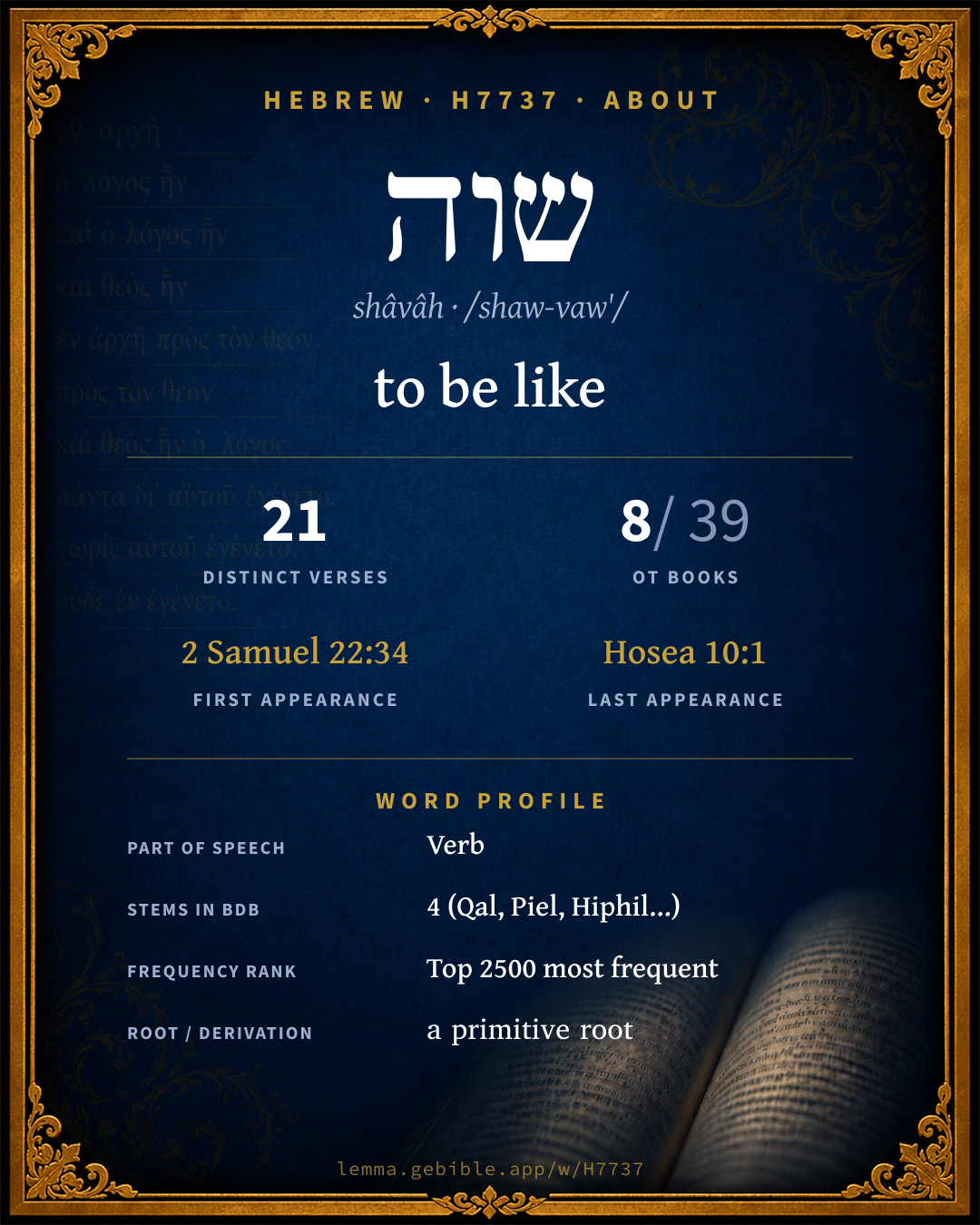
שָׁוָה
to be like
‘to be like’ is one of 2 main senses fuller range ↓
Full lexicon entry — Brown-Driver-Briggs (BDB)
From Brown-Driver-Briggs (BDB)
Where this word appears
See every Qal verb in the Hebrew Bible →
Grammar key — what these labels mean
Part of speech
- Verb
- An action or state-of-being word.
Stem
- Piel
- An intensive or resultative active stem. Here: ‘set’
- Qal
- The basic, simple active stem — the plain form of the verb (“he wrote”).
- Hiphil
- The causative active stem (“he caused / brought about”). Here: ‘make like’
Form
- Perfect
- A completed action or state — Hebrew marks aspect (completeness) more than strict tense (“he wrote”).
- Participle Active
- A verbal adjective expressing ongoing or characteristic action (“writing / one who writes”).
- Imperfect
- An incomplete, ongoing, or future action (“he will / would write”).
State
- Absolute
- The independent form of a noun, not bound to a following word.
Person
- 1st Person
- The speaker (“I / we”).
- 3rd Person
- The one spoken about (“he / she / it / they”).
- 2nd Person
- The one addressed (“you”).
Gender
- Common
- Either gender — not distinguished for this form.
- Masculine
- Grammatically masculine.
- Feminine
- Grammatically feminine.
Number
- Singular
- One.
- Plural
- More than one (in Hebrew, generally three or more).
Every verse where H7737 appears in the Book of Proverbs — 4 distinct verses. Click any verse to open its interlinear word-by-word view. Verse text shown in the World English Bible for context — . Each verse’s Hebrew form is shown with its reference; the English is not keyword-highlighted, since the data carries no word-level English alignment. Use “Compare translations” on any verse to read it across multiple English versions. This concordance covers the Hebrew Bible; Septuagint (Greek Old Testament) occurrences are not indexed here.
Proverbs
- Proverbs 3:15 יִֽשְׁווּ Qal impf 3mp She is more precious than rubies. None of the things you can desire are to be compared to her.
- Proverbs 8:11 יִֽשְׁווּ Qal impf 3mp For wisdom is better than rubies. All the things that may be desired can't be compared to it.
- Proverbs 26:4 תִּשְׁוֶה Qal impf 2ms Don't answer a fool according to his folly, Lest you also be like him.
- Proverbs 27:15 נִשְׁתָּוָֽה Nithpael pf 3fs A continual dropping on a rainy day And a contentious wife are alike:
About this entry
At a glance — auto-summarized from this page’s data, not written by a person. Every figure links to its source below. This summary describes the numbers; it doesn’t interpret them.
The Hebrew verb שוה centers on the idea of “to be like.” Across 4 stems, its meaning turns on the binyan (Qal, Piel). The Hebrew Bible uses it across 21 verses — uncommon. Psalms dominates its distribution — 6 of 21 verses. First canonically at 2 Samuel 22:34, it enters the text early. Dig into 21-verse concordance and the renderings breakdown below.
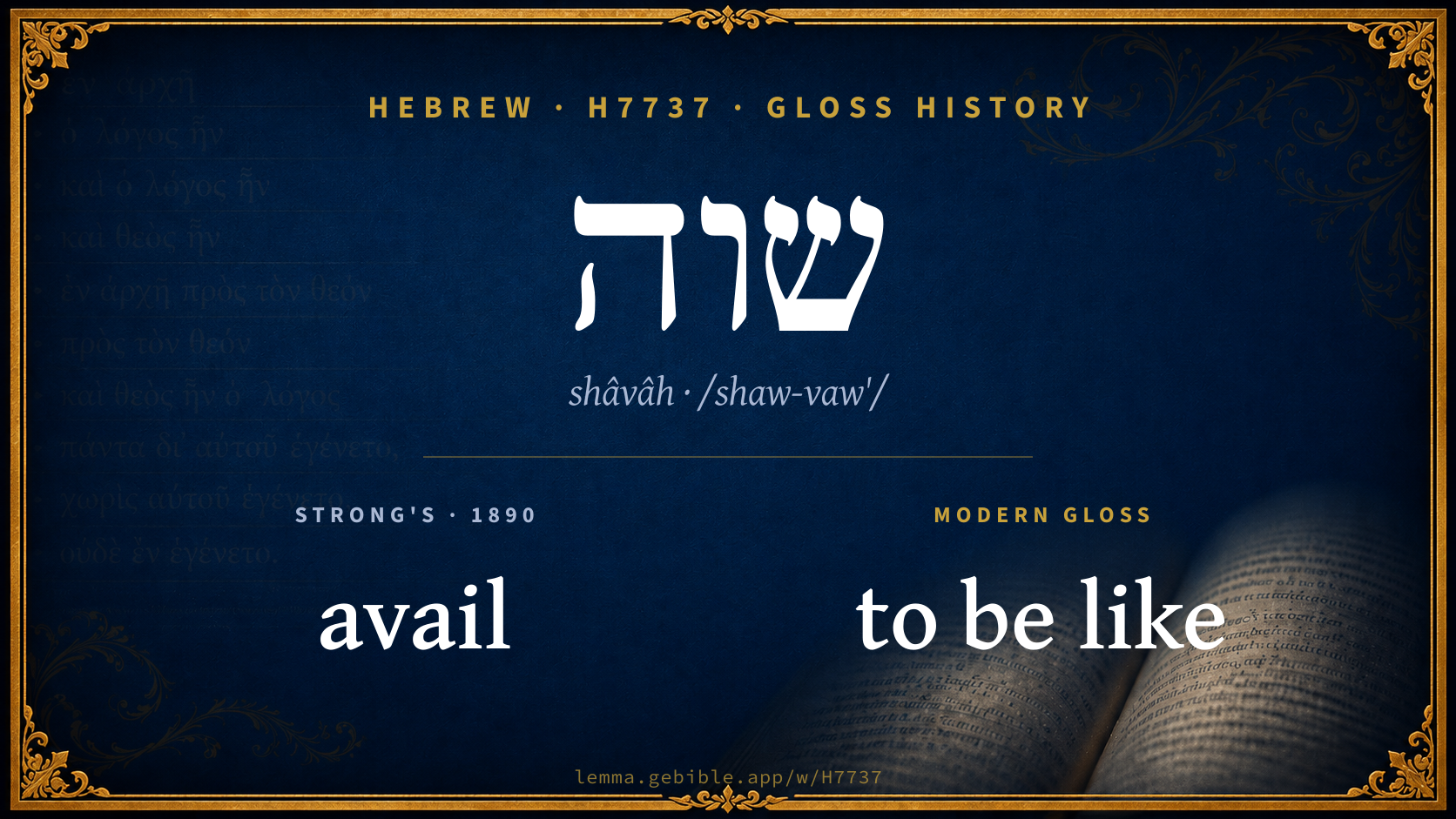
Gloss history
Strong's 1890 vs modern scholarship
About this word
Strong's H7737 catalogs a Hebrew word from the Hebrew Old Testament.
These counts are not copied from any lexicon or concordance. They are computed here, from the morphology-tagged Hebrew Old Testament. What Lemma adds →
- 21
- distinct verses
- The word appears in 21 distinct verses.
- 8 / 39
- OT books
- The word appears in 8 of 39 Old Testament books.
- #1,462
- by frequency
- Top 2500 most frequent Hebrew words (rank 1,462 of 8,640 Hebrew words by occurrence).
View all 21 occurrences in the concordance →
By section of the Old Testament
By traditional corpus
Conventional, traditional groupings — biblical authorship is debated, so this is a traditional corpus grouping, not an authorship claim. Each share is this word’s portion of its verses in that division of the Hebrew canon. Each figure is a share of the word’s 21 distinct verses.
- Writings (Ketuvim) 15 verses · 71%
- Prophets (Nevi'im) 6 verses · 29%
How translations render this word
Counts come from each version’s own published word-to-Strong’s tagging or interlinear alignment — an approximate guide to how each version renders this word, not a word-level alignment the data otherwise carries. Because each total is that version’s own tagged count, the per-version totals vary from one another and need not match the appearance or distinct-verse counts above. These counts may also differ from a printed concordance because Lemma counts each distinctly tagged rendering and does not collapse phrase taggings into a single head-word total. This is a fixed set of word-tagged versions (KJV, ASV, BSB, ULT) and does not change with the reading translation you choose elsewhere. Each version’s license is shown beside its name below (and on Sources).
BDB lists this Strong’s number as 2 distinct words (homographs). Each count above pools all of them and is not split by sense — see the Senses section below. A low-frequency rendering may belong to a different one of those words, not the primary meaning.
- King James Version†: Are not to be compared 2×, He maketh 2×
- American Standard Version†: He maketh 2×, Me 2×
- Berean Standard Bible†: Compares 2×, He makes 2×, I have set 2×
- unfoldingWord Literal Text†: Compare 2×, Do 2×, Equal 2×
King James Version Public Domain
Renders H7737 across 22† tagged occurrences — most commonly:
Plus 18 renderings that appear only once — usually multi-word phrases or single function words the recovered tagging swept in, not distinct renderings.
American Standard Version Public Domain
Renders H7737 across 22† tagged occurrences — most commonly:
Plus 18 renderings that appear only once — usually multi-word phrases or single function words the recovered tagging swept in, not distinct renderings.
Berean Standard Bible Public Domain
Renders H7737 across 22† tagged occurrences — most commonly:
Plus 16 renderings that appear only once — usually multi-word phrases or single function words the recovered tagging swept in, not distinct renderings.
unfoldingWord Literal Text CC BY-SA 4.0
Renders H7737 across 27† tagged occurrences — most commonly:
Plus 19 renderings that appear only once — usually multi-word phrases or single function words the recovered tagging swept in, not distinct renderings.
Senses in the full BDB
Hebrew verbs can shift meaning by stem (binyan): Qal is the basic action, Niphal is often passive or reflexive, Piel often intensifies or makes it factitive, and Hiphil is typically causative. The senses below are grouped under the stem BDB assigns to each. This entry also uses Nithp (a late reflexive/passive stem (Nithpael)).
What do BDB’s symbols mean?
BDB uses these scholarly abbreviations:
| Symbol | Meaning |
|---|---|
| 𝔊 | the Septuagint (the ancient Greek translation, LXX) |
| 𝔙 | the Vulgate (the Latin translation) |
| 𝔖 | the Syriac version (the Peshitta) |
| 𝔗 | the Targum (the Aramaic translation) |
| ψ | the Psalms |
| √ | root (the underlying root or stem) |
| ‖ | parallel passage (a synonymous or contrasted parallel) |
| † | the dagger: every passage where the word occurs is cited |
The 5 senses and sub-senses the full Brown-Driver-Briggs lexicon distinguishes for this word, in lexicon order (not ranked by frequency), with BDB’s own verbatim wording and sub-sense lettering. Shown in Hebrew script with BDB’s own scholarly abbreviations. The condensed entry is in the Lexicon Entry tab. See also the Forms in the corpus table below.
שוה I (be even, smooth, v. Pi., hence) agree with, be like, resemble (Arabic سوى ii. make even, flat, uniform (with something else)
Qal
- Pf. 3 ms. לֹא שׁ׳ לִי Jb 33:27 (si vera l.) it was not equalled to me, i.e. (v. infra; according to most) not requited (so De Di Da, and Is 16:6 𝔗); Bu אֵל לֹא שִׁוָּה God did not requite (or שִׁלֵּם for שׁוה); Du לֹא שִׁוָּה כַעֲוֹנִי (cf. 𝔊); Impf. 1 s. of י׳, אֶל־מִי … אֶשְׁוֶה Is 40:25 to whom shall I be like? (‖ תְּדַמְּיוּנִי), implying that he is incomp.; 3 mpl. לֹא יִשְׁווּ־בָהּ Pr 3:15 are not comparable with her (wisdom), so 8:11; 2 ms. פֶּן־תִּשְׁוֶה־לוֹ Pr 26:4 lest thou be like him (a fool); Pt. שֹׁוֶה בְּ Est 7:4 is not an equivalent for; c. לְ, suitable for 3:8, so 1:22 Hi Or RyKau (reading כֹּל שֹׁוֶה עִמּוֹ for כִּלְשׁוֹן עַמּוֹ, but v. Siegf.); adequate for 5:13. e.g. Job 33:27
Piel
- Pf. 3 ms. שִׁוָּה Is 28:25 he hath levelled its (the ground’s) surface; 1 s. שִׁוִּיתִי וְדוֹמַמְתִּי נַפְשִׁי ψ 131:2 I have smoothed (composed) and stilled my soul; so, sc. נַפְשִׁי Is 38:13 𝔙 Ges De al., Houb Lo Che Du al. read שִׁוַּעְתִּי I cried; acc. מִשְׁפָּטִים 119:30 accounted suitable, meet (‖ דֶּרֶךְ אֱמוּנָה בָּחָ֑רְתִּי), Hi, cf. Gr v 128 (v. Qal Est 3:8); We ins. לְנֶגְדִּי (II. שׁ׳, cf. ψ 16:8); Zenner Du אִוִּיתִי. e.g. Isaiah 28:25
Hiphil
- make like: Impf. 1 s. מָה אַשְׁוֶה־לָךְ La 2:13 (‖ אֲדַמֶּה); 2 mpl. לְמִי תְדַמְּיוּנִי וְתַשְׁווּ Is 46:5 (cf. Qal 40:25). e.g. Lamentations 2:13
Nithp
- (appar.) Pf. 3 fs. נִשְׁתָּ֑וָה (for נִשְׁתְּוָה) Pr 27:15 are alike, but read prob. Niph. 3 fs. נִשְׁוָ֑תָה Ges§ 75 x Toy al.—תשׁוה Jb 30:22 Kt v. II. שׁוא. e.g. Proverbs 27:15
שוה II
Piel
- set, place (Biblical Aramaic Hithpa. 𝔗 שְׁוָא Pa. set, make (often 𝔗 = שׂום, שׁית); Thes al. sub I. שׁ׳, orig. set, place, then set together, compare, make even, right, cf. Vulg. Ar. سَوَى ii. make (Wahrm, cf. also BaES 66));—Pf. 1 s. שִׁוִּיתִי ψ 16:8 I have set י׳ before me (לְנֶגְדִּי); שׁ׳ עֵזֶר עַל 89:20 I have placed strength upon a hero, cf. 21:6; Pt. מְשַׁוֶּה רַגְלַי כְּ 2 S 22:34 setting my feet like hinds = ψ 18:34 (cf. 𝔗 שַׁזִּי כְּ Gn 48:20 Je 29:22, for שׂים כְּ);—Is 38:13 v. I. שׁוה;—Impf. = make, produce, 3 ms. פְּרִי יְשַׁוֶּה לוֹ Ho 10:1 (Israel as vine), si vera l., v. We Now (‖ עשׂה פְּרִי Ho 9:16, cf. 8:7). e.g. Psalms 16:8
Senses from the full Brown-Driver-Briggs lexicon (Brown, Driver, Briggs; Oxford 1906 — public domain), digitized via Sefaria, supplemented by the OpenScriptures HebrewLexicon (CC BY 4.0). Full attribution on Sources.
Word origin
vb. (be even, smooth, v. Pi., hence) agree with, be like, resemble (Arabic سوى ii. make even, flat, uniform (with something else); Aramaic שְׁוָא (der. spec.) be like, ܫܘܳܐ be equal, fit, like, Pa. lay out smoothly, Aph. make plain, fit, worthy);—
— Brown-Driver-Briggs (Oxford 1906, public domain), digitized via Sefaria, supplemented by the OpenScriptures HebrewLexicon (CC BY 4.0). See Sources.
Origin: a primitive root
Jastrow Dictionary
A second Hebrew/Aramaic lexicon for comparison, covering Aramaic and post-biblical (Talmudic, Targumic, Midrashic) usage that the biblical-Hebrew BDB does not. Matched by lemma rather than by Strong’s number, so a lemma may carry more than one Jastrow headword (shown separately below), and the entries cover usage well beyond the Bible.
שְׁהֵי
- 1. same, to stand still; to tarry, gaze, be astonished. Targ. Y. Gen. XLIII, 10. Targ. Y. Ex. XII, 39. Targ. O. Gen. XXIV, 21. Targ. Is. XXIX, 9; a. fr.—Targ. Hab. I, 5 שְׁוָהוּ (ed. Lag. שְׁהוּ).—Ḥull. 75ᵇ מִשְׁהָא הוה שָׁהֵי ליה וכ׳ (איכא דאמרי) some say, he (Resh Laḳish) gazed at him (when R. Joḥ. gave his opinion) and was silent (and in the meanwhile R. Asi left the college room); Shebu. 40ᵃ; 45ᵇ. Ḥull. 9ᵃ זימנין דשהי ודריס וכ׳ sometimes he may pause in slaughtering or press the knife without knowing it; a. e. e.g. Habakkuk 1:5
- 2. to be vacant, lie waste. Targ. II Kings XIX, 25 Mus. (ed. דשְׁחוֹ; ed. Wil. דיִשְׁחוּ); Targ. Is. XXXVII, 26 (ed. דשחו).—[Ber. 6ᵃ ברכי דשהיי Ar., v. שַׁלְהֵי II.]
- to be delayed, tarry. Targ. Y. Gen. XIX, 16. Ib. XXXII, 5; 25. Targ. I Chr. XIII, 14; a. e.—Bets. 6ᵃ לא אמרן אלא דא׳ … מַשְׁהִינָן ליה they allow burial on the second festive day only when the corpse has been lying for some time, but if it was not, we postpone its burial. Yeb. 80ᵇ אִשְׁתְּהוּיֵי הוא דא׳ its birth was delayed. Ib. מִשְׁתְּהָא a birth may be delayed (beyond the time of maturity). Ib. וא׳ עד תריסר וכ׳ and he (the husband) tarried (was away from home) as much as twelve months; a. e.
- to delay, be slack. Targ. Y. Deut. VII, 10. Ib. XXII, 22 לֹא תַשְׁהוּנָהּ (ed. Vien. תִשְׁהוֹנֵיה, corr. acc.) do not delay her execution.—Bets. l. c., v. supra.
שָׁוָה
- , v. שוי
שָׁוֶה
- (שָׁוָה) joined, even; fitting, equal; equivalent, worth. Succ. 19ᵃ נראה מבחוץ וש׳ מבפנים if the post is visible from the outside, but even with the wall from within. Num. R. s. 93 הוי ש׳ לבני אדם be like other men (do not consider thyself exempt from the laws of morality). B. Kam. III, 9 שור ש׳ מנה וכ׳ an ox worth a Maneh that gored an ox worth two hundred Zuz. Ib. I, 3 שום כסף וש׳ כסף valuation of damages is done on the basis of money, and collected from money’s worth; ib. 14ᵇ ש׳ כסף מלמד וכ׳ ‘money’s worth’, this means that the court attaches only landed estate (v. אַחֲרָיוּת), but if the claimant anticipating the action of the court seized movable chattel &c.; מאי משמע … דבר הש׳ כל כסף how is this to be learned from the expression ‘money’s worth’?… A thing which is worth any money (which you pay for it, i.e. concerning which there is no redress for overreaching); ib. (another defin.) ש׳ כסף ולא כסף ‘money’s worth’ you may attach, but not cash.—ש׳ פרוטה, v. פְּרוּטָה. Bicc. II, 6 ש׳ לאילן is like (comes under the category of) trees. Ib. 8, sq.; a. v. fr.—גזרה ש׳, v. גְּזֵרָה.—הצד הש׳, v. צַד.—Ab. d’R. N. ch. XVI ש׳ לי המות משתתנני וכ׳ death would have been more acceptable to me than thy giving me away to this man, i.e. I should have chosen death rather than be married to this man.—Pl. שָׁוִים; שָׁוִין; שָׁוִו׳; שָׁווֹֹת. Yoma VI, 1 מצותן שיהיו שניהן ש׳ וכ׳ it is proper that they two be alike in appearance &c. Bets. 11ᵃ, a. fr. וש׳ וכ׳ both agree that &c. Pes. III, 4; a. fr.—B. Bath. IX, 10 (158ᵇ), a. e. את הש׳ that on which they agree, v. חָלַק.—בַּשָּׁוֶה a) at equal shares. Y. Keth. X, 33ᵈ bot. חולקות בש׳ divide it equally; a. fr.—b) for what it is worth, at a reasonable price. Snh. 106ᵃ, v. שְׁוִי h.
שָׁוֵה
- ; בש׳ on equal terms. Targ. Y. Deut. XVIII, 8 (ed. Vien. בְּשָׁוֶה).
שְׁוַהּ
- , v. שְׁוַוח
שְׁוָה
- , Targ. Hab. I, 5 שְׁוָהוּ, v. שְׁהֵי e.g. Habakkuk 1:5
שוי
- (b. h.) [to join, combine,]
- 1. to be even, equal, alike. M. Kat. 9ᵇ (ref. to Prov. III, 15) כל חפצך … הא חפצי שמים יִשְׁווּ בה all thy affairs are not of equal value with her (the Torah), but heaven’s affairs (pious deeds) are of equal value with her (you may interrupt study for pious works); וכתיב … חפצי שמים לא ישוו בה but it is also written (ib. VIII, 11), ‘and all affairs &c.’ (which implies that) even heaven’s affairs are not equal to her! Y. Peah I, 15ᵈ bot. חפציך וחפצי לא ישוו בה I sent thee something with which thy affairs and my affairs cannot compare; a. e.—Denom. שָׁוֶה, q. v. e.g. Proverbs 3:15
- 2. (denom. of שָׁוֶה) a) to be of value. Meg. 15ᵇ (ref. to Esth. V, 13) מלמד … כל זה איננו שֹׁוֶה לי this indicates that all that wicked man’s treasures were engraven (registered) in the tablet on his heart, but when he saw Mordecai, he said, ‘all this is of no value to me’.—b) to value, weigh, consider. Ib. 16ᵃ (ref. to Esth. VII, 4) צר זה אינו שוה בנזק וכ׳ this enemy has no consideration for the king’s loss &c. e.g. Esther 5:13
- 1. to place side by side. Y. Ber. I, 2ᶜ top זה … צריך להַשְׁווֹת את רגליו he that stands up to pray must set his feet together.
- 2. to make even, smooth, level. Tosef. B. Kam. XI, 14 אם עתיד להַשְׁווֹתוֹ וכ׳ if the hatcheller has to make the web even (cut away the protruding threads), he may take even a handbreadth (they belong to him); מַשְׁוֵיהוּ לאורכו וכ׳ he must shear it lengthwise, but not widthwise; B. Kam. 119ᵇ. Erub. 93ᵃ ה׳ פצימיה if he made the posts even, i.e. made walls to connect them in one line. Succ. 19ᵃ כשה׳ את קירויו when he made its ceiling even, i.e. extended it in a horizontal direction over the whole building; a. e.
- 3. to compare, make alike, place on a level standard. B. Bath. VIII, 5 וה׳ להן את חבכור and made the first-born alike with them, i.e. assigned to him an equal share with his brothers. Nidd. 46ᵇ ה׳ הכתוב הקטן כגדול וכ׳ the Scriptural text places the minor on a level with the adult as regards the laws of &c. Y. Kidd. I, 61ᵇ bot. ה׳ הכתוב מצוה … מצוה וכ׳ the Scripture puts the lightest command on a level with the most difficult (as regards reward). B. Kam. 15ᵃ; a. fr.
- 4. to harmonize, find in harmony. Gen. R. s. 34 שה׳ דעתו לדעת וכ׳ for he found his (Antoninus’) opinion in harmony with the Scriptural intimation; ib. שהִשְׁוָהּ לדעת וכ׳ for he found it in harmony &c. Lev. R. s. 4; Yalk. Gen. 137 we are the majority עמנו לע"א (עצמיכם) מפני מה אינכם מַשְׁוִים why do you not accommodate yourselves to us with regard to idolatry? Ib. ומַשְׁוֶה אתה עמהן and dost thou create harmony among them (thy sons)? עד … להשוות עמך והַשְׁוֵה עם בניך instead of asking me to agree with thee, go and make harmony among thy sons; Lev. R. l. c. עד שאתה משוה אותנו לך והשוה את בניך; a. e.
- to be compared, be equal. Yalk. Ex. 244 להִשָּׁווֹת, v. נָוָה.
- 1. to place. Midr. Till. to Ps. CXIX, 9 (ref. to Ps. XVI, 8, sq.) ובשביל ששִׁוִּיתִי וכ׳ and because I placed the Lord before me continually, therefore my heart rejoices &c.; a. e.— e.g. Psalms 16:8
- *2. [to level obstacles, overcome temptations,] to achieve. Tanḥ. Naso 28 (ref. to מצליח, Gen. XXXIX, 2) שִׁוִּיתָ מה שלא ש׳ וכ׳ thou hast achieved what Adam could not achieve (to resist temptation), v. שְׁוִיָּה. e.g. Genesis 39:2
- to be made alike; to join. Num. R. s. 1620 שאלו לא נִשְׁתַּוּוּ וכ׳ for if they had not joined the spies &c.; Tanḥ. ed. Bub. Sh’laḥ 20; (Tanḥ. ib. 11 שמעו).
A Dictionary of the Targumim, the Talmud Babli and Yerushalmi, and the Midrashic Literature (Marcus Jastrow; London, Luzac, 1903) — Public Domain. Digitized via Sefaria. Digitized via Sefaria. Full attribution on Sources.
Forms in the corpus
The 18 distinct written forms H7737 takes in the Hebrew Bible, most frequent first — each parse links to that stem’s occurrences in the concordance. Hebrew forms include their vowel points and cantillation, so a single lemma takes many written forms.
Same root — word family
Other BDB entries built from the same root as H7737, grouped by Strong’s listed origin. These share a root / origin per the lexicon — not necessarily a shared meaning. Each links to that word’s own entry.
Derived from this word
Proper names from this root
People and places named from this root — a name, not an additional meaning of the word.
Compare all same-root words → Showing 4 of 6 — not the complete family. 3 of the same-root words are proper names (people or places). They share a root, not necessarily a meaning.
Septuagint verse parallels
This word appears in 17 verses that also exist in the Greek Old Testament (Septuagint), out of the 21 Hebrew verses it occurs in. You can read those verses in Greek by switching the Old Testament edition to the Septuagint.
Read these verses in the Septuagint
- 2 Samuel 22:34
- Esther 3:8
- Job 33:27
- Psalms 16:8
- Proverbs 3:15
- Isaiah 28:25
- Lamentations 2:13
- Hosea 10:1
This is a verse-level parallel only — the same verses exist in both the Hebrew and Greek Old Testaments. No word-level Hebrew↔Greek correspondence is claimed: the data carries no such alignment, so no Greek word is shown as this Hebrew word’s translation. Coverage is not total — the Septuagint omits the deuterocanon and renumbers the Psalms, so some Hebrew verses have no direct Greek parallel.