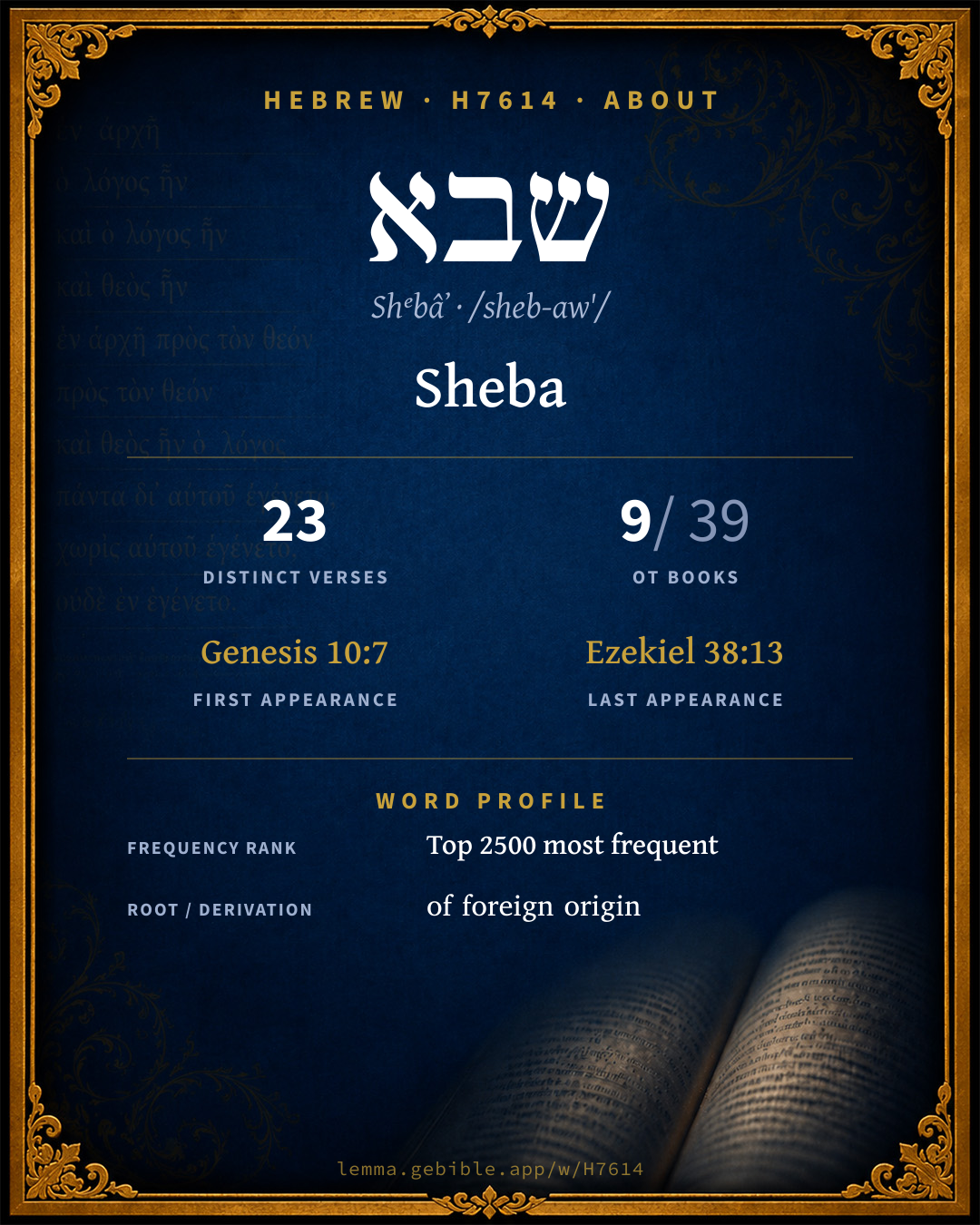
שְׁבָא
Sheba
BDB lists 5 entries for ‘Sheba’ fuller range ↓
Full lexicon entry — Brown-Driver-Briggs (BDB)
From Brown-Driver-Briggs (BDB)
Where this word appears
Grammar key — what these labels mean
Part of speech
- Noun
- A naming word — a person, place, thing, or idea.
Noun type
- Proper
- A name of a specific person, place, or people (e.g. Abraham, Zion, Israel).
Every verse where H7614 appears in the Book of 2 Chronicles — 4 distinct verses. Click any verse to open its interlinear word-by-word view. Verse text shown in the World English Bible for context — . Each verse’s Hebrew form is shown with its reference; the English is not keyword-highlighted, since the data carries no word-level English alignment. Use “Compare translations” on any verse to read it across multiple English versions. This concordance covers the Hebrew Bible; Septuagint (Greek Old Testament) occurrences are not indexed here.
2 Chronicles
- 2 Chronicles 9:1 שְׁבָ֗א n Proper When the queen of Sheba heard of the fame of Solomon, she came to prove Solomon with hard questions at Jerusalem, with a very great train, and camels that bore spices, and gold in abundance, and precious stones: and when she was come to Solomon, she talked with him of all that was in her heart.
- 2 Chronicles 9:3 שְׁבָ֔א n Proper When the queen of Sheba had seen the wisdom of Solomon, and the house that he had built,
- 2 Chronicles 9:9 שְׁבָ֖א n Proper She gave the king one hundred and twenty talents of gold, and spices in great abundance, and precious stones: neither was there any such spice as the queen of Sheba gave to king Solomon.
- 2 Chronicles 9:12 שְׁבָ֗א n Proper King Solomon gave to the queen of Sheba all her desire, whatever she asked, besides that which she had brought to the king. So she turned, and went to her own land, she and her servants.
About this entry
At a glance — auto-summarized from this page’s data, not written by a person. Every figure links to its source below. This summary describes the numbers; it doesn’t interpret them.
שבא (Shᵉbâʼ) is a Hebrew name most often rendered “Sheba.” Debuting at Genesis 10:7, it then recurs through the corpus. With 23 verses in 9 books, it is an uncommon word in the Hebrew Bible. The sections below give every occurrence and version rendering.
Gloss history
Strong's 1890 vs modern scholarship
About this word
Strong's H7614 catalogs a Hebrew word from the Hebrew Old Testament.
These counts are not copied from any lexicon or concordance. They are computed here, from the morphology-tagged Hebrew Old Testament. What Lemma adds →
- 23
- distinct verses
- The word appears in 23 distinct verses.
- 9 / 39
- OT books
- The word appears in 9 of 39 Old Testament books.
- #1,368
- by frequency
- Top 2500 most frequent Hebrew words (rank 1,368 of 8,640 Hebrew words by occurrence).
View all 23 occurrences in the concordance →
Most concentrated in
- 1 Kings 4 verses 17%
- 2 Chronicles 4 verses 17%
- Genesis 3 verses 13%
By section of the Old Testament
By traditional corpus
Conventional, traditional groupings — biblical authorship is debated, so this is a traditional corpus grouping, not an authorship claim. Each share is this word’s portion of its verses in that division of the Hebrew canon. Each figure is a share of the word’s 23 distinct verses.
- Writings (Ketuvim) 11 verses · 48%
- Prophets (Nevi'im) 9 verses · 39%
- Torah (Pentateuch) 3 verses · 13%
How translations render this word
Counts come from each version’s own published word-to-Strong’s tagging or interlinear alignment — an approximate guide to how each version renders this word, not a word-level alignment the data otherwise carries. Because each total is that version’s own tagged count, the per-version totals vary from one another and need not match the appearance or distinct-verse counts above. These counts may also differ from a printed concordance because Lemma counts each distinctly tagged rendering and does not collapse phrase taggings into a single head-word total. This is a fixed set of word-tagged versions (KJV, ASV, BSB, ULT) and does not change with the reading translation you choose elsewhere. Each version’s license is shown beside its name below (and on Sources).
- King James Version: Sheba 21×
- American Standard Version: Sheba 21×
- Berean Standard Bible: Sheba 22×
- unfoldingWord Literal Text: Sheba 22×
King James Version Public Domain
Renders H7614 across 23 tagged occurrences — most commonly:
Plus 2 renderings that appear only once — usually multi-word phrases or single function words the recovered tagging swept in, not distinct renderings.
American Standard Version Public Domain
Renders H7614 across 23 tagged occurrences — most commonly:
Plus 2 renderings that appear only once — usually multi-word phrases or single function words the recovered tagging swept in, not distinct renderings.
Berean Standard Bible Public Domain
Renders H7614 across 23 tagged occurrences — most commonly:
Plus 1 rendering that appears only once — usually multi-word phrases or single function words the recovered tagging swept in, not distinct renderings.
unfoldingWord Literal Text CC BY-SA 4.0
Renders H7614 across 23 tagged occurrences — most commonly:
Plus 1 rendering that appears only once — usually multi-word phrases or single function words the recovered tagging swept in, not distinct renderings.
Senses in BDB
The 5 senses BDB distinguishes for this word, in lexicon order (not ranked by frequency or importance). The full entry — with sub-senses — is in the Lexicon Entry tab.
- Sheba = "seven" or " an oath"
- son of Joktan and a descendant of Seth (noun proper masculine)
- son of Raamah, grandson of Cush, and a descendant of Ham (noun proper masculine)
- son of Jokshan, the son of Abraham by Keturah (noun proper masculine)
- a nation in southern Arabia (noun proper locative)
Word origin
n.pr.gent. et terr. Shebâ, in SW. Arabia (Sab. סבא DHMZMG xxxvii (1883), 9, סבא vb. = make campaign MordtHI 72 or expedition Sab.Denkm.No. 12, 1, 5, 14; cf. DSMargoliouth HastDB sheba F.B. Ency. Bib. sheba and reff.);—Sheba: מַלְכַּת־שׁ׳ 1 K 10:1, 4, 10, 13 = 2 Ch 9:1, 3, 9, 12; מַלְכֵי שׁ׳ ψ 72:10; famous for trade, רֹכְלֵי שׁ׳ Ez 27:22, 23, הֲלִיכֹת שׁ׳ Jb 6:19 (‖ תֵּמָא); yielding costly wares Ez 38:13, זְהַב שׁ׳ ψ 72:15, לְבוֹנָה מִשּׁ׳ Je 6:20 (‖ מֵאֶרֶץ מֶרְחָק, cf. foll.), paying homage and tribute to Israel in future Is 60:6; descended from (Yoḳtan and) Shem Gn 10:28 (J) = 1 Ch 1:22, from (Yoḳshan and) Abr. and Ḳeṭûrâh Gn 25:3 (J?) = 1 Ch 1:32 (i.e. a northern branch of Sheba, + דְּדָן, q.v.), but from כּוּשׁ Gn 10:7 (P) = 1 Ch 1:9; marauders, N. Arabia, Jb 1:15.
— Brown-Driver-Briggs (Oxford 1906, public domain), digitized via Sefaria, supplemented by the OpenScriptures HebrewLexicon (CC BY 4.0). See Sources.
Origin: of foreign origin
Jastrow Dictionary
A second Hebrew/Aramaic lexicon for comparison, covering Aramaic and post-biblical (Talmudic, Targumic, Midrashic) usage that the biblical-Hebrew BDB does not. Matched by lemma rather than by Strong’s number, so a lemma may carry more than one Jastrow headword (shown separately below), and the entries cover usage well beyond the Bible.
בָּא I
- (= אַבָּא)
- *1. father. Targ. O. Num. III, 24; 30 רב בית בא (and through the entire chapter ed. Berl.; oth. ed. אבא).
- 2. pr. n. m. Ba = Abba. Y. Ber. I, 2ᶜ top (interchanging with אבא); a. v. fr. in Y., v. אַבָּא II.
*בָּא II
- = בֵּיתָא, house. Targ. Is. V, 8 ed. Ven., oth. ed. בֵּיתָא.
בָּא III
- (part. of בֹּוא) coming, future. עולם הַבָּא (abbr. עו"הב) the world to come, futurity. Snh. X, 1; a. fr.—לְהַבָּא (Bab.), לַבָּא (Y.) in future. מכאן ול׳ (מיכן) from this date and further, opp. למפרע retrospectively, or מעיקרא in the past. Pes. 7ᵇ לה׳ משמע it refers to an act to be performed. Snh. 27ᵃ מיכן ולה׳ וכ׳ he becomes disqualified as a witness from now and in future (previous testimonies not being effected). Y. Ter. I, 40ᵇ bot.; a. fr.—V. בּוֹא.
שְׁבָא
- to capture, v. שְׁבֵי.
שְׁבָא ²
- (b. h.) pr. n. (the kingdom of) Sheba, in Arabia. Targ. II Esth. I, 2; a. e.—B. Bath. 15ᵇ, v. מַלְכָּה. Ib.; Y. Sot. V, end, 20ᵈ בימי מלכת ש׳ היה (Job) lived in the days of the queen of Sheba; Gen. R. s. 57; a. e.
A Dictionary of the Targumim, the Talmud Babli and Yerushalmi, and the Midrashic Literature (Marcus Jastrow; London, Luzac, 1903) — Public Domain. Digitized via Sefaria. Digitized via Sefaria. Full attribution on Sources.
Forms in the corpus
The 11 distinct written forms H7614 takes in the Hebrew Bible, most frequent first — each parse links to that state’s occurrences in the concordance. Hebrew forms include their vowel points and cantillation, so a single lemma takes many written forms.
| Form | Parsing | Example | Uses |
|---|---|---|---|
| שְׁבָ֗א | Noun, Proper | 1 Kings 10:1 | 4 |
| שְׁבָ֥א | Noun, Proper | Genesis 10:7 | 4 |
| שְׁבָ֖א | Noun, Proper | Genesis 25:3 | 3 |
| מִ/שְּׁבָ֣א | Noun, Proper | Isaiah 60:6 | 2 |
| שְׁבָ֔א | Noun, Proper | 1 Kings 10:4 | 2 |
| שְׁבָֽא | Noun, Proper | Genesis 10:28 | 2 |
| שְׁבָא֙ | Noun, Proper | Ezekiel 27:22 | 2 |
| שְׁ֝בָ֗א | Noun, Proper | Job 6:19 | 1 |
| שְׁ֫בָ֥א | Noun, Proper | Psalms 72:15 | 1 |
| שְׁבָ֑א | Noun, Proper | Ezekiel 27:23 | 1 |
| שְׁבָ֡א | Noun, Proper | Ezekiel 38:13 | 1 |
Same root — word family
Other BDB entries built from the same root as H7614, grouped by Strong’s listed origin. These share a root / origin per the lexicon — not necessarily a shared meaning. Each links to that word’s own entry.
Proper names from this root
People and places named from this root — a name, not an additional meaning of the word.
Compare all same-root words → 1 of the same-root words is a proper name (a person or place). They share a root, not necessarily a meaning.
Bible dictionary
Public-domain dictionary articles matched to this entry by name (Sheba). A biblical name can be shared by more than one person or place, so an article may treat several.
Easton's Bible Dictionary · M. G. Easton, 1897
An oath, seven. (1.) Heb. shebha, the son of Raamah (Gen. 10:7), whose descendants settled with those of Dedan on the Persian Gulf.
(2.) Heb. id. A son of Joktan (Gen. 10:28), probably the founder of the Sabeans.
(3.) Heb. id. A son of Jokshan, who was a son of Abraham by Keturah (Gen. 25:3).
(4.) Heb. id. A kingdom in Arabia Felix. Sheba, in fact, was Saba in Southern Arabia, the Sabaeans of classical geography, who carried on the trade in spices with the other peoples of the ancient world. They were Semites, speaking one of the two main dialects of Himyaritic or South Arabic. Sheba had become a monarchy before the days of Solomon. Its queen brought him gold, spices, and precious stones (1 Kings 10:1-13). She is called by our Lord the "queen of the south" (Matt. 12:42).
(5.) Heb. shebha', "seven" or "an oak." A town of Simeon (Josh. 19:2).
(6.) Heb. id. A "son of Bichri," of the family of Becher, the son of Benjamin, and thus of the stem from which Saul was descended (2 Sam. 20:1-22). When David was returning to Jerusalem after the defeat of Absalom, a strife arose between the ten tribes and the tribe of Judah, because the latter took the lead in bringing back the king. Sheba took advantage of this state of things, and raised the standard of revolt, proclaiming, "We have no part in David." With his followers he proceeded northward. David seeing it necessary to check this revolt, ordered Abishai to take the gibborim, "mighty men," and the body-guard and such troops as he could gather, and pursue Sheba. Joab joined the expedition, and having treacherously put Amasa to death, assumed the command of the army. Sheba took refuge in Abel-Bethmaachah, a fortified town some miles north of Lake Merom. While Joab was engaged in laying siege to this city, Sheba's head was, at the instigation of a "wise woman" who had held a parley with him from the city walls, thrown over the wall to the besiegers, and thus the revolt came to an end.
Smith's Bible Dictionary · William Smith, 1863
one of the towns of the allotment of Simeon, (Joshua 19:2) probably the same as Shema. (Joshua 15:26)
(seven, or all oath).
+ A son of Raamah son of Cush. (Genesis 10:7; 1 Chronicles 1:9) + A soil of Joktan. (Genesis 10:28; 1 Chronicles 1:22) + A son of Jokshan son of Keturah. (Genesis 25:3; 1 Chronicles 1:32) We shall consider, first, the history of the Joktanite Sheba; and secondly, the Cushite Sheba and the Keturahite Sheba together. I. The Joktanites were among the early colonists of southern Arabia, and the kingdom which they there founded was for many centuries called the kingdom of Sheba, after one of the sons of Joktan. The visit of the queen of Sheba to King Solomon. (1 Kings 10:1) is one of the familiar Bible incidents. The kingdom of Sheba embraced the greater part of the Yemen, or Arabia Felix. It bordered on the Red Sea, and was one of the most fertile districts of Arabia. Its chief cities, and probably successive capitals, were Seba, San'a (Uzal), and Zafar (Sephar). Seba was probably the name of the city, and generally of the country and nation. II. Sheba, son of Raamah son of Cush settled somewhere on the shores of the Persian Gulf. It was this Sheba that carried on the great Indian traffic with Palestine, in conjunction with, as we hold, the other Sheba, son of Jokshan son of Keturah, who like Dedan appears to have formed, with the Cushite of the same name, one tribe.
(on oath), the son of Bichri, a Benjamite, (2 Samuel 20:1-22) the last chief of the Absalom insurrection. The occasion seized by Sheba was the emulation between the northern and southern tribes on David's return. (2 Samuel 20:1,2) Sheba traversed the whole of Palestine apparently rousing the population, Joab following in full pursuit to the fortress Abel Beth-maachah, where Sheba was beheaded. (2 Samuel 20:3-22)
Hitchcock's Bible Names Dictionary · Roswell D. Hitchcock, 1869
captivity; old man; repose; oath
Classic public-domain reference works; full attribution on Sources.
Septuagint verse parallels
This word appears in 23 verses that also exist in the Greek Old Testament (Septuagint), out of the 23 Hebrew verses it occurs in. You can read those verses in Greek by switching the Old Testament edition to the Septuagint.
Read these verses in the Septuagint
- Genesis 10:7
- 1 Kings 10:1
- 1 Chronicles 1:9
- 2 Chronicles 9:1
- Job 1:15
- Psalms 72:10
- Isaiah 60:6
- Jeremiah 6:20
- Ezekiel 27:22
This is a verse-level parallel only — the same verses exist in both the Hebrew and Greek Old Testaments. No word-level Hebrew↔Greek correspondence is claimed: the data carries no such alignment, so no Greek word is shown as this Hebrew word’s translation. Coverage is not total — the Septuagint omits the deuterocanon and renumbers the Psalms, so some Hebrew verses have no direct Greek parallel.