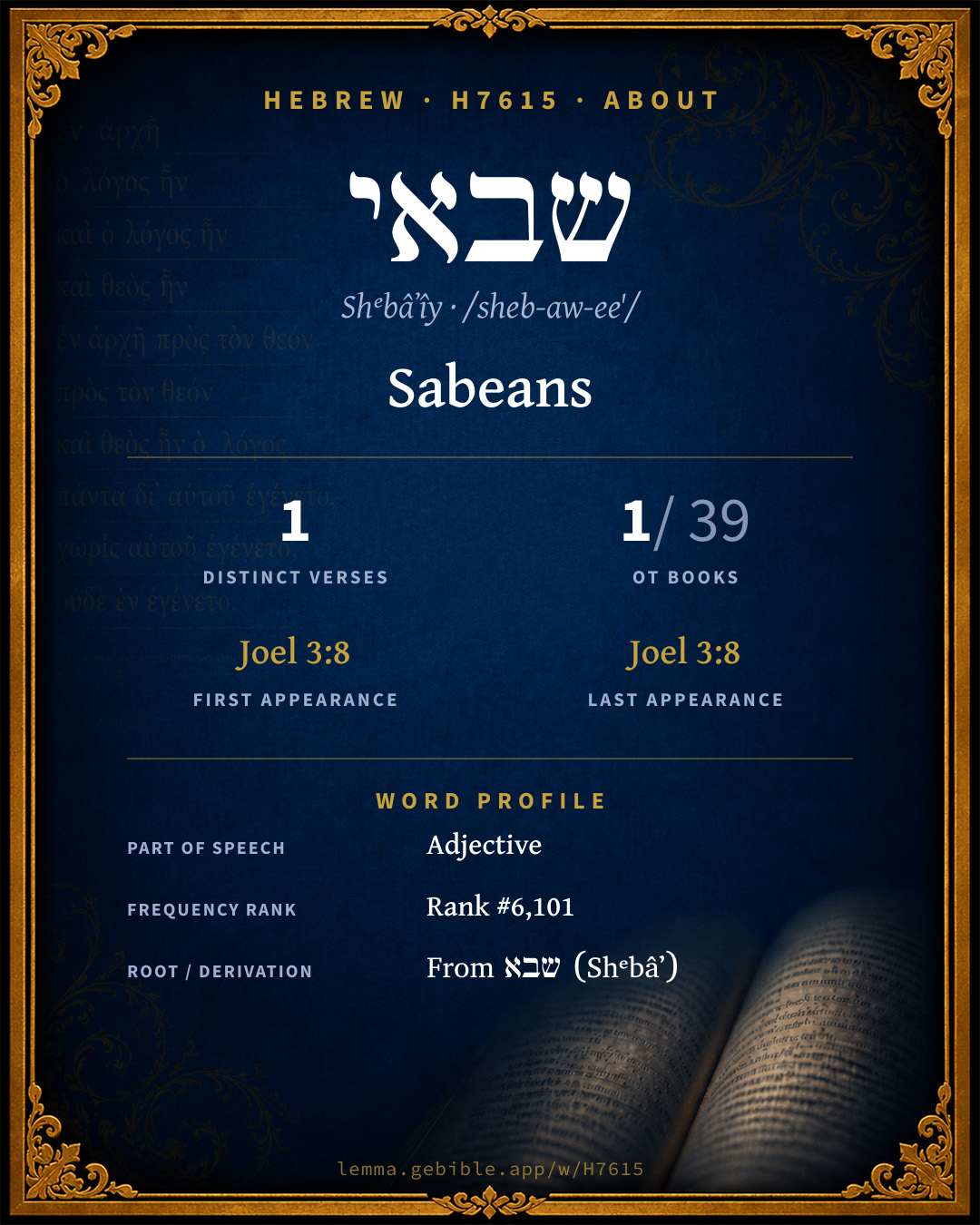
שְׁבָאִי
Sabeans
BDB lists 2 entries for ‘Sabeans’ fuller range ↓
Full lexicon entry — Brown-Driver-Briggs (BDB)
From Brown-Driver-Briggs (BDB)
Where this word appears
Grammar key — what these labels mean
Noun type
- Gentilic
- A noun naming a member of a people, tribe, or region of origin (e.g. an Israelite, a Moabite).
State
- Absolute
- The independent form of a noun, not bound to a following word.
Gender
- Masculine
- Grammatically masculine.
Number
- Plural
- More than one (in Hebrew, generally three or more).
Every verse where H7615 appears — 1 distinct verse across 1 book. Click any verse to open its interlinear word-by-word view. Verse text shown in the World English Bible for context — . Each verse’s Hebrew form is shown with its reference; the English is not keyword-highlighted, since the data carries no word-level English alignment. Use “Compare translations” on any verse to read it across multiple English versions. This concordance covers the Hebrew Bible; Septuagint (Greek Old Testament) occurrences are not indexed here.
Joel 1 verse
About this entry
At a glance — auto-summarized from this page’s data, not written by a person. Every figure links to its source below. This summary describes the numbers; it doesn’t interpret them.
שבאי (Shᵉbâʼîy) is a Hebrew name most often rendered “Sabeans.” The Hebrew Bible uses it only 1 verse. It clusters heavily in Joel, which alone accounts for 100% of its uses. Its lone occurrence is Joel 3:8. For the data behind this summary, explore 1-verse concordance and the renderings breakdown below.
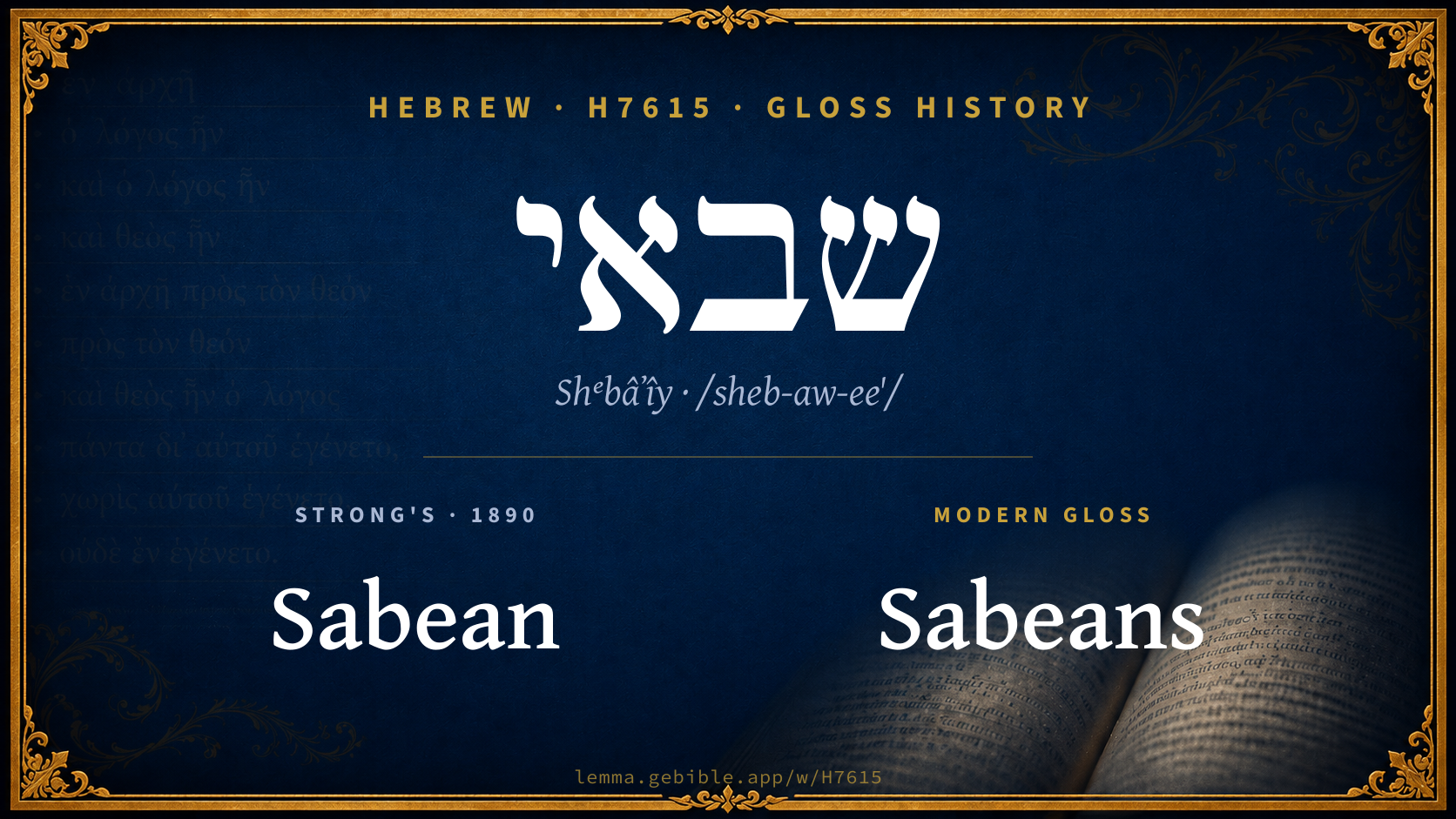
Gloss history
Strong's 1890 vs modern scholarship
About this word
Strong's H7615 catalogs a Hebrew word from the Hebrew Old Testament.
These counts are not copied from any lexicon or concordance. They are computed here, from the morphology-tagged Hebrew Old Testament. What Lemma adds →
- 1
- distinct verses
- The word appears in 1 distinct verse.
- 1 / 39
- OT books
- The word appears in 1 of 39 Old Testament books.
- #6,101
- by frequency
- Rank #6,101 (rank 6,101 of 8,640 Hebrew words by occurrence).
View all 1 occurrence in the concordance →
Most concentrated in
- Joel 1 verse 100%
By section of the Old Testament
By traditional corpus
Conventional, traditional groupings — biblical authorship is debated, so this is a traditional corpus grouping, not an authorship claim. Each share is this word’s portion of its verses in that division of the Hebrew canon. Each figure is a share of the word’s 1 distinct verse.
- Prophets (Nevi'im) 1 verse · 100%
How translations render this word
Counts come from each version’s own published word-to-Strong’s tagging or interlinear alignment — an approximate guide to how each version renders this word, not a word-level alignment the data otherwise carries. Because each total is that version’s own tagged count, the per-version totals vary from one another and need not match the appearance or distinct-verse counts above. These counts may also differ from a printed concordance because Lemma counts each distinctly tagged rendering and does not collapse phrase taggings into a single head-word total. This is a fixed set of word-tagged versions (KJV, ASV, BSB, ULT) and does not change with the reading translation you choose elsewhere. Each version’s license is shown beside its name below (and on Sources).
- King James Version: Sabeans 1×
- American Standard Version: Men of sheba 1×
- Berean Standard Bible: Sabeans 1×
- unfoldingWord Literal Text: Sabeans 1×
King James Version Public Domain
Renders H7615 across 1 tagged occurrence — most commonly:
American Standard Version Public Domain
Renders H7615 across 1 tagged occurrence — most commonly:
Berean Standard Bible Public Domain
Renders H7615 across 1 tagged occurrence — most commonly:
unfoldingWord Literal Text CC BY-SA 4.0
Renders H7615 across 1 tagged occurrence — most commonly:
Senses in BDB
The 2 senses BDB distinguishes for this word, in lexicon order (not ranked by frequency or importance). The full entry — with sub-senses — is in the Lexicon Entry tab.
- Sabeans = "drunkard" or " he who is coming"
- the people of the nation of Sheba
Word origin
[ שְׁבָאִי ] adj.gent. only pl. as subst., Jo 4:8
— Brown-Driver-Briggs (Oxford 1906, public domain), digitized via Sefaria, supplemented by the OpenScriptures HebrewLexicon (CC BY 4.0). See Sources.
Derived from שבא (Shᵉbâʼ) (H7614) — Sheba.
Jastrow Dictionary
A second Hebrew/Aramaic lexicon for comparison, covering Aramaic and post-biblical (Talmudic, Targumic, Midrashic) usage that the biblical-Hebrew BDB does not. Matched by lemma rather than by Strong’s number, so a lemma may carry more than one Jastrow headword (shown separately below), and the entries cover usage well beyond the Bible.
אִי־
- prefix, v. אִ־
אִי I
- fem. of אוּ q. v.
אִי II
- (= אִין; h. אִם; cmp. אוֹ)
- 1. if, whether. Targ. Cant. VII, 13; a. e.—Ber. 2ᵃ, a. fr. אי הכי (abbrev. א"ה) if this be so (introducing an argument against one’s opinion).—R. Hash. 3ᵃ כי משמש וכ׳ khi has four meanings, אי if, &c.—אי נמי (abbrev. א"נ) a) if you choose, it may also be said; or. B. Mets. 98ᵃ; a. fr.—b) even if, v. נַמִּי. Ḥull. 12ᵃ א"נ דילמא וכ׳ (Rashi א"נ שמע איניש וכ׳) even if somebody else overheard it; a. fr.—אי אמרת בשלמא (abbr. אא"ב = בשלמא אי אמרת) I grant, if you were to say … היינו then would be right what &c.; v. בשלמא. Yoma 17ᵇ; a. fr.—אי … אי whether … or. Targ. Koh. XI, 6. B. Mets. 98ᵃ; a. fr.
- 2. adv. of interrogation, v. אִין II. Targ. Job XI, 2 Ms. (ed. אין).
אִי III
- (= h. אֵין) not. Git. IV, 5 אי אפשר it is impossible. Keth. XII, 3 אי אפשי I want not; a. fr.
אִי IV
- (abbr. of אִית, as לי = לית) there is. Y. Snh. VI, 23ᵇ bot. אי בי וכ׳ there is in me (the possibility of) doing, i.e. I can do it. Ib. מה אי וכ׳ what is it thou canst do? (v. Y. Ḥag. II, 78ᵃ top).
אֵי II
- Interj. Eh! Oh! Woe! Targ. Y. II, Lev. XXVI, 29.—Taan. 7ᵃ אי חכמה וכ׳ Oh, for such a brilliant mind in such an ugly vessel (body)! R. Hash. 19ᵃ אי שמים Oh heavens!; a. fr. Y. Shek. V, end, 49ᵇ אי לי שאני וכ׳ woe unto me, that I thus see thee! Y. Yeb. XIII, 14ᵃ top; a. fr. [Babli, usually אוֹי.]
אֵי III
- (אֵיי) h. (b. h. אֵי, אַיֵה) where? what? how?—אי מנן whence? Targ. Josh. II, 4; a. e.—Hebr. אי זה (often אֵיזֶה, אֵזֶה in one word) who? which? Y. Kil. VIII, beg. 31ᵇ לאי זה דבר נאמר with regard to what (in what way, sense) has it been said? Y. Shebi. I, beg. 33ᵃ ואי זה זה and which (ploughing time) is this?; a. v. fr.—Y. Peah III, 17ᶜ top ואיי דינו מירוג (= אידין) and what is the meaning of merog? Kerith. 6ᵇ לאיי מיצרך צריכי what need is there (of the others)? Cmp. אֵיזֶה; אֵימָתי; Kerith. 6ᵇ לאיי מיצרך צריכי what need is there (of the others)? Cmp. אֵיזֶה; אֵימָתי; כֵּיצַד.
שַׁבַּאי
- (שָׁבָה) captor, guardsman of captives. Snh. 104ᵃ, sq. Gitt. 58ᵃ נתעלל בה ש׳ וכ׳ the captor abused her the whole night; Yalk. Jer. 276. Tanḥ. ed. Bub. B’shall. 4 נטל את השַׁבַּאיי וכ׳ he took (his son’s) captor and put him on the rack, Yalk. Ex. 225; a. e.—Pl. שַׁבָּאִים, שַׁבְּאִין. Midr. Till. to Ps. XVIII, 8 באו ש׳ ושבו וכ׳ captors came and led his son away; a. e.
A Dictionary of the Targumim, the Talmud Babli and Yerushalmi, and the Midrashic Literature (Marcus Jastrow; London, Luzac, 1903) — Public Domain. Digitized via Sefaria. Digitized via Sefaria. Full attribution on Sources.
Bible dictionary
Public-domain dictionary articles matched to this entry by name (Sabeans). A biblical name can be shared by more than one person or place, so an article may treat several.
Easton's Bible Dictionary · M. G. Easton, 1897
Descendants of Seba (Gen. 10:7); Africans (Isa. 43:3). They were "men of stature," and engaged in merchandise (Isa. 45:14). Their conversion to the Lord was predicted (Ps. 72:10). This word, in Ezek. 23:42, should be read, as in the margin of the Authorized Version, and in the Revised Version, "drunkards." Another tribe, apparently given to war, is mentioned in Job 1:15.
Smith's Bible Dictionary · William Smith, 1863
[Sheba]
Hitchcock's Bible Names Dictionary · Roswell D. Hitchcock, 1869
captivity; conversion; old age
Classic public-domain reference works; full attribution on Sources.