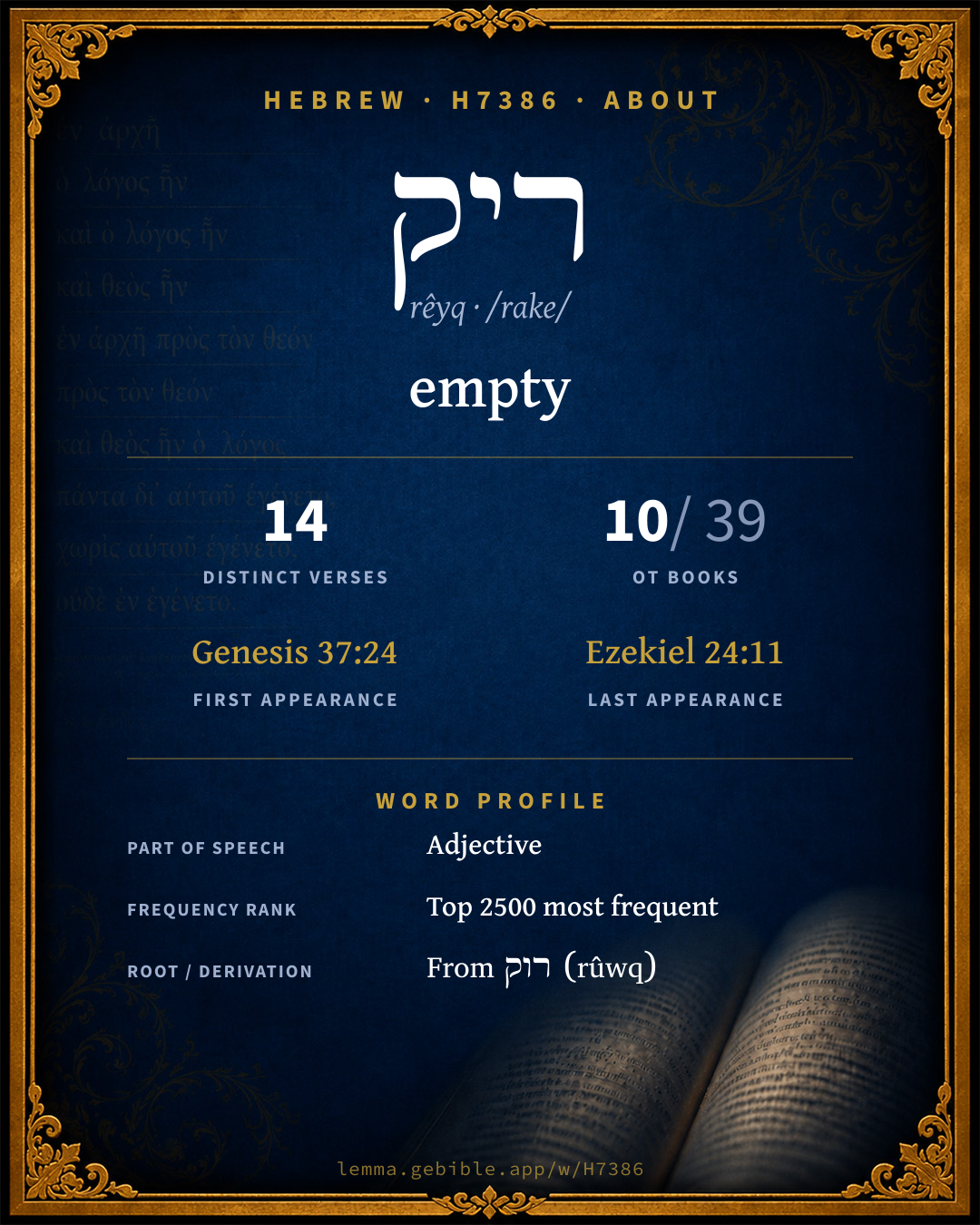
רֵיק
empty
‘empty’ is one of 3 main senses fuller range ↓
Full lexicon entry — Brown-Driver-Briggs (BDB)
From Brown-Driver-Briggs (BDB)
Where this word appears
Grammar key — what these labels mean
Part of speech
- Adjective
- A word that describes or qualifies a noun.
State
- Absolute
- The independent form of a noun, not bound to a following word.
Gender
- Masculine
- Grammatically masculine.
- Feminine
- Grammatically feminine.
Number
- Plural
- More than one (in Hebrew, generally three or more).
- Singular
- One.
Every verse where H7386 appears in the Book of Judges — 3 distinct verses. Click any verse to open its interlinear word-by-word view. Verse text shown in the World English Bible for context — . Each verse’s Hebrew form is shown with its reference; the English is not keyword-highlighted, since the data carries no word-level English alignment. Use “Compare translations” on any verse to read it across multiple English versions. This concordance covers the Hebrew Bible; Septuagint (Greek Old Testament) occurrences are not indexed here.
Judges
- Judges 7:16 רֵקִ֔ים adj Adjective mp He divided the three hundred men into three companies, and he put into the hands of all of them trumpets, and empty pitchers, with torches within the pitchers.
- Judges 9:4 רֵיקִים֙ adj Adjective mp They gave him seventy [pieces] of silver out of the house of Baal Berith, with which Abimelech hired vain and light fellows, who followed him.
- Judges 11:3 רֵיקִ֔ים adj Adjective mp Then Jephthah fled from his brothers, and lived in the land of Tob: and there were gathered vain fellows to Jephthah, and they went out with him.
About this entry
At a glance — auto-summarized from this page’s data, not written by a person. Every figure links to its source below. This summary describes the numbers; it doesn’t interpret them.
At its core, ריק (rêyq) means “empty.” It first appears in Genesis 37:24. It turns up in 14 verses across 10 books, an uncommon footprint. Not a single-sense word: explore its full sense range. It clusters with רוק, ריק and ריקם under a shared root. Each statement above links to its evidence; the full detail follows below.
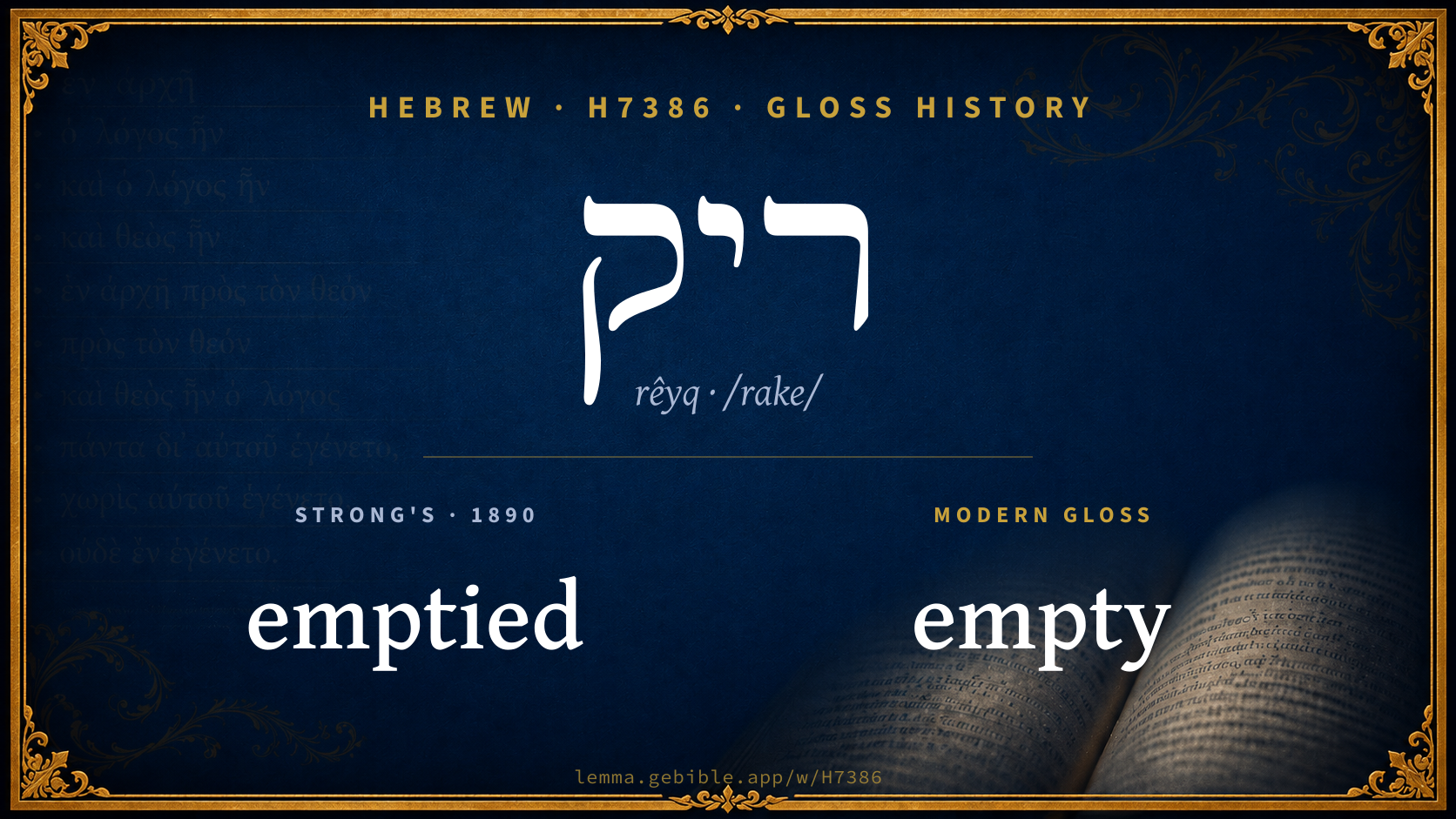
Gloss history
Strong's 1890 vs modern scholarship
About this word
Strong's H7386 catalogs a Hebrew word from the Hebrew Old Testament.
These counts are not copied from any lexicon or concordance. They are computed here, from the morphology-tagged Hebrew Old Testament. What Lemma adds →
- 14
- distinct verses
- The word appears in 14 distinct verses.
- 10 / 39
- OT books
- The word appears in 10 of 39 Old Testament books.
- #1,910
- by frequency
- Top 2500 most frequent Hebrew words (rank 1,910 of 8,640 Hebrew words by occurrence).
View all 14 occurrences in the concordance →
By section of the Old Testament
By traditional corpus
Conventional, traditional groupings — biblical authorship is debated, so this is a traditional corpus grouping, not an authorship claim. Each share is this word’s portion of its verses in that division of the Hebrew canon. Each figure is a share of the word’s 14 distinct verses.
- Prophets (Nevi'im) 7 verses · 50%
- Writings (Ketuvim) 4 verses · 29%
- Torah (Pentateuch) 3 verses · 21%
How translations render this word
Counts come from each version’s own published word-to-Strong’s tagging or interlinear alignment — an approximate guide to how each version renders this word, not a word-level alignment the data otherwise carries. Because each total is that version’s own tagged count, the per-version totals vary from one another and need not match the appearance or distinct-verse counts above. These counts may also differ from a printed concordance because Lemma counts each distinctly tagged rendering and does not collapse phrase taggings into a single head-word total. This is a fixed set of word-tagged versions (KJV, ASV, BSB, ULT) and does not change with the reading translation you choose elsewhere. Each version’s license is shown beside its name below (and on Sources).
- King James Version: Empty 4×, Vain 4×
- American Standard Version: Empty 4×, After vain 2×, Vain 2×
- Berean Standard Bible: Empty 2×, Fantasies 2×, Worthless 2×
- unfoldingWord Literal Text: Empty 5×, Worthless 3×, Empty things 2×
King James Version Public Domain
Renders H7386 across 14 tagged occurrences — most commonly:
Plus 6 renderings that appear only once — usually multi-word phrases or single function words the recovered tagging swept in, not distinct renderings.
American Standard Version Public Domain
Renders H7386 across 13 tagged occurrences — most commonly:
Plus 5 renderings that appear only once — usually multi-word phrases or single function words the recovered tagging swept in, not distinct renderings.
Berean Standard Bible Public Domain
Renders H7386 across 14 tagged occurrences — most commonly:
Plus 8 renderings that appear only once — usually multi-word phrases or single function words the recovered tagging swept in, not distinct renderings.
unfoldingWord Literal Text CC BY-SA 4.0
Renders H7386 across 15 tagged occurrences — most commonly:
Plus 5 renderings that appear only once — usually multi-word phrases or single function words the recovered tagging swept in, not distinct renderings.
Senses in the full BDB
What do BDB’s symbols mean?
BDB uses these scholarly abbreviations:
| Symbol | Meaning |
|---|---|
| 𝔊 | the Septuagint (the ancient Greek translation, LXX) |
| 𝔙 | the Vulgate (the Latin translation) |
| 𝔖 | the Syriac version (the Peshitta) |
| 𝔗 | the Targum (the Aramaic translation) |
| ψ | the Psalms |
| √ | root (the underlying root or stem) |
| ‖ | parallel passage (a synonymous or contrasted parallel) |
| † | the dagger: every passage where the word occurs is cited |
The 2 senses and sub-senses the full Brown-Driver-Briggs lexicon distinguishes for this word, in lexicon order (not ranked by frequency), with BDB’s own verbatim wording and sub-sense lettering. Shown in Hebrew script with BDB’s own scholarly abbreviations. The condensed entry is in the Lexicon Entry tab. See also the Forms in the corpus table below.
- 1. empty, of vessels 2 K 4:3 Ju 7:16 Ez 24:11 + (prob.) Je 14:3 (רֵיקִים for רֵיקָם), 51:34 (רֵיק for רִיק); of pit Gn 37:24 (J), lap Ne 5:13, ears of grain Gn 41:27 (E; דַּקּוֹת v 6, 7, 23, 24); רֵקָה נַפְשׁוֹ Is 29:8 (cf. 32:6 √ 1). e.g. 2 Kings 4:3
- 2. empty, idle, worthless, ethically; אנשׁים ריקים worthless fellows Ju 9:4; 11:3 2 Ch 13:7, so הָרֵקִים alone (as subst.) 2 S 6:20; מְרַדֵּף רֵיקִים Pr 12:11 AV RV of persons; vain, unprofitable things, 28:19 (v. Toy); דָּבָר ר׳ מִן Dt 32:47 (D) a thing too empty (of significance) for you; + (prob.) ψ 4:3 (רֵיק for MT רִיק) love an empty thing (‖ כזב), of abortive course of action. e.g. Judges 9:4
Senses from the full Brown-Driver-Briggs lexicon (Brown, Driver, Briggs; Oxford 1906 — public domain), digitized via Sefaria, supplemented by the OpenScriptures HebrewLexicon (CC BY 4.0). Full attribution on Sources.
Word origin
adj. empty, vain;—m. abs. רֵק Gn 37:24 + 2 times; f. רֵקָה Ez 24:11 Is 29:8; mpl. רֵ(י)קִים Ju 7:16 +; fpl. רֵקוֹת Gn 41:27;—
— Brown-Driver-Briggs (Oxford 1906, public domain), digitized via Sefaria, supplemented by the OpenScriptures HebrewLexicon (CC BY 4.0). See Sources.
Derived from רוק (rûwq) (H7324) — to empty.
Jastrow Dictionary
A second Hebrew/Aramaic lexicon for comparison, covering Aramaic and post-biblical (Talmudic, Targumic, Midrashic) usage that the biblical-Hebrew BDB does not. Matched by lemma rather than by Strong’s number, so a lemma may carry more than one Jastrow headword (shown separately below), and the entries cover usage well beyond the Bible.
רִיק
- , v. רוּק
רֵיק
- empty, void; worthless man. Y. Peah I, 15ᵇ bot., a. e. (ref. to Deut. XXXII, 47) ואם הוא ר׳ מכם וכ׳ and if it (a word of the Law) appear void (of meaning), it is your fault, because you do not toil to study it. Num. R. s. 420 (ref. to II Sam. VI, 20) הר׳ שבריקים זה וכ׳ the lowest of the low is the dancer, for there is none more void of all merits than he is; a. e.—Pl. רֵיקִים, רֵיקִין, רֵקִ׳. Ib.; Y. Succ. V, 55ᶜ top; Y. Snh. II, 20ᵇ bot.; a. e.—[Gen. R. s. 32, end הריקין, read: הרֵיקָן.]—Fem. רֵיקָה. Num. R. s. 2021 (ref. to Deut. l. c.) אפי׳ מצוה … ר׳ וקלה בה חיים וכ׳ even if there be a command which thou considerest empty and unimportant, there is in it life and length of days. e.g. Deuteronomy 32:47
רְקַק
- Targ. O. Lev. XV, 8 יְרוֹק (Y. יְרִיק). Targ. Deut. XXV, 9.—Part. רָקֵיק; pl. רְקִיקִין. Targ. II Esth. III, 8.—Koh. R. to VII, 9 כל דר׳ לעיל וכ׳ if a person spits upward, it will fall in his face (an angry person hurts himself). Y. Yeb. XII, end, 13ᵃ top ורַקַּת קדמנא וכ׳ she spat before us &c., v. רוּקָּא; Bab. ib. 39ᵇ וירקת. Ib. 106ᵃ אכלה תומא ורַקְּתָה if she ate garlic and had to spit. Lev. R. s. 9 עד דאזלת ורוּקַּת וכ׳ until thou goest and spittest in that preacher’s (R. Meir’s) face; ib. רוּקִי באנפי וכ׳ spit in my face seven times; ib. ואנא רַקִּית וכ׳ and I spat &c.; Num. R. s. 920; Y. Sot. I, 16ᵈ bot. ורוֹקְקִין בגויה וכ׳ spit into it (my eye) &c.; a. e.
A Dictionary of the Targumim, the Talmud Babli and Yerushalmi, and the Midrashic Literature (Marcus Jastrow; London, Luzac, 1903) — Public Domain. Digitized via Sefaria. Digitized via Sefaria. Full attribution on Sources.
Forms in the corpus
The 14 distinct written forms H7386 takes in the Hebrew Bible, most frequent first — each parse links to that state’s occurrences in the concordance. Hebrew forms include their vowel points and cantillation, so a single lemma takes many written forms.
| Form | Parsing | Example | Uses |
|---|---|---|---|
| הָ/רֵק֔וֹת | Adjective, Adjective, Feminine, Plural, Absolute | Genesis 41:27 | 1 |
| הָ/רֵקִֽים | Adjective, Adjective, Masculine, Plural, Absolute | 2 Samuel 6:20 | 1 |
| וְ/רֵיקָ֣ה | Adjective, Adjective, Feminine, Singular, Absolute | Isaiah 29:8 | 1 |
| וָ/רֵ֑ק | Adjective, Adjective, Masculine, Singular, Absolute | Nehemiah 5:13 | 1 |
| רֵ֔ק | Adjective, Adjective, Masculine, Singular, Absolute | Genesis 37:24 | 1 |
| רֵ֝קִ֗ים | Adjective, Adjective, Masculine, Plural, Absolute | Proverbs 28:19 | 1 |
| רֵ֥ק | Adjective, Adjective, Masculine, Singular, Absolute | Deuteronomy 32:47 | 1 |
| רֵיקִ֔ים | Adjective, Adjective, Masculine, Plural, Absolute | Judges 11:3 | 1 |
| רֵיקִ֣ים | Adjective, Adjective, Masculine, Plural, Absolute | Proverbs 12:11 | 1 |
| רֵיקִים֙ | Adjective, Adjective, Masculine, Plural, Absolute | Judges 9:4 | 1 |
| רֵקִ֔ים | Adjective, Adjective, Masculine, Plural, Absolute | Judges 7:16 | 1 |
| רֵקִ֖ים | Adjective, Adjective, Masculine, Plural, Absolute | 2 Kings 4:3 | 1 |
| רֵקִים֙ | Adjective, Adjective, Masculine, Plural, Absolute | 2 Chronicles 13:7 | 1 |
| רֵקָ֑ה | Adjective, Adjective, Feminine, Singular, Absolute | Ezekiel 24:11 | 1 |
Same root — word family
Other BDB entries built from the same root as H7386, grouped by Strong’s listed origin. These share a root / origin per the lexicon — not necessarily a shared meaning. Each links to that word’s own entry.
Derives from
Shares the same root
Derived from this word
Proper names from this root
People and places named from this root — a name, not an additional meaning of the word.
Compare all same-root words → Showing 4 of 5 — not the complete family. 1 of the same-root words is a proper name (a person or place). They share a root, not necessarily a meaning.
Septuagint verse parallels
This word appears in 13 verses that also exist in the Greek Old Testament (Septuagint), out of the 14 Hebrew verses it occurs in. You can read those verses in Greek by switching the Old Testament edition to the Septuagint.
Read these verses in the Septuagint
- Genesis 37:24
- Deuteronomy 32:47
- Judges 7:16
- 2 Samuel 6:20
- 2 Kings 4:3
- 2 Chronicles 13:7
- Proverbs 12:11
- Isaiah 29:8
- Ezekiel 24:11
This is a verse-level parallel only — the same verses exist in both the Hebrew and Greek Old Testaments. No word-level Hebrew↔Greek correspondence is claimed: the data carries no such alignment, so no Greek word is shown as this Hebrew word’s translation. Coverage is not total — the Septuagint omits the deuterocanon and renumbers the Psalms, so some Hebrew verses have no direct Greek parallel.