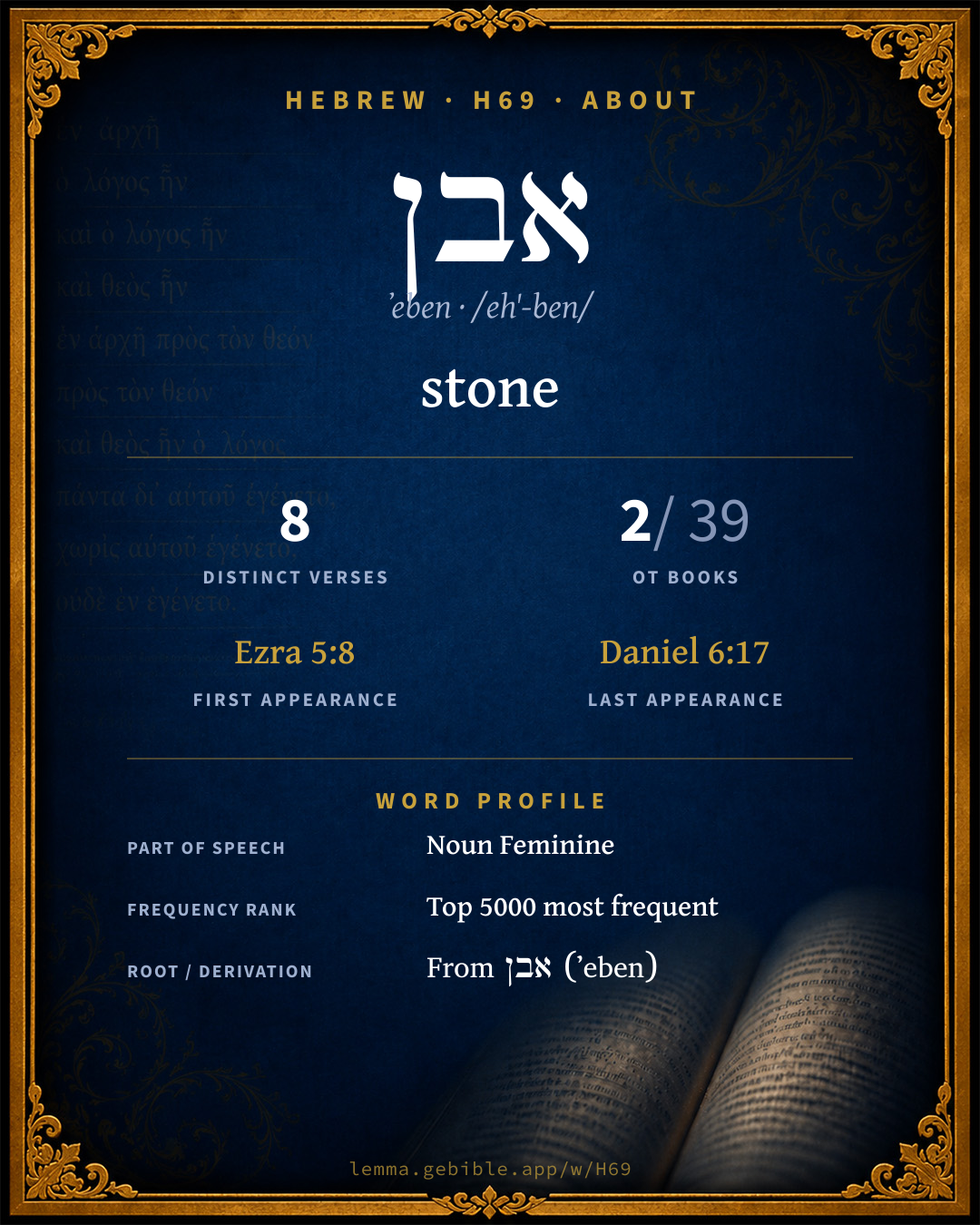
אֶ֫בֶן
stone
‘stone’ is one of 3 main senses fuller range ↓
Full lexicon entry — Brown-Driver-Briggs (BDB)
From Brown-Driver-Briggs (BDB)
Where this word appears
See every Absolute-state word in the Hebrew Bible →
Grammar key — what these labels mean
Part of speech
- Noun
- A naming word — a person, place, thing, or idea.
Noun type
- Common
- A common noun — a general class of person, place, or thing (“king,” “city,” “water”), not a specific name.
State
- Absolute
- The independent form of a noun, not bound to a following word.
- Construct
- A noun bound to a following noun in a possessive / “of” relationship (the construct chain).
Gender
- Feminine
- Grammatically feminine.
Number
- Singular
- One.
3 distinct verses where H69 appears in the Absolute state, across 1 book. Filtered view — show all forms. Click any verse to open its interlinear word-by-word view. Verse text shown in the World English Bible for context — . Each verse’s Hebrew form is shown with its reference; the English is not keyword-highlighted, since the data carries no word-level English alignment. Use “Compare translations” on any verse to read it across multiple English versions. This concordance covers the Hebrew Bible; Septuagint (Greek Old Testament) occurrences are not indexed here.
Daniel 3 verses
- Daniel 2:34 אֶ֨בֶן֙ n c fs You saw until a stone was cut out without hands, which struck the image on its feet that were of iron and clay, and broke them in pieces.
- Daniel 2:45 אֶ֜בֶן n c fs Because you saw that a stone was cut out of the mountain without hands, and that it broke in pieces the iron, the brass, the clay, the silver, and the gold; the great God has made known to the king what shall happen hereafter: and the dream is certain, and the interpretation of it sure.
- Daniel 6:17 אֶ֣בֶן n c fs A stone was brought, and laid on the mouth of the den; and the king sealed it with his own signet, and with the signet of his lords; that nothing might be changed concerning Daniel.
About this entry
At a glance — auto-summarized from this page’s data, not written by a person. Every figure links to its source below. This summary describes the numbers; it doesn’t interpret them.
אבן — transliterated ʼeben — is a Hebrew noun carrying the sense “stone.” Its uses cluster heavily in Daniel (75% of all occurrences). With 8 verses in 2 books, it is an uncommon word in the Hebrew Bible. Debuting at Ezra 5:8, it then recurs through the corpus. The lexicon spreads it across several senses; see its full sense range. See the sense tree, 8-verse concordance, and the renderings breakdown below.
Gloss history
Strong's 1890 vs modern scholarship
About this word
Strong's H69 catalogs a Hebrew word from the Hebrew Old Testament.
These counts are not copied from any lexicon or concordance. They are computed here, from the morphology-tagged Hebrew Old Testament. What Lemma adds →
- 8
- distinct verses
- The word appears in 8 distinct verses.
- 2 / 39
- OT books
- The word appears in 2 of 39 Old Testament books.
- #2,625
- by frequency
- Top 5000 most frequent Hebrew words (rank 2,625 of 8,640 Hebrew words by occurrence).
View all 8 occurrences in the concordance →
By traditional corpus
Conventional, traditional groupings — biblical authorship is debated, so this is a traditional corpus grouping, not an authorship claim. Each share is this word’s portion of its verses in that division of the Hebrew canon. Each figure is a share of the word’s 8 distinct verses.
- Writings (Ketuvim) 8 verses · 100%
How translations render this word
Counts come from each version’s own published word-to-Strong’s tagging or interlinear alignment — an approximate guide to how each version renders this word, not a word-level alignment the data otherwise carries. Because each total is that version’s own tagged count, the per-version totals vary from one another and need not match the appearance or distinct-verse counts above. These counts may also differ from a printed concordance because Lemma counts each distinctly tagged rendering and does not collapse phrase taggings into a single head-word total. This is a fixed set of word-tagged versions (KJV, ASV, BSB, ULT) and does not change with the reading translation you choose elsewhere. Each version’s license is shown beside its name below (and on Sources).
- King James Version: Stone 6×, Stones 2×
- American Standard Version: Stone 5×, Stones 2×
- Berean Standard Bible: Stone 6×
- unfoldingWord Literal Text: Stone 7×
King James Version Public Domain
Renders H69 across 8 tagged occurrences — most commonly:
American Standard Version Public Domain
Renders H69 across 8 tagged occurrences — most commonly:
Plus 1 rendering that appears only once — usually multi-word phrases or single function words the recovered tagging swept in, not distinct renderings.
Berean Standard Bible Public Domain
Renders H69 across 8 tagged occurrences — most commonly:
Plus 2 renderings that appear only once — usually multi-word phrases or single function words the recovered tagging swept in, not distinct renderings.
unfoldingWord Literal Text CC BY-SA 4.0
Renders H69 across 8 tagged occurrences — most commonly:
Plus 1 rendering that appears only once — usually multi-word phrases or single function words the recovered tagging swept in, not distinct renderings.
9 senses and sub-senses in the full BDB
What do BDB’s symbols mean?
BDB uses these scholarly abbreviations:
| Symbol | Meaning |
|---|---|
| 𝔊 | the Septuagint (the ancient Greek translation, LXX) |
| 𝔙 | the Vulgate (the Latin translation) |
| 𝔖 | the Syriac version (the Peshitta) |
| 𝔗 | the Targum (the Aramaic translation) |
| ψ | the Psalms |
| √ | root (the underlying root or stem) |
| ‖ | parallel passage (a synonymous or contrasted parallel) |
| † | the dagger: every passage where the word occurs is cited |
The 9 senses and sub-senses the full Brown-Driver-Briggs lexicon distinguishes for this word, in lexicon order (not ranked by frequency), with BDB’s own verbatim wording and sub-sense lettering. Shown in Hebrew script with BDB’s own scholarly abbreviations. The condensed entry is in the Lexicon Entry tab. See also the Forms in the corpus table below.
- 1. in natural state, used as pillow Gn 28:11, 18 (E); seat Ex 17:12 (E); cover of well Gn 29:3(×2), 8, 10 (J) causing one to stumble Is 8:14; marring good ground 2 K 3:19, 25; hand-missile Ex 21:18 (JE) Nu 35:17, 23 (P) 2 S 16:6, 13, especially in judicial stoning, with vb. רָגַם Lv 20:2, 27; 24:23 Nu 14:10; 15:35, 36 Jos 7:25a (all P), so also Dt 21:21 2 Ch 24:21 Ez 16:40; 23:47; cf. 1 K 12:18 = 2 Ch 10:18; with vb. סָקַל Dt 13:11; 17:5; 22:21, 24 1 K 21:13; also Jos 7:25b (JE or D); sling-stones Ju 20:16 1 S 17:40, 49(×2), 50 2 Ch 26:14; hurled by engines 2 Ch 26:15; set up for inscribing law Dt 27:2, 4, 8 Jos 8:32 (all D); as memorial Jos 4:3, 5, 6, 7, 8, 9, 20, 21 (JED) 1 S 7:12; as sacred pillar (מַצֵּבָה) Gn 28:18; 35:14 (anointed with oil), 28:22 (= בֵּיתאֵל) cf. יִשְׂרָאֵל (רֹעֶה)א׳ Gn 49:24 (v. Di); as witness 31:45 cf. Jos 24:26, 27 (all JE); pl. gathered into heap (גַּל) over dead, Jos 7:26 (v. Di) 8:29 cf. 10:18, 27 (JE) 2 S 18:17; גַּל on which meal was eaten, in a compact Gn 31:46(×2) (JE); built into altar Ex 20:25 Dt 27:5, 6 (JED) Jos 8:31 1 K 18:31, 32, 38; cf. 2 K 23:15 𝔊 Klo (for הבמה); of figured stone (forbidden) א׳ מַשְׂכִּית Lv 26:1 (H); א׳ גדולה where ark rested 1 S 6:14, 15 also v 18 (MT אבל q.v.); (v. for other noteworthy stones 9. infr.) e.g. Genesis 28:11
- 2. stone, as material, of tablets Ex 24:12; 31:18; 34:1 (pl.) v 4(×2) (JE) Dt 4:13; 5:19; 9:9, 10, 11; 10:1, 3; of vessels, hence prob. Ex 7:19 (P; א׳ = vessels of stone ‖ עצים) v. Di; idols (‖ עץ) Dt 4:28; 28:36, 64; 29:16 2 K 19:18 = Is 37:19; also Je 3:9 Ez 20:32; pavement 2 K 16:17; edifice 1 K 6:7 cf. Gn 11:3; also 2 S 5:11 2 K 12:13 1 Ch 22:15; often pl. of (worked) stones Lv 14:40, 42(×2), 43, 45 (P; in wall of house) 2 K 22:6 +, cf. of city-wall Ne 3:35; of (ruined) city 1 K 15:22 Ne 3:34; tomb Is 14:19; אֲבָנִים יְקָרוֹת (costly building-stones) 1 K 5:31; 7:9, 10, 11 (v. also sub 3); אַבְנֵי־שַׁיִשׁ = marble (v. 𝔊) 1 Ch 29:2; אַבְנֵי גָזִית = hewn stones 1 K 5:31 1 Ch 22:2 Ez 40:42 (for altar-tables),—cf. גָּזִית; א׳ מַחְצֵב 2 K 12:13; 22:6 2 Ch 34:11; foundation-stone, corner-stone Is 28:16 Je 51:26 Jb 38:6 ψ 118:22; cap-stone, completing the building, הָא׳ הָרִאשֹׁנָה Zc 4:7 (but v. רֹאשׁ פִּנָּה ψ 118:22 as above), Zc 3:9 upon one stone seven eyes, prob. refers to this cap- or head-stone; the eyes are symbol of God’s watchfulness; perhaps explaining cup-stones found in Orient, v. GutheZPV 1890, 129; stone-cutters חָרָשֵׁי א׳ 2 S 5:11 1 Ch 22:15; חֹצְבֵי הָא׳ 2 K 12:13 cf. 1 Ch 22:2. e.g. Exodus 24:12
- 3. precious stone, gen. with modifying word א׳ יְקָרָה coll. 2 S 12:30 1 K 10:2 + often (v. 2); א׳ הַשֹׁהַם Gn 2:12 (J) cf. Ex 25:7; 28:9; 35:9, 27; 39:6 (P) 1 Ch 29:2; א׳ מִלֻּאִים Ex 25:7; 35:9, 27 cf. 1 Ch 29:2; א׳ סַפִּיר Ez 1:26; 10:1; אַבְנֵי אֶקְדָּח Is 54:12; א׳ חֵפֶץ ib.; אַבְנֵי פוּךְ וְרִקְמָה 1 Ch 29:2; א׳ חֵן Pr 17:8; on אַבְנֵי אֵשׁ (stones of fire) Ez 28:14, 16 as precious stones = Assyrian aban išâti (?) v. DlPa 118 & W 40; but Sm al. thunderbolts; also without distinctive modifier Ex 25:7; 35:9; חָרַשׁ א׳ engraver in stone Ex 28:11 cf. 31:5; 35:33 (P). e.g. 2 Samuel 12:30
- 4. stones containing metal, = ore, Dt 8:9 (v. Di) Jb 28:2 cf. v. 3. e.g. Deuteronomy 8:9
- 5. a weight, as orig. stone (v. Pr 27:3 cf. Eng. weight stone = 14 lb) אַבְנֵי־כִיס Pr 16:11 (cf. Assyrian DlW 38); א׳ הַמֶּלֶךְ 2 S 14:26 (i.e. according to royal standard; cf. COT Gn 23:16); א׳ וָא׳ Dt 25:13 Pr 20:10, 23 (i.e. different weights, for dishonest use); כִּיס אַבְנֵי מִרְמָה Mi 6:11; just weights אַבְנֵי־צֶדֶק Lv 19:36; א׳ שְׁלֵמָה Pr 11:1; hence also heavy mass of metal (lead) Zc 5:8. e.g. Proverbs 27:3
- 6. plummet Is 34:11 (stones of devastation, or emptiness, cf. on sense 2 K 21:13 Am 7:7, 8); also made of metal הא׳ הַבְּדִּיל Zc 4:10 (conversely plummet from plumbum). e.g. Isaiah 34:11
- 7. objectslike stones; partic. hail, explicitly, אַבְנֵי הַבָּרָד Jos 10:11 cf. Is 30:30; א׳ אֶלְגָּבִישׁ Ez 13:11, 13; 38:22; but also גְּדֹלוֹת אֲבָנִים Jos 10:11 (E) (cf. Assyrian DlW 38); lime-stones אַבְנֵי־גִד Is 27:9. e.g. Joshua 10:11
- 8. in sim. (mostly poet.) of sinking in water Ex 15:5 = Ne 9:11; motionlessness Ex 15:16; strength Jb 6:12; firmness 41:16; solidity (of ice) 38:30; in prose, of commonness 1 K 10:27 2 Ch 1:15; also metaph. of one in fear 1 S 25:37 (i.e. petrified with terror, cf. Ex 15:16 supr.); לֵב הָא׳ = perverse, hard heart Ez 11:19; 36:26; אַבְנֵי־נֵזֶר Zc 9:16 (of ransomed Isr.)—א׳ personif. Hb 2:11 cf. v 19; cf. Ez 13:11 (v. 7 supr.) e.g. Exodus 15:5
- 9. In topogr. terms (nearly = n.pr.); אֶבֶן בֹּהַן Jos 15:6; 18:17; א׳ הָעֶזֶר 1 S 5:1 cf. 7:12, also 4:1 (We Dr); הָא׳ הָאָ֑זֶל 1 S 20:19, read הָאַרְגָּב הַלָּאז v. 𝔊 here & v 41 (We Dr Klo); א׳ הַזֹּחֶלֶת 1 K 1:9 (where WeSkizzen III,171 comp. Ar. Zuḥal = Saturn). e.g. Joshua 15:6
Senses from the full Brown-Driver-Briggs lexicon (Brown, Driver, Briggs; Oxford 1906 — public domain), digitized via Sefaria, supplemented by the OpenScriptures HebrewLexicon (CC BY 4.0). Full attribution on Sources.
Word origin
n.f. Gn 29:2 (m. 1 S 17:40?) stone (Assyrian abnu, = the sharp, projecting? v. DlW, Pr 107; Ph. אבן; Aramaic. אֶבֶן, ܐܰܒܢܳܐ; Ethiopic እብን Sab. אבנ[ם] DHMZMG 1883, 341) = א׳ abs. Gn 28:22 +; אָ֑בֶן 11:3 +; cstr. 49:24 +; sf. אַבְנוֹ 2 K 3:25; אֲבָנִים Gn 31:46 +, etc.;—a stone (large or small).
— Brown-Driver-Briggs (Oxford 1906, public domain), digitized via Sefaria, supplemented by the OpenScriptures HebrewLexicon (CC BY 4.0). See Sources.
Derived from אבן (ʼeben) (H68) — stone.
Jastrow Dictionary
A second Hebrew/Aramaic lexicon for comparison, covering Aramaic and post-biblical (Talmudic, Targumic, Midrashic) usage that the biblical-Hebrew BDB does not. Matched by lemma rather than by Strong’s number, so a lemma may carry more than one Jastrow headword (shown separately below), and the entries cover usage well beyond the Bible.
אֶבֶן
- , v. Ges. H. Dict. s. v.) stone. Sabb. 10ᵃ; Pes. 12ᵇ כזורק א׳ וכ׳ like throwing a stone into a leather bottle (has no effect, or is indigestible). Num. R. s. 22 (prov.) into a well out of which you drank אל תזרוק בו א׳ cast no stone.—א׳ טובה jewel. B. Bath. 16ᵇ; a. fr. Pl. אֲבָנִים, const. אַבְנֵי. Gen. R. s. 68 שנים עשרה א׳. Ib. אם מתאחות הן שלשה א׳ (read שלש) if these three stones shall grow into one; a. fr.
- Stone Chamber, name of a Temple compartment. Parah III, 1.—א׳ גליון, v. אָוֶן.—א׳ הטועים (א׳ טועין, א׳ טוען, v. טָעָה) Stone of Losers (Claims), a place in Jerusalem where lost and found things were deposited and claimed. Taan. III, 8; Y. ib. 66ᵈ bot.; B. Mets. 28ᵇ—א׳ המבר or א׳ המקח auction place (for slaves). Sifré Deut. 26. Sifra B’har ch. VII, s. 6. Yalk. Lev. 667 א׳ הלקח.—א׳ מסמא a stone used for closing a pit etc. Nidd. 69ᵇ בא׳ מ׳ the corpse was put on a closing (immovable) stone; a. e.—קבועה א׳ a stone rooted in the ground, opp. תלושה. Y. Sotah IX, 23ᶜ top.—אבני השדה v. אדני.—שׁוֹאֶבֶת א׳ magnetic stone, load-stone. Snh. 107ᵇ; a. e.—א׳ הַשָּׁעוֹת stone-dial, Kel. XII, 4; a. e.—א׳ שְׁתִיָּה foundation stone, stone Sh’thiya which in the second Temple occupied the place of the Holy Arc. Yoma V, 2 (3); v. Ib. a. l.—אבנים תּוֹשָׁבוֹת immigrant stones, i.e. stones brought over from another ground. Tosef. Shebi. III, 4; cmp. Shebi. III, 7 a. Y. Ib. a. l.—א׳ תלושה v. sup. א׳ קבועה.—א׳ תקומה preserving stone, a stone believed to protect against abortion. Sabb. 66ᵇ.—[For other combinations see respective determinants.]
אֶבֶן ²
- Targ. Gen. XXVIII, 18; a. fr.—Pl. אַבְנַיָּא, אַבְנֵי, אַבְנִין. Targ. Ex. XXVIII, 11; a. fr. Lev. R. s. 16; a. e.—א׳ דאכפא weight-stones, to prevent the sheaves being blown away. B. Bath. 69ᵃ.—א׳ דכוחלא black marble stone. Kidd. 12ᵃ. [Targ. Prov. XXIII, 28, read with Ms. Luzz. וצאדא בניא שברי and captures foolish sons.] [Y. B. Bath. II, 13ᶜ … דיין אבן corrupt a. defective.]
אֹבֶן
- , only in Du. אָבְנַיִם (b. h.,
- 1. the potter’s turning implement.
- 2. the passage of the embryo, vagina. Ex. R. s. 1 (etym.) מקום שהולד נפנה בו (some ed. נקנה incorr.) where the child turns (to come to light). [Oth. etym. v. ibid. a. Sot. 11ᵇ.]
A Dictionary of the Targumim, the Talmud Babli and Yerushalmi, and the Midrashic Literature (Marcus Jastrow; London, Luzac, 1903) — Public Domain. Digitized via Sefaria. Digitized via Sefaria. Full attribution on Sources.
Forms in the corpus
The 7 distinct written forms H69 takes in the Hebrew Bible, most frequent first — each parse links to that state’s occurrences in the concordance. Hebrew forms include their vowel points and cantillation, so a single lemma takes many written forms.
| Form | Parsing | Example | Uses |
|---|---|---|---|
| אֶ֣בֶן | Noun, Common, Feminine, Singular, Absolute | Daniel 6:17 | 2 |
| אֶ֜בֶן | Noun, Common, Feminine, Singular, Absolute | Daniel 2:45 | 1 |
| אֶ֤בֶן | Noun, Common, Feminine, Singular, Construct | Ezra 6:4 | 1 |
| אֶ֨בֶן֙ | Noun, Common, Feminine, Singular, Absolute | Daniel 2:34 | 1 |
| וְ/אַבְנָ֗/א | Particle, Definite Article | Daniel 5:23 | 1 |
| וְ/אַבְנָ֣/א | Particle, Definite Article | Daniel 2:35 | 1 |
| וְ/אַבְנָֽ/א | Particle, Definite Article | Daniel 5:4 | 1 |
Same root — word family
Other BDB entries built from the same root as H69, grouped by Strong’s listed origin. These share a root / origin per the lexicon — not necessarily a shared meaning. Each links to that word’s own entry.
Derives from
Shares the same root
Proper names from this root
People and places named from this root — a name, not an additional meaning of the word.
Compare all same-root words → Showing 4 of 5 — not the complete family. 2 of the same-root words are proper names (people or places). They share a root, not necessarily a meaning.
Septuagint verse parallels
This word appears in 7 verses that also exist in the Greek Old Testament (Septuagint), out of the 8 Hebrew verses it occurs in. You can read those verses in Greek by switching the Old Testament edition to the Septuagint.
Read these verses in the Septuagint
This is a verse-level parallel only — the same verses exist in both the Hebrew and Greek Old Testaments. No word-level Hebrew↔Greek correspondence is claimed: the data carries no such alignment, so no Greek word is shown as this Hebrew word’s translation. Coverage is not total — the Septuagint omits the deuterocanon and renumbers the Psalms, so some Hebrew verses have no direct Greek parallel.