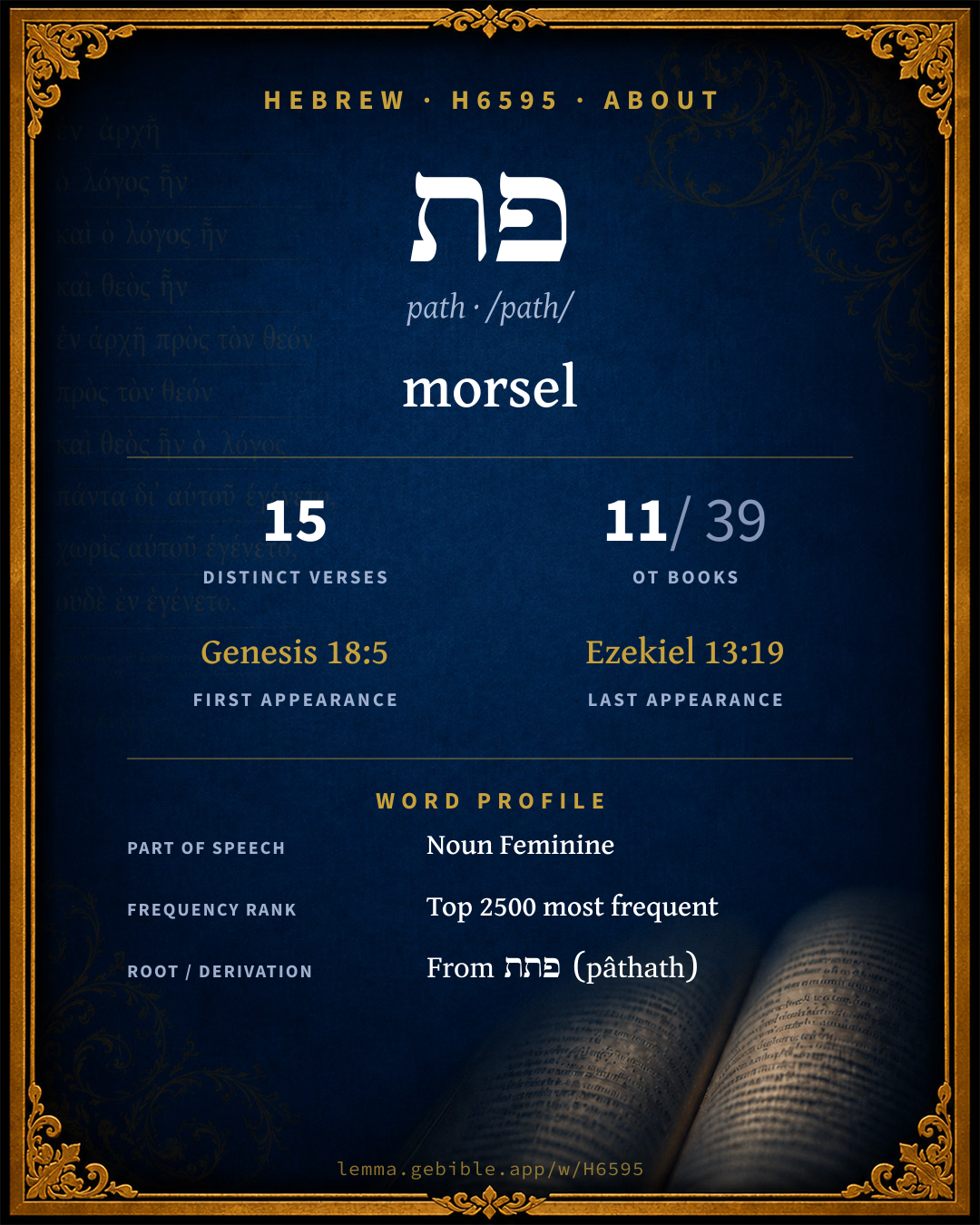
פַּת
morsel
Full lexicon entry — Brown-Driver-Briggs (BDB)
From Brown-Driver-Briggs (BDB)
Where this word appears
Grammar key — what these labels mean
Part of speech
- Noun
- A naming word — a person, place, thing, or idea.
Noun type
- Common
- A common noun — a general class of person, place, or thing (“king,” “city,” “water”), not a specific name.
State
- Construct
- A noun bound to a following noun in a possessive / “of” relationship (the construct chain).
- Absolute
- The independent form of a noun, not bound to a following word.
Gender
- Feminine
- Grammatically feminine.
- Masculine
- Grammatically masculine.
Number
- Singular
- One.
- Plural
- More than one (in Hebrew, generally three or more).
Every verse where H6595 appears in the Book of Genesis — 1 distinct verse. Click any verse to open its interlinear word-by-word view. Verse text shown in the World English Bible for context — . Each verse’s Hebrew form is shown with its reference; the English is not keyword-highlighted, since the data carries no word-level English alignment. Use “Compare translations” on any verse to read it across multiple English versions. This concordance covers the Hebrew Bible; Septuagint (Greek Old Testament) occurrences are not indexed here.
Genesis
About this entry
At a glance — auto-summarized from this page’s data, not written by a person. Every figure links to its source below. This summary describes the numbers; it doesn’t interpret them.
“morsel” is the headline sense of the Hebrew noun פת (path). Its earliest occurrence is Genesis 18:5. The Hebrew Bible uses it across 15 verses — uncommon. See the sense tree, 15-verse concordance, and the renderings breakdown below.
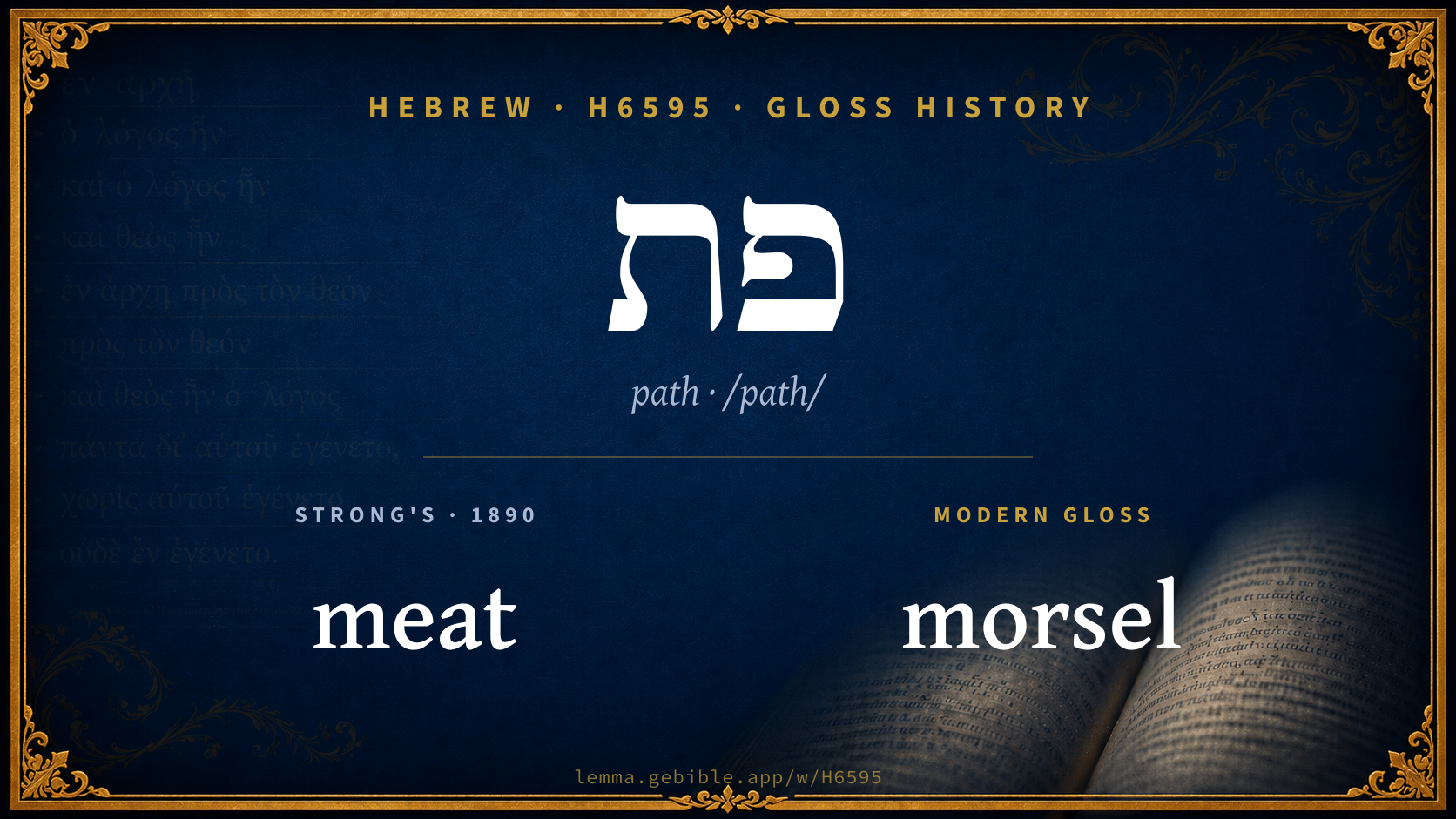
Gloss history
Strong's 1890 vs modern scholarship
About this word
Strong's H6595 catalogs a Hebrew word from the Hebrew Old Testament.
These counts are not copied from any lexicon or concordance. They are computed here, from the morphology-tagged Hebrew Old Testament. What Lemma adds →
- 15
- distinct verses
- The word appears in 15 distinct verses.
- 11 / 39
- OT books
- The word appears in 11 of 39 Old Testament books.
- #1,836
- by frequency
- Top 2500 most frequent Hebrew words (rank 1,836 of 8,640 Hebrew words by occurrence).
View all 15 occurrences in the concordance →
By section of the Old Testament
By traditional corpus
Conventional, traditional groupings — biblical authorship is debated, so this is a traditional corpus grouping, not an authorship claim. Each share is this word’s portion of its verses in that division of the Hebrew canon. Each figure is a share of the word’s 15 distinct verses.
- Prophets (Nevi'im) 6 verses · 40%
- Writings (Ketuvim) 6 verses · 40%
- Torah (Pentateuch) 3 verses · 20%
How translations render this word
Counts come from each version’s own published word-to-Strong’s tagging or interlinear alignment — an approximate guide to how each version renders this word, not a word-level alignment the data otherwise carries. Because each total is that version’s own tagged count, the per-version totals vary from one another and need not match the appearance or distinct-verse counts above. These counts may also differ from a printed concordance because Lemma counts each distinctly tagged rendering and does not collapse phrase taggings into a single head-word total. This is a fixed set of word-tagged versions (KJV, ASV, BSB, ULT) and does not change with the reading translation you choose elsewhere. Each version’s license is shown beside its name below (and on Sources).
- King James Version: Morsel 7×, Pieces 3×, Piece 2×
- American Standard Version: Morsel 8×, Pieces 2×
- Berean Standard Bible: Morsel 4×, Piece 3×
- unfoldingWord Literal Text: Morsel 4×, Piece of 4×, Pieces 2×
King James Version Public Domain
Renders H6595 across 15 tagged occurrences — most commonly:
Plus 3 renderings that appear only once — usually multi-word phrases or single function words the recovered tagging swept in, not distinct renderings.
American Standard Version Public Domain
Renders H6595 across 15 tagged occurrences — most commonly:
Plus 5 renderings that appear only once — usually multi-word phrases or single function words the recovered tagging swept in, not distinct renderings.
Berean Standard Bible Public Domain
Renders H6595 across 14 tagged occurrences — most commonly:
Plus 7 renderings that appear only once — usually multi-word phrases or single function words the recovered tagging swept in, not distinct renderings. Not rendered by a distinct English word in 1 further occurrence.
unfoldingWord Literal Text CC BY-SA 4.0
Renders H6595 across 16 tagged occurrences — most commonly:
Plus 6 renderings that appear only once — usually multi-word phrases or single function words the recovered tagging swept in, not distinct renderings.
Senses in BDB
The 1 sense BDB distinguishes for this word, in lexicon order (not ranked by frequency or importance). The full entry — with sub-senses — is in the Lexicon Entry tab.
- fragment, bit, morsel (of bread), piece
Word origin
n.f. Pr 17:1 fragment, bit, morsel of bread;—abs. פ׳ חֲרֵבָה Pr 17:1 a dry morsel; cstr. פַּת־לָחֶם Gn 18:5; Ju 19:5; 1 S 2:36; 28:22; 1 K 17:11; Pr 28:21; sf. פִּתִּי Jb 31:17, פִּתְּךָ Pr 23:8, פִּתֵּךְ Ru 2:14, פִּתּוֹ 2 S 12:3; pl. פִּתִּים Lv 2:6; 6:14; in sim. ψ 147:17.
— Brown-Driver-Briggs (Oxford 1906, public domain), digitized via Sefaria, supplemented by the OpenScriptures HebrewLexicon (CC BY 4.0). See Sources.
Derived from פתת (pâthath) (H6626) — to crumble.
Jastrow Dictionary
A second Hebrew/Aramaic lexicon for comparison, covering Aramaic and post-biblical (Talmudic, Targumic, Midrashic) usage that the biblical-Hebrew BDB does not. Matched by lemma rather than by Strong’s number, so a lemma may carry more than one Jastrow headword (shown separately below), and the entries cover usage well beyond the Bible.
פת
- two. Snh. 4ᵇ פת באפריקי שתים pth in Afriḳi means two; Men. 34ᵇ; Zeb. 37ᵇ
פַּת
- c. (b. h.; a piece of bread, in gen. bread, food, sustenance. B. Mets. 107ᵇ פת שחרית breakfast. Ib. (ref. to Ex. XXIII, 25) זו פת במלח וכ׳ that is the morning bread with salt and a ladleful of water. Ab. Zar. II, 6 והפת והשמן שלהן their (the gentiles’) bread and oil; ib. 36ᵃ פִּיתָּן ושמנן. Yoma 74ᵇ, v. סַל. Hor. 13ᵇ פת שלא בשל וכ׳ bread not sufficiently cooked (baked). Ib. פת פחמין bread baked on coals. Gen. R. s. 67 פִּיתְּךָ אפויה, v. אָפָה; a. fr.—[פת כומרין, v. פַּתְכּוּמְרִין.]—Pl. פִּתִּים, פִּתִּין, פִּי׳ pieces. Men. III, 2 או שפתתן פ׳ מרובות or if he broke them in too many (small) pieces; ib. 18ᵇ מאי פ׳ מרובות שריבה בפתיתין ‘many pieces’ means that he parted the pieces repeatedly; Sifra Vayikra, N’dab., Par. 10, ch. XII (ref. to Lev. II, 6) אותה לפ׳ ואין פִּתֶּיהָ לפ׳ thou shalt part it in pieces, but not its pieces again in pieces; Yalk. Lev. 450, v. פָּתִית. e.g. Exodus 23:25
A Dictionary of the Targumim, the Talmud Babli and Yerushalmi, and the Midrashic Literature (Marcus Jastrow; London, Luzac, 1903) — Public Domain. Digitized via Sefaria. Digitized via Sefaria. Full attribution on Sources.
Forms in the corpus
The 10 distinct written forms H6595 takes in the Hebrew Bible, most frequent first — each parse links to that state’s occurrences in the concordance. Hebrew forms include their vowel points and cantillation, so a single lemma takes many written forms.
| Form | Parsing | Example | Uses |
|---|---|---|---|
| פַּת | Noun, Common, Feminine, Singular, Construct | 1 Kings 17:11 | 5 |
| פִּתִּ֔ים | Noun, Common, Feminine, Plural, Absolute | Leviticus 2:6 | 2 |
| וּ/בִ/פְת֣וֹתֵי | Noun, Common, Masculine, Plural, Construct | Ezekiel 13:19 | 1 |
| כְ/פִתִּ֑ים | Noun, Common, Feminine, Plural, Absolute | Psalms 147:17 | 1 |
| מִ/פִּתּ֨/וֹ | Noun, Common, Feminine, Singular, Construct | 2 Samuel 12:3 | 1 |
| פַת | Noun, Common, Feminine, Singular, Construct | Genesis 18:5 | 1 |
| פִּֽתְּ/ךָ | Noun, Common, Feminine, Singular, Construct | Proverbs 23:8 | 1 |
| פִּתִּ֣/י | Noun, Common, Feminine, Singular, Construct | Job 31:17 | 1 |
| פִּתֵּ֖/ךְ | Noun, Common, Feminine, Singular, Construct | Ruth 2:14 | 1 |
| פַּ֣ת | Noun, Common, Feminine, Singular, Absolute | Proverbs 17:1 | 1 |
Septuagint verse parallels
This word appears in 14 verses that also exist in the Greek Old Testament (Septuagint), out of the 15 Hebrew verses it occurs in. You can read those verses in Greek by switching the Old Testament edition to the Septuagint.
Read these verses in the Septuagint
- Genesis 18:5
- Leviticus 2:6
- Judges 19:5
- Ruth 2:14
- 1 Samuel 2:36
- 2 Samuel 12:3
- 1 Kings 17:11
- Job 31:17
- Proverbs 17:1
- Ezekiel 13:19
This is a verse-level parallel only — the same verses exist in both the Hebrew and Greek Old Testaments. No word-level Hebrew↔Greek correspondence is claimed: the data carries no such alignment, so no Greek word is shown as this Hebrew word’s translation. Coverage is not total — the Septuagint omits the deuterocanon and renumbers the Psalms, so some Hebrew verses have no direct Greek parallel.