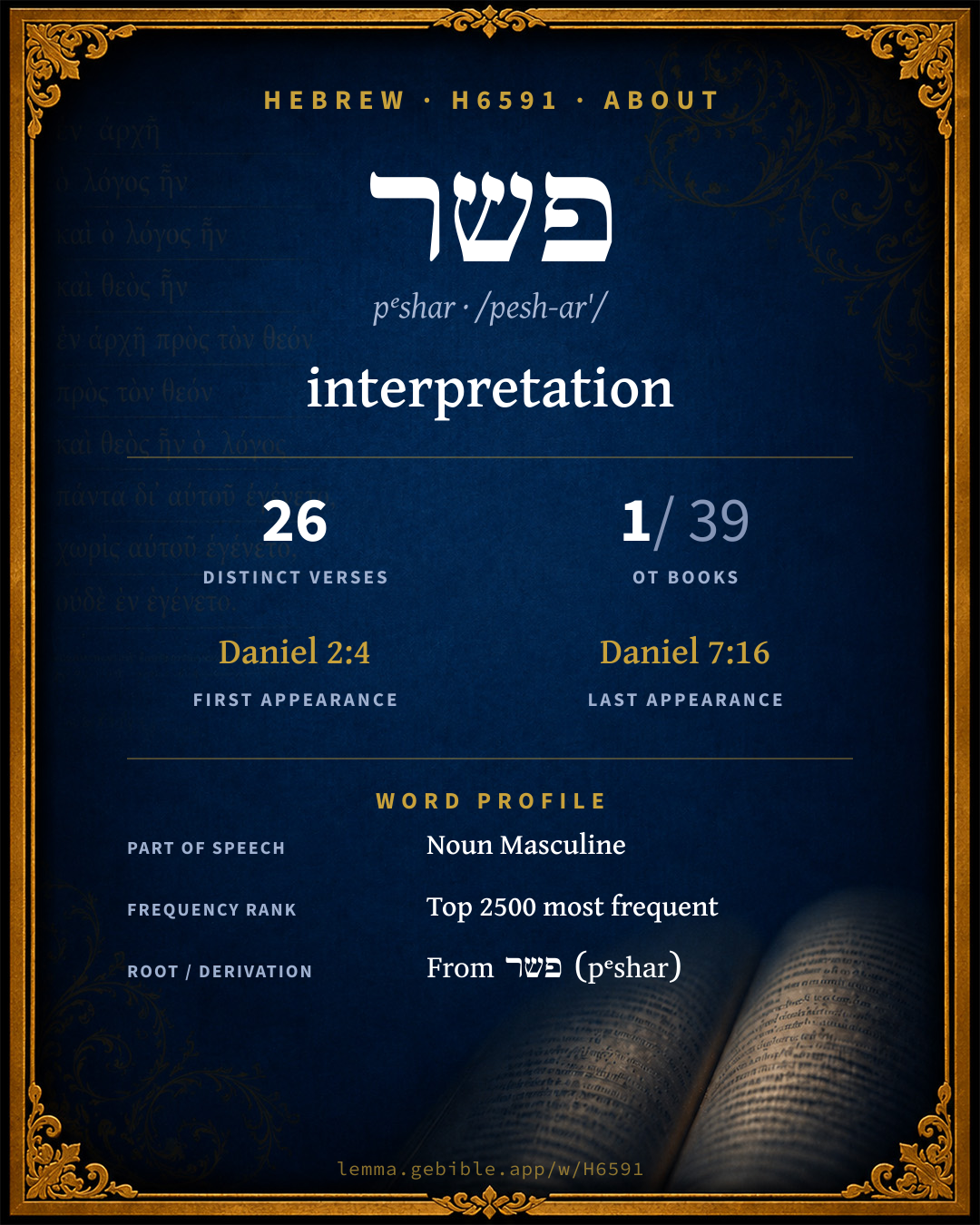
פְּשַׁר
interpretation
Full lexicon entry — Brown-Driver-Briggs (BDB)
From Brown-Driver-Briggs (BDB)
Where this word appears
See every Construct-state word in the Hebrew Bible →
Grammar key — what these labels mean
Part of speech
- Noun
- A naming word — a person, place, thing, or idea.
Noun type
- Common
- A common noun — a general class of person, place, or thing (“king,” “city,” “water”), not a specific name.
State
- Construct
- A noun bound to a following noun in a possessive / “of” relationship (the construct chain).
- Determined
- A noun marked definite — in Aramaic, the emphatic state.
- Absolute
- The independent form of a noun, not bound to a following word.
Gender
- Masculine
- Grammatically masculine.
Number
- Singular
- One.
- Plural
- More than one (in Hebrew, generally three or more).
1 distinct verse where H6591 appears in the Absolute state, across 1 book. Filtered view — show all forms. Click any verse to open its interlinear word-by-word view. Verse text shown in the World English Bible for context — . Each verse’s Hebrew form is shown with its reference; the English is not keyword-highlighted, since the data carries no word-level English alignment. Use “Compare translations” on any verse to read it across multiple English versions. This concordance covers the Hebrew Bible; Septuagint (Greek Old Testament) occurrences are not indexed here.
Daniel 1 verse
About this entry
At a glance — auto-summarized from this page’s data, not written by a person. Every figure links to its source below. This summary describes the numbers; it doesn’t interpret them.
The Hebrew noun פשר centers on the idea of “interpretation.” Daniel dominates its distribution — 26 of 26 verses. Spanning 26 verses in 1 book, it ranks among the moderately common words of the Hebrew Bible. Its earliest occurrence is Daniel 2:4. Related forms include פשר and פשר. Dig into 26-verse concordance and the renderings breakdown below.
Gloss history
Strong's 1890 vs modern scholarship
About this word
Strong's H6591 catalogs a Hebrew word from the Hebrew Old Testament.
These counts are not copied from any lexicon or concordance. They are computed here, from the morphology-tagged Hebrew Old Testament. What Lemma adds →
- 26
- distinct verses
- The word appears in 26 distinct verses.
- 1 / 39
- OT books
- The word appears in 1 of 39 Old Testament books.
- #1,086
- by frequency
- Top 2500 most frequent Hebrew words (rank 1,086 of 8,640 Hebrew words by occurrence).
View all 26 occurrences in the concordance →
Most concentrated in
- Daniel 26 verses 100%
By section of the Old Testament
By traditional corpus
Conventional, traditional groupings — biblical authorship is debated, so this is a traditional corpus grouping, not an authorship claim. Each share is this word’s portion of its verses in that division of the Hebrew canon. Each figure is a share of the word’s 26 distinct verses.
- Writings (Ketuvim) 26 verses · 100%
How translations render this word
Counts come from each version’s own published word-to-Strong’s tagging or interlinear alignment — an approximate guide to how each version renders this word, not a word-level alignment the data otherwise carries. Because each total is that version’s own tagged count, the per-version totals vary from one another and need not match the appearance or distinct-verse counts above. These counts may also differ from a printed concordance because Lemma counts each distinctly tagged rendering and does not collapse phrase taggings into a single head-word total. This is a fixed set of word-tagged versions (KJV, ASV, BSB, ULT) and does not change with the reading translation you choose elsewhere. Each version’s license is shown beside its name below (and on Sources).
- King James Version: Interpretation 26×, Is the interpretation 2×
- American Standard Version: Interpretation 19×, Interpretation thereof 5×, Is the interpretation 2×
- Berean Standard Bible: Interpretation 20×, Interpret it 4×, Is the interpretation 2×
- unfoldingWord Literal Text: Interpretation 24×, And 9×, Interpretation of 3×
King James Version Public Domain
Renders H6591 across 31 tagged occurrences — most commonly:
Plus 3 renderings that appear only once — usually multi-word phrases or single function words the recovered tagging swept in, not distinct renderings.
American Standard Version Public Domain
Renders H6591 across 31 tagged occurrences — most commonly:
Plus 5 renderings that appear only once — usually multi-word phrases or single function words the recovered tagging swept in, not distinct renderings.
Berean Standard Bible Public Domain
Renders H6591 across 31 tagged occurrences — most commonly:
Plus 5 renderings that appear only once — usually multi-word phrases or single function words the recovered tagging swept in, not distinct renderings.
unfoldingWord Literal Text CC BY-SA 4.0
Renders H6591 across 44 tagged occurrences — most commonly:
Plus 8 renderings that appear only once — usually multi-word phrases or single function words the recovered tagging swept in, not distinct renderings.
Senses in BDB
The 1 sense BDB distinguishes for this word, in lexicon order (not ranked by frequency or importance). The full entry — with sub-senses — is in the Lexicon Entry tab.
- interpretation (of dream)
Word origin
פְּשַׁר 31 n.m. interpretation (of dream)
— Brown-Driver-Briggs (Oxford 1906, public domain), digitized via Sefaria, supplemented by the OpenScriptures HebrewLexicon (CC BY 4.0). See Sources.
Derived from פשר (pᵉshar) (H6590) — to interpret.
Jastrow Dictionary
A second Hebrew/Aramaic lexicon for comparison, covering Aramaic and post-biblical (Talmudic, Targumic, Midrashic) usage that the biblical-Hebrew BDB does not. Matched by lemma rather than by Strong’s number, so a lemma may carry more than one Jastrow headword (shown separately below), and the entries cover usage well beyond the Bible.
פָּשַׁר
- [to divide, to spread,]
- 1. to melt, dissolve. Mekh. B’shall., Vayassʿa, s. 4 (expl. ונמס, Ex. XVI, 21, cmp. פִּשְׁפָּשׁ III) כיון … היה פוֹשֵׁר והולך וכ׳ when the sun shone upon it (the manna), it melted and formed rivulets which ran &c. e.g. Exodus 16:21
- 2. to be stale, tepid. Tanḥ. Vayesheb 4 כוס פשור (prob. to be read פּוֹשֵׁר) a cup of wine mixed with stale water. Sifra M’tsorʿa, ch. I מים פושרים stale water (from pools), opp. מים חיים. Par. VIII, 9 (מים) המלוחים והפּוֹשְׁרִים salty water and pool water.—In gen. פּוֹשְׁרִים, פּוֹשְׁרִין (sub. מים) tepid liquids. Y. Sabb. XX, 17ᶜ bot., opp. צונין. Gen. R. s. 86 when his master said to him מזוג פ׳ והיו פ׳ mix the wine with tepid water, it was tepid, opp. רותחין. Ber. 16ᵇ; Y. ib. II, 5ᵇ bot.; v. כָּוָה. Y. Nidd. II, beg. 50ᶜ; a. fr.—[Y. Keth. X, end, 34ᵃ, v. Pi.—Yalk. Gen. 38 ופשרתי, v. Nithpa
- 1. to make tepid; to temper, cool. Sabb. 40ᵇ מפני שמַפְשִׁיר מים שעליו because (by standing against the fire after a cold bath) he tempers (warms) the water on his body. Ib. III, 5 (41ᵃ, sq.) כדי להַפְשִׁירָן enough to temper the cold water, opp. בשביל שיחמו to get hot. Y. ib. III, 6ᵇ top מותר להַפְשִׁיר במקום שהיד שולטת you may temper (cold water, on the Sabbath) by contact with a temperature which the hand can endure. Lev. R. s. 26 (ref. to Ez. X, 7) הִפְשִׁירָן ונתנן וכ׳ he lowered the temperature of the coals and handed them to him; Yalk. Kings 220; Tanḥ. Emor 3; Midr. Sam. ch. XXIV (Yoma 77ᵃ נצטננו). Pesik. R. s. 12 (ref. to קָרְךָ, Deut. XXV, 18) אשר קֵירְךָ הִפְשִׁירְךָ וכ׳ ‘who cooled thee’, he (Amalek) made thee lukewarm, he made thee cold like water (so that others were encouraged to attack thee); a. fr. e.g. Ezekiel 10:7
- 2. (v. פְּשָׁרָה) to compromise. Y. Sot. V, 20ᶜ bot. אברהם עשה … וה׳ עמו וכרות עמו וכ׳ Abraham changed the evil inclination within him into good …, he compromised with it, (as we read, Neh. IX, 8,) and he made a covenant with it (his heart); Y. Ber. IX, 14ᵇ bot. והפסיד אלא (corr. acc.).—Tosef. Erub. XI (VIII), 11, v. infra. e.g. Nehemiah 9:8
- to be dissolved; to be tempered. B. Kam. 28ᵇ אפי׳ נִפְשָׁרָה even if the vessel fell apart (and its contents made the ground slippery). Sabb. 40ᵇ לא בשביל שיבשל … שיִפָּשֵׁר not that it (the oil) be heated to boiling, but only that it be tempered (or be made more liquid).
- 1. to separate, tear loose, disengage. Tanḥ. Ki Thissa 1 את מְפַשֵּׁר אותה וכ׳ thou disengagest it (the thorn sticking to thy garments) here, and it sticks there; Pesik. R. s. 10 beg. והוא מפשר אותה וכ׳ (not אותם). Y. Sabb. VII, 10ᵃ bot. מְפַשְּׁרָן וכ׳ he may pick them (the thorns) out, … provided he does not tear the garment; Tosef. Erub. XI (VIII), 11 מפשר בידו Var. (ed. Zuck. מפשיר). Pesik. R. s. 13 עמד ופִשְּׁרוֹ הימנו he stood up and tore it (the dog) away from him. Ib. זכור היאך פִּישַּׁרְתִּי הימך וכ׳ remember how I tore the dog away from thee; a. e.
- 2. to temper. Lam. R. to I, 12 יום אחד היה חרון … פִּשְּׁרוֹ the glowing wrath of the Lord lasted one day; if Israel had repented, he would have cooled it off.
- 3. to compromise, arbitrate. Y. B. Mets. VI, 11ᵃ top באותו שיכול לפַשֵּׁר in a case of seizure for service (אנגריא), when he might have compromised (pay a certain amount and release the seized animal). Y. Snh. I, 18ᵇ bot. שנים שפִּישְּׁרוּ וכ׳ when two judges have arbitrated, the parties cannot retract. Y. Keth. X, end, 34ᵃ [read:] פי׳ מן השני חזקה וכ׳ if he compromised with the second creditor, it is taken for granted that the first creditor has a right to seize the debtor’s property (without regard to the claims of the second); פי׳ מן הראשון … פי׳ if he compromised with the first creditor …, he has compromised (the compromise is binding, and the second creditor cannot seize that portion of the property which the first would have had a right to claim, v. Asheri to Keth. 91ᵇ).
- to be disentangled; trnsf. to be acquitted, pardoned. Gen. R. s. 22 עשיתי תשובה ונִתְפַּשַּׁרְתִּי I repented and was pardoned; Lev. R. s. 10; Midr. Till. to Ps. C; Yalk. Gen. 38 ופשרתי (corr. acc.).
פְּשַׁר I
- 1. to melt, be dissolved. Targ. O. Ex. XVI, 21.—Trnsf. (of a charm) to vanish, be broken. Snh. 67ᵇ כי מטא לאשקויי מייא פ׳ וכ׳ when he came (to a river) to let the ass drink, it disappeared (the charm was broken), and there stood a landing board (v. אוּסְקָנִיתָא).
- 2. [to dissolve,] to chew the cud. Targ. Y. Lev. XI, 7. Targ. Deut. XIV, 8.
- 3. to solve a riddle or a dream; to interpret. Targ. Gen. XL, 16. Ib. XLI, 12; a. fr. (in O. ed. Berl. interch. with Pa.).—Lam. R. to I, 1 דלמא דאתון (חדא איתתא) רבתי חכימין למִיפְשַׁר חלמא וכ׳ do you understand how to interpret a dream which I had as well as your master?; a. e.
- 1. to disengage, tear loose. Pesik. Shek., p. 11ᵃ דאת מְפַשֵּׁר לה וכ׳ (not ליה) which thou makest loose here &c., v. preced. a. סִירְתָּא; Yalk. Prov. 953; Yalk. Ex. 386.—Snh. l. c. פַּשְּׁרָה לה (Ms. K. פַּשַּׁרְתָּהּ) she released (disenchanted) her.
- 2. to solve (a riddle), interpret (a dream). Targ. O. Gen. XLI, 15 וּמְפַשַּׁר ed. Berl. (ed. Amst. לְמִפְשַׁר). Ib. XL, 16; a. fr. (v. supra).—Targ. Cant. II, 5 (some ed. מַפְשַׁר Af.).—Yoma 28ᵇ הוא חלים והוא מפשר did he dream and himself interpret?, i.e. did he answer his own query? Ber. 56ᵃ מפשר חלמי הוה was an interpreter of dreams; ib. מפשר ליה וכ׳, v. גְּרִיעוּתָא. Lam. R. to I, 1 רבתי (חד כות׳ 1) חד … עביד נפשיה מפשר חלמין a certain Samaritan professed to be an interpreter of dreams; a. fr.—Part. pass. מְפַשַּׁר. Ber. 55ᵇ חלמא דלא מפ׳ וכ׳ a dream not interpreted is like a letter not read (has no effect).
- 3. to release, settle with. Y. Keth. X, end, 34ᵃ [read as Asheri to Keth. 91ᵇ:] קום פַּשֵּׁר (or פַּשְּׁרִין) rise and settle with me; יכיל מומר ליה פַּשְּׁרִין ואי טרף טרף he may say to him, settle with me, and if he (the prior creditor) should seize (what you give me in settlement), he may seize it. Pesik. Shub., p. 164ᵇ פשר פריטך settle thy account; a. e.
- to be released. Ib. עד זמן דמִתְפַּשּׁר פריטוי until he has redeemed his debt; וכיון דנתפשר וכ׳ (read: דאתפשר) and when his account was settled (v. סְפַן).
פַּשַּׁר
- (preced.) interpreter. Targ. O. Gen. XL, 8 ed. Berl. (oth. ed. פָּשַׁר). Ib. XLI, 15.
פְּשַׁר II
- (preced.) interpretation. Targ. Y. Gen. XL, 8 פ׳ לית ליה (O. פַּשַּׁר, v. preced.).
A Dictionary of the Targumim, the Talmud Babli and Yerushalmi, and the Midrashic Literature (Marcus Jastrow; London, Luzac, 1903) — Public Domain. Digitized via Sefaria. Digitized via Sefaria. Full attribution on Sources.
Forms in the corpus
The 20 distinct written forms H6591 takes in the Hebrew Bible, most frequent first — each parse links to that state’s occurrences in the concordance. Hebrew forms include their vowel points and cantillation, so a single lemma takes many written forms.
Same root — word family
Other BDB entries built from the same root as H6591, grouped by Strong’s listed origin. These share a root / origin per the lexicon — not necessarily a shared meaning. Each links to that word’s own entry.
Derives from
Derived from this word
Compare all same-root words → They share a root, not necessarily a meaning.
Septuagint verse parallels
This word appears in 25 verses that also exist in the Greek Old Testament (Septuagint), out of the 26 Hebrew verses it occurs in. You can read those verses in Greek by switching the Old Testament edition to the Septuagint.
Read these verses in the Septuagint
This is a verse-level parallel only — the same verses exist in both the Hebrew and Greek Old Testaments. No word-level Hebrew↔Greek correspondence is claimed: the data carries no such alignment, so no Greek word is shown as this Hebrew word’s translation. Coverage is not total — the Septuagint omits the deuterocanon and renumbers the Psalms, so some Hebrew verses have no direct Greek parallel.