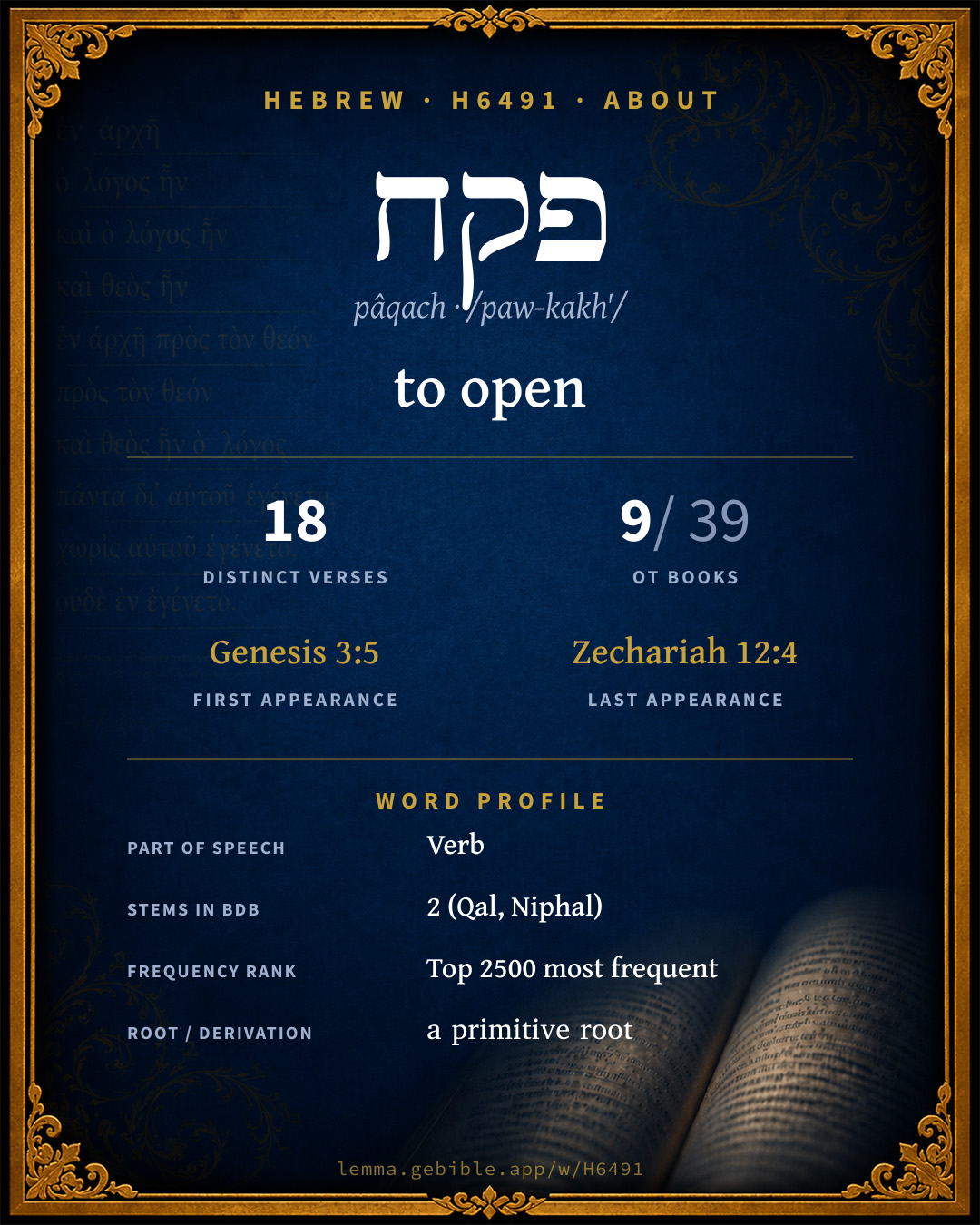
פָּקַח
to open
‘to open’ is one of 2 main senses fuller range ↓
Full lexicon entry — Brown-Driver-Briggs (BDB)
From Brown-Driver-Briggs (BDB)
Where this word appears
See every Niphal verb in the Hebrew Bible →
Grammar key — what these labels mean
Part of speech
- Verb
- An action or state-of-being word.
Stem
- Qal
- The basic, simple active stem — the plain form of the verb (“he wrote”). Here: ‘open eyes’
- Niphal
- Usually the simple passive or reflexive of the Qal (“he was written”).
Form
- Imperative
- A direct command (“write!”).
- Sequential Imperfect
- An imperfect with prefixed waw — the standard past-narrative form (waw-consecutive imperfect).
- Sequential Perfect
- A perfect with prefixed waw continuing a preceding imperfect or command (waw-consecutive perfect).
- Infinitive Construct
- A bound verbal noun, frequently with prepositions (“to write / in writing”).
- Imperfect
- An incomplete, ongoing, or future action (“he will / would write”).
- Infinitive Absolute
- An unbound verbal noun, often intensifying or standing in for a finite verb.
- Perfect
- A completed action or state — Hebrew marks aspect (completeness) more than strict tense (“he wrote”).
- Participle Active
- A verbal adjective expressing ongoing or characteristic action (“writing / one who writes”).
- Participle Passive
- A verbal adjective expressing action received (“written”).
State
- Absolute
- The independent form of a noun, not bound to a following word.
Person
- 2nd Person
- The one addressed (“you”).
- 3rd Person
- The one spoken about (“he / she / it / they”).
- 1st Person
- The speaker (“I / we”).
Gender
- Masculine
- Grammatically masculine.
- Common
- Either gender — not distinguished for this form.
- Feminine
- Grammatically feminine.
Number
- Singular
- One.
- Plural
- More than one (in Hebrew, generally three or more).
Every verse where H6491 appears in the Book of Genesis — 3 distinct verses. Click any verse to open its interlinear word-by-word view. Verse text shown in the World English Bible for context — . Each verse’s Hebrew form is shown with its reference; the English is not keyword-highlighted, since the data carries no word-level English alignment. Use “Compare translations” on any verse to read it across multiple English versions. This concordance covers the Hebrew Bible; Septuagint (Greek Old Testament) occurrences are not indexed here.
Genesis
- Genesis 3:5 וְ/נִפְקְח֖וּ conj + Niphal wpf 3cp for God knows that in the day you eat it, your eyes will be opened, and you will be like God, knowing good and evil."
- Genesis 3:7 וַ/תִּפָּקַ֨חְנָה֙ conj + Niphal wimpf 3fp Both of their eyes were opened, and they knew that they were naked. They sewed fig leaves together, and made themselves aprons.
- Genesis 21:19 וַ/יִּפְקַ֤ח conj + Qal wimpf 3ms God opened her eyes, and she saw a well of water. She went, filled the bottle with water, and gave the boy drink.
About this entry
At a glance — auto-summarized from this page’s data, not written by a person. Every figure links to its source below. This summary describes the numbers; it doesn’t interpret them.
פקח (pâqach) is a Hebrew verb most often rendered “to open.” Debuting at Genesis 3:5, it then recurs through the corpus. With 18 verses in 9 books, it is an uncommon word in the Hebrew Bible. Different stems carry different senses — BDB groups them under 2 stems, among them Qal and Niphal. From the same root come פקח, פקחקוח and פקח. For the data behind this summary, explore the sense tree and the renderings breakdown below.
Gloss history
Strong's 1890 vs modern scholarship
About this word
Strong's H6491 catalogs a Hebrew word from the Hebrew Old Testament.
These counts are not copied from any lexicon or concordance. They are computed here, from the morphology-tagged Hebrew Old Testament. What Lemma adds →
- 18
- distinct verses
- The word appears in 18 distinct verses.
- 9 / 39
- OT books
- The word appears in 9 of 39 Old Testament books.
- #1,462
- by frequency
- Top 2500 most frequent Hebrew words (rank 1,462 of 8,640 Hebrew words by occurrence).
View all 18 occurrences in the concordance →
By section of the Old Testament
By traditional corpus
Conventional, traditional groupings — biblical authorship is debated, so this is a traditional corpus grouping, not an authorship claim. Each share is this word’s portion of its verses in that division of the Hebrew canon. Each figure is a share of the word’s 18 distinct verses.
- Prophets (Nevi'im) 10 verses · 56%
- Writings (Ketuvim) 5 verses · 28%
- Torah (Pentateuch) 3 verses · 17%
How translations render this word
Counts come from each version’s own published word-to-Strong’s tagging or interlinear alignment — an approximate guide to how each version renders this word, not a word-level alignment the data otherwise carries. Because each total is that version’s own tagged count, the per-version totals vary from one another and need not match the appearance or distinct-verse counts above. These counts may also differ from a printed concordance because Lemma counts each distinctly tagged rendering and does not collapse phrase taggings into a single head-word total. This is a fixed set of word-tagged versions (KJV, ASV, BSB, ULT) and does not change with the reading translation you choose elsewhere. Each version’s license is shown beside its name below (and on Sources).
- King James Version: Open 6×, Opened 4×, Shall be opened 2×
- American Standard Version: Open 6×, Opened 4×
- Berean Standard Bible: Open 7×, Opened 5×
- unfoldingWord Literal Text: Open 7×, Opened 4×, And 3×
King James Version Public Domain
Renders H6491 across 20 tagged occurrences — most commonly:
Plus 8 renderings that appear only once — usually multi-word phrases or single function words the recovered tagging swept in, not distinct renderings.
American Standard Version Public Domain
Renders H6491 across 20 tagged occurrences — most commonly:
Plus 10 renderings that appear only once — usually multi-word phrases or single function words the recovered tagging swept in, not distinct renderings.
Berean Standard Bible Public Domain
Renders H6491 across 19 tagged occurrences — most commonly:
Plus 7 renderings that appear only once — usually multi-word phrases or single function words the recovered tagging swept in, not distinct renderings. Not rendered by a distinct English word in 1 further occurrence.
unfoldingWord Literal Text CC BY-SA 4.0
Renders H6491 across 25 tagged occurrences — most commonly:
Plus 6 renderings that appear only once — usually multi-word phrases or single function words the recovered tagging swept in, not distinct renderings.
Senses in the full BDB
Hebrew verbs can shift meaning by stem (binyan): Qal is the basic action, Niphal is often passive or reflexive, Piel often intensifies or makes it factitive, and Hiphil is typically causative. The senses below are grouped under the stem BDB assigns to each.
What do BDB’s symbols mean?
BDB uses these scholarly abbreviations:
| Symbol | Meaning |
|---|---|
| 𝔊 | the Septuagint (the ancient Greek translation, LXX) |
| 𝔙 | the Vulgate (the Latin translation) |
| 𝔖 | the Syriac version (the Peshitta) |
| 𝔗 | the Targum (the Aramaic translation) |
| ψ | the Psalms |
| √ | root (the underlying root or stem) |
| ‖ | parallel passage (a synonymous or contrasted parallel) |
| † | the dagger: every passage where the word occurs is cited |
The 6 senses and sub-senses the full Brown-Driver-Briggs lexicon distinguishes for this word, in lexicon order (not ranked by frequency), with BDB’s own verbatim wording and sub-sense lettering. Shown in Hebrew script with BDB’s own scholarly abbreviations. The condensed entry is in the Lexicon Entry tab. See also the Forms in the corpus table below.
Qal
- Pf. 3 ms. פ׳ Jb 27:19; 2 ms. פָּקַחְתָּ 14:3; Impf. 3 ms. וַיִּפְקַח Gn 21:19 +; 1 s. אֶפְקַח Zc 12:4; Imv. ms. פְּקַח 2 K 6:17 +, so Dn 9:18 Qr (Kt פקחה); Inf. abs. פָּקוֹחַ Is 42:20; cstr. לִפְקֹחַ v 7; Pt. act. פֹּקֵחַ ψ 146:8; pass. fpl. פְּקֻחוֹת Je 32:19;— e.g. Job 27:19
- 1. open eyes:
- a. one’s own 2 K 4:35; Jb 27:19; Pr 20:13; 2 K 19:16 = Is 37:17; Dn 9:18; + עַל Je 32:19; Zc 12:4 Jb 14:3. e.g. 2 Kings 4:35
- b. eyes of others Gn 21:19 2 K 6:17(×2), 20(×2) Is 42:7 ψ 146:8;—for details v. עַיִן 1 j. e.g. Genesis 21:19
- 2. open ears = hear Is 42:20 (without understanding; fig. of Isr.). e.g. Isaiah 42:20
Niphal
- Pf. 3 pl. consec. וְנִפְקְחוּ Gn 3:5; Impf. 3 fpl. תִּפָּקַחְנָה Is 35:5, וַתּ׳ Gn 3:7;—be opened, of eyes; fig., so as to know good and evil Gn 3:5, 7; opp. blindness (fig.) Is 35:5. e.g. Genesis 3:5
Senses from the full Brown-Driver-Briggs lexicon (Brown, Driver, Briggs; Oxford 1906 — public domain), digitized via Sefaria, supplemented by the OpenScriptures HebrewLexicon (CC BY 4.0). Full attribution on Sources.
Word origin
vb. open eyes and (once) ears (NH id., open (and remove) rubbish heap, sq. עַל look to, attend to; Arabic فَقَحَ blossom, ii. open eyes; J.Aram פְּקַח open eyes, etc.; Syriac ܦܩܰܚ blossom);—
— Brown-Driver-Briggs (Oxford 1906, public domain), digitized via Sefaria, supplemented by the OpenScriptures HebrewLexicon (CC BY 4.0). See Sources.
Origin: a primitive root
Jastrow Dictionary
A second Hebrew/Aramaic lexicon for comparison, covering Aramaic and post-biblical (Talmudic, Targumic, Midrashic) usage that the biblical-Hebrew BDB does not. Matched by lemma rather than by Strong’s number, so a lemma may carry more than one Jastrow headword (shown separately below), and the entries cover usage well beyond the Bible.
פָּקַח
- (b. h.) to break through, open.
- 1. to open. B. Bath. 12ᵇ אפילו … יין מְפַקְּחוֹ even if his heart be closed like a virgin (his mind be dull), wine will open it (make it bright).—Esp. (with גַּל) to open a heap of debris; to attempt to rescue a person supposed to be buried in debris. Ohol. XVI, 4 המְפקּחַ בגל he who digs among debris (not knowing certainly that a corpse is buried there). Pes. VIII, 6. Keth. 15ᵇ לְפַקֵּחַ עליו את הגל as regards digging for his sake (on the Sabbath). Ib. 5ᵃ מִפַקְּחִין פיקוח נפש, v. פִּיקּוּחַ; a. fr.
- 2. [to have the eyes open,] to guard, watch, care. Ib. הולכין … לפקח על עסקי רבים וכ׳ we may assemble in synagogues and school houses (in theatres and circuses) in order to watch over public affairs, on the Sabbath. Sabb. 150ᵇ לפקח על עסקי כלה וכ׳ to make arrangements for the reception of a bride &c.; Y. Ber. III, beg. 5ᵈ; a. fr.
- , Nithpa. נִתְפַּקֵּחַ (v. פִּקֵּחַ)
- 1. to recover the faculty of hearing (and speech). Gitt. II, 6. Yeb. 113ᵃ. Gen. R. s. 53; a. e.
- 2. to recover the faculty of speech. Pesik. R. s. 42 וכל אלם נפקח and every mute was made speaking.
- to cause to escape. B. Bath. 10ᵃ שינה מַפְקַחְתּוֹ, v. פָּכַח.
פְּקַח I
- , to open (the eye); (with על) to guard, care. Targ. Job XIV, 3. Ib. XXVII, 19. Targ. Ps. (XLVI, 8; a. fr.
- 1. to remove debris. Targ. Koh. III, 5.
- 2. to make open-minded, bright. Hor. 13ᵇ; Snh. 70ᵃ; Yoma 76ᵇ פַּקְחִין (= פקחני) made me open-minded, v. רֵיחָנָא.
- to awaken, become sober. Targ. Ps. LXXVIII, 65 (h. text מתרונן).
פְּקַח II
- (preced.) brighteness, prudence. Targ. Prov. XXVI, 12 פ׳ סכלא וכ׳ Ms. (ed. only סכלא, v. Pesh.) the cunning of a fool is better than his (h. text תקוה).
פִּקֵּחַ
- , פִּקַּחַת, פִּיקַּ׳ f. (b. h.; preced. wds.) [open,]
- 1. (opp. to חֵרֵשׁ) hearing. Yeb. XIV, 1 חרש שנשא פ׳ ופ׳ וכ׳ if a deaf mute married one hearing, or a hearing person married &c.; פ׳ שנשא פ׳ ונתחרשה if one hearing married one hearing, and she became deaf (and dumb); a. fr.
- 2. (opp. to סוּמָא or עִוֵּר) seeing. Ex. R. s. 36 משל לפ׳ וסומא וכ׳ like a seeing and a blind man walking together &c. Ex. R. s. 3 (ref. to Ex. IV, 11) פ׳ לראייה פ׳ לשמיעה piḳḳeaḥ refers both to sight and to hearing; a. e. e.g. Exodus 4:11
- 3. (opp. to טִפֵּשׁ) bright, smart, prudent. Keth. 88ᵃ (in Chald. dict.) אי פ׳ הוא וכ׳ if he (the husband) be prudent, he may cause her to have an oath administered to her according to Biblical law. Y. Meg. II, end, 73ᶜ הוי פ׳ ושתוק be prudent and keep silence; Yoma 7ᵃ. Y. Sabb. II, end, 5ᶜ אשה פ׳ a wise woman; a. fr.—Pl. פִּקְחִים, פִּקְחִין, פִּי׳; פִּקְחוֹת, פִּי׳. Yeb. XIV, 3, sq. Sabb. 153ᵃ. Y. Kidd. IV, 66ᶜ; Treat. Sof’rim XV, 10 רובן … פ׳ most bastards are bright; a. fr.
A Dictionary of the Targumim, the Talmud Babli and Yerushalmi, and the Midrashic Literature (Marcus Jastrow; London, Luzac, 1903) — Public Domain. Digitized via Sefaria. Digitized via Sefaria. Full attribution on Sources.
Forms in the corpus
The 18 distinct written forms H6491 takes in the Hebrew Bible, most frequent first — each parse links to that stem’s occurrences in the concordance. Hebrew forms include their vowel points and cantillation, so a single lemma takes many written forms.
Same root — word family
Other BDB entries built from the same root as H6491, grouped by Strong’s listed origin. These share a root / origin per the lexicon — not necessarily a shared meaning. Each links to that word’s own entry.
Derived from this word
Proper names from this root
People and places named from this root — a name, not an additional meaning of the word.
Compare all same-root words → Showing 4 of 5 — not the complete family. 2 of the same-root words are proper names (people or places). They share a root, not necessarily a meaning.
Septuagint verse parallels
This word appears in 18 verses that also exist in the Greek Old Testament (Septuagint), out of the 18 Hebrew verses it occurs in. You can read those verses in Greek by switching the Old Testament edition to the Septuagint.
Read these verses in the Septuagint
- Genesis 3:5
- 2 Kings 4:35
- Job 14:3
- Psalms 146:8
- Proverbs 20:13
- Isaiah 35:5
- Jeremiah 32:19
- Daniel 9:18
- Zechariah 12:4
This is a verse-level parallel only — the same verses exist in both the Hebrew and Greek Old Testaments. No word-level Hebrew↔Greek correspondence is claimed: the data carries no such alignment, so no Greek word is shown as this Hebrew word’s translation. Coverage is not total — the Septuagint omits the deuterocanon and renumbers the Psalms, so some Hebrew verses have no direct Greek parallel.