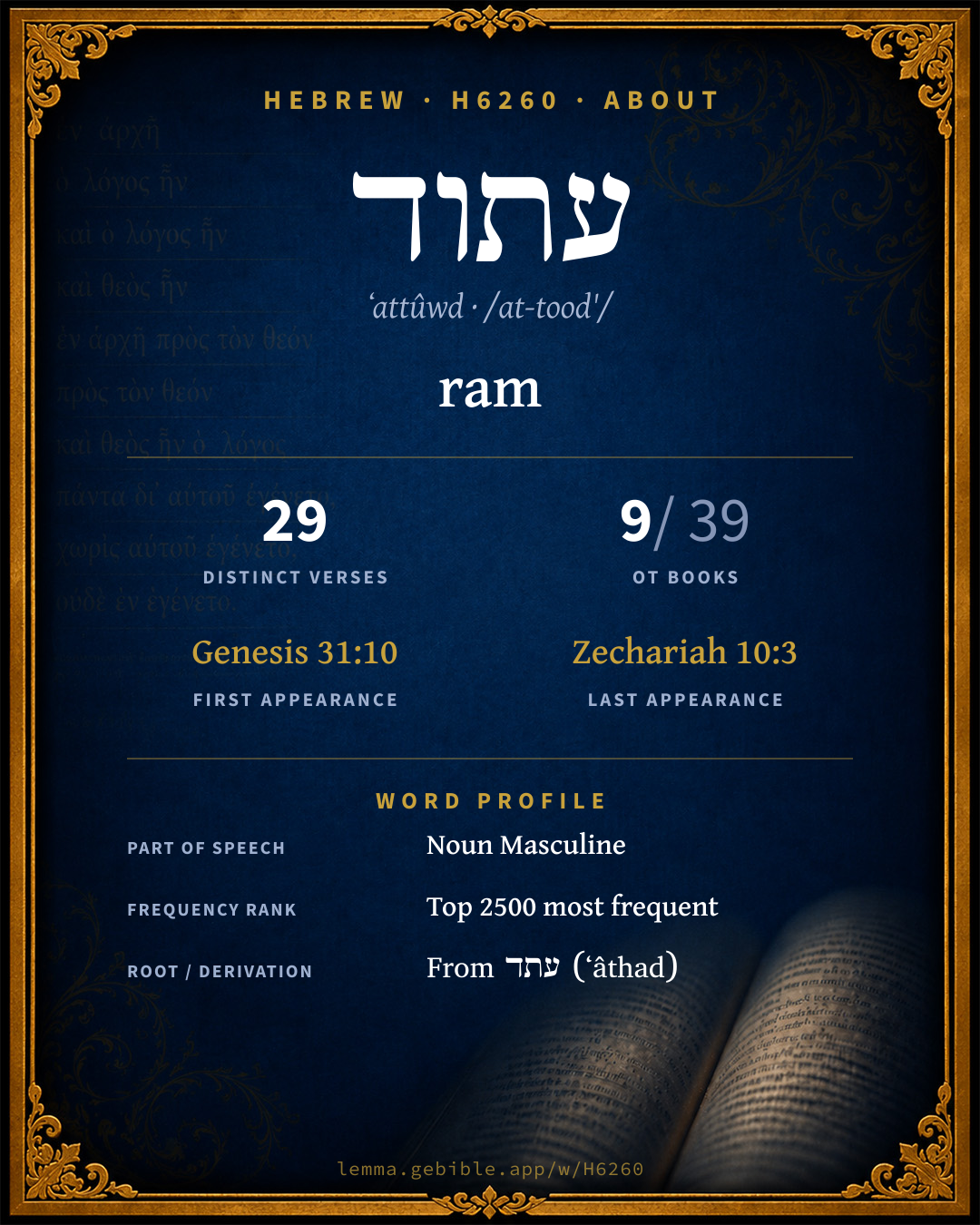
עַתּוּד
ram
Full lexicon entry — Brown-Driver-Briggs (BDB)
From Brown-Driver-Briggs (BDB)
Where this word appears
See every Absolute-state word in the Hebrew Bible →
Grammar key — what these labels mean
Part of speech
- Noun
- A naming word — a person, place, thing, or idea.
Noun type
- Common
- A common noun — a general class of person, place, or thing (“king,” “city,” “water”), not a specific name.
State
- Absolute
- The independent form of a noun, not bound to a following word.
- Construct
- A noun bound to a following noun in a possessive / “of” relationship (the construct chain).
Gender
- Masculine
- Grammatically masculine.
Number
- Plural
- More than one (in Hebrew, generally three or more).
28 distinct verses where H6260 appears in the Absolute state, across 9 books. Filtered view — show all forms. Click any verse to open its interlinear word-by-word view. Verse text shown in the World English Bible for context — . Each verse’s Hebrew form is shown with its reference; the English is not keyword-highlighted, since the data carries no word-level English alignment. Use “Compare translations” on any verse to read it across multiple English versions. This concordance covers the Hebrew Bible; Septuagint (Greek Old Testament) occurrences are not indexed here.
Genesis 2 verses
- Genesis 31:10 הָֽ/עַתֻּדִים֙ ptcl def.art + n c mp It happened at the time that the flock conceive, that I lifted up my eyes, and saw in a dream, and behold, the male goats which leaped on the flock were streaked, speckled, and grizzled.
- Genesis 31:12 הָֽ/עַתֻּדִים֙ ptcl def.art + n c mp He said, 'Now lift up your eyes, and behold, all the male goats which leap on the flock are streaked, speckled, and grizzled, for I have seen all that Laban does to you.
Numbers 13 verses
- Numbers 7:17 עַתּוּדִ֣ים n c mp and for the sacrifice of peace offerings, two oxen, five rams, five male goats, and five male lambs a year old. This was the offering of Nahshon the son of Amminadab.
- Numbers 7:23 עַתּוּדִ֣ים n c mp and for the sacrifice of peace offerings, two oxen, five rams, five male goats, five male lambs a year old. This was the offering of Nethanel the son of Zuar.
- Numbers 7:29 עַתֻּדִ֣ים n c mp and for the sacrifice of peace offerings, two oxen, five rams, five male goats, and five male lambs a year old. This was the offering of Eliab the son of Helon.
- Numbers 7:35 עַתֻּדִ֣ים n c mp and for the sacrifice of peace offerings, two oxen, five rams, five male goats, and five male lambs a year old. This was the offering of Elizur the son of Shedeur.
- Numbers 7:41 עַתֻּדִ֣ים n c mp and for the sacrifice of peace offerings, two oxen, five rams, five male goats, and five male lambs a year old: this was the offering of Shelumiel the son of Zurishaddai.
- Numbers 7:47 עַתֻּדִ֣ים n c mp and for the sacrifice of peace offerings, two oxen, five rams, five male goats, and five male lambs a year old. This was the offering of Eliasaph the son of Deuel.
- Numbers 7:53 עַתֻּדִ֣ים n c mp and for the sacrifice of peace offerings, two oxen, five rams, five male goats, and five male lambs a year old. This was the offering of Elishama the son of Ammihud.
- Numbers 7:59 עַתֻּדִ֣ים n c mp and for the sacrifice of peace offerings, two oxen, five rams, five male goats, and five male lambs a year old. This was the offering of Gamaliel the son of Pedahzur.
- Numbers 7:65 עַתֻּדִ֣ים n c mp and for the sacrifice of peace offerings, two oxen, five rams, five male goats, and five male lambs a year old. This was the offering of Abidan the son of Gideoni.
- Numbers 7:71 עַתֻּדִ֣ים n c mp and for the sacrifice of peace offerings, two oxen, five rams, five male goats, and five male lambs a year old. This was the offering of Ahiezer the son of Ammishaddai.
- Numbers 7:77 עַתֻּדִ֣ים n c mp and for the sacrifice of peace offerings, two oxen, five rams, five male goats, and five male lambs a year old. This was the offering of Pagiel the son of Ochran.
- Numbers 7:83 עַתֻּדִ֣ים n c mp and for the sacrifice of peace offerings, two oxen, five rams, five male goats, and five male lambs a year old. This was the offering of Ahira the son of Enan.
- Numbers 7:88 עַתֻּדִ֣ים n c mp and all the oxen for the sacrifice of peace offerings twenty-four bulls, the rams sixty, the male goats sixty, the male lambs a year old sixty. This was the dedication of the altar, after it was anointed.
Deuteronomy 1 verse
Psalms 3 verses
- Psalms 50:9 עַתּוּדִֽים n c mp I have no need for a bull from your stall, Nor male goats from your pens.
- Psalms 50:13 עַתּוּדִ֣ים n c mp Will I eat the flesh of bulls, Or drink the blood of goats?
- Psalms 66:15 עַתּוּדִ֣ים n c mp I will offer to you burnt offerings of fat animals, With the offering of rams, I will offer bulls with goats. Selah.
Proverbs 1 verse
Isaiah 2 verses
- Isaiah 1:11 וְ/עַתּוּדִ֖ים conj + n c mp "What are the multitude of your sacrifices to me?," says Yahweh. "I have had enough of the burnt offerings of rams, And the fat of fed animals. I don't delight in the blood of bulls, Or of lambs, Or of male goats.
- Isaiah 34:6 וְ/עַתּוּדִ֔ים conj + n c mp The sword of Yahweh is filled with blood, it is made fat with fatness, with the blood of lambs and goats, with the fat of the kidneys of rams; for Yahweh has a sacrifice in Bozrah, and a great slaughter in the land of Edom.
Jeremiah 2 verses
Ezekiel 3 verses
- Ezekiel 27:21 וְ/עַתּוּדִ֔ים conj + n c mp Arabia, and all the princes of Kedar, they were the merchants of your hand; in lambs, and rams, and goats, in these were they your merchants.
- Ezekiel 34:17 וְ/לָ/עַתּוּדִֽים conj + prep det + n c mp As for you, O my flock, thus says the Lord Yahweh: Behold, I judge between sheep and sheep, the rams and the male goats.
- Ezekiel 39:18 וְ/עַתּוּדִים֙ conj + n c mp You shall eat the flesh of the mighty, and drink the blood of the princes of the earth, of rams, of lambs, and of goats, of bulls, all of them fatlings of Bashan.
Zechariah 1 verse
About this entry
At a glance — auto-summarized from this page’s data, not written by a person. Every figure links to its source below. This summary describes the numbers; it doesn’t interpret them.
עתוד (ʻattûwd) is a Hebrew noun most often rendered “ram.” Where the King James Version says “he goats,” newer translations reach for “male goats” (Berean Standard Bible); the renderings breakdown has the detail. The Hebrew Bible uses it across 29 verses — moderately common. Numbers dominates its distribution — 13 of 29 verses. Debuting at Genesis 31:10, it then recurs through the corpus. The sections below give every sense, occurrence, and version rendering.
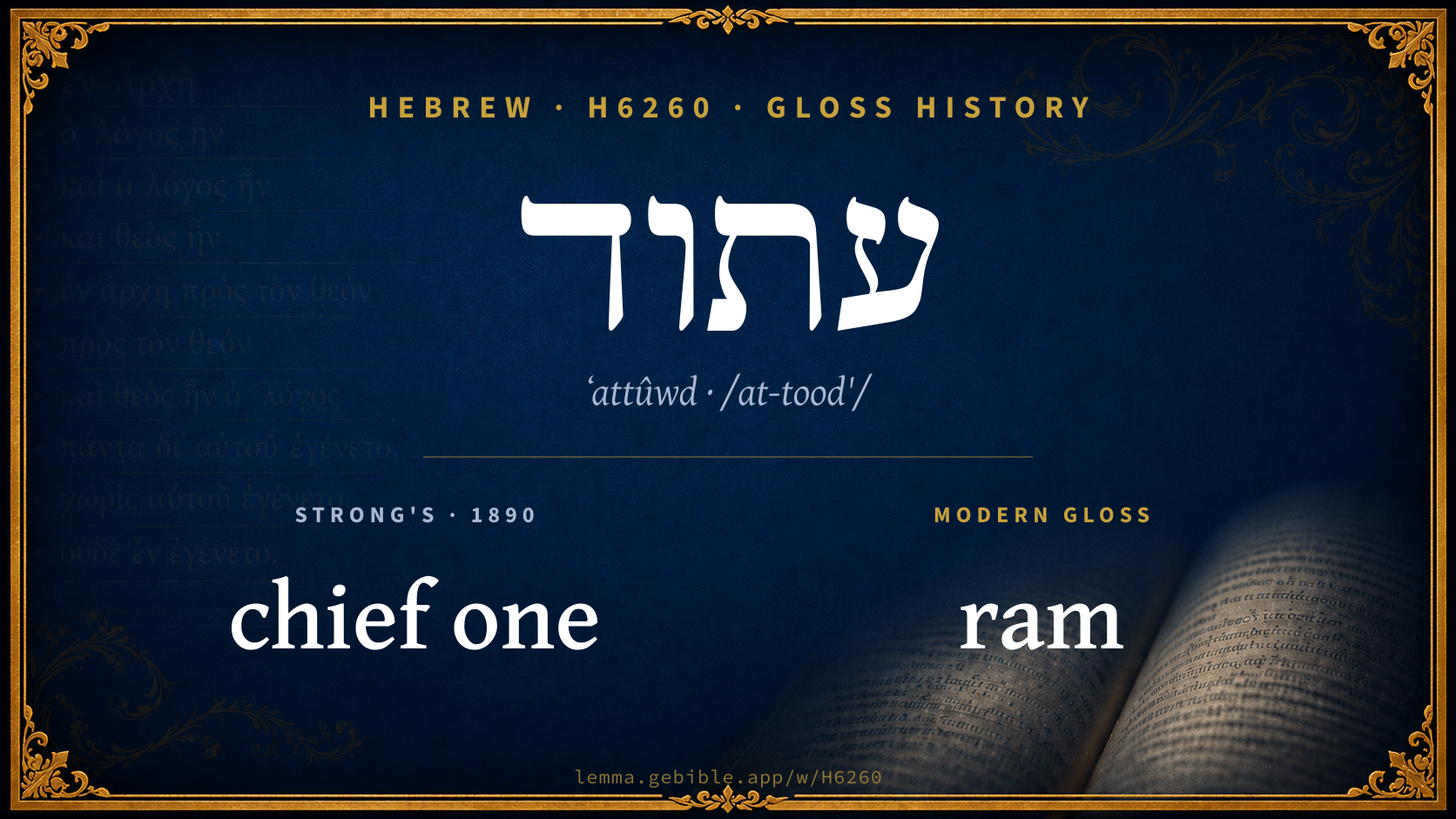
Gloss history
Strong's 1890 vs modern scholarship
About this word
Strong's H6260 catalogs a Hebrew word from the Hebrew Old Testament.
These counts are not copied from any lexicon or concordance. They are computed here, from the morphology-tagged Hebrew Old Testament. What Lemma adds →
- 29
- distinct verses
- The word appears in 29 distinct verses.
- 9 / 39
- OT books
- The word appears in 9 of 39 Old Testament books.
- #1,160
- by frequency
- Top 2500 most frequent Hebrew words (rank 1,160 of 8,640 Hebrew words by occurrence).
View all 29 occurrences in the concordance →
By section of the Old Testament
By traditional corpus
Conventional, traditional groupings — biblical authorship is debated, so this is a traditional corpus grouping, not an authorship claim. Each share is this word’s portion of its verses in that division of the Hebrew canon. Each figure is a share of the word’s 29 distinct verses.
- Torah (Pentateuch) 16 verses · 55%
- Prophets (Nevi'im) 9 verses · 31%
- Writings (Ketuvim) 4 verses · 14%
How translations render this word
Counts come from each version’s own published word-to-Strong’s tagging or interlinear alignment — an approximate guide to how each version renders this word, not a word-level alignment the data otherwise carries. Because each total is that version’s own tagged count, the per-version totals vary from one another and need not match the appearance or distinct-verse counts above. These counts may also differ from a printed concordance because Lemma counts each distinctly tagged rendering and does not collapse phrase taggings into a single head-word total. This is a fixed set of word-tagged versions (KJV, ASV, BSB, ULT) and does not change with the reading translation you choose elsewhere. Each version’s license is shown beside its name below (and on Sources).
- King James Version: He goats 16×, Goats 8×
- American Standard Version: He-goats 17×, Goats 7×
- Berean Standard Bible: Male goats 14×, Goats 9×, Males 2×
- unfoldingWord Literal Text: Male goats 18×, Goats 6×, He goats 2×
King James Version Public Domain
Renders H6260 across 29 tagged occurrences — most commonly:
Plus 5 renderings that appear only once — usually multi-word phrases or single function words the recovered tagging swept in, not distinct renderings.
American Standard Version Public Domain
Renders H6260 across 29 tagged occurrences — most commonly:
Plus 5 renderings that appear only once — usually multi-word phrases or single function words the recovered tagging swept in, not distinct renderings.
Berean Standard Bible Public Domain
Renders H6260 across 29 tagged occurrences — most commonly:
Plus 4 renderings that appear only once — usually multi-word phrases or single function words the recovered tagging swept in, not distinct renderings.
unfoldingWord Literal Text CC BY-SA 4.0
Renders H6260 across 27 tagged occurrences — most commonly:
Plus 1 rendering that appears only once — usually multi-word phrases or single function words the recovered tagging swept in, not distinct renderings.
Senses in BDB
The 1 sense BDB distinguishes for this word, in lexicon order (not ranked by frequency or importance). The full entry — with sub-senses — is in the Lexicon Entry tab.
- ram, he-goat, chief one
Word origin
עַתּוּד he-goat
— Brown-Driver-Briggs (Oxford 1906, public domain), digitized via Sefaria, supplemented by the OpenScriptures HebrewLexicon (CC BY 4.0). See Sources.
Derived from עתד (ʻâthad) (H6257) — to prepare.
Jastrow Dictionary
A second Hebrew/Aramaic lexicon for comparison, covering Aramaic and post-biblical (Talmudic, Targumic, Midrashic) usage that the biblical-Hebrew BDB does not. Matched by lemma rather than by Strong’s number, so a lemma may carry more than one Jastrow headword (shown separately below), and the entries cover usage well beyond the Bible.
עַתּוּד
- [leader of the flock,] ram.—Pl. עַתּוּדִים. Num. R. s. 13 ואין ע׳ אלא לשון עמידה ʿattudim has the meaning of standing (readiness). Y. Ab. Zar. II, 41ᵈ top (ref. to Prov. XXVII, 26) הגדילו ונעשו כע׳ וכ׳ when the pupils have grown and become (strong) like rams, then reveal to them the secrets of the Law. Ḥull. 84ᵃ (ref. to Prov. l. c.) לעולם … ויקח ע׳ וכ׳ at all times a man may sell a field and buy rams (flocks), but he should not sell flocks to buy a field; a. e. e.g. Proverbs 27:26
A Dictionary of the Targumim, the Talmud Babli and Yerushalmi, and the Midrashic Literature (Marcus Jastrow; London, Luzac, 1903) — Public Domain. Digitized via Sefaria. Digitized via Sefaria. Full attribution on Sources.
Forms in the corpus
The 11 distinct written forms H6260 takes in the Hebrew Bible, most frequent first — each parse links to that state’s occurrences in the concordance. Hebrew forms include their vowel points and cantillation, so a single lemma takes many written forms.
| Form | Parsing | Example | Uses |
|---|---|---|---|
| עַתֻּדִ֣ים | Noun, Common, Masculine, Plural, Absolute | Numbers 7:29 | 11 |
| עַתּוּדִ֣ים | Noun, Common, Masculine, Plural, Absolute | Numbers 7:17 | 4 |
| וְ/עַתּוּדִ֔ים | Noun, Common, Masculine, Plural, Absolute | Deuteronomy 32:14 | 3 |
| עַתּוּדִֽים | Noun, Common, Masculine, Plural, Absolute | Jeremiah 51:40 | 3 |
| הָֽ/עַתֻּדִים֙ | Noun, Common, Masculine, Plural, Absolute | Genesis 31:10 | 2 |
| הָ/עַתּוּדִ֖ים | Noun, Common, Masculine, Plural, Absolute | Zechariah 10:3 | 1 |
| וְ/לָ/עַתּוּדִֽים | Noun, Common, Masculine, Plural, Absolute | Ezekiel 34:17 | 1 |
| וְ/עַתּוּדִ֖ים | Noun, Common, Masculine, Plural, Absolute | Isaiah 1:11 | 1 |
| וְ/עַתּוּדִים֙ | Noun, Common, Masculine, Plural, Absolute | Ezekiel 39:18 | 1 |
| כְּ/עַתּוּדִ֖ים | Noun, Common, Masculine, Plural, Absolute | Jeremiah 50:8 | 1 |
| עַתּ֣וּדֵי | Noun, Common, Masculine, Plural, Construct | Isaiah 14:9 | 1 |
Same root — word family
Other BDB entries built from the same root as H6260, grouped by Strong’s listed origin. These share a root / origin per the lexicon — not necessarily a shared meaning. Each links to that word’s own entry.
Derives from
Shares the same root
Compare all same-root words → They share a root, not necessarily a meaning.
Septuagint verse parallels
This word appears in 27 verses that also exist in the Greek Old Testament (Septuagint), out of the 29 Hebrew verses it occurs in. You can read those verses in Greek by switching the Old Testament edition to the Septuagint.
Read these verses in the Septuagint
- Genesis 31:10
- Numbers 7:17
- Deuteronomy 32:14
- Psalms 50:9
- Proverbs 27:26
- Isaiah 1:11
- Jeremiah 50:8
- Ezekiel 27:21
- Zechariah 10:3
This is a verse-level parallel only — the same verses exist in both the Hebrew and Greek Old Testaments. No word-level Hebrew↔Greek correspondence is claimed: the data carries no such alignment, so no Greek word is shown as this Hebrew word’s translation. Coverage is not total — the Septuagint omits the deuterocanon and renumbers the Psalms, so some Hebrew verses have no direct Greek parallel.