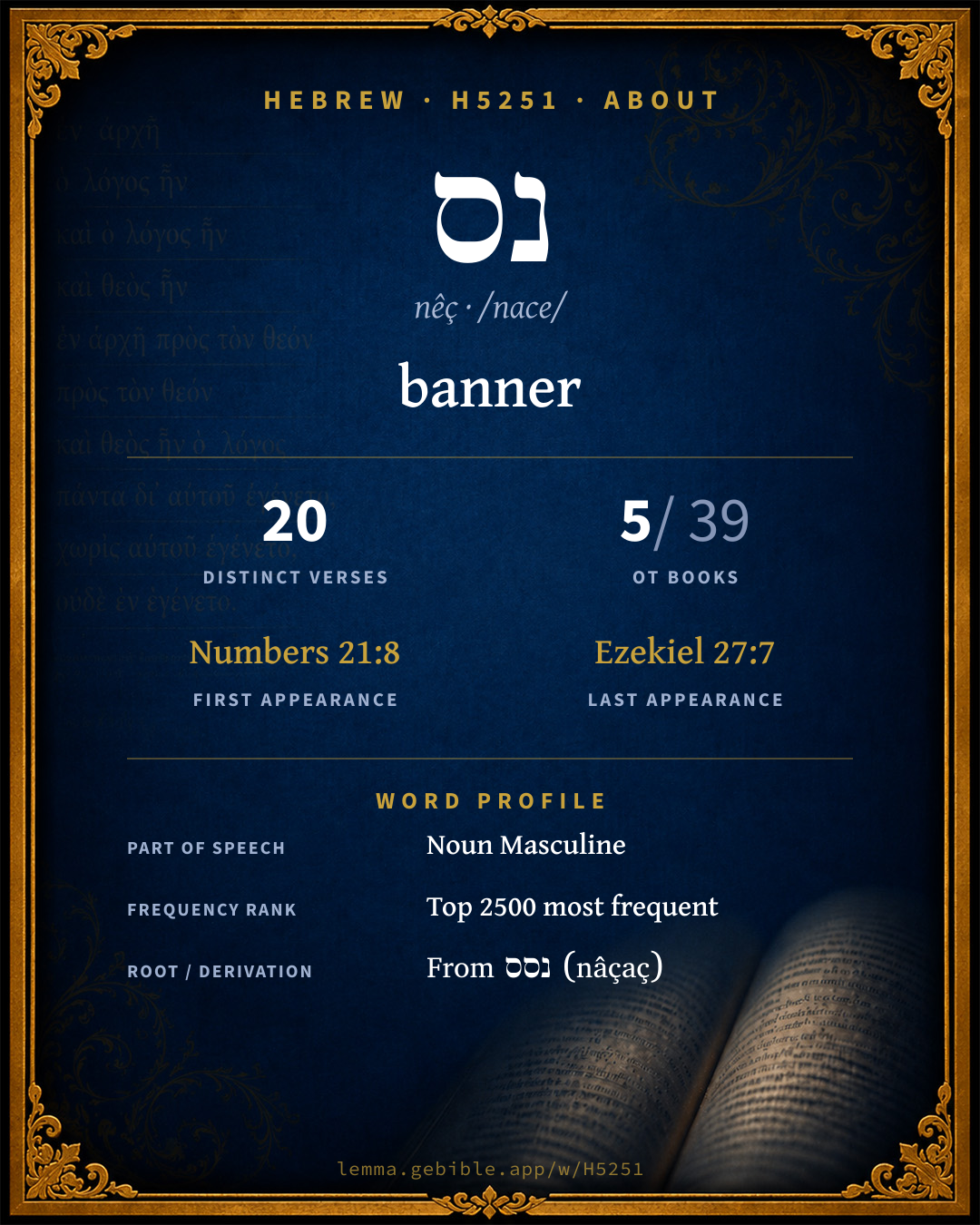
נֵס
banner
also: something lifted up, standard, signal, signal pole fuller range ↓
Full lexicon entry — Brown-Driver-Briggs (BDB)
From Brown-Driver-Briggs (BDB)
Where this word appears
Grammar key — what these labels mean
Part of speech
- Noun
- A naming word — a person, place, thing, or idea.
Noun type
- Common
- A common noun — a general class of person, place, or thing (“king,” “city,” “water”), not a specific name.
State
- Absolute
- The independent form of a noun, not bound to a following word.
- Construct
- A noun bound to a following noun in a possessive / “of” relationship (the construct chain).
Gender
- Masculine
- Grammatically masculine.
Number
- Singular
- One.
Every verse where H5251 appears in the Book of Jeremiah — 5 distinct verses. Click any verse to open its interlinear word-by-word view. Verse text shown in the World English Bible for context — . Each verse’s Hebrew form is shown with its reference; the English is not keyword-highlighted, since the data carries no word-level English alignment. Use “Compare translations” on any verse to read it across multiple English versions. This concordance covers the Hebrew Bible; Septuagint (Greek Old Testament) occurrences are not indexed here.
Jeremiah
- Jeremiah 4:6 נֵ֣ס n c ms Set up a standard toward Zion: flee for safety, don't stay; for I will bring evil from the north, and a great destruction.
- Jeremiah 4:21 נֵּ֑ס n c ms How long shall I see the standard, and hear the sound of the trumpet?
- Jeremiah 50:2 נֵ֔ס n c ms Declare you among the nations and publish, and set up a standard; publish, and don't conceal: say, Babylon is taken, Bel is disappointed, Merodach is dismayed; her images are disappointed, her idols are dismayed.
- Jeremiah 51:12 נֵ֗ס n c ms Set up a standard against the walls of Babylon, make the watch strong, set the watchmen, prepare the ambushes; for Yahweh has both purposed and done that which he spoke concerning the inhabitants of Babylon.
- Jeremiah 51:27 נֵ֣ס n c ms Set up a standard in the land, blow the trumpet among the nations, prepare the nations against her, call together against her the kingdoms of Ararat, Minni, and Ashkenaz: appoint a marshal against her; cause the horses to come up as the rough canker-worm.
About this entry
At a glance — auto-summarized from this page’s data, not written by a person. Every figure links to its source below. This summary describes the numbers; it doesn’t interpret them.
At its core, נס (nêç) means “banner.” Its uses cluster heavily in Isaiah (50% of all occurrences). With 20 verses in 5 books, it is an uncommon word in the Hebrew Bible. Beyond its headline sense, its full sense range takes in “something lifted up”, “standard”, and “signal”. The King James Version usually renders it “standard,” while modern versions prefer “banner” (Berean Standard Bible) — see the renderings breakdown. Each statement above links to its evidence; the full detail follows below.
Gloss history
Strong's 1890 vs modern scholarship
About this word
Strong's H5251 catalogs a Hebrew word from the Hebrew Old Testament.
These counts are not copied from any lexicon or concordance. They are computed here, from the morphology-tagged Hebrew Old Testament. What Lemma adds →
- 20
- distinct verses
- The word appears in 20 distinct verses.
- 5 / 39
- OT books
- The word appears in 5 of 39 Old Testament books.
- #1,513
- by frequency
- Top 2500 most frequent Hebrew words (rank 1,513 of 8,640 Hebrew words by occurrence).
View all 20 occurrences in the concordance →
By section of the Old Testament
By traditional corpus
Conventional, traditional groupings — biblical authorship is debated, so this is a traditional corpus grouping, not an authorship claim. Each share is this word’s portion of its verses in that division of the Hebrew canon. Each figure is a share of the word’s 20 distinct verses.
- Prophets (Nevi'im) 16 verses · 80%
- Torah (Pentateuch) 3 verses · 15%
- Writings (Ketuvim) 1 verse · 5%
How translations render this word
Counts come from each version’s own published word-to-Strong’s tagging or interlinear alignment — an approximate guide to how each version renders this word, not a word-level alignment the data otherwise carries. Because each total is that version’s own tagged count, the per-version totals vary from one another and need not match the appearance or distinct-verse counts above. These counts may also differ from a printed concordance because Lemma counts each distinctly tagged rendering and does not collapse phrase taggings into a single head-word total. This is a fixed set of word-tagged versions (KJV, ASV, BSB, ULT) and does not change with the reading translation you choose elsewhere. Each version’s license is shown beside its name below (and on Sources).
BDB lists this Strong’s number as 2 distinct words (homographs). Each count above pools all of them and is not split by sense — see the Senses section below. A low-frequency rendering may belong to a different one of those words, not the primary meaning.
- King James Version†: Standard 7×, Ensign 6×, Banner 2×
- American Standard Version†: Ensign 9×, Standard 7×
- Berean Standard Bible†: Banner 12×, Pole 2×, Signal flag 2×
- unfoldingWord Literal Text†: Banner 13×
King James Version Public Domain
Renders H5251 across 20† tagged occurrences — most commonly:
Plus 3 renderings that appear only once — usually multi-word phrases or single function words the recovered tagging swept in, not distinct renderings.
American Standard Version Public Domain
Renders H5251 across 20† tagged occurrences — most commonly:
Plus 4 renderings that appear only once — usually multi-word phrases or single function words the recovered tagging swept in, not distinct renderings.
Berean Standard Bible Public Domain
Renders H5251 across 21† tagged occurrences — most commonly:
Plus 5 renderings that appear only once — usually multi-word phrases or single function words the recovered tagging swept in, not distinct renderings.
unfoldingWord Literal Text CC BY-SA 4.0
Renders H5251 across 18† tagged occurrences — most commonly:
Plus 5 renderings that appear only once — usually multi-word phrases or single function words the recovered tagging swept in, not distinct renderings.
6 senses and sub-senses in the full BDB
What do BDB’s symbols mean?
BDB uses these scholarly abbreviations:
| Symbol | Meaning |
|---|---|
| 𝔊 | the Septuagint (the ancient Greek translation, LXX) |
| 𝔙 | the Vulgate (the Latin translation) |
| 𝔖 | the Syriac version (the Peshitta) |
| 𝔗 | the Targum (the Aramaic translation) |
| ψ | the Psalms |
| √ | root (the underlying root or stem) |
| ‖ | parallel passage (a synonymous or contrasted parallel) |
| † | the dagger: every passage where the word occurs is cited |
The 6 senses and sub-senses the full Brown-Driver-Briggs lexicon distinguishes for this word, in lexicon order (not ranked by frequency), with BDB’s own verbatim wording and sub-sense lettering. Shown in Hebrew script with BDB’s own scholarly abbreviations. The condensed entry is in the Lexicon Entry tab. See also the Forms in the corpus table below.
- 1.
- a. standard, as rallying-point, י׳ נִסִּי Ex 17:15 (E), י׳ my standard (name of altar); conspicuously set on hill Is 30:17 (sim. of solitariness; ‖ תֹּרֶן עַל־רֹאשׁ הָהָר); signal of war [v. SchumacherZPV ix. 232, Across the Jordan, 104 f.] (especially to the nations, for destruction or deliverance of Judah, Is Je), נָשָׂא נ׳ לַגּוֹיִם Is 5:26; 11:12 cf. 18:3 (on mts., ‖ תָּקַע שׁוֹפָר); אֶל־עַמִּים אָרִים נ׳ 49:22 (‖ אֶשָּׂא אֶל־גּוֹיִם יָדִי),—in all these subj. י׳; cf. עֹמֵד לְנֵס עַמִּים Is 11:10 (of Mess. kg.); שְׂאוּ נ׳ 13:2 (on mt.) 31:9, Je 50:2; 51:12 (c. אֶל־ against), v 27 (‖ תִּקְעוּ שׁוֹפָר בַּגּוֹיִם), הָרִימוּ נ׳ עַל־עַמִּים Is 62:10, cf. Je 4:21 (‖ קוֹל שׁוֹפָר); נָתַתָּה … נ׳ לְהִתְנוֹסֵס ψ 60:6 thou hast set a standard (only) for fleeing. e.g. Exodus 17:15
- b. signal, שְׂאוּ נ׳ צִיּ֫וֹנָה Je 4:6 (i.e. to direct refugees to Zion). e.g. Jeremiah 4:6
- 2. standard, as pole, supporting serpent of bronze Nu 21:8, 9 (JE). e.g. Numbers 21:8
- 3.
- a. ensign, signal, שֵׁשׁ … מִמִּצְרַיִם הָיָה מִפְרָשֵׁךְ לִהְיוֹת לָךְ לְנֵס Ez 27:7 byssus from Egypt was thy sail, to serve thee for an ensign (so DaToy; on lack of pennon on ancient ships v. Co; > del. Co Berthol); so e.g. Ezekiel 27:7
- b. (since sails were the only ensign) = sail Is 33:23 (Che Di al.; > pennon Ges Hi Ew De Du). e.g. Isaiah 33:23
- 4. sign (cf. NH) = warning Nu 26:10 (P). e.g. Numbers 26:10
Senses from the full Brown-Driver-Briggs lexicon (Brown, Driver, Briggs; Oxford 1906 — public domain), digitized via Sefaria, supplemented by the OpenScriptures HebrewLexicon (CC BY 4.0). Full attribution on Sources.
Word origin
n.[m.] standard, ensign, signal, sign (NH id., flag, usually sign, i.e. miracle; 𝔗 נֵס, נִסָּא sign, miracle);—נ׳ abs. Nu 21:8 +; cstr. Is 31:9; sf. נִסִּי Ex 17:15; Is 49:22;—
— Brown-Driver-Briggs (Oxford 1906, public domain), digitized via Sefaria, supplemented by the OpenScriptures HebrewLexicon (CC BY 4.0). See Sources.
Derived from נסס (nâçaç) (H5264) — to be lifted up.
Jastrow Dictionary
A second Hebrew/Aramaic lexicon for comparison, covering Aramaic and post-biblical (Talmudic, Targumic, Midrashic) usage that the biblical-Hebrew BDB does not. Matched by lemma rather than by Strong’s number, so a lemma may carry more than one Jastrow headword (shown separately below), and the entries cover usage well beyond the Bible.
נֵס I
- נסס to lift up,
- 1. flag. B. Bath. V, 1, v. אֲדָרָא II. Gen. R. s. 55, beg. (ref. to Ps. LX, 6) כנס הזה וכ׳ like the flag of a ship; ib. (ref. to נסה, Gen. XXII, 1) גדלו כנס וכ׳ he lifted Abraham up like &c.; Yalk. Ps. 777 כנסו של וכ׳ (read: כנס זה); a. e. e.g. Psalms 60:6
- 2. (cmp. אוֹת, מוֹפֵת) sign, wonder, providential event. Nidd. 31ᵃ אפי׳ בעל הנס אינו מכיר בנִסּוֹ even he to whom the providential sign happens, does not recognize it. Yoma 21ᵃ כרובים בנס וכ׳ the cherubs (above the ark in the Solomonic Temple) stood by a miracle. Ib., a. e. נס גדול היה וכ׳ a great miracle was connected with the show-bread which was as fresh at its removal &c. Sot. 47ᵃ, a. fr. נס בתוך נס a double wonder. Ned. 41ᵃ גדול נס שנעשה וכ׳ the wonder of recovery which the sick man experiences, is greater than that which happened to Hananiah, Mishael &c. Sabb. 23ᵃ, a. e. אף הן היו באותו הנס the women, too, were concerned in that wonderful delivery. Ib. ונימעוט נס why not omit the benediction mentioning the wonder (שעשה נסים וכ׳)?; a. v. fr.—Pl. נִסִּים, נִסִּין, נִי׳. Ber. IX, 1 הרואה מקום שנעשו בו נ׳ … ברוך שעשה נ׳ וכ׳ he who sees a place where miracles happened to Israel, must say, Blessed be he who performed wonders &c. Ib. 60ᵃ, a. fr. מעשה נ׳ (abbrev. מ"נ) a miraculous event, v. זָכַר. Yoma 29ᵃ אסתר סוף כל הנ׳ the Book of Esther is the last record of miracles. Taan. 25ᵃ; Snh. 109ᵃ top, v. לָמַד; a. v. fr.
*נֵס II
- island. Deut. R. s. 2, v. נִיסָא.—Pl. נִיסִים, נִיסִין, נֵסִין, v. נִיסָא.
נֵס
- 1. flag, sign, miraculous event. Targ. Y. Num. XXV, 8; a. fr.—Y. Pes. V, 32ᶜ bot. נסא הוה רב a great event (delivery from danger) had occurred; Y. Taan. III, end, 67ᵃ ניסא. Ber. 54ᵃ נ׳ דרבים a providential event which concerns the community, opp. נ׳ דיחיד. Meg. 3ᵇ משום פרסומי נ׳ because it is a duty to proclaim the wonderful event (in the Book of Esther); Sabb. 23ᵇ פרסומי נ׳ to proclaim the wonderful events (of the Maccabean days, by lighting the candles); a. v. fr.—Pl. נִסִּין, נִסַּיָּא, נִסֵּי, נִי׳. Targ. O. Ex. XVII, 15. Targ. Y. II, Num. XXI, 14; a. fr.—Y. Ter. VIII, end, 46ᶜ. Yoma 21ᵃ נ׳ דגואי wonders which happened within the Temple; נ׳ דבראי outside of the Temple. Ib.ᵇ נ׳ דקביעי permanent, regularly recurring wonders; a. fr.
- 2. (= נִסָּיוֹן) trial.—Pl. as ab. Targ. Y. II, Ex. XV, 25.—Y. Maas. Sh. V, end, 55ᶜ (oneirocritical play on נִיסַן) וניסין לית את חמי and thou shalt experience no trials; (Lam. R. to I, 1 רבתי נִסְיוֹנִין (חד מתלמ׳); Ber. 56ᵇ ולא אתית לידי נסיון).
A Dictionary of the Targumim, the Talmud Babli and Yerushalmi, and the Midrashic Literature (Marcus Jastrow; London, Luzac, 1903) — Public Domain. Digitized via Sefaria. Digitized via Sefaria. Full attribution on Sources.
Forms in the corpus
The 16 distinct written forms H5251 takes in the Hebrew Bible, most frequent first — each parse links to that state’s occurrences in the concordance. Hebrew forms include their vowel points and cantillation, so a single lemma takes many written forms.
Septuagint verse parallels
This word appears in 20 verses that also exist in the Greek Old Testament (Septuagint), out of the 20 Hebrew verses it occurs in. You can read those verses in Greek by switching the Old Testament edition to the Septuagint.
Read these verses in the Septuagint
This is a verse-level parallel only — the same verses exist in both the Hebrew and Greek Old Testaments. No word-level Hebrew↔Greek correspondence is claimed: the data carries no such alignment, so no Greek word is shown as this Hebrew word’s translation. Coverage is not total — the Septuagint omits the deuterocanon and renumbers the Psalms, so some Hebrew verses have no direct Greek parallel.