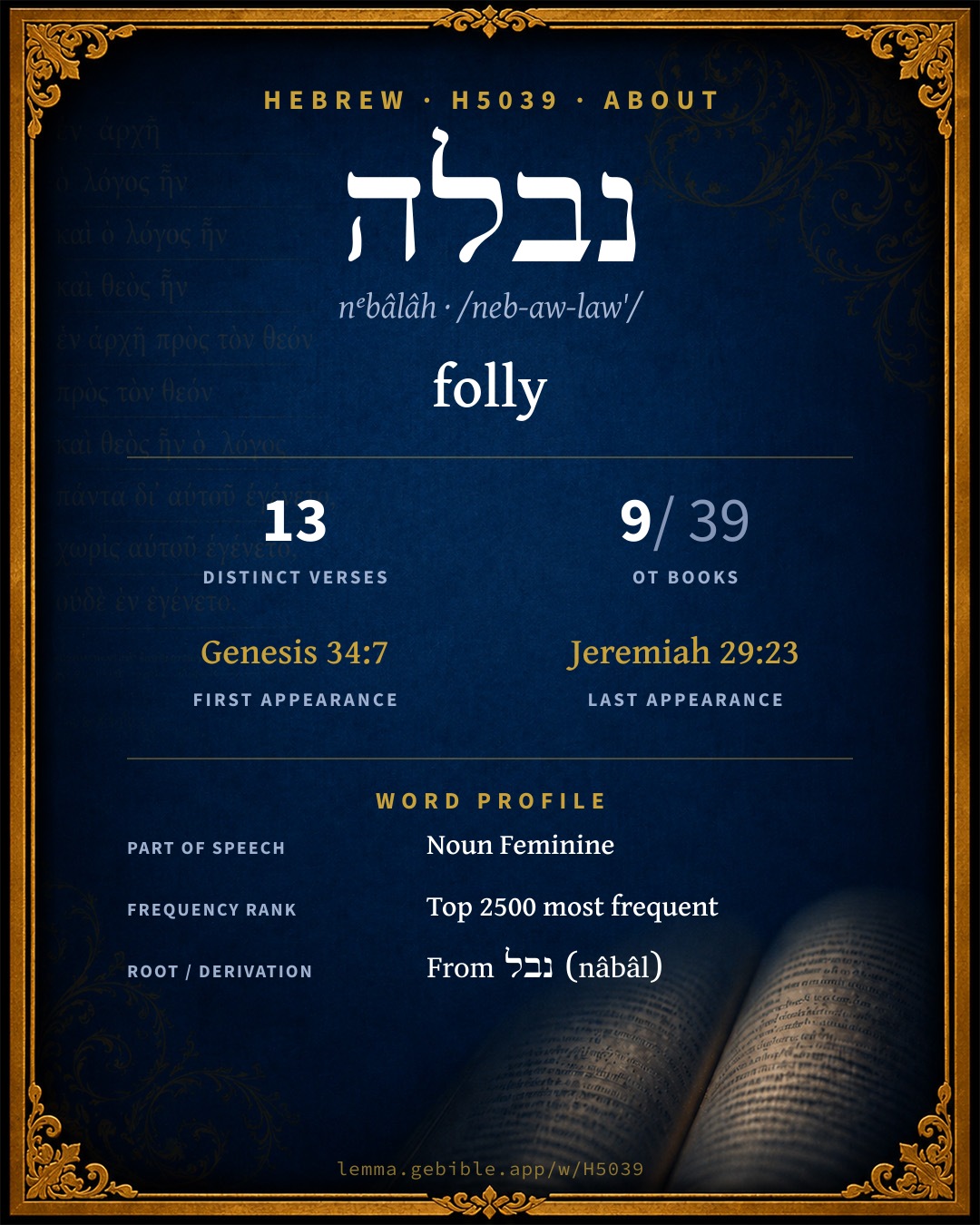
נְבָלָה
folly
‘folly’ is one of 3 main senses fuller range ↓
Full lexicon entry — Brown-Driver-Briggs (BDB)
From Brown-Driver-Briggs (BDB)
Where this word appears
Grammar key — what these labels mean
Part of speech
- Noun
- A naming word — a person, place, thing, or idea.
Noun type
- Common
- A common noun — a general class of person, place, or thing (“king,” “city,” “water”), not a specific name.
State
- Absolute
- The independent form of a noun, not bound to a following word.
Gender
- Feminine
- Grammatically feminine.
Number
- Singular
- One.
Every verse where H5039 appears in the Book of Judges — 4 distinct verses. Click any verse to open its interlinear word-by-word view. Verse text shown in the World English Bible for context — . Each verse’s Hebrew form is shown with its reference; the English is not keyword-highlighted, since the data carries no word-level English alignment. Use “Compare translations” on any verse to read it across multiple English versions. This concordance covers the Hebrew Bible; Septuagint (Greek Old Testament) occurrences are not indexed here.
Judges
- Judges 19:23 הַ/נְּבָלָ֥ה ptcl def.art + n c fs The man, the master of the house, went out to them, and said to them, No, my brothers, please don't act so wickedly; seeing that this man is come into my house, don't do this folly.
- Judges 19:24 הַ/נְּבָלָ֥ה ptcl def.art + n c fs Behold, here is my daughter a virgin, and his concubine; them I will bring out now, and humble you them, and do with them what seems good to you: but to this man don't do any such folly.
- Judges 20:6 וּ/נְבָלָ֖ה conj + n c fs I took my concubine, and cut her in pieces, and sent her throughout all the country of the inheritance of Israel; for they have committed lewdness and folly in Israel.
- Judges 20:10 הַ֨/נְּבָלָ֔ה ptcl def.art + n c fs and we will take ten men of one hundred throughout all the tribes of Israel, and one hundred of one thousand, and a thousand out of ten thousand, to get food for the people, that they may do, when they come to Gibeah of Benjamin, according to all the folly that they have worked in Israel.
About this entry
At a glance — auto-summarized from this page’s data, not written by a person. Every figure links to its source below. This summary describes the numbers; it doesn’t interpret them.
נבלה (nᵉbâlâh) is a Hebrew noun most often rendered “folly.” Its English rendering has broadened — “folly” classically, “outrage” (Berean Standard Bible) in modern versions; see the renderings breakdown. Spanning 13 verses in 9 books, it ranks among the uncommon words of the Hebrew Bible. Judges dominates its distribution — 4 of 13 verses. It is not a single-sense word — see its full sense range. For the data behind this summary, explore the sense tree and the renderings breakdown below.
Gloss history
Strong's 1890 vs modern scholarship
About this word
Strong's H5039 catalogs a Hebrew word from the Hebrew Old Testament.
These counts are not copied from any lexicon or concordance. They are computed here, from the morphology-tagged Hebrew Old Testament. What Lemma adds →
- 13
- distinct verses
- The word appears in 13 distinct verses.
- 9 / 39
- OT books
- The word appears in 9 of 39 Old Testament books.
- #2,001
- by frequency
- Top 2500 most frequent Hebrew words (rank 2,001 of 8,640 Hebrew words by occurrence).
View all 13 occurrences in the concordance →
By section of the Old Testament
By traditional corpus
Conventional, traditional groupings — biblical authorship is debated, so this is a traditional corpus grouping, not an authorship claim. Each share is this word’s portion of its verses in that division of the Hebrew canon. Each figure is a share of the word’s 13 distinct verses.
- Prophets (Nevi'im) 10 verses · 77%
- Torah (Pentateuch) 2 verses · 15%
- Writings (Ketuvim) 1 verse · 8%
How translations render this word
Counts come from each version’s own published word-to-Strong’s tagging or interlinear alignment — an approximate guide to how each version renders this word, not a word-level alignment the data otherwise carries. Because each total is that version’s own tagged count, the per-version totals vary from one another and need not match the appearance or distinct-verse counts above. These counts may also differ from a printed concordance because Lemma counts each distinctly tagged rendering and does not collapse phrase taggings into a single head-word total. This is a fixed set of word-tagged versions (KJV, ASV, BSB, ULT) and does not change with the reading translation you choose elsewhere. Each version’s license is shown beside its name below (and on Sources).
- King James Version: Folly 7×, Villany 2×
- American Standard Version: Folly 10×
- Berean Standard Bible: Outrage 5×, Folly 3×
- unfoldingWord Literal Text: Outrage 4×, Disgraceful thing 2×, Foolishness 2×
King James Version Public Domain
Renders H5039 across 13 tagged occurrences — most commonly:
Plus 4 renderings that appear only once — usually multi-word phrases or single function words the recovered tagging swept in, not distinct renderings.
American Standard Version Public Domain
Renders H5039 across 13 tagged occurrences — most commonly:
Plus 3 renderings that appear only once — usually multi-word phrases or single function words the recovered tagging swept in, not distinct renderings.
Berean Standard Bible Public Domain
Renders H5039 across 13 tagged occurrences — most commonly:
Plus 5 renderings that appear only once — usually multi-word phrases or single function words the recovered tagging swept in, not distinct renderings.
unfoldingWord Literal Text CC BY-SA 4.0
Renders H5039 across 12 tagged occurrences — most commonly:
Plus 4 renderings that appear only once — usually multi-word phrases or single function words the recovered tagging swept in, not distinct renderings.
Senses in the full BDB
What do BDB’s symbols mean?
BDB uses these scholarly abbreviations:
| Symbol | Meaning |
|---|---|
| 𝔊 | the Septuagint (the ancient Greek translation, LXX) |
| 𝔙 | the Vulgate (the Latin translation) |
| 𝔖 | the Syriac version (the Peshitta) |
| 𝔗 | the Targum (the Aramaic translation) |
| ψ | the Psalms |
| √ | root (the underlying root or stem) |
| ‖ | parallel passage (a synonymous or contrasted parallel) |
| † | the dagger: every passage where the word occurs is cited |
The 2 senses and sub-senses the full Brown-Driver-Briggs lexicon distinguishes for this word, in lexicon order (not ranked by frequency), with BDB’s own verbatim wording and sub-sense lettering. Shown in Hebrew script with BDB’s own scholarly abbreviations. The condensed entry is in the Lexicon Entry tab. See also the Forms in the corpus table below.
- 1. disgraceful folly, especially of sins of unchastity Ju 19:23 (wanton deed GFM), so דְּבַר הַנּ׳ הַזֹּאת v 24, 2 S 13:12; often עָשָׂה נ׳ בְּיִשְׂרָאֵל i.e. do a thing disgraceful according to Isr.’s standard: Gn 34:7 (J), Dt 22:21 (cf. Dr on meaning of wd.; only here of woman), Ju 20:6 (+ זִמָּה), v 10 Je 29:23 (cf. לֹא יֵעָשֶׂה כֵּן בְּיִשְׂרָאֵל 2 S 13:12); also of inhospitable churlishness 1 S 25:25 (v. i, ii. נָבָל, and especially Is 32:6); of profane action Jos 7:15 (Achan; עָשָׂה נ׳ בְּיִשְׂרָאֵל); of senseless and irreligious language Is 9:16 דֹּבֵר, 32:6 (יְדַבֵּר). e.g. Judges 19:23
- 2. contumely, disgrace עֲשׂוֹת עִמָּכֶם נ׳ Jb 42:8 (of י׳), i.e. deal out to you disgrace, expose you and punish you as נְכָלִים (cf. 2 S 3:33, sub נָבָל), because of your utterances about me. e.g. Job 42:8
Senses from the full Brown-Driver-Briggs lexicon (Brown, Driver, Briggs; Oxford 1906 — public domain), digitized via Sefaria, supplemented by the OpenScriptures HebrewLexicon (CC BY 4.0). Full attribution on Sources.
Word origin
n.f. senselessness (as shewn in disregard of moral and religious claims), especially of disgraceful sins; also disgrace;—always abs. נ׳;—
— Brown-Driver-Briggs (Oxford 1906, public domain), digitized via Sefaria, supplemented by the OpenScriptures HebrewLexicon (CC BY 4.0). See Sources.
Derived from נבל (nâbâl) (H5036) — foolish.
Jastrow Dictionary
A second Hebrew/Aramaic lexicon for comparison, covering Aramaic and post-biblical (Talmudic, Targumic, Midrashic) usage that the biblical-Hebrew BDB does not. Matched by lemma rather than by Strong’s number, so a lemma may carry more than one Jastrow headword (shown separately below), and the entries cover usage well beyond the Bible.
בלי ²
- , v. בלל; cmp. נבל) to be crumbled; to be worn out, to fail, decay, perish. Koh. R. to I, 4 הוא בוֹלֶה it (the generation of man) decays (dies out), אינה בוֹלָה it (the earth) does not grow old. Taan. 9ᵃ (play on עד בלי די Mal. III, 10) עד שיִבְלוּ שפתותיכם מלומר די until your lips grow tired from saying, It is enough; (Y. ib. III, 66ᵈ bot. שיבללו, v. בָּלַל); a. fr.—Part. pass. בָּלוּי outworn. Pl. בְּלוּיִים. Midr. Till. to Ps. XXV, 1. e.g. Malachi 3:10
- to wear out, outlive, survive. Lev. R. s. 4 הנפש מְבַלָּה וכ׳ the soul survives the body. Lev. R. s. 19 (play on אין בלתך, I Sam. II, 2) אין לְבַלֹּותֶךָ there is none to outlive thee. Koh. R. l. c.; Cant. R. to V, 15 one erects a building ואחר מְבַלֶּה אותו (not מכלה) and another man ruins it. Snh. 105ᵃ, v. בִּלְעָם. e.g. 1 Samuel 2:2
- , Nithpa. נִתְבַּלָּה to become outworn, fade away. Esth. R. introd. עתידין לְהִבָּלוֹת (Gen. R. s. 42 לִבְלוֹת) are destined to decay. Deut. R. s. 7, end נִתְבַּלּוּ (the garments) were worn out. B. Mets. 87ᵃ נ׳ הבשר her body was withered. B. Bath. 146ᵃ עשויין לִיבָּלוֹת made to be used up.
נְבֵלָה
- carrion, an animal that has died a natural death. Gen. R. s. 81, end להוט אחר הנ׳ greedy for carrion. Ukts. III, 3 נִבְלַת בהמה טמאה the carcass of an unclean animal; a. fr.—Esp. (ritual) an animal not slaughtered according to the ritual rules (v. דְּרָסָה, הַגְרָמָה &c.). Ḥull. II, 4 כל שנפסלה בשחיטתה נ׳ whatever has become unfit through faulty slaughtering, is called n’belah, contrad. to טְרֵפָה. Ab. Zar. 67ᵇ sq. כל הראויה לגר קרויה נ׳ וכ׳ that which is fit for the stranger (Deut. XIV, 21) is called n’belah (the eating of which is a punishable offence), whatever is unfit for the stranger (putrefied &c.) is no longer called n’belah. Ker. 21ᵃ נְבֵילָתוֹ מנלן whence do we derive the prohibition to eat it when unlawfully slaughtered? Y. Shebi. IV, 35ᵃ bot. (in Chald. dict.) בשר דנ׳ forbidden meat; Ḥull. 95ᵃ בְּשַׂר נ׳, opp. בשר שחוטה. Ib. מותרות משום נ׳ they are permitted as far as n’belah is concerned, i.e. they do not make unclean (Lev. XI, 39); a. v. fr.—Pl. נְבֵלוֹת, נְבֵילוֹת. Ib.; Shek. VII, 3 איברים נ׳ if found cut in limbs, they are forbidden, opp. מותרות. Eduy. VIII, 1. Ib. V, 1; a. fr. e.g. Deuteronomy 14:21
נְבָלָה
- 1. meanness, obscenity. Treat. Der. Er. ch. II מְדַבְּרֵי נ׳ those talking obscenely. Ib. הדר בנ׳ עם אשתו who lives with his wife in an obscene manner; a. e.—Pl. נְבָלוֹת. Ex. R. s. 24 (ref. to Deut. XXXII, 6) עם נבל שעשו נ׳ וכ׳ ‘a disgraced people’, for they did disgraceful things, as it is said (Ps. LXXIX, 2), they made ‘the disgraced’ of thy people food &c. (taking נִבְלַת as if from נְבָלָה).—2) destruction. Gen. R. s. 38; Yalk. ib. 62 (play on וְנָבְלָה, Gen. XI, 7) משפתם אעשה (עמהם) נ׳ through their own lips I shall bring destruction upon them. e.g. Deuteronomy 32:6
A Dictionary of the Targumim, the Talmud Babli and Yerushalmi, and the Midrashic Literature (Marcus Jastrow; London, Luzac, 1903) — Public Domain. Digitized via Sefaria. Digitized via Sefaria. Full attribution on Sources.
Forms in the corpus
The 10 distinct written forms H5039 takes in the Hebrew Bible, most frequent first — each parse links to that state’s occurrences in the concordance. Hebrew forms include their vowel points and cantillation, so a single lemma takes many written forms.
| Form | Parsing | Example | Uses |
|---|---|---|---|
| הַ/נְּבָלָ֥ה | Noun, Common, Feminine, Singular, Absolute | 2 Samuel 13:12 | 3 |
| וּ/נְבָלָ֖ה | Noun, Common, Feminine, Singular, Absolute | 1 Samuel 25:25 | 2 |
| הַ֨/נְּבָלָ֔ה | Noun, Common, Feminine, Singular, Absolute | Judges 20:10 | 1 |
| נְבָלָ֑ה | Noun, Common, Feminine, Singular, Absolute | Isaiah 9:17 | 1 |
| נְבָלָ֔ה | Noun, Common, Feminine, Singular, Absolute | Job 42:8 | 1 |
| נְבָלָ֖ה | Noun, Common, Feminine, Singular, Absolute | Joshua 7:15 | 1 |
| נְבָלָ֜ה | Noun, Common, Feminine, Singular, Absolute | Jeremiah 29:23 | 1 |
| נְבָלָ֞ה | Noun, Common, Feminine, Singular, Absolute | Genesis 34:7 | 1 |
| נְבָלָ֣ה | Noun, Common, Feminine, Singular, Absolute | Isaiah 32:6 | 1 |
| נְבָלָה֙ | Noun, Common, Feminine, Singular, Absolute | Deuteronomy 22:21 | 1 |
Same root — word family
Other BDB entries built from the same root as H5039, grouped by Strong’s listed origin. These share a root / origin per the lexicon — not necessarily a shared meaning. Each links to that word’s own entry.
Derives from
Shares the same root
Proper names from this root
People and places named from this root — a name, not an additional meaning of the word.
Compare all same-root words → Showing 4 of 5 — not the complete family. 2 of the same-root words are proper names (people or places). They share a root, not necessarily a meaning.
Septuagint verse parallels
This word appears in 12 verses that also exist in the Greek Old Testament (Septuagint), out of the 13 Hebrew verses it occurs in. You can read those verses in Greek by switching the Old Testament edition to the Septuagint.
Read these verses in the Septuagint
- Genesis 34:7
- Deuteronomy 22:21
- Joshua 7:15
- Judges 19:23
- 1 Samuel 25:25
- 2 Samuel 13:12
- Job 42:8
- Isaiah 9:17
This is a verse-level parallel only — the same verses exist in both the Hebrew and Greek Old Testaments. No word-level Hebrew↔Greek correspondence is claimed: the data carries no such alignment, so no Greek word is shown as this Hebrew word’s translation. Coverage is not total — the Septuagint omits the deuterocanon and renumbers the Psalms, so some Hebrew verses have no direct Greek parallel.