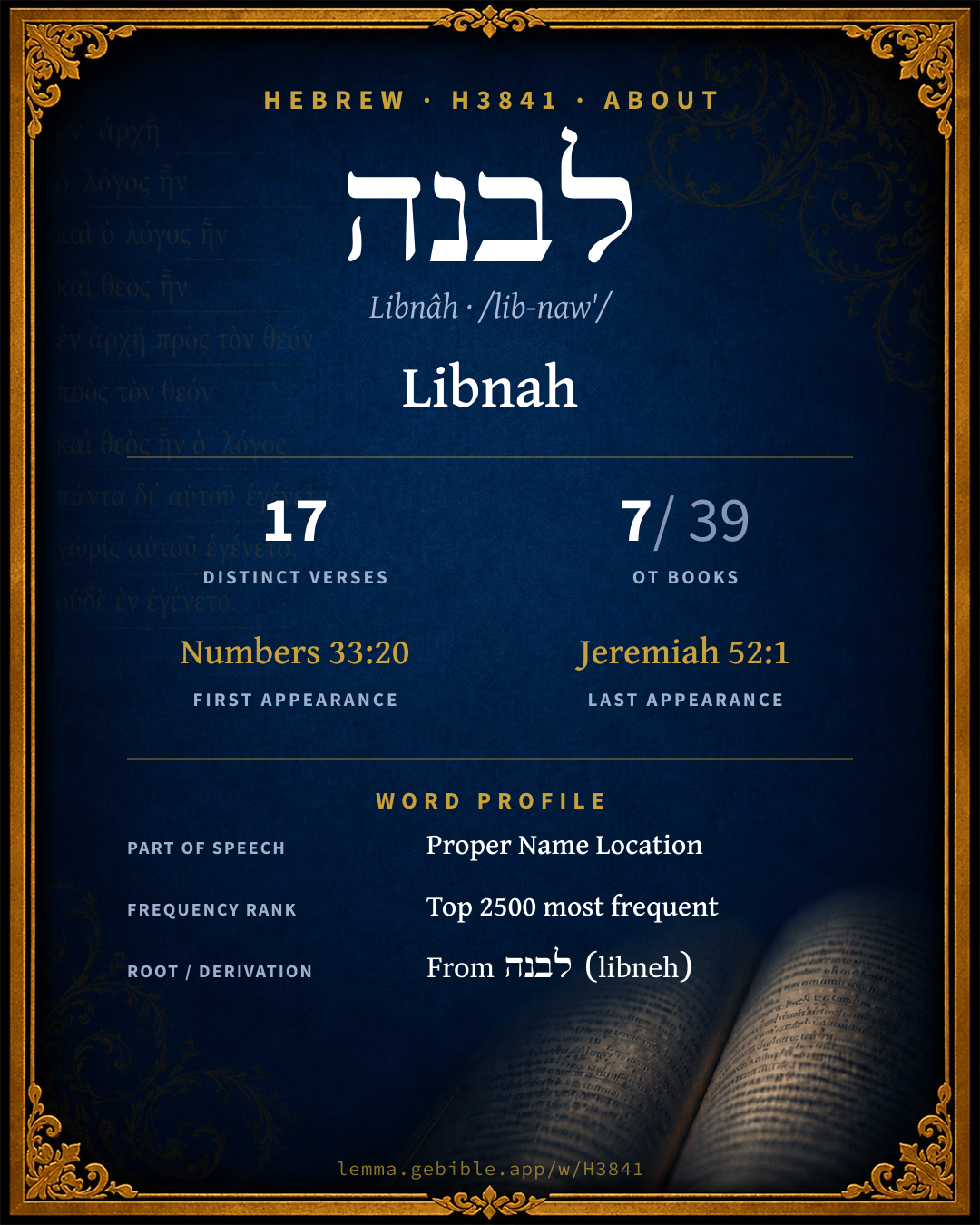
לִבְנָה
Libnah
BDB lists 3 entries for ‘Libnah’ fuller range ↓
Full lexicon entry — Brown-Driver-Briggs (BDB)
From Brown-Driver-Briggs (BDB)
Where this word appears
Grammar key — what these labels mean
Part of speech
- Noun
- A naming word — a person, place, thing, or idea.
Noun type
- Proper
- A name of a specific person, place, or people (e.g. Abraham, Zion, Israel).
Every verse where H3841 appears in the Book of 1 Chronicles — 1 distinct verse. Click any verse to open its interlinear word-by-word view. Verse text shown in the World English Bible for context — . Each verse’s Hebrew form is shown with its reference; the English is not keyword-highlighted, since the data carries no word-level English alignment. Use “Compare translations” on any verse to read it across multiple English versions. This concordance covers the Hebrew Bible; Septuagint (Greek Old Testament) occurrences are not indexed here.
1 Chronicles
About this entry
At a glance — auto-summarized from this page’s data, not written by a person. Every figure links to its source below. This summary describes the numbers; it doesn’t interpret them.
“Libnah” is the headline sense of the Hebrew name לבנה (Libnâh). First canonically at Numbers 33:20, it enters the text early. It appears 17 verses across 7 books of the Hebrew Bible, among its uncommon vocabulary. More than a third of its appearances fall in Joshua. See 17-verse concordance and the renderings breakdown below.
Gloss history
Strong's 1890 vs modern scholarship
About this word
Strong's H3841 catalogs a Hebrew word from the Hebrew Old Testament.
These counts are not copied from any lexicon or concordance. They are computed here, from the morphology-tagged Hebrew Old Testament. What Lemma adds →
- 17
- distinct verses
- The word appears in 17 distinct verses.
- 7 / 39
- OT books
- The word appears in 7 of 39 Old Testament books.
- #1,612
- by frequency
- Top 2500 most frequent Hebrew words (rank 1,612 of 8,640 Hebrew words by occurrence).
View all 17 occurrences in the concordance →
By section of the Old Testament
By traditional corpus
Conventional, traditional groupings — biblical authorship is debated, so this is a traditional corpus grouping, not an authorship claim. Each share is this word’s portion of its verses in that division of the Hebrew canon. Each figure is a share of the word’s 17 distinct verses.
- Prophets (Nevi'im) 13 verses · 76%
- Torah (Pentateuch) 2 verses · 12%
- Writings (Ketuvim) 2 verses · 12%
How translations render this word
Counts come from each version’s own published word-to-Strong’s tagging or interlinear alignment — an approximate guide to how each version renders this word, not a word-level alignment the data otherwise carries. Because each total is that version’s own tagged count, the per-version totals vary from one another and need not match the appearance or distinct-verse counts above. These counts may also differ from a printed concordance because Lemma counts each distinctly tagged rendering and does not collapse phrase taggings into a single head-word total. This is a fixed set of word-tagged versions (KJV, ASV, BSB, ULT) and does not change with the reading translation you choose elsewhere. Each version’s license is shown beside its name below (and on Sources).
- King James Version: Libnah 14×, Against libnah 3×
- American Standard Version: Libnah 10×, Against libnah 3×, Did libnah 2×
- Berean Standard Bible: Libnah 15×, She was from libnah 3×
- unfoldingWord Literal Text: Libnah 17×
King James Version Public Domain
Renders H3841 across 18 tagged occurrences — most commonly:
Plus 1 rendering that appears only once — usually multi-word phrases or single function words the recovered tagging swept in, not distinct renderings.
American Standard Version Public Domain
Renders H3841 across 18 tagged occurrences — most commonly:
Plus 3 renderings that appear only once — usually multi-word phrases or single function words the recovered tagging swept in, not distinct renderings.
Berean Standard Bible Public Domain
Renders H3841 across 18 tagged occurrences — most commonly:
unfoldingWord Literal Text CC BY-SA 4.0
Renders H3841 across 17 tagged occurrences — most commonly:
Senses in the full BDB
What do BDB’s symbols mean?
BDB uses these scholarly abbreviations:
| Symbol | Meaning |
|---|---|
| 𝔊 | the Septuagint (the ancient Greek translation, LXX) |
| 𝔙 | the Vulgate (the Latin translation) |
| 𝔖 | the Syriac version (the Peshitta) |
| 𝔗 | the Targum (the Aramaic translation) |
| ψ | the Psalms |
| √ | root (the underlying root or stem) |
| ‖ | parallel passage (a synonymous or contrasted parallel) |
| † | the dagger: every passage where the word occurs is cited |
The 2 senses and sub-senses the full Brown-Driver-Briggs lexicon distinguishes for this word, in lexicon order (not ranked by frequency), with BDB’s own verbatim wording and sub-sense lettering. Shown in Hebrew script with BDB’s own scholarly abbreviations. The condensed entry is in the Lexicon Entry tab. See also the Forms in the corpus table below.
- 1. city in SW. Judah, exact site unknown, captured by Joshua, according to D, Jos 10:29(×2), 31, 32, 39; 12:15 (all D), 15:42 (P); Levit. city 21:13 (P) = 1 Ch 6:42; further 2 K 8:22 = 2 Ch 21:10, 2 K 19:8 = Is 37:8, 2 K 23:31; 24:18 = Je 52:1; 𝔊 Λεβνα. Vid. LagOnom. 247, 135, 26; 2nd ed. 273 Λεβνα; BuhlGeogr. 193. e.g. Joshua 10:29
- 2. station of Isr. in wilderness, between רִמֹּן פָּ֑רֶץ and רִסָּה Nu 33:20, 21 (perhaps = לָבֶן Dt 1:1); 𝔊 Λεμωνα, A 𝔊L Λεβωνα. e.g. Numbers 33:20
Senses from the full Brown-Driver-Briggs lexicon (Brown, Driver, Briggs; Oxford 1906 — public domain), digitized via Sefaria, supplemented by the OpenScriptures HebrewLexicon (CC BY 4.0). Full attribution on Sources.
Word origin
Derived from לבנה (libneh) (H3839) — poplar.
Jastrow Dictionary
A second Hebrew/Aramaic lexicon for comparison, covering Aramaic and post-biblical (Talmudic, Targumic, Midrashic) usage that the biblical-Hebrew BDB does not. Matched by lemma rather than by Strong’s number, so a lemma may carry more than one Jastrow headword (shown separately below), and the entries cover usage well beyond the Bible.
בני
- [to combine,] to build. Sabb. XII, 1 הַבּוֹנֶה he who builds (on the Sabbath). Ib.] 102ᵇ משום בונה (isguilty) because it is one of the labors classified under ‘building’; a. fr.—Metaph. to educate, train. Ber. 64ᵃ (ref. to Is. LIV, 93) א"ת בָּנַיִךְ אלא בוֹנַיִּךְ read not banayikh (thy children), but bonayikh (thy builders, trainers); v. בַּנָּאִים.—Ex. R. s. 23 (play on b’noth, Cant. I, 5) בּוֹנוֹת וכ׳ the authorities directing the building of Jerusalem; v. Pi.—Ḥull. 78ᵇ זה בנה אב, v. אָב, a. בִּנְיָן. [Tosef. Par. VII (VI), 4 בְּנָאוֹ ed. Zuck., v. כָּנַן.] e.g. Isaiah 54:93
- 1. to be built up. Y. B. Bath. III, 14ᵇ, a. fr. לְהִיבָּנוֹת, לִיבָּנוֹת.
- 2. (denom. of בֵּן) to get children. Gen. R. s. 71.
- (denom. of בֵּן) to be adopted, naturalized. Pesik. R. s. 43 נִתְבַּנּוּ בישראל they became full Israelitish citizens.
- to lay out, plan a city, determine its limits. Ex. R. l. c. the Great Sanedrin held sessions ומְבַנָּים אותה (not אותם) and determined the limits of Jerusalem; v. Snh. I, 5.—Part. Pu. מְבוּנֶּה cultivated; built (of human stature), well-proportioned. Keth. 112ᵃ; Sot. 34ᵇ היתה מְבוּנָּה על וכ׳ it (Hebron, in spite of the rocky nature of its soil) was seven times better cultivated than Zoan (one measure of its land yielding as much as did seven measures of the soil of Zoan). Ib. 42ᵇ (play on benayim, I Sam. XVII, 4) מב׳ מכל מום his build was without blemish. e.g. 1 Samuel 17:4
לְבֵנָה
- לבן to stamp, tread, cmp. לבד; v. Schr. KAT2, p. 121 note) brick. Lev. R. s. 23 (ref. to Ex. XXIV, 10, cmp. Targ. Y. ib.) זה עד שלא נגאלו אבל משנגאלו היכן היתה דרכה של ל׳ להנתן וכ׳ this (brick of sapphire under his feet) was before they (the Israelites) were redeemed, but after their redemption the brick was placed where it belonged. Kel. IX, 6 ל׳ שבלעה וכ׳ a brick in which a metal ring has entirely disappeared; Tosef. Mikv. VI (VII), 12 טבעת שנתונה בל׳ וכ׳ a ring which was stuck into a brick of soft clay. Ab. Zar. 46ᵃ שזקף ל׳, v. זָקַף; a. fr.—Pl. לְבֵנִים, לְבֵי׳, Ex. R. s. 5. Pirké d’R. El. ch. XLVIII בין לובן הל׳ between the layers of bricks. B. Bath. I, 1; a. fr.—Trnsf. l’benah, the larger portion of a line filled out with writing; [Rashi: the blank], v. אָרִיחַ. e.g. Exodus 24:10
לִבְנָה
- , v. עַרְקת
לְבָנָה
- (b. h.)
- 1. fem. of לָבָן q. v.
- 2. moon. Ber. 59ᵇ. Erub. 56ᵃ והוא דאתיליד ל׳ או בל׳ וכ׳ provided the new moon sets in either at the moon-hour (the second hour of the night of the first day of the week and every eighth hour suceeding) or under the planet Tsedek (Jupiter). Pesik. R. s. 15, a. fr. מונים לל׳, v. מָנָה II. Ib. מולד הל׳, v. מוֹלָד. Gen. R. s. 33, end ימות הל׳, v. יוֹם; a. fr.
A Dictionary of the Targumim, the Talmud Babli and Yerushalmi, and the Midrashic Literature (Marcus Jastrow; London, Luzac, 1903) — Public Domain. Digitized via Sefaria. Digitized via Sefaria. Full attribution on Sources.
Forms in the corpus
The 12 distinct written forms H3841 takes in the Hebrew Bible, most frequent first — each parse links to that state’s occurrences in the concordance. Hebrew forms include their vowel points and cantillation, so a single lemma takes many written forms.
| Form | Parsing | Example | Uses |
|---|---|---|---|
| לִבְנָ֑ה | Noun, Proper | 2 Kings 19:8 | 3 |
| לִבְנָ֖ה | Noun, Proper | 1 Chronicles 6:57 | 3 |
| מִ/לִּבְנָֽה | Noun, Proper | 2 Kings 23:31 | 3 |
| בְּ/לִבְנָֽה | Noun, Proper | Numbers 33:20 | 1 |
| לְ/לִבְנָ֖ה | Noun, Proper | Joshua 10:39 | 1 |
| לְ/לִבְנָֽה | Noun, Proper | Joshua 10:32 | 1 |
| לִבְנָ֛ה | Noun, Proper | 2 Chronicles 21:10 | 1 |
| לִבְנָ֥ה | Noun, Proper | Joshua 15:42 | 1 |
| לִבְנָֽה | Noun, Proper | Joshua 10:29 | 1 |
| לִבְנָה֙ | Noun, Proper | Joshua 12:15 | 1 |
| מִ/לִּבְנָ֑ה | Noun, Proper | Numbers 33:21 | 1 |
| מִ/לִּבְנָ֖ה | Noun, Proper | Joshua 10:31 | 1 |
Bible dictionary
Public-domain dictionary articles matched to this entry by name (Libnah). A biblical name can be shared by more than one person or place, so an article may treat several.
Easton's Bible Dictionary · M. G. Easton, 1897
Transparency; whiteness. (1.) One of the stations of the Israelites in the wilderness (Num. 33:20, 21).
(2.) One of the royal cities of the Canaanites taken by Joshua (Josh. 10:29-32; 12:15). It became one of the Levitical towns in the tribe of Judah (21:13), and was strongly fortified. Sennacherib laid siege to it (2 Kings 19:8; Isa. 37:8). It was the native place of Hamutal, the queen of Josiah (2 Kings 23:31). It stood near Lachish, and has been identified with the modern Arak el-Menshiyeh.
Smith's Bible Dictionary · William Smith, 1863
(whiteness).
+ A royal city of the Canaanites which lay in the southwest part of the Holy Land, taken by Joshua immediately after the rout of Beth-horon. It was near Lachish, west of Makkedah. It was appropriated with its "suburbs" to the priests. (Joshua 21:13; 1 Chronicles 6:57) In the reign of Jehoram the son of Jehoshaphat it "revolted" form Judah at the same time with Edom. (2 Kings 8:22; 2 Chronicles 21:10) Probably the modern Ayak el-Menshiyeh . + One of the stations at which the Israelites encamped on their journey between the wilderness of Sinai and Kadesh. (Numbers 33:20,21)
Hitchcock's Bible Names Dictionary · Roswell D. Hitchcock, 1869
white; whiteness
Classic public-domain reference works; full attribution on Sources.
Septuagint verse parallels
This word appears in 17 verses that also exist in the Greek Old Testament (Septuagint), out of the 17 Hebrew verses it occurs in. You can read those verses in Greek by switching the Old Testament edition to the Septuagint.
Read these verses in the Septuagint
- Numbers 33:20
- Joshua 10:29
- 2 Kings 8:22
- 1 Chronicles 6:57
- 2 Chronicles 21:10
- Isaiah 37:8
- Jeremiah 52:1
This is a verse-level parallel only — the same verses exist in both the Hebrew and Greek Old Testaments. No word-level Hebrew↔Greek correspondence is claimed: the data carries no such alignment, so no Greek word is shown as this Hebrew word’s translation. Coverage is not total — the Septuagint omits the deuterocanon and renumbers the Psalms, so some Hebrew verses have no direct Greek parallel.