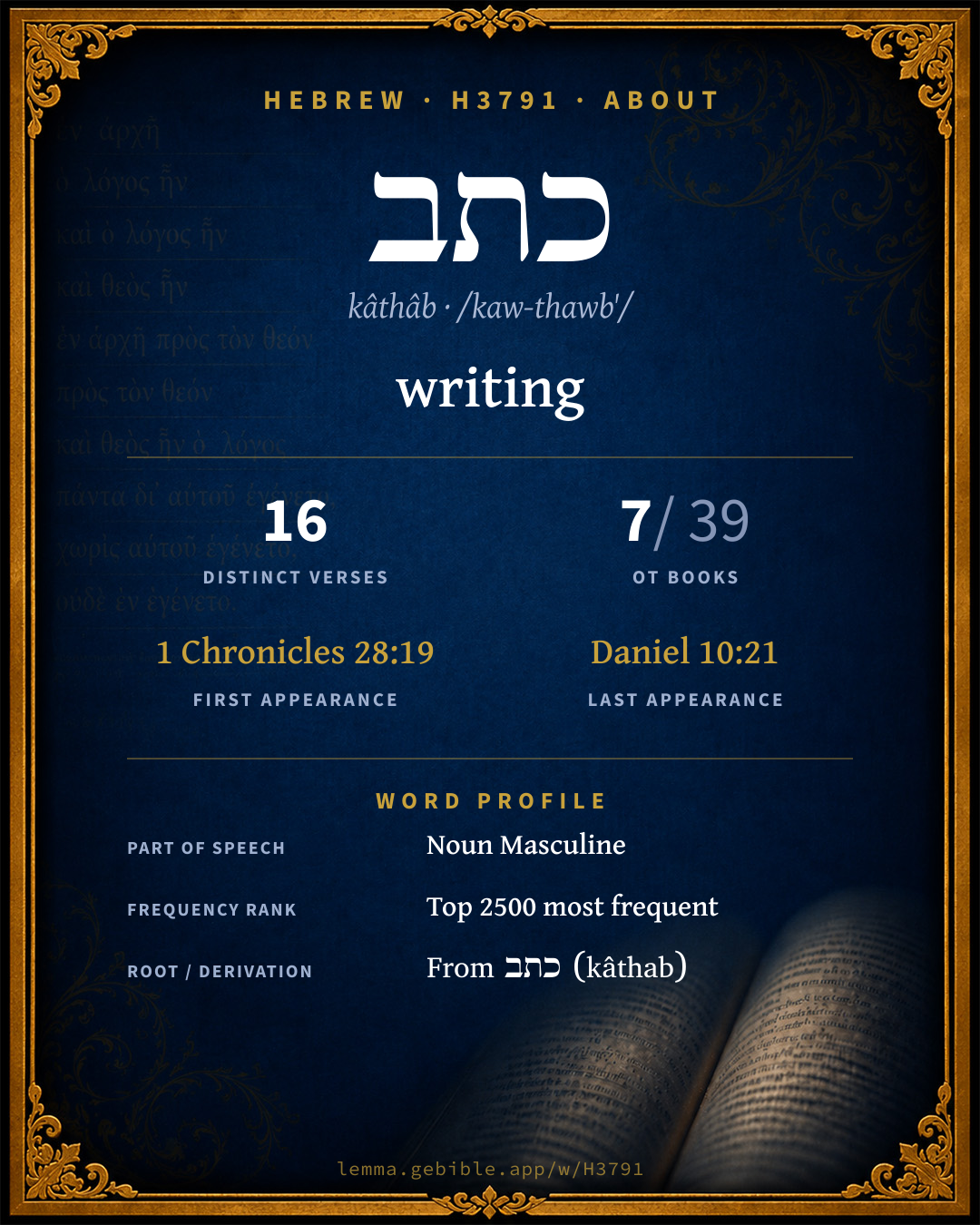
כְּתָב
writing
also: document, edict fuller range ↓
Full lexicon entry — Brown-Driver-Briggs (BDB)
From Brown-Driver-Briggs (BDB)
Where this word appears
Grammar key — what these labels mean
Part of speech
- Noun
- A naming word — a person, place, thing, or idea.
Noun type
- Common
- A common noun — a general class of person, place, or thing (“king,” “city,” “water”), not a specific name.
State
- Construct
- A noun bound to a following noun in a possessive / “of” relationship (the construct chain).
- Absolute
- The independent form of a noun, not bound to a following word.
Gender
- Masculine
- Grammatically masculine.
Number
- Singular
- One.
Every verse where H3791 appears in the Book of 1 Chronicles — 1 distinct verse. Click any verse to open its interlinear word-by-word view. Verse text shown in the World English Bible for context — . Each verse’s Hebrew form is shown with its reference; the English is not keyword-highlighted, since the data carries no word-level English alignment. Use “Compare translations” on any verse to read it across multiple English versions. This concordance covers the Hebrew Bible; Septuagint (Greek Old Testament) occurrences are not indexed here.
1 Chronicles
About this entry
At a glance — auto-summarized from this page’s data, not written by a person. Every figure links to its source below. This summary describes the numbers; it doesn’t interpret them.
כתב (kâthâb) is a Hebrew noun most often rendered “writing.” It clusters heavily in Esther, which alone accounts for 50% of its uses. With 16 verses in 7 books, it is an uncommon word in the Hebrew Bible. It first appears in 1 Chronicles 28:19. Beyond its headline sense, its full sense range takes in “document” and “edict”. The sections below give every sense, occurrence, and version rendering.
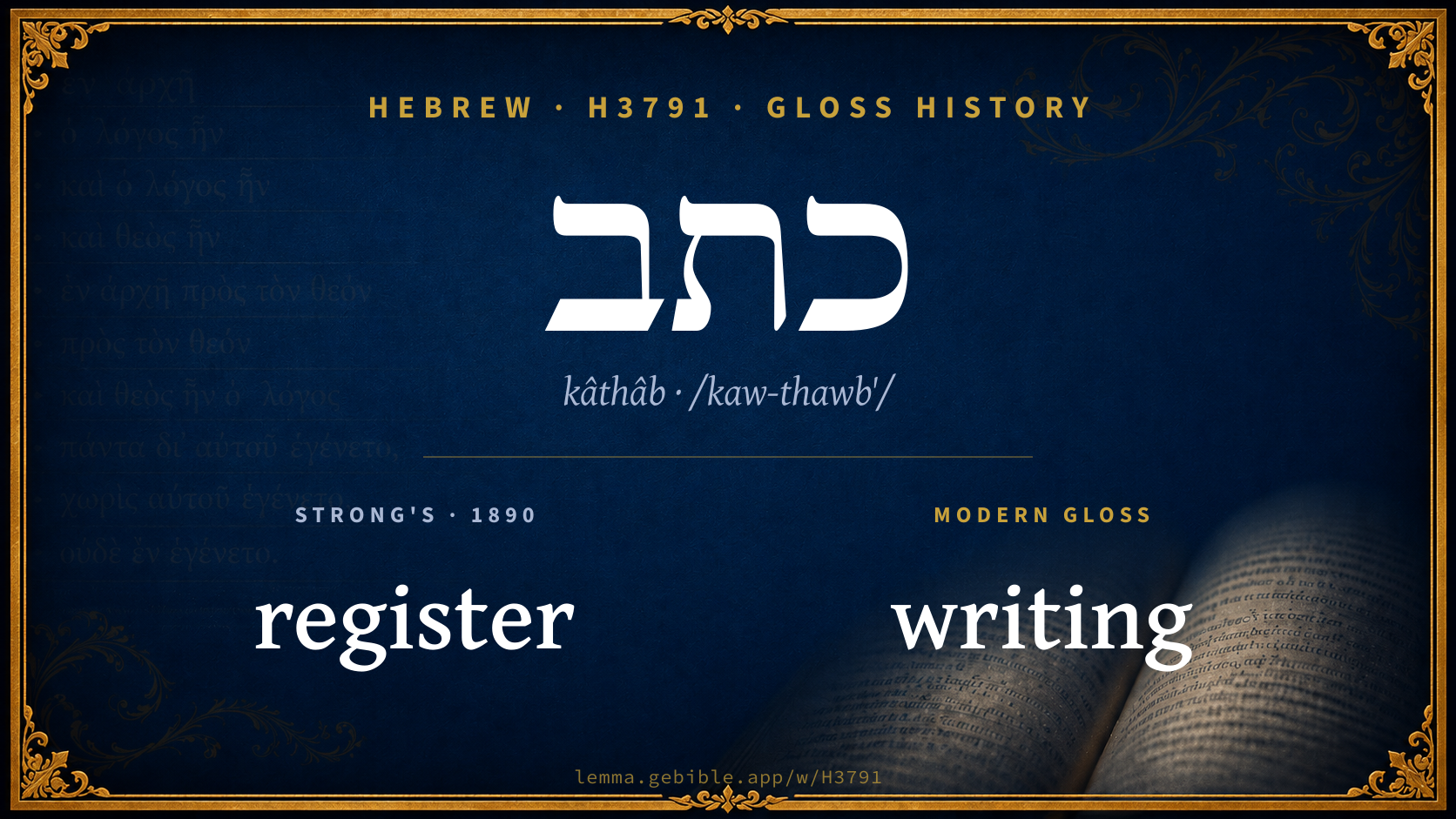
Gloss history
Strong's 1890 vs modern scholarship
About this word
Strong's H3791 catalogs a Hebrew word from the Hebrew Old Testament.
These counts are not copied from any lexicon or concordance. They are computed here, from the morphology-tagged Hebrew Old Testament. What Lemma adds →
- 16
- distinct verses
- The word appears in 16 distinct verses.
- 7 / 39
- OT books
- The word appears in 7 of 39 Old Testament books.
- #1,752
- by frequency
- Top 2500 most frequent Hebrew words (rank 1,752 of 8,640 Hebrew words by occurrence).
View all 16 occurrences in the concordance →
Most concentrated in
- Esther 8 verses 50%
- 2 Chronicles 2 verses 13%
- Ezra 2 verses 13%
By section of the Old Testament
By traditional corpus
Conventional, traditional groupings — biblical authorship is debated, so this is a traditional corpus grouping, not an authorship claim. Each share is this word’s portion of its verses in that division of the Hebrew canon. Each figure is a share of the word’s 16 distinct verses.
- Writings (Ketuvim) 15 verses · 94%
- Prophets (Nevi'im) 1 verse · 6%
How translations render this word
Counts come from each version’s own published word-to-Strong’s tagging or interlinear alignment — an approximate guide to how each version renders this word, not a word-level alignment the data otherwise carries. Because each total is that version’s own tagged count, the per-version totals vary from one another and need not match the appearance or distinct-verse counts above. These counts may also differ from a printed concordance because Lemma counts each distinctly tagged rendering and does not collapse phrase taggings into a single head-word total. This is a fixed set of word-tagged versions (KJV, ASV, BSB, ULT) and does not change with the reading translation you choose elsewhere. Each version’s license is shown beside its name below (and on Sources).
- King James Version: Writing 8×, According to the writing 4×, According to their writing 2×
- American Standard Version: Writing 8×, According to the writing 5×, Register 2×
- Berean Standard Bible: Family records 2×, Own script 2×, Text 2×
- unfoldingWord Literal Text: Writing 4×, Record 3×, According to its writing 2×
King James Version Public Domain
Renders H3791 across 17 tagged occurrences — most commonly:
Plus 1 rendering that appears only once — usually multi-word phrases or single function words the recovered tagging swept in, not distinct renderings.
American Standard Version Public Domain
Renders H3791 across 17 tagged occurrences — most commonly:
Plus 2 renderings that appear only once — usually multi-word phrases or single function words the recovered tagging swept in, not distinct renderings.
Berean Standard Bible Public Domain
Renders H3791 across 15 tagged occurrences — most commonly:
Plus 9 renderings that appear only once — usually multi-word phrases or single function words the recovered tagging swept in, not distinct renderings. Not rendered by a distinct English word in 2 further occurrences.
unfoldingWord Literal Text CC BY-SA 4.0
Renders H3791 across 16 tagged occurrences — most commonly:
Plus 5 renderings that appear only once — usually multi-word phrases or single function words the recovered tagging swept in, not distinct renderings.
Senses in the full BDB
What do BDB’s symbols mean?
BDB uses these scholarly abbreviations:
| Symbol | Meaning |
|---|---|
| 𝔊 | the Septuagint (the ancient Greek translation, LXX) |
| 𝔙 | the Vulgate (the Latin translation) |
| 𝔖 | the Syriac version (the Peshitta) |
| 𝔗 | the Targum (the Aramaic translation) |
| ψ | the Psalms |
| √ | root (the underlying root or stem) |
| ‖ | parallel passage (a synonymous or contrasted parallel) |
| † | the dagger: every passage where the word occurs is cited |
The 5 senses and sub-senses the full Brown-Driver-Briggs lexicon distinguishes for this word, in lexicon order (not ranked by frequency), with BDB’s own verbatim wording and sub-sense lettering. Shown in Hebrew script with BDB’s own scholarly abbreviations. The condensed entry is in the Lexicon Entry tab. See also the Forms in the corpus table below.
- 1. register, enrolment, Ez 13:9 Ezr 2:62 = Ne 7:64. e.g. Ezekiel 13:9
- 2. = mode of writing, character, letter, וּכ׳ הַנִּשְׁתְּוָן כָּתוּב אֲרָמִית Ezr 4:7 and the writing of the document was written in Aramaic (characters; so prob., v. Be-Ry Ryle, cf. NH Hoffm ZAW i. (1881), 334 ff.); cf. Est 1:22; 3:12; 8:9(×2). e.g. Ezra 4:7
- 3. = letter, 2 Ch 2:10 Est 9:27. e.g. 2 Chronicles 2:10
- 4. of a royal enactment, edict 2 Ch 35:4 (‖ מִכְתָּב), Est 3:14; 8:8, 13; more fully כְּתָב־הַדָּת 4:8. e.g. 2 Chronicles 35:4
- 5. of a writing with divine authority 1 Ch 28:19; כ׳ אֱמֶת Dn 10:21; i.e. a book of truth. e.g. 1 Chronicles 28:19
Senses from the full Brown-Driver-Briggs lexicon (Brown, Driver, Briggs; Oxford 1906 — public domain), digitized via Sefaria, supplemented by the OpenScriptures HebrewLexicon (CC BY 4.0). Full attribution on Sources.
Word origin
n.m. Ezr 4:7 writing (late Aramaic; Biblical Aramaic כְּתָב, Syriac ܟܬܳܒ);—כ׳ abs. 1 Ch 28:19 + 4 times; cstr. Ez 13:9 + 4 times; sf. כְּתָבָהּ Est 1:22 + 2 times; כְּתָבָם Ezr 2:62 + 3 times;—writing:
— Brown-Driver-Briggs (Oxford 1906, public domain), digitized via Sefaria, supplemented by the OpenScriptures HebrewLexicon (CC BY 4.0). See Sources.
Derived from כתב (kâthab) (H3789) — to write.
Jastrow Dictionary
A second Hebrew/Aramaic lexicon for comparison, covering Aramaic and post-biblical (Talmudic, Targumic, Midrashic) usage that the biblical-Hebrew BDB does not. Matched by lemma rather than by Strong’s number, so a lemma may carry more than one Jastrow headword (shown separately below), and the entries cover usage well beyond the Bible.
כָּתַב
- H. Dict. s. v.) [to join sign to sign,] to compose, write; to promise in writing, to will, assign, consign. Gitt. 20ᵃ וכ׳ ולא חקק it says (Deut. XXIV, 1) ‘and he shall write’ but not engrave; Y. ib. II, 44ᵇ top, v. כְּתִיבָה. Macc. III, 6 (ref. to Lev. XIX, 28) עד שׁיִכְתּוֹב וכ׳ unless he writes (designs) and etches with ink, stibium or anything that marks; Sifra K’doshim, Par. 3, ch. VI, v. כְּתוֹבֶת.—Meg. 9ᵃ כִּתְבוּ לי תורת וכ׳ write (translate) for me the Law &c. Ib. 7ᵃ כִּתְבוּנִי בספר Ms. M. (ed. לדורות) write me down (record my deeds) in a book (Book of Esther). Ex. R. s. 47, beg. כְּתוֹב אתה write thou thyself. Sabb. XII, 3 הכּוֹתֵב וכ׳ he who writes two letters (on the Sabbath). Ib. 5 נתכוין לִכְתּוֹב ח"ית if he intended to write a Ḥeth.—Keth. IX, 1 הכּוֹתֵב לאשתו וכ׳ he who declares to his wife &c.; ib. 83ᵃ תני ר׳ חייא האומר R. Ḥ. interpreted it, ‘he who says’ (verbally). Ib. 102ᵇ מאי כּוֹתְבִין אומרים ‘they write’ (in the Mishnah) means merely they declare. Ib. V, 1 והיא כוֹתֶבֶת וכ׳ and she may write (a receipt), I have received &c.—Pes. 50ᵇ כּוֹתְבֵי ספרים וכ׳ copyists of sacred books, or T’fillin &c. B. Bath. 14ᵇ משה כ׳ ספרו וכ׳ Moses is the author of his book, the chapter of Balaam, and the Book of Job; a. v. fr.—Part. pass. כָּתוּב, f. כְּתוּבָה; pl. כְּתוּבִים, כְּתוּבִין; כְּתוּבוֹת. Meg. 31ᵃ דבר זה כ׳ בתורה וכ׳ this is written in the Law, and repeated in the Prophets &c. Ib. 7ᵃ כבר כ׳ אני וכ׳ I am already recorded in the chronicles of &c. Y. Shek. VI, 49ᵈ bot. כיצד היו הלוחות כ׳ how was the writing on the tablets arranged?—Gitt. 54ᵇ כל ס"ת … כ׳ לשמן any scroll of the Law in which the Divine names are not written with full consciousness, v. שֵׁם; a. fr.—V. כָּתוּב. e.g. Deuteronomy 24:1
- to be written, be reduced to writing; to be written upon. Meg. I, 8 הספרים נִכְתָּבִים בכל לשון the Biblical books may be written in (translated into) any language (v. ib. 9ᵃ); ib. לא התירו שׁיִכָּתְבוּ וכ׳ they permitted them to be translated only into Greek. Ib. 7ᵃ נאמרה לִיכָּתֵב was indited (by the divine spirit) for the purpose of being written (as a book); Yoma 29ᵃ נתנה ליכתב (some ed. לִכְתּוֹב); a. v. fr.
- 1. to cause to be written or recorded, to dictate, indite. Gen. R. s. 22 כבר הִכְתַּבְתִּי לך וכ׳ I have already ordered to be written in the Law &c. Ruth R. to II, 14 אילו היה ראובן יודע שהק"בה מַכְתִּיב עליו וכ׳ if R. had known that the Lord would cause to be written about him (Gen. XXXVII, 21) &c.; a. fr.—Lev. R. s. 24 ג׳ פרשיות ה׳ לנו וכ׳ (Pesik. R. s. 15; Yalk. Ex. 307 כתכ) there are three sections that Moses indited for us in the Law. e.g. Genesis 37:21
- 2. to consign, enlist in the army, levy. Ex. R. s. 15 (מלך) ב"וד מַכְתִּיב לו וכ׳ a human king levies soldiers for himself, strong &c.; Tanḥ. Ḥayé 3 מסביב (corr. acc.). Cant. R. to II, 8, a. e. מַכְתֶּבֶת, v. טִירוֹנְיָא.—Part. pass. מוּכְתָּב recorded; levied. Kidd. IV, 5, v. אִסְטְרַטְיָא II.—Tosef. B. Bath. IV, 7; B. Bath. 92ᵇ; Keth. 58ᵃ מ׳ למלכות levied for royal service (comment.: sentenced to death); Kidd. 11ᵃ נִכְתָּב.—Gen. R. s. 89 (Yalk. ib. 147 כתיב), v. סַקְרָרִין.
כְּתַב I
- Targ. Deut. VI, 9 (v. Berl. Targ. O. II, p. 51). Ib. XXXI, 24. Targ. Josh. XVIII, 4; a. v. fr.—Part. pass. (כְּתוּב) כְּתִיב. Targ. Ex. XXXI, 18. Targ. O. Num. XI, 26 (Y. כתוביא); a. fr.—B. Kam. 88ᵃ bot. כְּתַבְתִּינְהוּ לניכסי וכ׳ she willed her property to &c. Gitt. 20ᵃ איהי קא כָתְבָה ליה she (the wife) had it written (at her expense). B. Bath. 168ᵇ ולִיכְתּוֹב לן מר וכ׳ write for us another document (copy) in addition to this; a. v. fr.—Sabb. 115ᵇ היכא דכְתִיבֵי תרגום וכ׳ when the books are written in Chaldaic or any other tongue (than Hebrew); a. fr.—Esp. (in arguments on Biblical texts) כ׳ or כ׳ רחמנא the Lord has written, the text reads. Pes. 21ᵇ טעמא דכ׳רחמנא וכ׳ this is so because the text reads לא יֵאָכֵל (passive voice), but if it did not read so &c. Ib. לִכְתּוֹב רחמנא וכ׳ it ought to read &c. Ber. 3ᵇ א"ה לכתוב מהנשף וכ׳ if this were so (that נשף invariably means evening), it ought to read (I Sam. XXX, 17) מהנשף ועד הנשף; a. v. fr.—כְּתִיב it is written, it reads (used also in Hebr. diction). Ib. 13ᵇ דִּכְ׳ לדבר בם for it says (Deut. XI, 19) ‘to speak thereof’; ה"נ הא כ׳ ודברת בם here, too, (in the first part of the Sh’ma) it says (VI, 7), ‘and thou shalt speak thereof’!—Meg. 10ᵇ כ׳ הכא ויהי … וכ׳ התם ויהי here (Lev. IX, 1) vayhi is used, and there (Gen. I, 5) vayhi is used. Ib. והָכְ׳, והא כ׳ but does it not also read &c.?—Gen. R. s. 1 ומאי כ׳ אחריו and what do we read after this?—הדא הוא דכ׳, v. דָּא I.—Snh. 71ᵃ, a. e. בעינן קרא כְּדִכְ׳ we must construe the Biblical text as it is written (literally, e.g. Mish. ib. VIII, 4 as an interpretation of Deut. XXI, 19); a. v. fr.—B. Kam. 66ᵃ שינוי קונה כְּתִיבָה ותנינא כ׳ that a change of form of a stolen object gives possession (compelling the thief to restore in value) is written (intimated in the Biblical text) and has been taught in the Mishnah.—V. כְּתִיב. e.g. 1 Samuel 30:17
- to be written, recorded &c. Targ. Esth. I, 19. Targ. Ps. XL, 8. Ib. LXXXVII, 6 דמִכָּתְבִין Ms. (ed. דמְכַתְּבִין Pa.); a. fr.—Meg. 7ᵃ דאיבעי איכתיב וכ׳ (Ms. M. מאי דבעי כתיב, v. Rabb. D. S. a. l. note; Rashi: דאי בעי כתב) that which was liked was written down &c.; a. fr.
כְּתָב
- preced.) writing, writ; character. Ab. V, 6; Pes. 54ᵃ; Sifré Deut. 355 (of things created in the last hour of the sixth day) הכתב והמִכְתָּב the art of writing and the writing on the tablets (Ex. XXXII, 16; Rashi to Pes. l. c. והמְכַתֵּב and the pencil); Mekh. B’shall., Vayassa, s. 5 only כתב. Ab. Zar. 10ᵃ אין להם לא כ׳ ולא לשון they (the Romans) have neither (original) types nor language; Gitt. 80ᵃ (of פרסיים!). Y. Meg. I, 71ᵇ bot., v. אַשּׁוּרִי. Snh. 21ᵇ; Meg. 8ᵇ כ׳ עברי(ת), v. לִיבּוֹנָאָה. [Ib. עד שיכתבנו בכתב אשורית, strike out בכתב, v. Rabb. D. S. a. l., a. Meg. 9ᵃ.]—תורה שֶׁבִּכְּ׳ written Law, opp. שבעל פה. Yoma 28ᵇ; a. fr.—Meg. 18ᵇ שלא מן הכ׳ without a written copy, from memory.—Pes. 21ᵇ, a. e. דברים כִּכְתָבָן וכ׳ וכ׳ construe the Biblical words as they are written (Deut. XIV, 21), to the resident stranger give it as a present, to the foreigner sell it.—כְּתַב יד signature. Keth. II, 3 sq.; a. fr.—Tosef. B. Kam. VII, 4 כ׳ היכר יד שלו.—Gen. R. s. 48 בכל מקום … הכ׳ רבה על הנקודה אתה דורש את הכ׳ וכ׳ wherever you find in the Biblical text the plain writing, i.e. the number of undotted letters in a word, prevailing over the number of the dotted, you must interpret the undotted (ignoring the dotted); where the dotted prevail, you must interpret the dotted, e.g. א̇לי̇ו̇ (Gen. XVIII, 9) read אַיּוֹ, where is he (Abraham)?; ib. s. 78; Cant. R. to VII, 5.—Tosef. Meg. IV (III), 41 (ref. to II Kings X, 27 מחראות) קורין אותו ככְתָבוֹ we read it as it is written (not as emended in the K’ri); a. fr.—Pl. כְּתָבִים, כְּתָבִין. Tanḥ. Masé 1; Num. R. s. 23, beg. כ׳ רעים מן המלכות government papers containing orders of hard measures against the Jews. Esth. R. introd. כְּתָבָיו של מלך royal decrees. Ex. R. s. 20 עד שילמוד בני כ׳ (some ed. כתובין) until my son shall have studied documents; a. e. e.g. Exodus 32:16
כְּתַב II
- Targ. Y. Lev. XIX, 28 (h. text כְּתֹבֶת).—Targ. Y. Gen. XLVIII, 9 (marriage contract, v. כְּתוּבָּה). Targ. Ex. XXXII, 16 (h. text מכתב); a. fr.—Lev. R. s. 28, end מה דאמר כְּתַבְכוֹן what your sacred writ says.—Pl. (כָּתְבִין) כְּתָבִין, כִּתְבִין, כִּתְבֵי. Targ. II Esth. IV, 12. Ib. VII, 10; a. e.—Gen. R. s. 10; Lev. R. s. 22 כ׳ בישין וכ׳ evil decrees against the Jews of Caesarea (v. preced.); Tanḥ. Ḥuck. 1.
תַּב
- to give, v. יְתֵב II.
A Dictionary of the Targumim, the Talmud Babli and Yerushalmi, and the Midrashic Literature (Marcus Jastrow; London, Luzac, 1903) — Public Domain. Digitized via Sefaria. Digitized via Sefaria. Full attribution on Sources.
Forms in the corpus
The 12 distinct written forms H3791 takes in the Hebrew Bible, most frequent first — each parse links to that state’s occurrences in the concordance. Hebrew forms include their vowel points and cantillation, so a single lemma takes many written forms.
| Form | Parsing | Example | Uses |
|---|---|---|---|
| כִּ/כְתָבָ֔/הּ | Noun, Common, Masculine, Singular, Construct | Esther 1:22 | 3 |
| הַ/כְּתָ֗ב | Noun, Common, Masculine, Singular, Absolute | Esther 3:14 | 2 |
| כְתָבָ֛/ם | Noun, Common, Masculine, Singular, Construct | Ezra 2:62 | 2 |
| בִּ/כְתָ֔ב | Noun, Common, Masculine, Singular, Absolute | 2 Chronicles 2:11 | 1 |
| בִּ/כְתָ֖ב | Noun, Common, Masculine, Singular, Construct | Daniel 10:21 | 1 |
| בִּ/כְתָ֗ב | Noun, Common, Masculine, Singular, Construct | 2 Chronicles 35:4 | 1 |
| בִּ/כְתָ֛ב | Noun, Common, Masculine, Singular, Absolute | 1 Chronicles 28:19 | 1 |
| וּ/בִ/כְתָ֤ב | Noun, Common, Masculine, Singular, Construct | Ezekiel 13:9 | 1 |
| וּ/כְתָב֙ | Noun, Common, Masculine, Singular, Construct | Ezra 4:7 | 1 |
| כְתָ֞ב | Noun, Common, Masculine, Singular, Absolute | Esther 8:8 | 1 |
| כְּתָֽב | Noun, Common, Masculine, Singular, Construct | Esther 4:8 | 1 |
| כִּ/כְתָבָ֖/ם | Noun, Common, Masculine, Singular, Construct | Esther 9:27 | 1 |
Same root — word family
Other BDB entries built from the same root as H3791, grouped by Strong’s listed origin. These share a root / origin per the lexicon — not necessarily a shared meaning. Each links to that word’s own entry.
Derives from
Shares the same root
Derived from this word
Compare all same-root words → Showing 4 of 6 — not the complete family. They share a root, not necessarily a meaning.
Septuagint verse parallels
This word appears in 15 verses that also exist in the Greek Old Testament (Septuagint), out of the 16 Hebrew verses it occurs in. You can read those verses in Greek by switching the Old Testament edition to the Septuagint.
Read these verses in the Septuagint
This is a verse-level parallel only — the same verses exist in both the Hebrew and Greek Old Testaments. No word-level Hebrew↔Greek correspondence is claimed: the data carries no such alignment, so no Greek word is shown as this Hebrew word’s translation. Coverage is not total — the Septuagint omits the deuterocanon and renumbers the Psalms, so some Hebrew verses have no direct Greek parallel.