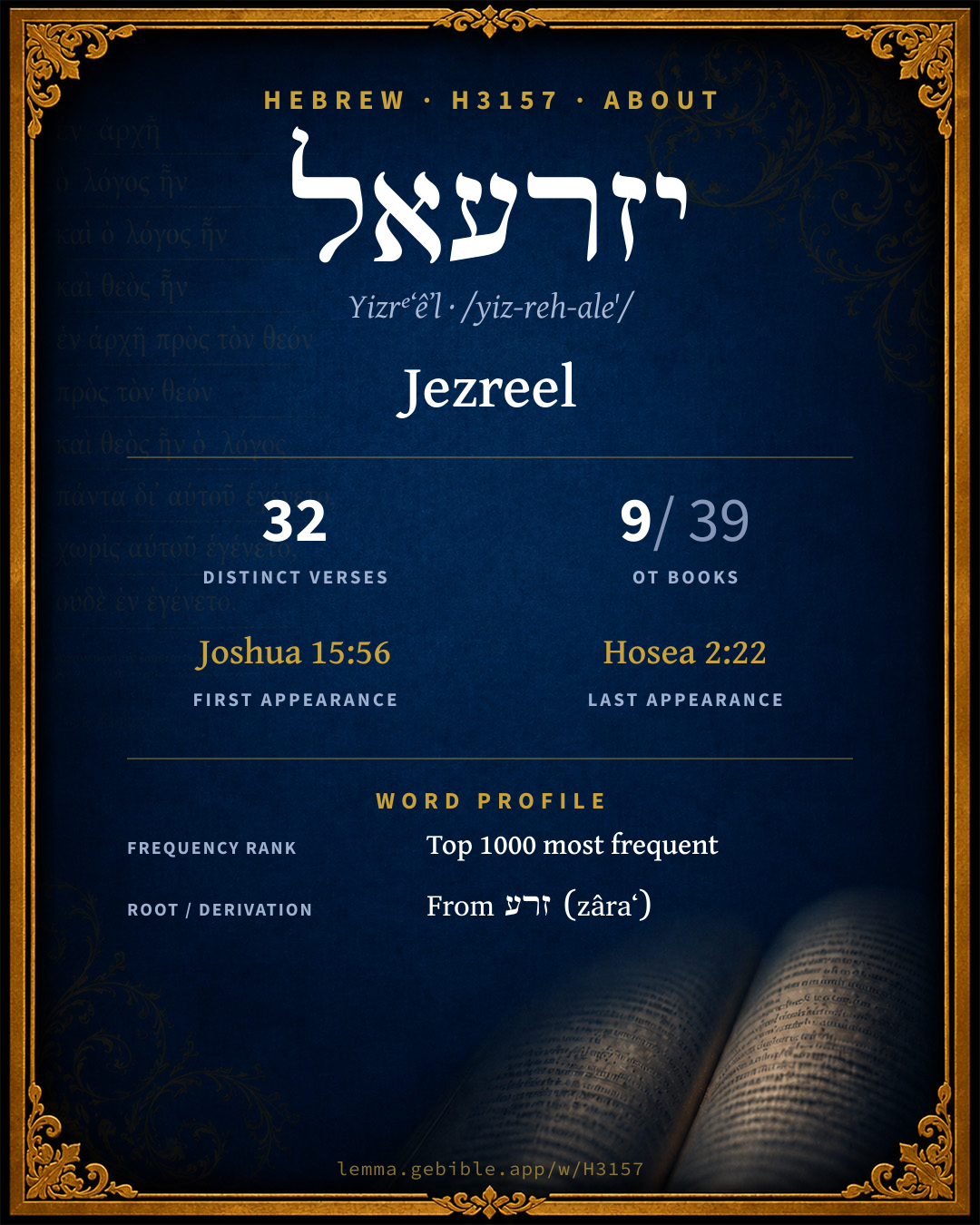
יִזְרְעֶאל
Jezreel
BDB lists 5 entries for ‘Jezreel’ fuller range ↓
Full lexicon entry — Brown-Driver-Briggs (BDB)
From Brown-Driver-Briggs (BDB)
Where this word appears
Grammar key — what these labels mean
Part of speech
- Noun
- A naming word — a person, place, thing, or idea.
Noun type
- Proper
- A name of a specific person, place, or people (e.g. Abraham, Zion, Israel).
Every verse where H3157 appears in the Book of 2 Chronicles — 1 distinct verse. Click any verse to open its interlinear word-by-word view. Verse text shown in the World English Bible for context — . Each verse’s Hebrew form is shown with its reference; the English is not keyword-highlighted, since the data carries no word-level English alignment. Use “Compare translations” on any verse to read it across multiple English versions. This concordance covers the Hebrew Bible; Septuagint (Greek Old Testament) occurrences are not indexed here.
2 Chronicles
About this entry
At a glance — auto-summarized from this page’s data, not written by a person. Every figure links to its source below. This summary describes the numbers; it doesn’t interpret them.
יזרעאל — transliterated Yizrᵉʻêʼl — is a Hebrew name carrying the sense “Jezreel.” Debuting at Joshua 15:56, it then recurs through the corpus. Spanning 32 verses in 9 books, it ranks among the moderately common words of the Hebrew Bible. Its uses concentrate in 2 Kings (38% of all occurrences). See 32-verse concordance and the renderings breakdown below.
Gloss history
Strong's 1890 vs modern scholarship
About this word
Strong's H3157 catalogs a Hebrew word from the Hebrew Old Testament.
These counts are not copied from any lexicon or concordance. They are computed here, from the morphology-tagged Hebrew Old Testament. What Lemma adds →
- 32
- distinct verses
- The word appears in 32 distinct verses.
- 9 / 39
- OT books
- The word appears in 9 of 39 Old Testament books.
- #990
- by frequency
- Top 1000 most frequent Hebrew words (rank 990 of 8,640 Hebrew words by occurrence).
View all 32 occurrences in the concordance →
By section of the Old Testament
By traditional corpus
Conventional, traditional groupings — biblical authorship is debated, so this is a traditional corpus grouping, not an authorship claim. Each share is this word’s portion of its verses in that division of the Hebrew canon. Each figure is a share of the word’s 32 distinct verses.
- Prophets (Nevi'im) 30 verses · 94%
- Writings (Ketuvim) 2 verses · 6%
How translations render this word
Counts come from each version’s own published word-to-Strong’s tagging or interlinear alignment — an approximate guide to how each version renders this word, not a word-level alignment the data otherwise carries. Because each total is that version’s own tagged count, the per-version totals vary from one another and need not match the appearance or distinct-verse counts above. These counts may also differ from a printed concordance because Lemma counts each distinctly tagged rendering and does not collapse phrase taggings into a single head-word total. This is a fixed set of word-tagged versions (KJV, ASV, BSB, ULT) and does not change with the reading translation you choose elsewhere. Each version’s license is shown beside its name below (and on Sources).
- King James Version: Jezreel 31×
- American Standard Version: Jezreel 31×
- Berean Standard Bible: Jezreel 36×
- unfoldingWord Literal Text: Jezreel 34×
King James Version Public Domain
Renders H3157 across 36 tagged occurrences — most commonly:
Plus 5 renderings that appear only once — usually multi-word phrases or single function words the recovered tagging swept in, not distinct renderings.
American Standard Version Public Domain
Renders H3157 across 36 tagged occurrences — most commonly:
Plus 5 renderings that appear only once — usually multi-word phrases or single function words the recovered tagging swept in, not distinct renderings.
Berean Standard Bible Public Domain
Renders H3157 across 36 tagged occurrences — most commonly:
unfoldingWord Literal Text CC BY-SA 4.0
Renders H3157 across 36 tagged occurrences — most commonly:
Plus 2 renderings that appear only once — usually multi-word phrases or single function words the recovered tagging swept in, not distinct renderings.
Senses in the full BDB
What do BDB’s symbols mean?
BDB uses these scholarly abbreviations:
| Symbol | Meaning |
|---|---|
| 𝔊 | the Septuagint (the ancient Greek translation, LXX) |
| 𝔙 | the Vulgate (the Latin translation) |
| 𝔖 | the Syriac version (the Peshitta) |
| 𝔗 | the Targum (the Aramaic translation) |
| ψ | the Psalms |
| √ | root (the underlying root or stem) |
| ‖ | parallel passage (a synonymous or contrasted parallel) |
| † | the dagger: every passage where the word occurs is cited |
The 6 senses and sub-senses the full Brown-Driver-Briggs lexicon distinguishes for this word, in lexicon order (not ranked by frequency), with BDB’s own verbatim wording and sub-sense lettering. Shown in Hebrew script with BDB’s own scholarly abbreviations. The condensed entry is in the Lexicon Entry tab. See also the Forms in the corpus table below.
- 1. n.pr.loc. (God soweth; Sab. אלדֿרא Mordt ZMG 1879, 489; v. LagBN 131)—י׳ Jos 15:56 2 S 2:9 +; יִזְרְעֶ֑אל 1 S 25:43 Jos 17:16 +; יִזְרְעֶ֫אלָה Jos 19:18 + 6 times: e.g. Joshua 15:56
- a. city in the Negeb of Judah Jos 15:56 1 S 25:43 (home of Ahinoam, one of David’s wives), site unknown; cf. n.pr.m. 1 Ch 4:3. e.g. Joshua 15:56
- b. city in Issachar Jos 19:18 on NW. spur of Mt. Gilboa 2 S 4:4 (cf. 1 S 31:1, 8) 1 K 4:12 (cf. 1 S 31:10, 12), mod. Zerʿîn (RobBR ii. 318 ff. BdPal 244), close to scene of great battle with Philistines 1 S 29:1 (בְּעַיִן אשׁר בְיִז׳, cf. RobBR ii. 323) v 11; subject to Ishbosheth 2 S 2:9 (yet v. infr.), residence of Ahab and Jehoram of Isr. 1 K 18:45, 46; 21:1 (Naboth) 2 K 8:29(×2) = 2 Ch 22:6(×2), 2 K 9:15(×2), 16, 17, 30; 10:11 cf. דְּמֵי יִז׳ Ho 1:4, and symbolical name of Hosea’s son Ho 1:4 (cf. Che);—in 2 K 10:1 for שָׂרֵי יִז׳ read שָׂרֵי שֹׁמְרוֹן so 𝔊. Used by Hosea as representing Isr., with play on etymol., Ho 2:24 (cf. וּזְרַעְתִּיהָ לִּי בָּאָרֶץ v 25), cf. also גָּדוֹל יוֹם יִז׳ v 2. Territory immediately about the city is חֵלֶק יִז׳ 2 K 9:10, 36, 37; cf. חֵל יִז׳ 1 K 21:23 (read prob חלק, v. Th Klo after 𝔖 𝔙; the adjacent plain is עֵמֶק יִז׳ (cf. Di Jos 17:16 BdPal 229) Jos 17:16 Ju 6:33 Ho 1:5 (perh. also = יִז׳ 2 S 2:9 supr., ‖ Gilead, Ephr., Benj., etc.) e.g. Joshua 19:18
- 2. n.pr.m.
- a. Hosea’s son Ho 1:4, cf. 1 b supr. e.g. Hosea 1:4
- b. Judahite name 1 Ch 4:3, cf. 1 a supr. e.g. 1 Chronicles 4:3
Senses from the full Brown-Driver-Briggs lexicon (Brown, Driver, Briggs; Oxford 1906 — public domain), digitized via Sefaria, supplemented by the OpenScriptures HebrewLexicon (CC BY 4.0). Full attribution on Sources.
Word origin
v. sub זרע p. 283a supr.
— Brown-Driver-Briggs (Oxford 1906, public domain), digitized via Sefaria, supplemented by the OpenScriptures HebrewLexicon (CC BY 4.0). See Sources.
Derived from זרע (zâraʻ) (H2232) — to sow.
Forms in the corpus
The 21 distinct written forms H3157 takes in the Hebrew Bible, most frequent first — each parse links to that state’s occurrences in the concordance. Hebrew forms include their vowel points and cantillation, so a single lemma takes many written forms.
| Form | Parsing | Example | Uses |
|---|---|---|---|
| יִזְרְעֶֽאל | Noun, Proper | Hosea 1:5 | 7 |
| יִזְרְעֶ֑אל | Noun, Proper | Hosea 1:4 | 3 |
| יִזְרְעֶֽאלָ/ה | Noun, Proper | 1 Kings 18:45 | 3 |
| בְ/יִזְרְעֶ֗אל | Noun, Proper | 2 Chronicles 22:6 | 2 |
| בְּ/יִזְרְעֶ֖אל | Noun, Proper | 2 Chronicles 22:6 | 2 |
| בְּ/יִזְרְעֶֽאל | Noun, Proper | 1 Samuel 29:1 | 2 |
| יִזְרְעֶ֑אלָ/ה | Noun, Proper | 2 Kings 9:30 | 2 |
| יִזְרְעֶאל֙ | Noun, Proper | Hosea 1:4 | 2 |
| בִ/יְזְרְעֶ֗אל | Noun, Proper | 2 Kings 9:15 | 1 |
| בְּ/יִזְרְעֶ֑אל | Noun, Proper | 1 Kings 21:1 | 1 |
| בְּ/יִזְרְעֶ֔אל | Noun, Proper | 2 Kings 10:11 | 1 |
| בְּ/יִזְרְעֶ֗אל | Noun, Proper | 2 Kings 9:17 | 1 |
| וְ/יִזְרְעֶ֥אל | Noun, Proper | Joshua 15:56 | 1 |
| יִזְרְעֶ֔אל | Noun, Proper | 2 Kings 9:36 | 1 |
| יִזְרְעֶ֔אלָ/ה | Noun, Proper | 2 Kings 9:16 | 1 |
| יִזְרְעֶ֖אל | Noun, Proper | 2 Kings 9:10 | 1 |
| יִזְרְעֶ֥אל | Noun, Proper | 1 Chronicles 4:3 | 1 |
| יִזְרְעֶ֥אלָ/ה | Noun, Proper | Joshua 19:18 | 1 |
| לְ/יִזְרְעֶ֗אל | Noun, Proper | 1 Kings 4:12 | 1 |
| מִֽ/יִּזְרְעֶ֑אל | Noun, Proper | 1 Samuel 25:43 | 1 |
| מִֽ/יִּזְרְעֶ֗אל | Noun, Proper | 2 Samuel 4:4 | 1 |
Same root — word family
Other BDB entries built from the same root as H3157, grouped by Strong’s listed origin. These share a root / origin per the lexicon — not necessarily a shared meaning. Each links to that word’s own entry.
Derives from
Shares the same root
- זרוע zᵉrôwaʻ H2220 arm
- זרוע zêrûwaʻ H2221 seed
- זרע zeraʻ H2233 seed
- זרע zêrôaʻ H2235 vegetables
- מזרע mizrâʻ H4218 seed
Proper names from this root
People and places named from this root — a name, not an additional meaning of the word.
Compare all same-root words → Showing 4 of 8 — not the complete family. 1 of the same-root words is a proper name (a person or place). They share a root, not necessarily a meaning.
Bible dictionary
Public-domain dictionary articles matched to this entry by name (Jezreel). A biblical name can be shared by more than one person or place, so an article may treat several.
Easton's Bible Dictionary · M. G. Easton, 1897
God scatters. (1.) A town of Issachar (Josh. 19:18), where the kings of Israel often resided (1 Kings 18:45; 21:1; 2 Kings 9:30). Here Elijah met Ahab, Jehu, and Bidkar; and here Jehu executed his dreadful commission against the house of Ahab (2 Kings 9:14-37; 10:1-11). It has been identified with the modern Zerin, on the most western point of the range of Gilboa, reaching down into the great and fertile valley of Jezreel, to which it gave its name.
(2.) A town in Judah (Josh. 15:56), to the south-east of Hebron. Ahinoam, one of David's wives, probably belonged to this place (1 Sam. 27:3).
(3.) A symbolical name given by Hosea to his oldest son (Hos. 1:4), in token of a great slaughter predicted by him, like that which had formerly taken place in the plain of Esdraelon (comp. Hos. 1:4, 5).
Smith's Bible Dictionary · William Smith, 1863
+ A city situated in the plain of the same name between Gilboa and Little Hermon, now generally called Esdraelon. [Esdraelon] It appears in (Joshua 19:18) but its historical importance dates from the reign of Ahab, B.C. 918-897, who chose it for his chief residence. The situation of the modern village of Zerin still remains to show the fitness of his choice. Int he neighborhood, or within the town probably, were a temple and grove of Eastward, with an establishment of 400 priests supported by Jezebel. (1 Kings 16:33; 2 Kings 10:11) The palace of Ahab, (1 Kings 21:1; 18:46) probably containing his "ivory house," (1 Kings 22:39) was on the eastern side of the city, forming part of the city wall. Comp. (1 Kings 21:1; 2 Kings 9:25,30,33) Whether the vineyard of Naboth was here or at Samaria is a doubtful question. Still in the same eastern direction are two springs, one 12 minutes from the town, the other 20 minutes. The latter, probably from both its size and its situation, was known as "the spring of Jezreel." With the fall of the house of Ahab the glory of Jezreel departed. + A town in Judah, in the neighborhood of the southern Carmel. (Joshua 15:56) Here David in his wanderings took Ahinoam the Israelites for his first wife. (1 Samuel 27:3; 30:5) + The eldest son of the prophet Hosea. (Hosea 1:4)
(seed of God), a descendant of the father or founder of Etam, of the line of Judah. (1 Chronicles 4:3) (B.C. about 1445).
Classic public-domain reference works; full attribution on Sources.
Septuagint verse parallels
This word appears in 31 verses that also exist in the Greek Old Testament (Septuagint), out of the 32 Hebrew verses it occurs in. You can read those verses in Greek by switching the Old Testament edition to the Septuagint.
Read these verses in the Septuagint
- Joshua 15:56
- Judges 6:33
- 1 Samuel 25:43
- 2 Samuel 2:9
- 1 Kings 4:12
- 2 Kings 8:29
- 1 Chronicles 4:3
- 2 Chronicles 22:6
- Hosea 1:4
This is a verse-level parallel only — the same verses exist in both the Hebrew and Greek Old Testaments. No word-level Hebrew↔Greek correspondence is claimed: the data carries no such alignment, so no Greek word is shown as this Hebrew word’s translation. Coverage is not total — the Septuagint omits the deuterocanon and renumbers the Psalms, so some Hebrew verses have no direct Greek parallel.