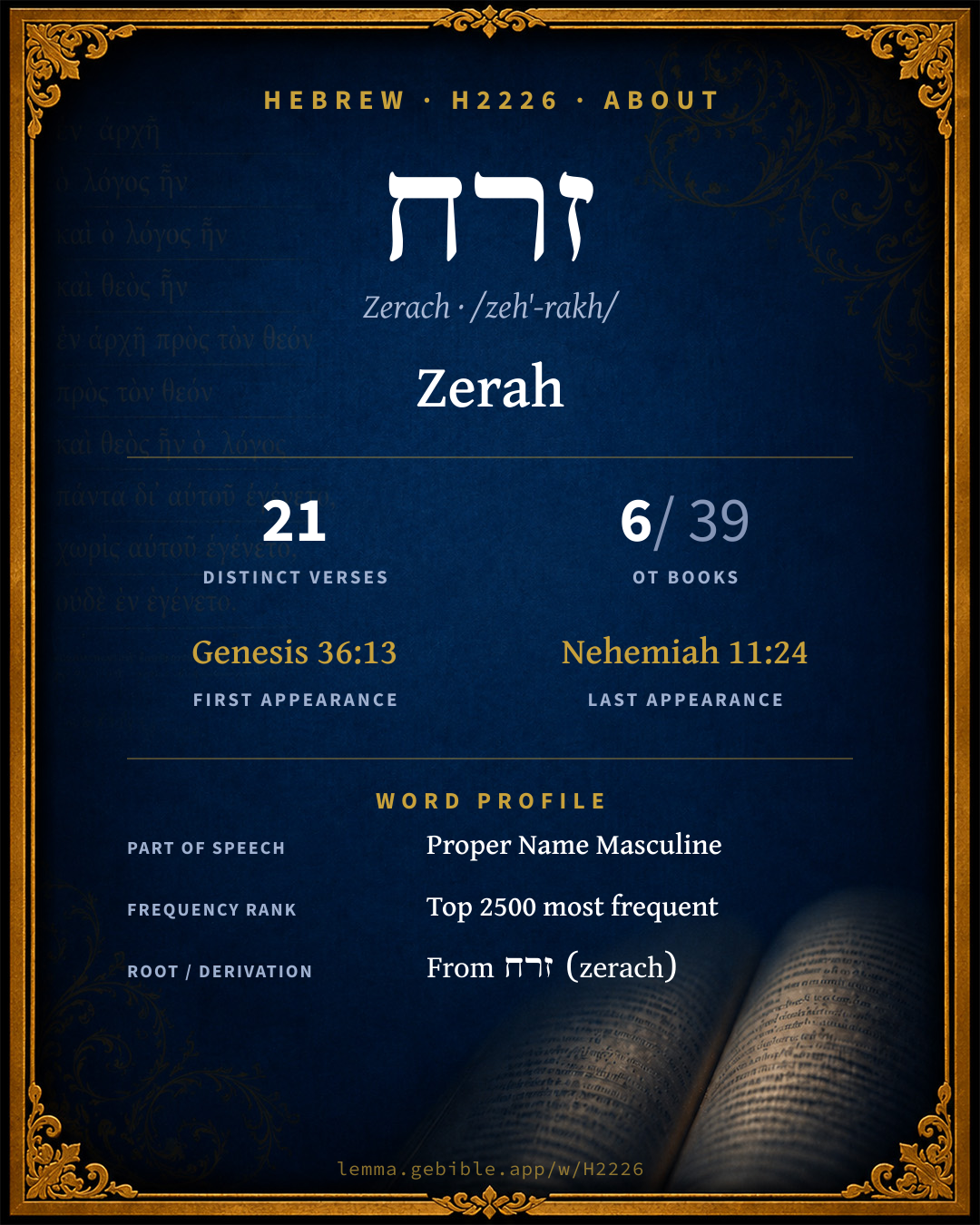
זֶ֫רַח
Zerah
BDB lists 7 entries for ‘Zerah’ fuller range ↓
Full lexicon entry — Brown-Driver-Briggs (BDB)
From Brown-Driver-Briggs (BDB)
Where this word appears
Grammar key — what these labels mean
Part of speech
- Noun
- A naming word — a person, place, thing, or idea.
Noun type
- Proper
- A name of a specific person, place, or people (e.g. Abraham, Zion, Israel).
Every verse where H2226 appears — 21 distinct verses across 6 books. Click any verse to open its interlinear word-by-word view. Verse text shown in the World English Bible for context — . Each verse’s Hebrew form is shown with its reference; the English is not keyword-highlighted, since the data carries no word-level English alignment. Use “Compare translations” on any verse to read it across multiple English versions. This concordance covers the Hebrew Bible; Septuagint (Greek Old Testament) occurrences are not indexed here.
Genesis 5 verses
- Genesis 36:13 וָ/זֶ֖רַח conj + n Proper These are the sons of Reuel: Nahath, Zerah, Shammah, and Mizzah. These were the sons of Basemath, Esau's wife.
- Genesis 36:17 זֶ֔רַח n Proper These are the sons of Reuel, Esau's son: chief Nahath, chief Zerah, chief Shammah, chief Mizzah: these are the chiefs who came of Reuel in the land of Edom; these are the sons of Basemath, Esau's wife.
- Genesis 36:33 זֶ֖רַח n Proper Bela died, and Jobab, the son of Zerah of Bozrah, reigned in his place.
- Genesis 38:30 זָֽרַח n Proper Afterward his brother came out, that had the scarlet thread on his hand, and his name was called Zerah.
- Genesis 46:12 וָ/זָ֑רַח conj + n Proper The sons of Judah: Er, Onan, Shelah, Perez, and Zerah; but Er and Onan died in the land of Canaan. The sons of Perez were Hezron and Hamul.
Numbers 2 verses
- Numbers 26:13 לְ/זֶ֕רַח prep + n Proper of Zerah, the family of the Zerahites; of Shaul, the family of the Shaulites.
- Numbers 26:20 לְ/זֶ֕רַח prep + n Proper The sons of Judah after their families were: of Shelah, the family of the Shelanites; of Perez, the family of the Perezites; of Zerah, the family of the Zerahites.
Joshua 4 verses
- Joshua 7:1 זֶ֜רַח n Proper But the children of Israel committed a trespass in the devoted thing; for Achan, the son of Carmi, the son of Zabdi, the son of Zerah, of the tribe of Judah, took of the devoted thing: and the anger of Yahweh was kindled against the children of Israel.
- Joshua 7:18 זֶ֖רַח n Proper and he brought near his household man by man; and Achan, the son of Carmi, the son of Zabdi, the son of Zerah, of the tribe of Judah, was taken.
- Joshua 7:24 זֶ֡רַח n Proper Joshua, and all Israel with him, took Achan the son of Zerah, and the silver, and the mantle, and the wedge of gold, and his sons, and his daughters, and his oxen, and his donkeys, and his sheep, and his tent, and all that he had: and they brought them up to the valley of Achor.
- Joshua 22:20 זֶ֗רַח n Proper Didn't Achan the son of Zerah commit a trespass in the devoted thing, and wrath fell on all the congregation of Israel? and that man didn't perish alone in his iniquity.
1 Chronicles 8 verses
- 1 Chronicles 1:37 זֶ֖רַח n Proper The sons of Reuel: Nahath, Zerah, Shammah, and Mizzah.
- 1 Chronicles 1:44 זֶ֖רַח n Proper Bela died, and Jobab the son of Zerah of Bozrah reigned in his place.
- 1 Chronicles 2:4 זָ֑רַח n Proper Tamar his daughter-in-law bore him Perez and Zerah. All the sons of Judah were five.
- 1 Chronicles 2:6 זֶ֗רַח n Proper The sons of Zerah: Zimri, and Ethan, and Heman, and Calcol, and Dara; five of them in all.
- 1 Chronicles 4:24 זֶ֥רַח n Proper The sons of Simeon: Nemuel, and Jamin, Jarib, Zerah, Shaul;
- 1 Chronicles 6:21 זֶ֥רַח n Proper Joah his son, Iddo his son, Zerah his son, Jeatherai his son.
- 1 Chronicles 6:41 זֶ֖רַח n Proper the son of Ethni, the son of Zerah, the son of Adaiah,
- 1 Chronicles 9:6 זֶ֖רַח n Proper Of the sons of Zerah: Jeuel, and their brothers, six hundred ninety.
2 Chronicles 1 verse
Nehemiah 1 verse
About this entry
At a glance — auto-summarized from this page’s data, not written by a person. Every figure links to its source below. This summary describes the numbers; it doesn’t interpret them.
“Zerah” is the headline sense of the Hebrew name זרח (Zerach). First canonically at Genesis 36:13, it enters the text early. It appears 21 verses across 6 books of the Hebrew Bible, among its uncommon vocabulary. More than a third of its appearances fall in 1 Chronicles. See 21-verse concordance and the renderings breakdown below.
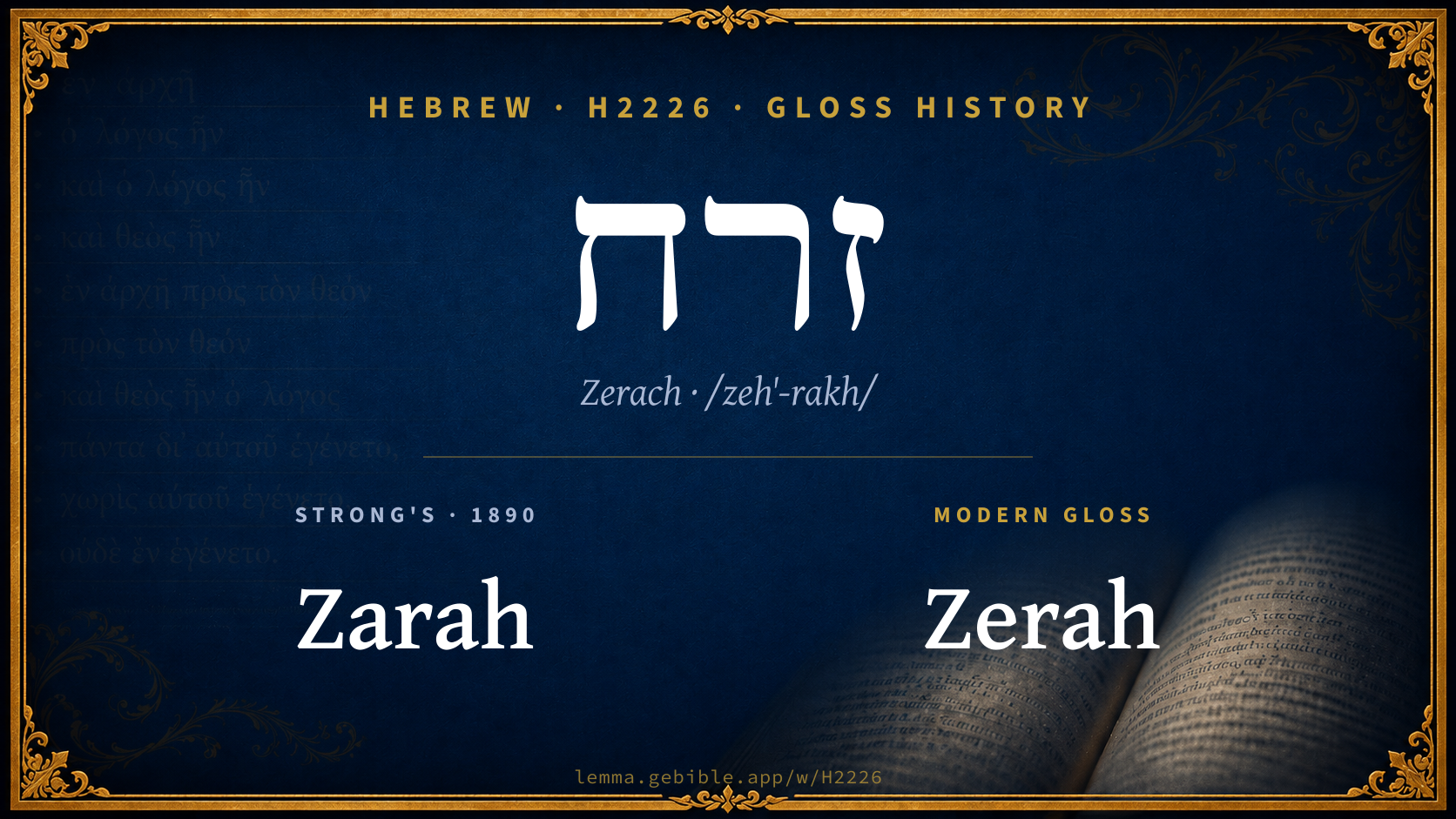
Gloss history
Strong's 1890 vs modern scholarship
About this word
Strong's H2226 catalogs a Hebrew word from the Hebrew Old Testament.
These counts are not copied from any lexicon or concordance. They are computed here, from the morphology-tagged Hebrew Old Testament. What Lemma adds →
- 21
- distinct verses
- The word appears in 21 distinct verses.
- 6 / 39
- OT books
- The word appears in 6 of 39 Old Testament books.
- #1,462
- by frequency
- Top 2500 most frequent Hebrew words (rank 1,462 of 8,640 Hebrew words by occurrence).
View all 21 occurrences in the concordance →
Most concentrated in
- 1 Chronicles 8 verses 38%
- Genesis 5 verses 24%
- Joshua 4 verses 19%
By section of the Old Testament
By traditional corpus
Conventional, traditional groupings — biblical authorship is debated, so this is a traditional corpus grouping, not an authorship claim. Each share is this word’s portion of its verses in that division of the Hebrew canon. Each figure is a share of the word’s 21 distinct verses.
- Writings (Ketuvim) 10 verses · 48%
- Torah (Pentateuch) 7 verses · 33%
- Prophets (Nevi'im) 4 verses · 19%
How translations render this word
Counts come from each version’s own published word-to-Strong’s tagging or interlinear alignment — an approximate guide to how each version renders this word, not a word-level alignment the data otherwise carries. Because each total is that version’s own tagged count, the per-version totals vary from one another and need not match the appearance or distinct-verse counts above. These counts may also differ from a printed concordance because Lemma counts each distinctly tagged rendering and does not collapse phrase taggings into a single head-word total. This is a fixed set of word-tagged versions (KJV, ASV, BSB, ULT) and does not change with the reading translation you choose elsewhere. Each version’s license is shown beside its name below (and on Sources).
BDB lists this Strong’s number as 2 distinct words (homographs). Each count above pools all of them and is not split by sense — see the Senses section below. A low-frequency rendering may belong to a different one of those words, not the primary meaning.
- King James Version†: Zerah 19×
- American Standard Version†: Zerah 20×
- Berean Standard Bible†: Zerah 20×
- unfoldingWord Literal Text†: Zerah 21×
King James Version Public Domain
Renders H2226 across 21† tagged occurrences — most commonly:
Plus 2 renderings that appear only once — usually multi-word phrases or single function words the recovered tagging swept in, not distinct renderings.
American Standard Version Public Domain
Renders H2226 across 21† tagged occurrences — most commonly:
Plus 1 rendering that appears only once — usually multi-word phrases or single function words the recovered tagging swept in, not distinct renderings.
Berean Standard Bible Public Domain
Renders H2226 across 21† tagged occurrences — most commonly:
Plus 1 rendering that appears only once — usually multi-word phrases or single function words the recovered tagging swept in, not distinct renderings.
unfoldingWord Literal Text CC BY-SA 4.0
Renders H2226 across 21† tagged occurrences — most commonly:
9 senses and sub-senses in the full BDB
What do BDB’s symbols mean?
BDB uses these scholarly abbreviations:
| Symbol | Meaning |
|---|---|
| 𝔊 | the Septuagint (the ancient Greek translation, LXX) |
| 𝔙 | the Vulgate (the Latin translation) |
| 𝔖 | the Syriac version (the Peshitta) |
| 𝔗 | the Targum (the Aramaic translation) |
| ψ | the Psalms |
| √ | root (the underlying root or stem) |
| ‖ | parallel passage (a synonymous or contrasted parallel) |
| † | the dagger: every passage where the word occurs is cited |
The 9 senses and sub-senses the full Brown-Driver-Briggs lexicon distinguishes for this word, in lexicon order (not ranked by frequency), with BDB’s own verbatim wording and sub-sense lettering. Shown in Hebrew script with BDB’s own scholarly abbreviations. The condensed entry is in the Lexicon Entry tab. See also the Forms in the corpus table below.
זרח I [m.] dawning, shining
זרח II m. (on form cf. LgBN77, and Anm.)
- 1. 𝔊 Ζαρα, son of Judah and Tamar Gn 38:30; 46:12 (both J), 1 Ch 2:4 (all זָ֑רַח), v 6; as head of a family Nu 26:20 Jos 7:1 (both P), v 18, 24 (JE), 22:20 (P) 1 Ch 9:6 (𝔊L Ζηρα), Ne 11:24 (cf. SmListen 7). e.g. Genesis 38:30
- 2. Edomites:
- a. 𝔊 Ζαρε Gn 36:13, 17 (both P) = 1 Ch 1:37. e.g. Genesis 36:13
- b. 𝔊 Ζαρα Gn 36:33 (P) = 1 Ch 1:44 (b=a?). e.g. Genesis 36:33
- 3. 𝔊L Ζαρα, Levites:
- a. (var. Ιααρα) 1 Ch 6:6. e.g. 1 Chronicles 6:6
- b. (var. Ζααραι) 1 Ch 6:26. e.g. 1 Chronicles 6:26
- 4. head of a Simeonite family, 𝔊 Ζαρα Nu 26:13 (P), 1 Ch 4:24 (var. Ζαρες) (= צֹחַר 𝔊 Σααρ Gn 46:10 Ex 6:15, cf. Di Nu 26:13). e.g. Numbers 26:13
- 5. a Cushite, 𝔊 Ζαρε, foe of king Asa 2 Ch 14:8. e.g. 2 Chronicles 14:8
Senses from the full Brown-Driver-Briggs lexicon (Brown, Driver, Briggs; Oxford 1906 — public domain), digitized via Sefaria, supplemented by the OpenScriptures HebrewLexicon (CC BY 4.0). Full attribution on Sources.
Word origin
I. n.[m.] dawning, shining;—only fig., נֹגַהּ זַרְחֵךְ i.e. of Zion, Is 60:3 (‖ אוֹר).
II. n.pr.m. (on form cf. LgBN77, and Anm.)—
— Brown-Driver-Briggs (Oxford 1906, public domain), digitized via Sefaria, supplemented by the OpenScriptures HebrewLexicon (CC BY 4.0). See Sources.
Derived from זרח (zerach) (H2225) — dawning.
Jastrow Dictionary
A second Hebrew/Aramaic lexicon for comparison, covering Aramaic and post-biblical (Talmudic, Targumic, Midrashic) usage that the biblical-Hebrew BDB does not. Matched by lemma rather than by Strong’s number, so a lemma may carry more than one Jastrow headword (shown separately below), and the entries cover usage well beyond the Bible.
זָרַח
- cmp. next w.) [to spread,] to shine, sparkle, rise (cmp. הָנֵץ). Ḥull. 91ᵇ וכי שמש … זָרְחָה did the sun rise for him (Jacob) alone? Y. Snh. VIII, end, 26ᶜ החמה זוֹרַחַת וכי … does the sun shine on him (the thief) alone? a. fr.—Tanḥ. Tsav 13, a. fr. צרעת זרחה וכ׳ leprosy broke out on &c.
- 1. to make shine. Gen. R. s. 22 ה׳ לו הצרעת the Lord made leprosy glisten on his face. Ib. ה׳ … חמה he caused the globe of the sun to shine bright for him (a sign of pardon). Lev. R. s. 28, beg. דיין שהקב"ה מַזְרִיחַ וכ׳ it is reward enough for them that the Lord lets the sun rise &c. Macc. 10ᵃ (ref. to מזרחה, Deut. IV, 41) הַזְרֵחַ שמש וכ׳ let the sun shine on unwilling manslayers (give them safety). Ib. הִזְרַחְתָּ וכ׳ thou (Moses) hast &c. e.g. Deuteronomy 4:41
- 2. (neut. verb) to glisten. Shebi. IV, 7 משיַזְרִיחוּ (Ms. M. משהִזְ׳) when the young figs begin to glisten.
- 3. (denom. of מִזְרָח) to go east. Gen. R. s. 61, end (ref. to Gen. XXV, 6) כל מה … להַזְרִיחַ תַּזְרִיחוּ go as far east as you can. e.g. Genesis 25:6
A Dictionary of the Targumim, the Talmud Babli and Yerushalmi, and the Midrashic Literature (Marcus Jastrow; London, Luzac, 1903) — Public Domain. Digitized via Sefaria. Digitized via Sefaria. Full attribution on Sources.
Forms in the corpus
The 13 distinct written forms H2226 takes in the Hebrew Bible, most frequent first — each parse links to that state’s occurrences in the concordance. Hebrew forms include their vowel points and cantillation, so a single lemma takes many written forms.
| Form | Parsing | Example | Uses |
|---|---|---|---|
| זֶ֖רַח | Noun, Proper | Genesis 36:33 | 6 |
| זֶ֗רַח | Noun, Proper | 1 Chronicles 2:6 | 2 |
| זֶ֥רַח | Noun, Proper | 1 Chronicles 4:24 | 2 |
| לְ/זֶ֕רַח | Noun, Proper | Numbers 26:13 | 2 |
| וָ/זֶ֖רַח | Noun, Proper | Genesis 36:13 | 1 |
| וָ/זָ֑רַח | Noun, Proper | Genesis 46:12 | 1 |
| זֶ֔רַח | Noun, Proper | Genesis 36:17 | 1 |
| זֶ֜רַח | Noun, Proper | Joshua 7:1 | 1 |
| זֶ֡רַח | Noun, Proper | Joshua 7:24 | 1 |
| זֶ֣רַח | Noun, Proper | 2 Chronicles 14:9 | 1 |
| זֶ֤רַח | Noun, Proper | Nehemiah 11:24 | 1 |
| זָ֑רַח | Noun, Proper | 1 Chronicles 2:4 | 1 |
| זָֽרַח | Noun, Proper | Genesis 38:30 | 1 |
Same root — word family
Other BDB entries built from the same root as H2226, grouped by Strong’s listed origin. These share a root / origin per the lexicon — not necessarily a shared meaning. Each links to that word’s own entry.
Derives from
Proper names from this root
People and places named from this root — a name, not an additional meaning of the word.
Compare all same-root words → Showing 4 of 5 — not the complete family. 3 of the same-root words are proper names (people or places). They share a root, not necessarily a meaning.
Bible dictionary
Public-domain dictionary articles matched to this entry by name (Zerah). A biblical name can be shared by more than one person or place, so an article may treat several.
Easton's Bible Dictionary · M. G. Easton, 1897
Sunrise. (1.) An "Ethiopian," probably Osorkon II., the successor of Shishak on the throne of Egypt. With an enormous army, the largest we read of in Scripture, he invaded the kingdom of Judah in the days of Asa (2 Chr. 14:9-15). He reached Zephathah, and there encountered the army of Asa. This is the only instance "in all the annals of Judah of a victorious encounter in the field with a first-class heathen power in full force." The Egyptian host was utterly routed, and the Hebrews gathered "exceeding much spoil." Three hundred years elapsed before another Egyptian army, that of Necho (B.C. 609), came up against Jerusalem.
(2.) A son of Tamar (Gen. 38:30); called also Zara (Matt. 1:3).
(3.) A Gershonite Levite (1 Chr. 6:21, 41).
Smith's Bible Dictionary · William Smith, 1863
(rising (of the sun)).
+ A son of Reuel, son of Esau, (Genesis 36:13; 1 Chronicles 1:37) and one of the "dukes" or phylarchs of the Edomites. (Genesis 36:17) (B.C. after 1760.) + Less properly, Zarah, twin son, with his elder brother Pharez, of Judah and Tamar. (Genesis 38:30; 1 Chronicles 2:4; Matthew 1:3) (B.C. about 1728.) His descendants were called Zarhites, Ezrahites and Izrahites. (Numbers 26:20; 1 Kings 4:31; 1 Chronicles 27:8,11) + Son of Simeon, (1 Chronicles 4:24) called Zohar in (Genesis 46:10) (B.C. 1706.) + A Gershonite Levite, son of Iddo or Adaiah. (1 Chronicles 6:21,41) (B.C. 1043.) + The Ethiopian or Cushite, an invader of Judah, defeated by Asa about B.C. 941. [Asa] Zerah is probably the Hebrew name of Usarken I., second king of the Egyptian twenty-second dynasty; or perhaps more probably Usarken II his second successor. In the fourteenth year of Asa, Zerah the Ethiopian, with a mighty army of or million, invaded his kingdom, and advanced unopposed in the field as far as the valley of Zephathah at Mareshah. The Egyptian monuments enable us to picture the general disposition of Zerah's army. The chariots formed the first corps in a single or double line; behind them, massed in phalanxes, were heavy-armed troops; probably on the flanks stood archers and horsemen in lighter formations. After a prayer by Asa, his army attacked the Egyptians and defeated them. The chariots, broken by the charge and with horses made unmanageable by flights of arrows must have been forced back upon the cumbrous host behind. So complete was the overthrow that the Hebrews could capture and spoil the cities around Gerah which must have been in alliance with Zerah. The defeat of the Egyptian army is without parallel in the history of the Jews. On no other occasion did an Israelite army meet an army of one of the great powers and defeat it.
Hitchcock's Bible Names Dictionary · Roswell D. Hitchcock, 1869
same as Zarah
Classic public-domain reference works; full attribution on Sources.
Septuagint verse parallels
This word appears in 19 verses that also exist in the Greek Old Testament (Septuagint), out of the 21 Hebrew verses it occurs in. You can read those verses in Greek by switching the Old Testament edition to the Septuagint.
Read these verses in the Septuagint
This is a verse-level parallel only — the same verses exist in both the Hebrew and Greek Old Testaments. No word-level Hebrew↔Greek correspondence is claimed: the data carries no such alignment, so no Greek word is shown as this Hebrew word’s translation. Coverage is not total — the Septuagint omits the deuterocanon and renumbers the Psalms, so some Hebrew verses have no direct Greek parallel.