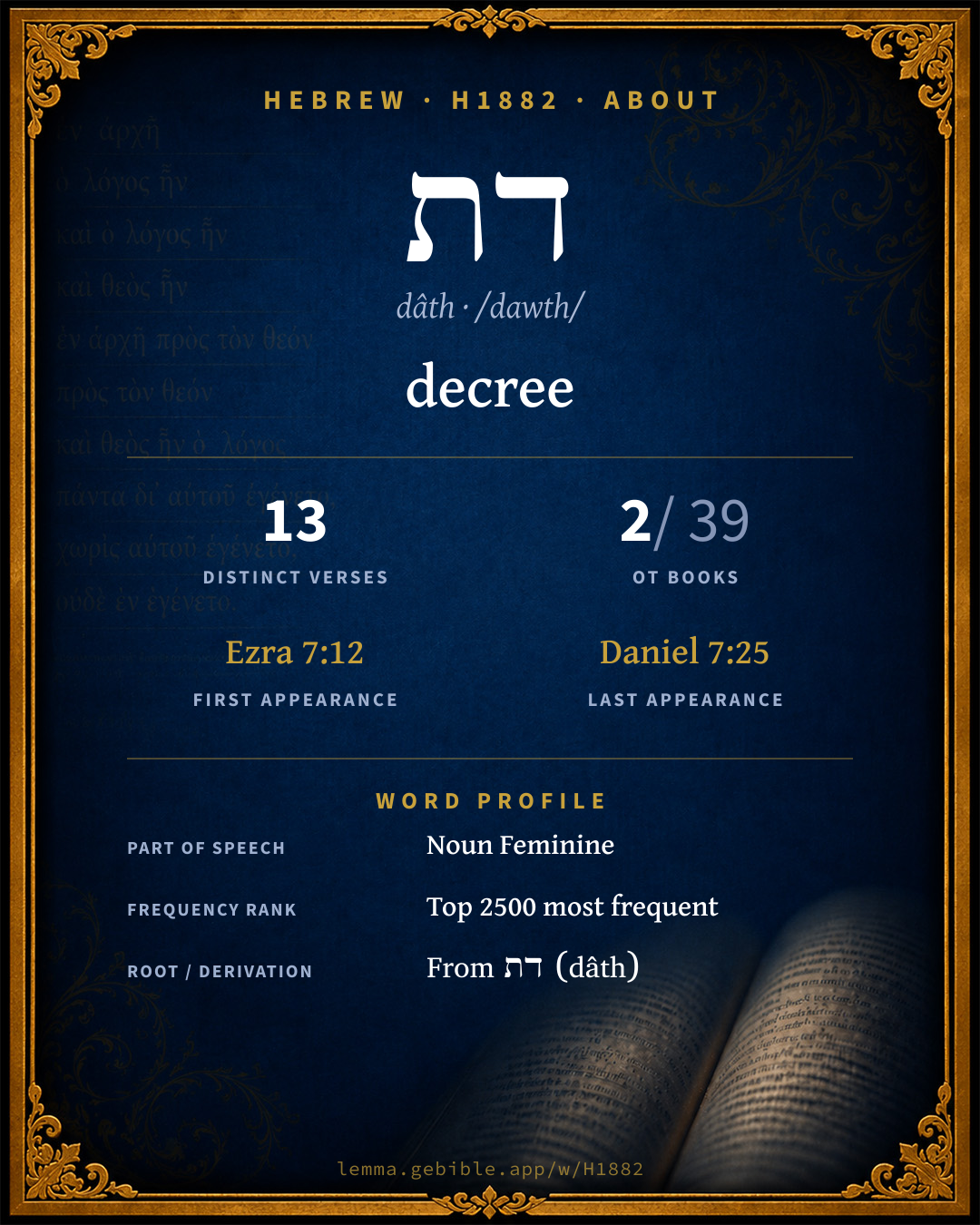
דָּת
decree
‘decree’ is one of 4 main senses fuller range ↓
Full lexicon entry — Brown-Driver-Briggs (BDB)
From Brown-Driver-Briggs (BDB)
Where this word appears
Grammar key — what these labels mean
Part of speech
- Noun
- A naming word — a person, place, thing, or idea.
Noun type
- Common
- A common noun — a general class of person, place, or thing (“king,” “city,” “water”), not a specific name.
State
- Construct
- A noun bound to a following noun in a possessive / “of” relationship (the construct chain).
- Absolute
- The independent form of a noun, not bound to a following word.
Gender
- Feminine
- Grammatically feminine.
Number
- Singular
- One.
- Plural
- More than one (in Hebrew, generally three or more).
Every verse where H1882 appears in the Book of Ezra — 5 distinct verses. Click any verse to open its interlinear word-by-word view. Verse text shown in the World English Bible for context — . Each verse’s Hebrew form is shown with its reference; the English is not keyword-highlighted, since the data carries no word-level English alignment. Use “Compare translations” on any verse to read it across multiple English versions. This concordance covers the Hebrew Bible; Septuagint (Greek Old Testament) occurrences are not indexed here.
Ezra
- Ezra 7:12 דָּתָ֜/א n c fs det + ptcl def.art Artaxerxes, king of kings, to Ezra the priest, the scribe of the law of the God of heaven, perfect and so forth.
- Ezra 7:14 בְּ/דָ֥ת prep + n c fs cs Because you are sent of the king and his seven counselors, to inquire concerning Judah and Jerusalem, according to the law of your God which is in your hand,
- Ezra 7:21 דָּתָ/א֙ n c fs det + ptcl def.art I, even I Artaxerxes the king, do make a decree to all the treasurers who are beyond the River, that whatever Ezra the priest, the scribe of the law of the God of heaven, shall require of you, it be done with all diligence,
- Ezra 7:25 דָּתֵ֣י n c fp cs You, Ezra, after the wisdom of your God who is in your hand, appoint magistrates and judges, who may judge all the people who are beyond the River, all such as know the laws of your God; and teach you him who doesn't know them.
- Ezra 7:26 דָּתָ֣/א וְ/דָתָ/א֙ n c fs det + ptcl def.art conj + n c fs det + ptcl def.art Whoever will not do the law of your God, and the law of the king, let judgment be executed on him with all diligence, whether it be to death, or to banishment, or to confiscation of goods, or to imprisonment.
About this entry
At a glance — auto-summarized from this page’s data, not written by a person. Every figure links to its source below. This summary describes the numbers; it doesn’t interpret them.
At its core, דת (dâth) means “decree.” The word gravitates to Daniel (62%), then Ezra. It appears 13 verses across 2 books of the Hebrew Bible, among its uncommon vocabulary. Scripture first uses it in Ezra 7:12. Not a single-sense word: explore its full sense range. Each statement above links to its evidence; the full detail follows below.
Gloss history
Strong's 1890 vs modern scholarship
About this word
Strong's H1882 catalogs a Hebrew word from the Hebrew Old Testament.
These counts are not copied from any lexicon or concordance. They are computed here, from the morphology-tagged Hebrew Old Testament. What Lemma adds →
- 13
- distinct verses
- The word appears in 13 distinct verses.
- 2 / 39
- OT books
- The word appears in 2 of 39 Old Testament books.
- #1,910
- by frequency
- Top 2500 most frequent Hebrew words (rank 1,910 of 8,640 Hebrew words by occurrence).
View all 13 occurrences in the concordance →
By traditional corpus
Conventional, traditional groupings — biblical authorship is debated, so this is a traditional corpus grouping, not an authorship claim. Each share is this word’s portion of its verses in that division of the Hebrew canon. Each figure is a share of the word’s 13 distinct verses.
- Writings (Ketuvim) 13 verses · 100%
How translations render this word
Counts come from each version’s own published word-to-Strong’s tagging or interlinear alignment — an approximate guide to how each version renders this word, not a word-level alignment the data otherwise carries. Because each total is that version’s own tagged count, the per-version totals vary from one another and need not match the appearance or distinct-verse counts above. These counts may also differ from a printed concordance because Lemma counts each distinctly tagged rendering and does not collapse phrase taggings into a single head-word total. This is a fixed set of word-tagged versions (KJV, ASV, BSB, ULT) and does not change with the reading translation you choose elsewhere. Each version’s license is shown beside its name below (and on Sources).
- King James Version: Law 5×, According to the law 3×, Decree 2×
- American Standard Version: Law 6×, According to the law 3×
- Berean Standard Bible: Law 5×, According to the law 2×, Laws 2×
- unfoldingWord Literal Text: Law 5×, According to the law of 2×, Decree 2×
King James Version Public Domain
Renders H1882 across 14 tagged occurrences — most commonly:
Plus 2 renderings that appear only once — usually multi-word phrases or single function words the recovered tagging swept in, not distinct renderings.
American Standard Version Public Domain
Renders H1882 across 14 tagged occurrences — most commonly:
Plus 5 renderings that appear only once — usually multi-word phrases or single function words the recovered tagging swept in, not distinct renderings.
Berean Standard Bible Public Domain
Renders H1882 across 14 tagged occurrences — most commonly:
Plus 5 renderings that appear only once — usually multi-word phrases or single function words the recovered tagging swept in, not distinct renderings.
unfoldingWord Literal Text CC BY-SA 4.0
Renders H1882 across 14 tagged occurrences — most commonly:
Plus 5 renderings that appear only once — usually multi-word phrases or single function words the recovered tagging swept in, not distinct renderings.
Senses in the full BDB
What do BDB’s symbols mean?
BDB uses these scholarly abbreviations:
| Symbol | Meaning |
|---|---|
| 𝔊 | the Septuagint (the ancient Greek translation, LXX) |
| 𝔙 | the Vulgate (the Latin translation) |
| 𝔖 | the Syriac version (the Peshitta) |
| 𝔗 | the Targum (the Aramaic translation) |
| ψ | the Psalms |
| √ | root (the underlying root or stem) |
| ‖ | parallel passage (a synonymous or contrasted parallel) |
| † | the dagger: every passage where the word occurs is cited |
The 2 senses and sub-senses the full Brown-Driver-Briggs lexicon distinguishes for this word, in lexicon order (not ranked by frequency), with BDB’s own verbatim wording and sub-sense lettering. Shown in Hebrew script with BDB’s own scholarly abbreviations. The condensed entry is in the Lexicon Entry tab. See also the Forms in the corpus table below.
- 1. decree, edict, commission of Pers. king Ezr 8:36 (word elsewhere only in Est) Est 2:8 (‖ דְּבַר הַמֶּלֶךְ), 4:3 (‖ id.) 8:17 (‖ id.) 9:1 (‖ id.; c. עשׂה execute) cf. also 9:13; c. vb. נָתַן 3:14, 15; 8:13, 14; 9:14; written כְּתָב־הַדָּת 4:8 (cf. 3:14; 8:13). e.g. Ezra 8:36
- 2. law, permanently valid and applicable, וְיִכָּתֵב בְּדָתֵי פָרַס־וּמָדַי וְלֹא יַעֲבוֹר Est 1:19 cf. v 15; 4:11, 16; יֹדְעֵי דָּת וָדִין 1:13 those that understood law and judgment; דָּתֵי הַמֶּלֶךְ 3:8; of laws of the Jews in Persia 3:8; even of rules for drinking at a feast 1:8; for purifying of women 2:12.—The distinction between 1 & 2 is not absolute. The king’s will was law, and the royal edict (דְּבַר מַלְכוּת) concerning Vashti was reckoned among the laws (דָּתֵי) of the Persians & Medes (1:19).—In Dt 33:2 MT אֵשׁ דָּת לָמוֹ fire was a law for them is corrupt; many emend. proposed, cf. Di; Di suggests אֵשׁ [לַפִּ]דֹת fire of flames, flaming fire, cf. הַלַּפִּידִם Ex 20:18 (but לַפִּדֹת pl. in ת—ֹ not in OT unless as n.pr.), or (better), אֵשׁ [יֹקֶ]דֶת a burning fire, cf. Is 65:5 (diff. sense). e.g. Esther 1:19
Senses from the full Brown-Driver-Briggs lexicon (Brown, Driver, Briggs; Oxford 1906 — public domain), digitized via Sefaria, supplemented by the OpenScriptures HebrewLexicon (CC BY 4.0). Full attribution on Sources.
Word origin
n.f. Est 3:15; 4:11; decree, law, usage, only in Persian period (Biblical Aramaic NH id., Syriac ܕܰܬܳܐ or ܕܳܬܳܐ Pers. loan-w., Old Pers. dâta, law, SpiegAPK 225)—ד׳ abs. Est 1:8 + 9 times; cstr. דַּת Est 2:12, דָּת 9:13; sf. דָּתוֹ Est 2:8 + 4 times; pl. cstr. דָּתֵי Ezr 8:36 + 2 times; sf. דָּתֵיהֶם Est 3:8;—
— Brown-Driver-Briggs (Oxford 1906, public domain), digitized via Sefaria, supplemented by the OpenScriptures HebrewLexicon (CC BY 4.0). See Sources.
Derived from דת (dâth) (H1881) — decree.
Jastrow Dictionary
A second Hebrew/Aramaic lexicon for comparison, covering Aramaic and post-biblical (Talmudic, Targumic, Midrashic) usage that the biblical-Hebrew BDB does not. Matched by lemma rather than by Strong’s number, so a lemma may carry more than one Jastrow headword (shown separately below), and the entries cover usage well beyond the Bible.
דַּתְּ
- = דְּאַתְּ. Y. Snh. X, 27ᵈ bot., a. fr. כמה דת מר (= דתימר כמה) as thou sayest, i.e. as we read in Scriptures &c.—Y. Ab. Zar. II, 42ᵃ top הדא דת מר וכ׳ (interch. with הדא דאת אמר = הדא דתימא) that which thou sayest (hast recited), applies only &c.—Y. Snh. X, 29ᵈ top על דעתך דת מר according to thy opinion who sayest; a. fr.
דָּת
- (b. h.; = דנת,, Arab, dîn corresp. to our w.)
- 1. custom, law; judgment, punishment. Esth. R. to I, 8 כדַת כל מקום וכ׳ in accordance with the usages of &c.—Keth. VII, 6 דַּת משה Mosaic (ritual) law, ד׳ יהודית Jewish custom (chastity, decency); Tosef. ib. VII, 6 ד׳ משה וישראל. Ib. 7 שעברו על הדת who disregard the Jewish custom. Esth. R. to I, 15 כדת just dealing, v. אַכְזְרִיּוּת. Meg. 12ᵃ ד׳ של תורה the Biblical dues (sacrifices); a. fr.
- 2. religion. Succ. 56ᵇ המירה דָתָהּ (Tosef. ib. IV, 28 נשתמדה) she changed her faith, became an apostate. Yeb. 70ᵇ; Pes. 96ᵃ (ref. to Ex. XII, 43, v. דְּרָשָׁא) בו המרת דת וכ׳ to eat of it (the passover lamb) apostasy does unfit, but &c.—Pl. דָּתִין. Koh. R. to VII, 19 (play on ידותון, I Chr. XXV, 3) הנבא על הד׳ ועל הדינין וכ׳ (Asaph) who prophesied over the judgments and dispensations that passed over him; Cant. R. to IV, 4 (corr. acc.). [As to derivation of our w. from the Persian, v. Ges. H. Dict.10 s. v.] e.g. Exodus 12:43
דָּת ²
- Dan. VI, 16. Ib. II, 15; a. fr.—Pl. constr. דָּתֵי. Ezra VII, 25. e.g. Daniel 6:16
A Dictionary of the Targumim, the Talmud Babli and Yerushalmi, and the Midrashic Literature (Marcus Jastrow; London, Luzac, 1903) — Public Domain. Digitized via Sefaria. Digitized via Sefaria. Full attribution on Sources.
Forms in the corpus
The 12 distinct written forms H1882 takes in the Hebrew Bible, most frequent first — each parse links to that state’s occurrences in the concordance. Hebrew forms include their vowel points and cantillation, so a single lemma takes many written forms.
| Form | Parsing | Example | Uses |
|---|---|---|---|
| בְּ/דָ֥ת | Noun, Common, Feminine, Singular, Construct | Daniel 6:5 | 2 |
| כְּ/דָת | Noun, Common, Feminine, Singular, Construct | Daniel 6:8 | 2 |
| דָֽתְ/כ֗וֹן | Noun, Common, Feminine, Singular, Construct | Daniel 2:9 | 1 |
| דָת֙ | Noun, Common, Feminine, Singular, Absolute | Daniel 6:15 | 1 |
| דָתָ֛/א | Particle, Definite Article | Daniel 2:15 | 1 |
| דָּתֵ֣י | Noun, Common, Feminine, Plural, Construct | Ezra 7:25 | 1 |
| דָּתָ/א֙ | Particle, Definite Article | Ezra 7:21 | 1 |
| דָּתָ֜/א | Particle, Definite Article | Ezra 7:12 | 1 |
| דָּתָ֣/א | Particle, Definite Article | Ezra 7:26 | 1 |
| וְ/דָ֔ת | Noun, Common, Feminine, Singular, Absolute | Daniel 7:25 | 1 |
| וְ/דָתָ/א֙ | Particle, Definite Article | Ezra 7:26 | 1 |
| וְ/דָתָ֣/א | Particle, Definite Article | Daniel 2:13 | 1 |
Septuagint verse parallels
This word appears in 13 verses that also exist in the Greek Old Testament (Septuagint), out of the 13 Hebrew verses it occurs in. You can read those verses in Greek by switching the Old Testament edition to the Septuagint.
Read these verses in the Septuagint
This is a verse-level parallel only — the same verses exist in both the Hebrew and Greek Old Testaments. No word-level Hebrew↔Greek correspondence is claimed: the data carries no such alignment, so no Greek word is shown as this Hebrew word’s translation. Coverage is not total — the Septuagint omits the deuterocanon and renumbers the Psalms, so some Hebrew verses have no direct Greek parallel.