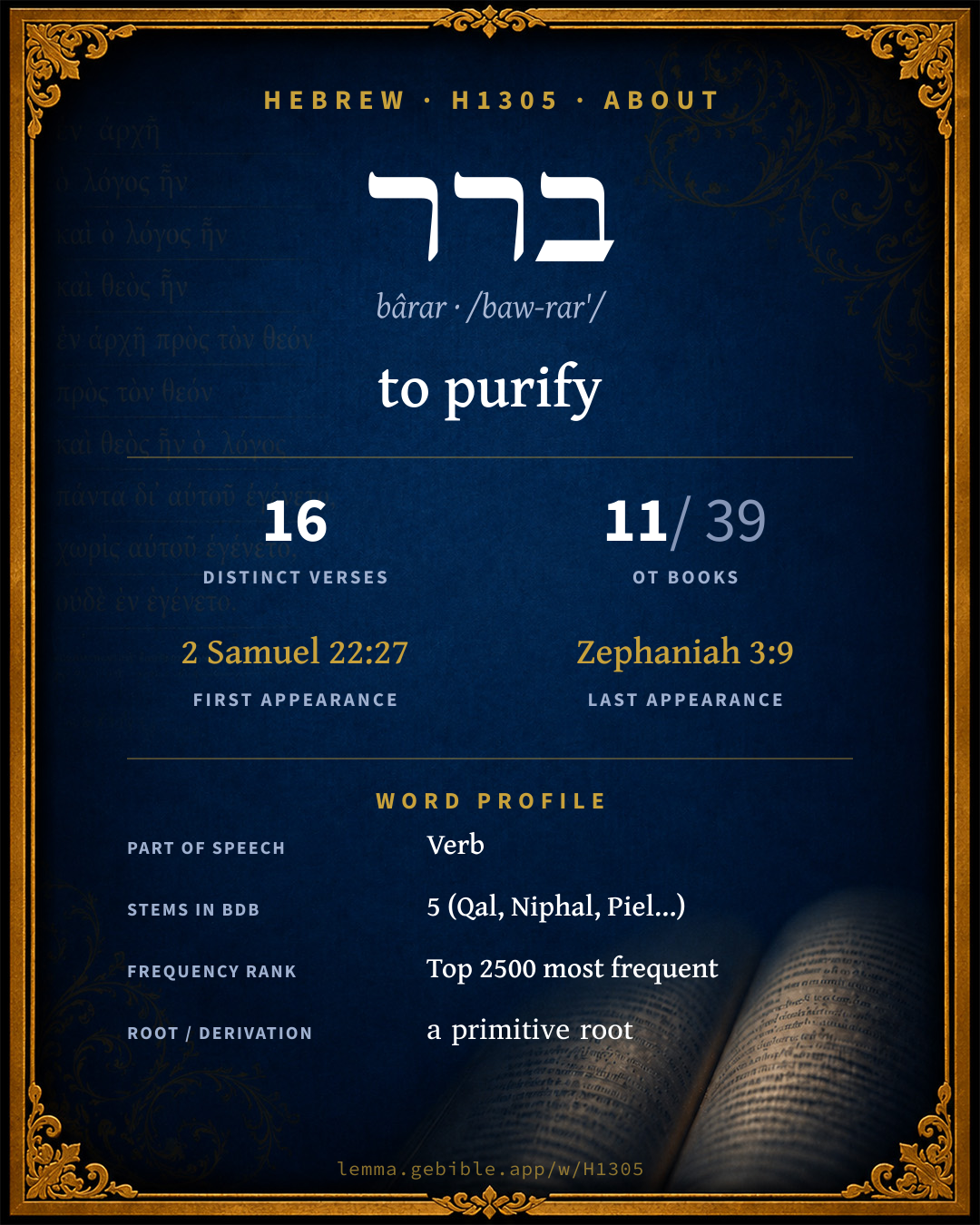
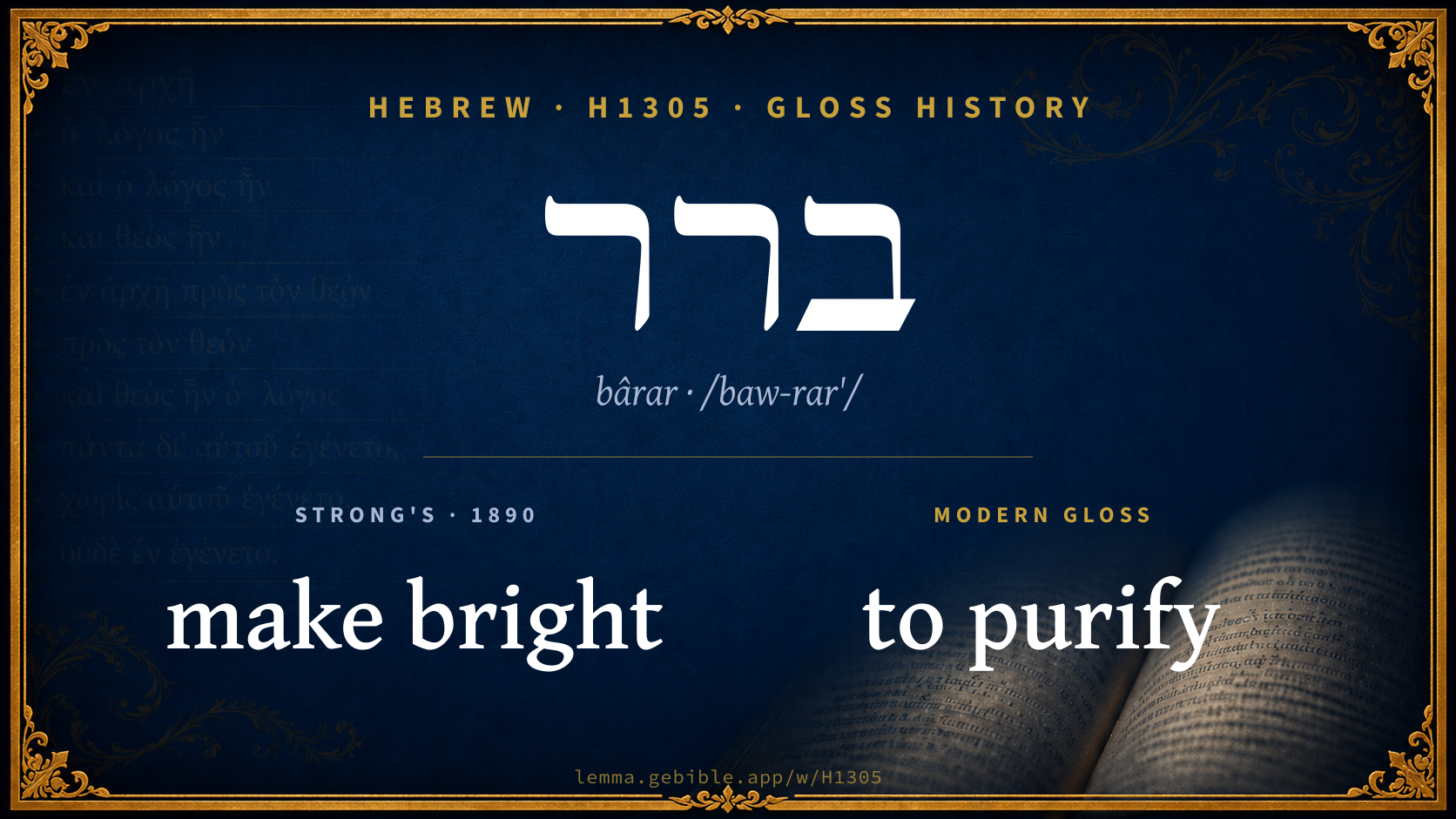
בָּרַר
to purify
also: select, polish, choose, purge fuller range ↓
Full lexicon entry — Brown-Driver-Briggs (BDB)
From Brown-Driver-Briggs (BDB)
Where this word appears
Grammar key — what these labels mean
Part of speech
- Verb
- An action or state-of-being word.
- Adjective
- A word that describes or qualifies a noun.
Stem
- Qal
- The basic, simple active stem — the plain form of the verb (“he wrote”). Here: ‘purge out’
- Niphal
- Usually the simple passive or reflexive of the Qal (“he was written”).
- Piel
- An intensive or resultative active stem.
- Hiphil
- The causative active stem (“he caused / brought about”). Here: ‘purify’
- Hithpael
- The reflexive or reciprocal stem (the subject acts on itself). Here: ‘purify oneself’
Form
- Participle Passive
- A verbal adjective expressing action received (“written”).
- Participle Active
- A verbal adjective expressing ongoing or characteristic action (“writing / one who writes”).
- Infinitive Construct
- A bound verbal noun, frequently with prepositions (“to write / in writing”).
- Sequential Perfect
- A perfect with prefixed waw continuing a preceding imperfect or command (waw-consecutive perfect).
- Imperfect
- An incomplete, ongoing, or future action (“he will / would write”).
- Imperative
- A direct command (“write!”).
State
- Absolute
- The independent form of a noun, not bound to a following word.
Person
- 1st Person
- The speaker (“I / we”).
- 2nd Person
- The one addressed (“you”).
- 3rd Person
- The one spoken about (“he / she / it / they”).
Gender
- Masculine
- Grammatically masculine.
- Feminine
- Grammatically feminine.
- Common
- Either gender — not distinguished for this form.
Number
- Plural
- More than one (in Hebrew, generally three or more).
- Singular
- One.
Every verse where H1305 appears in the Book of 1 Chronicles — 3 distinct verses. Click any verse to open its interlinear word-by-word view. Verse text shown in the World English Bible for context — . Each verse’s Hebrew form is shown with its reference; the English is not keyword-highlighted, since the data carries no word-level English alignment. Use “Compare translations” on any verse to read it across multiple English versions. This concordance covers the Hebrew Bible; Septuagint (Greek Old Testament) occurrences are not indexed here.
1 Chronicles
- 1 Chronicles 7:40 בְּרוּרִים֙ Qal ptcp.pass mp All these were the children of Asher, heads of the fathers' houses, choice and mighty men of valor, chief of the princes. The number of them reckoned by genealogy for service in war was twenty-six thousand men.
- 1 Chronicles 9:22 הַ/בְּרוּרִים֙ ptcl def.art + Qal ptcp.pass mp All these who were chosen to be porters in the thresholds were two hundred and twelve. These were reckoned by genealogy in their villages, whom David and Samuel the seer did ordain in their office of trust.
- 1 Chronicles 16:41 הַ/בְּרוּרִ֔ים ptcl def.art + Qal ptcp.pass mp and with them Heman and Jeduthun, and the rest who were chosen, who were mentioned by name, to give thanks to Yahweh, because his loving kindness endures forever;
About this entry
At a glance — auto-summarized from this page’s data, not written by a person. Every figure links to its source below. This summary describes the numbers; it doesn’t interpret them.
ברר — transliterated bârar — is a Hebrew verb carrying the sense “to purify.” The verb spans 5 stems, from Qal to Niphal. With 16 verses in 11 books, it is an uncommon word in the Hebrew Bible. It first appears in 2 Samuel 22:27. From the same root come בר, בר and בר. See the sense tree, 16-verse concordance, and the renderings breakdown below.
Gloss history
Strong's 1890 vs modern scholarship
About this word
Strong's H1305 catalogs a Hebrew word from the Hebrew Old Testament.
These counts are not copied from any lexicon or concordance. They are computed here, from the morphology-tagged Hebrew Old Testament. What Lemma adds →
- 16
- distinct verses
- The word appears in 16 distinct verses.
- 11 / 39
- OT books
- The word appears in 11 of 39 Old Testament books.
- #1,612
- by frequency
- Top 2500 most frequent Hebrew words (rank 1,612 of 8,640 Hebrew words by occurrence).
View all 16 occurrences in the concordance →
Most concentrated in
- 1 Chronicles 3 verses 19%
- Isaiah 2 verses 13%
- Jeremiah 2 verses 13%
By section of the Old Testament
By traditional corpus
Conventional, traditional groupings — biblical authorship is debated, so this is a traditional corpus grouping, not an authorship claim. Each share is this word’s portion of its verses in that division of the Hebrew canon. Each figure is a share of the word’s 16 distinct verses.
- Writings (Ketuvim) 9 verses · 56%
- Prophets (Nevi'im) 7 verses · 44%
How translations render this word
Counts come from each version’s own published word-to-Strong’s tagging or interlinear alignment — an approximate guide to how each version renders this word, not a word-level alignment the data otherwise carries. Because each total is that version’s own tagged count, the per-version totals vary from one another and need not match the appearance or distinct-verse counts above. These counts may also differ from a printed concordance because Lemma counts each distinctly tagged rendering and does not collapse phrase taggings into a single head-word total. This is a fixed set of word-tagged versions (KJV, ASV, BSB, ULT) and does not change with the reading translation you choose elsewhere. Each version’s license is shown beside its name below (and on Sources).
- King James Version: Pure 3×, Choice 2×, Thou wilt shew thyself pure 2×
- American Standard Version: Pure 3×, Choice 2×, Thou wilt show thyself pure 2×
- Berean Standard Bible: Pure 3×, Choice 2×, Chosen 2×
- unfoldingWord Literal Text: Chosen 2×, Pure 2×, Purified 2×
King James Version Public Domain
Renders H1305 across 18 tagged occurrences — most commonly:
Plus 11 renderings that appear only once — usually multi-word phrases or single function words the recovered tagging swept in, not distinct renderings.
American Standard Version Public Domain
Renders H1305 across 18 tagged occurrences — most commonly:
Plus 11 renderings that appear only once — usually multi-word phrases or single function words the recovered tagging swept in, not distinct renderings.
Berean Standard Bible Public Domain
Renders H1305 across 18 tagged occurrences — most commonly:
Plus 9 renderings that appear only once — usually multi-word phrases or single function words the recovered tagging swept in, not distinct renderings.
unfoldingWord Literal Text CC BY-SA 4.0
Renders H1305 across 17 tagged occurrences — most commonly:
Plus 9 renderings that appear only once — usually multi-word phrases or single function words the recovered tagging swept in, not distinct renderings.
10 senses and sub-senses in the full BDB
Hebrew verbs can shift meaning by stem (binyan): Qal is the basic action, Niphal is often passive or reflexive, Piel often intensifies or makes it factitive, and Hiphil is typically causative. The senses below are grouped under the stem BDB assigns to each. This entry also uses Hithpael (reflexive or reciprocal).
What do BDB’s symbols mean?
BDB uses these scholarly abbreviations:
| Symbol | Meaning |
|---|---|
| 𝔊 | the Septuagint (the ancient Greek translation, LXX) |
| 𝔙 | the Vulgate (the Latin translation) |
| 𝔖 | the Syriac version (the Peshitta) |
| 𝔗 | the Targum (the Aramaic translation) |
| ψ | the Psalms |
| √ | root (the underlying root or stem) |
| ‖ | parallel passage (a synonymous or contrasted parallel) |
| † | the dagger: every passage where the word occurs is cited |
The 10 senses and sub-senses the full Brown-Driver-Briggs lexicon distinguishes for this word, in lexicon order (not ranked by frequency), with BDB’s own verbatim wording and sub-sense lettering. Shown in Hebrew script with BDB’s own scholarly abbreviations. The condensed entry is in the Lexicon Entry tab. See also the Forms in the corpus table below.
Qal
- 1. purge out, purify
- 2. choose, select, only Pt. and in Chronicler
- 3. cleanse, make shining, polish
- 4. test, prove
Niphal
- . purify oneself
Piel
- . purify
Hiphil
- 1. purify, cleanse
- 2. polish arrows
Hithpael
- 1. purify oneself
- 2. shew oneself pure, just, kind
Senses from the full Brown-Driver-Briggs lexicon (Brown, Driver, Briggs; Oxford 1906 — public domain), digitized via Sefaria, supplemented by the OpenScriptures HebrewLexicon (CC BY 4.0). Full attribution on Sources.
Word origin
[ בָּרַר ] vb. purify, select
— Brown-Driver-Briggs (Oxford 1906, public domain), digitized via Sefaria, supplemented by the OpenScriptures HebrewLexicon (CC BY 4.0). See Sources.
Origin: a primitive root
Jastrow Dictionary
A second Hebrew/Aramaic lexicon for comparison, covering Aramaic and post-biblical (Talmudic, Targumic, Midrashic) usage that the biblical-Hebrew BDB does not. Matched by lemma rather than by Strong’s number, so a lemma may carry more than one Jastrow headword (shown separately below), and the entries cover usage well beyond the Bible.
בָּרַר
- [to clear, clean; to place outside, whence]
- 1. to make clear, prove, ascertain. Keth. 46ᵃ (interpret. Deut. XXII, 17) ובוֹרְרִין את הדבר וכ׳ and they make the fact as clear (bright) as a new garment.—Part. pass. בָּרוּר q. v. e.g. Deuteronomy 22:17
- 2. to single out, select, sift, assort. Maasr. II, 6 שאָבוֹר לי which I may select for me. Ib. בּוֹרֵר ואוכל he has a right to pick out and eat (one after the other). Kil. II, 1 יָבוֹר he must take it out entirely. Sabb. VII, 2 הבּוֹרֵר he who sifts (a labor forbidden on the Sabbath). Y. ib. VII, 10ᵃ, a. fr. משום בורר (is guilty) because it comes under the class of sifting. Bab. ib. 74ᵃ בורר ואוכל וכ׳ he may take out singly and eat, take out singly and put it down (rejecting it) ולא יִבְרוֹר but he must not assort (v. discussion ibid.). Gitt. V, 9 לא תָבוֹר she must not help her to sift the grain. Snh. 45ᵃ בְּרוֹר לו וכ׳ choose for the convict the most gentle method of execution; Sot. 8ᵇ, a. fr.—Snh. III, 1 זה בורר וכ׳ each party chooses one judge, and the two judges בּוֹרְרִין וכ׳ elect a third.
- 1. to prove, ascertain. Snh. 23ᵇ צריך לבָרֵר the claimant must offer clear evidence. Kerith. 24ᵃ לב׳ עוון to ascertain whether or not the woman was guilty; Num. R. s. 9, v. בָּעַר. Y. Kidd. III, 63ᵈ, v. סִימְפּוֹן. Lev. R. s. 11; v. Nithpa.
- 2. to sift, select. Y. Ber. IX, 13ᶜ top דש זרה ובי׳ he threshed, winnowed and sifted. Y. Ned. I, beg. 51ᵃ לשונות שביררו להן וכ׳ the terms (for oaths, vows &c.) which the Mishnahs have selected (as substitutes for the real expressions of oaths &c.); Bab. Ned. 10ᵇ שבדו, v. בָּדָא. [Esth. R. to I, 22 [read:] בירר להם בלשון … רומי מלשון יוני interpreted for them (the Bible) in Latin &c., v. בָּדָא. The passage is defective; cmp. Y. Meg. I, 71ᶜ top.] [Y. Snh. X, 28ᵃ בחרו להם ביררו הברזל וכ׳, read בְּרִיּוּת, they selected (as similes for the Law) the soundness of the iron and the fixedness of the tree; cmp. Num. R. s. 14; Koh. R. to XII, 11.]
- to be cleared up, to be decided (between two alternatives); v. בְּרֵירָה. Bets. 4ᵃ (a hen is bought either for consumption or for breeding) נשחטה הובְרָרָה וכ׳ by its being killed, it appears that it was originally intended for slaughtering; Ḥull. 14ᵃ
- to be selected. Tanḥ. Sh’laḥ. 4 נִבְרְרוּ צדיקים they were righteous at the time they were selected.
- 1. to desire clearness, to seek evidence, search for truth. Lev. R. s. 11 (ref. to II Sam. XXII, 26 sq.) בשעה שנ׳ על עסקיו הק"בה בירר לו וכ׳ when he desired to be enlightened about his affairs (asking, ‘Whereby shall I know, Gen. XV, 8), the Lord enlightened him &c. (ib. 13). Ib. בשעה שנ׳ וכ׳ (with ref. to Moses); Midr. Till. to Ps. XVIII, 26 sq. e.g. 2 Samuel 22:26
- 2. to be confirmed, established. Tanḥ. T’tsavveh 9, end [read:] נִתְבָּרְרָה כהונה בידם through them the priesthood became established. Pesik. Dibré p. 115ᵇ [read as:] Yalk. Jer. 258 לא נ׳ … עד שעמד וכ׳ their prophecies were not fulfilled until Jer. arose.
בְּרַר
- Pa. בָּרֵיר same. Targ. I Chr. XXI, 13. Targ. Is. I, 25; a. e.—Bekh. 57ᵃ לִיבְרוֹר חד וכ׳ let him take out (for destruction) one lamb as an equivalent of the dog; v. בְּרֵירָה; Y. Shek. VI, 50ᵇ נברור וכ׳ let him &c.
- to be clear, pure. Targ. Job XXV, 5.
A Dictionary of the Targumim, the Talmud Babli and Yerushalmi, and the Midrashic Literature (Marcus Jastrow; London, Luzac, 1903) — Public Domain. Digitized via Sefaria. Digitized via Sefaria. Full attribution on Sources.
Forms in the corpus
The 18 distinct written forms H1305 takes in the Hebrew Bible, most frequent first — each parse links to that stem’s occurrences in the concordance. Hebrew forms include their vowel points and cantillation, so a single lemma takes many written forms.
Same root — word family
Other BDB entries built from the same root as H1305, grouped by Strong’s listed origin. These share a root / origin per the lexicon — not necessarily a shared meaning. Each links to that word’s own entry.
Derived from this word
Compare all same-root words → They share a root, not necessarily a meaning.
Septuagint verse parallels
This word appears in 14 verses that also exist in the Greek Old Testament (Septuagint), out of the 16 Hebrew verses it occurs in. You can read those verses in Greek by switching the Old Testament edition to the Septuagint.
Read these verses in the Septuagint
- 2 Samuel 22:27
- 1 Chronicles 7:40
- Job 33:3
- Ecclesiastes 3:18
- Isaiah 49:2
- Jeremiah 4:11
- Ezekiel 20:38
- Daniel 11:35
- Zephaniah 3:9
This is a verse-level parallel only — the same verses exist in both the Hebrew and Greek Old Testaments. No word-level Hebrew↔Greek correspondence is claimed: the data carries no such alignment, so no Greek word is shown as this Hebrew word’s translation. Coverage is not total — the Septuagint omits the deuterocanon and renumbers the Psalms, so some Hebrew verses have no direct Greek parallel.