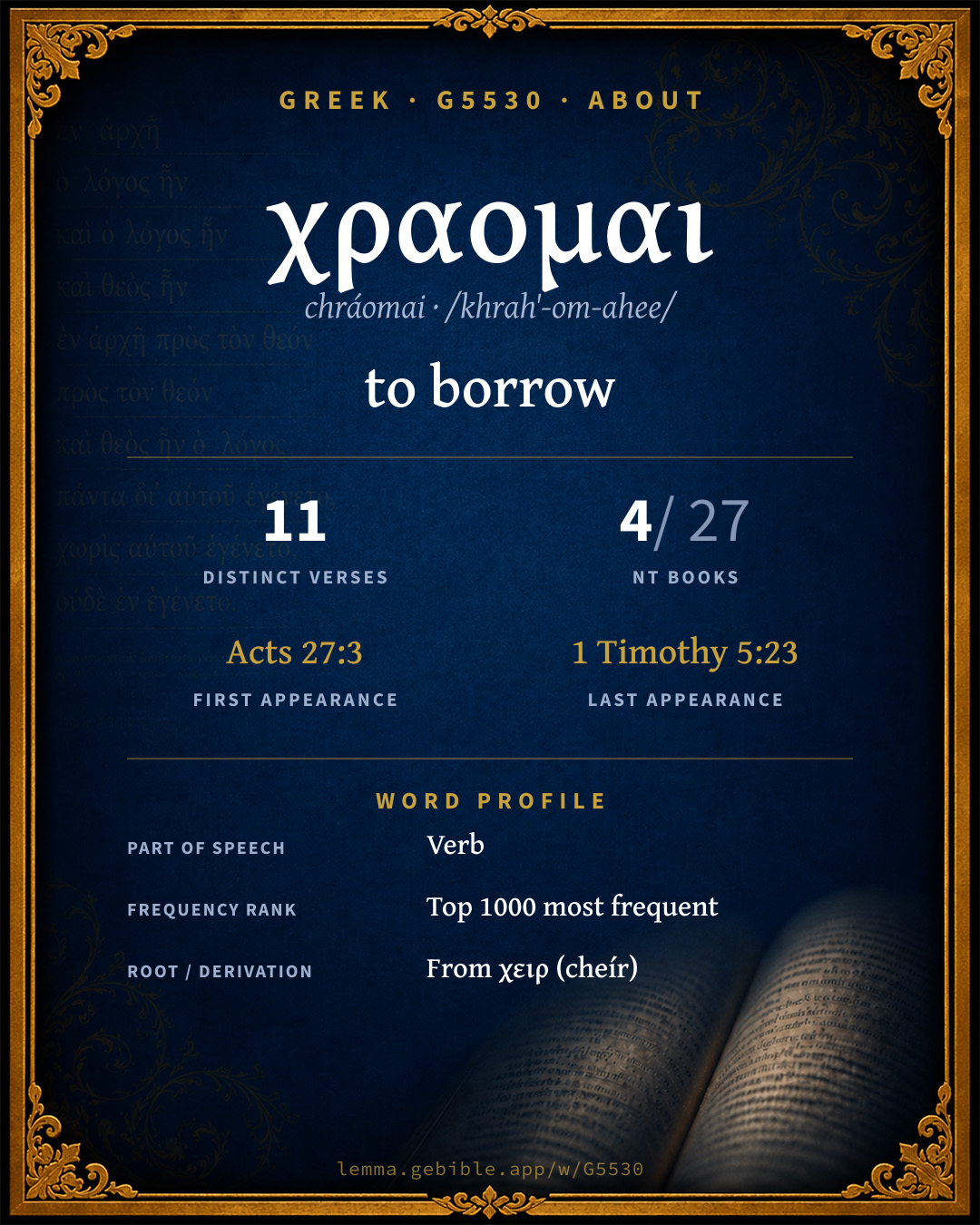
χράομαι
to borrow
‘to borrow’ is one of 3 main senses fuller range ↓
Full lexicon entry — Thayer's Greek Lexicon
From Thayer's Greek Lexicon
Where this word appears
Grammar key — what these labels mean
Part of speech
- Verb
- An action or state-of-being word.
Tense
- Aorist
- Action viewed as a simple whole, without regard to duration — often past (perfective aspect).
- Imperfect
- Continuous or repeated action in past time (“was writing”).
- Present
- Ongoing or general action in present time (imperfective aspect).
- Perfect
- A completed past action with continuing present results.
Voice
- Middle deponent
- Middle in form but active in meaning.
- Middle or Passive deponent
- Middle/passive in form but active in meaning.
Mood
- Indicative
- States a fact or asks a factual question (the mood of reality).
- Imperative
- Expresses a command or request.
- Participle
- A verbal adjective (“writing,” “having written”).
- Subjunctive
- Expresses probability, purpose, or possibility (the mood of contingency).
Case
- Nominative
- The case of the subject (and the predicate nominative).
Person
- 1st person
- The speaker (“I / we”).
- 2nd person
- The one addressed (“you”).
- 3rd person
- The one spoken about (“he / she / it / they”).
Gender
- Masculine
- Grammatically masculine.
Number
- Plural
- More than one.
- Singular
- One.
Every verse where G5530 appears in the Book of 1 Timothy — 2 distinct verses. Click any verse to open its interlinear word-by-word view. Verse text shown in the World English Bible for context — . Each verse’s Greek form is shown with its reference; the English is not keyword-highlighted, since the data carries no word-level English alignment. Use “Compare translations” on any verse to read it across multiple English versions. This concordance covers the Greek New Testament; Septuagint (Greek Old Testament) occurrences of this word are not indexed here.
1 Timothy
About this entry
At a glance — auto-summarized from this page’s data, not written by a person. Every figure links to its source below. This summary describes the numbers; it doesn’t interpret them.
“to borrow” is the headline sense of the Greek verb χραομαι (chráomai). Scripture first uses it in Acts 27:3. It appears 11 verses across 4 books of the Greek New Testament, among its uncommon vocabulary. More than a third of its appearances fall in 1 Corinthians. Catalogued under 3 senses, its meaning is not single-sense. The sections below give every sense, occurrence, and version rendering.
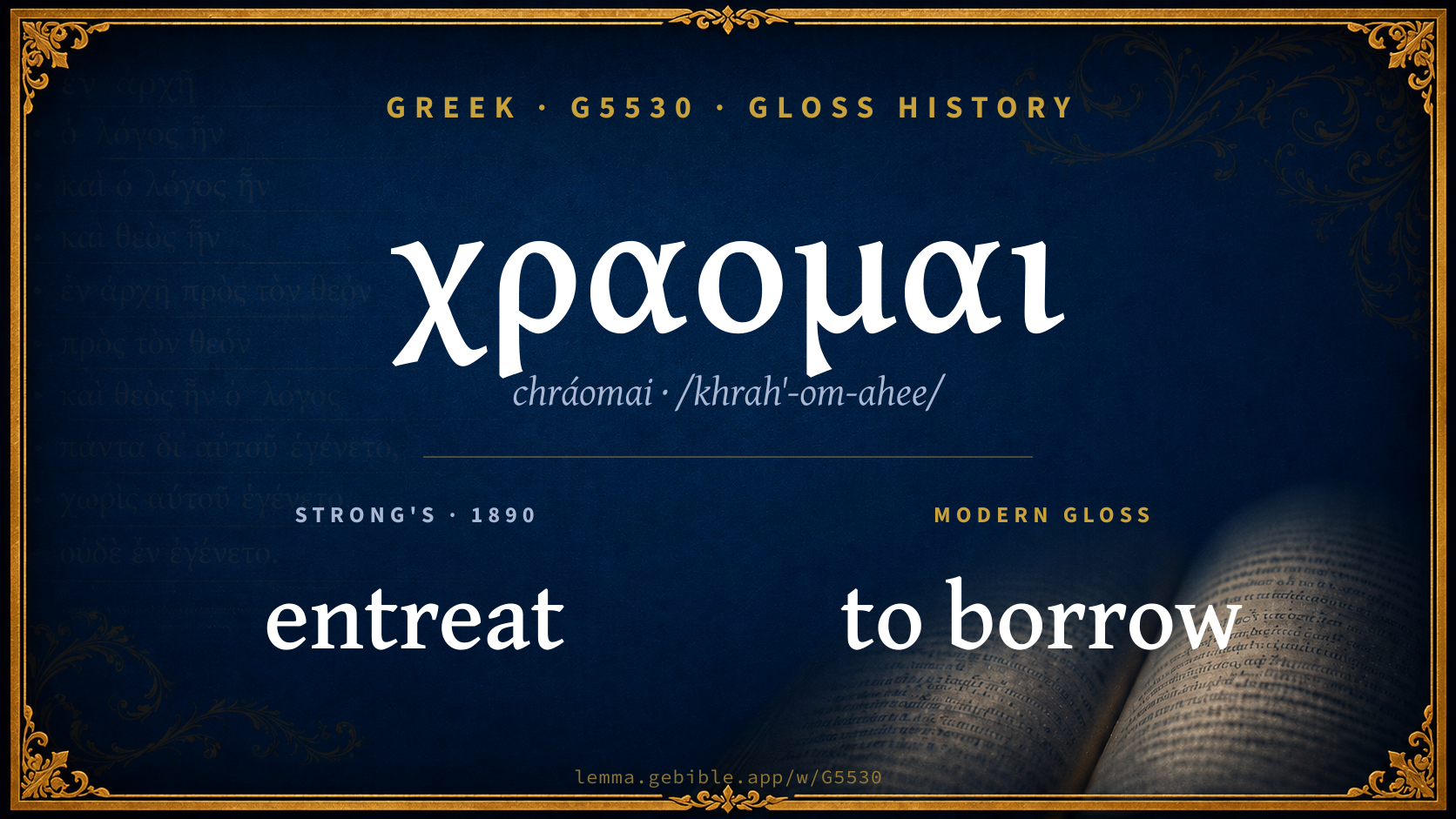
Gloss history
Strong's 1890 vs modern scholarship
About this word
Strong's G5530 catalogs a Greek word from the Greek New Testament.
These counts are not copied from any lexicon or concordance. They are computed here, from the morphology-tagged Greek New Testament. What Lemma adds →
- 11
- distinct verses
- The word appears in 11 distinct verses.
- 4 / 27
- NT books
- The word appears in 4 of 27 New Testament books.
- #978
- by frequency
- Top 1000 most frequent Greek words (rank 978 of 5,347 Greek words by occurrence).
View all 11 occurrences in the concordance →
Most concentrated in
- 1 Corinthians 4 verses 36%
- 2 Corinthians 3 verses 27%
- Acts 2 verses 18%
By section of the New Testament
By traditional corpus
Conventional, traditional groupings — biblical authorship is debated, so this is a traditional corpus grouping, not an authorship claim. Some books belong to more than one corpus (Luke is in both the Gospels and the Lukan corpus, and so on), so these shares overlap and need not total 100%. Each figure is a share of the word’s 11 distinct verses.
- Pauline corpus 9 verses · 82%
- Lukan (Luke–Acts) 2 verses · 18%
How translations render this word
Counts come from each version’s own published word-to-Strong’s tagging or interlinear alignment — an approximate guide to how each version renders this word, not a word-level alignment the data otherwise carries. Because each total is that version’s own tagged count, the per-version totals vary from one another and need not match the appearance or distinct-verse counts above. These counts may also differ from a printed concordance because Lemma counts each distinctly tagged rendering and does not collapse phrase taggings into a single head-word total. This is a fixed set of word-tagged versions (KJV, ASV, BSB, ULT) and does not change with the reading translation you choose elsewhere. Each version’s license is shown beside its name below (and on Sources).
- King James Version: Use 3×
- American Standard Version: Use 5×
- Berean Standard Bible: Use 2×
- unfoldingWord Literal Text: Take advantage of 2×
King James Version Public Domain
Renders G5530 across 11 tagged occurrences — most commonly:
Plus 8 renderings that appear only once — usually multi-word phrases or single function words the recovered tagging swept in, not distinct renderings. Not rendered by a distinct English word in 1 further occurrence.
American Standard Version Public Domain
Renders G5530 across 11 tagged occurrences — most commonly:
Plus 6 renderings that appear only once — usually multi-word phrases or single function words the recovered tagging swept in, not distinct renderings.
Berean Standard Bible Public Domain
Renders G5530 across 11 tagged occurrences — most commonly:
Plus 9 renderings that appear only once — usually multi-word phrases or single function words the recovered tagging swept in, not distinct renderings.
unfoldingWord Literal Text CC BY-SA 4.0
Renders G5530 across 17 tagged occurrences — most commonly:
Plus 15 renderings that appear only once — usually multi-word phrases or single function words the recovered tagging swept in, not distinct renderings.
Senses in Thayer's
The 3 senses Thayer's distinguishes for this word, in lexicon order (not ranked by frequency or importance). The full entry — with sub-senses — is in the Lexicon Entry tab.
- to receive a loan
- borrow
- to take for one's use, to use
Word origin
Derived from χειρ (cheír) (G5495) — hand.
Middle voice of a primary verb (perhaps rather from G5495 to handle ); to furnish what is needed; (give an oracle graze [touch slightly] light upon etc.) that is (by implication) to employ or (by extension) to act towards one in a given manner : - entreat use. Compare G5531 G5534 .
— Strong’s Exhaustive Concordance (1890), public domain.
Forms in the corpus
The 11 distinct written forms G5530 takes in the Greek New Testament, most frequent first — each parse links to that tense’s occurrences in the concordance.
Same root — word family
Other Thayer's entries built from the same root as G5530, grouped by Strong’s listed origin. These share a root / origin per the lexicon — not necessarily a shared meaning. Each links to that word’s own entry.
Derives from
Shares the same root
- χειραγωγος cheiragōgós G5497 hand-leading
- χειρογραφον cheirógraphon G5498 handwriting
- χειροποιητος cheiropoíētos G5499 handmade
- χειροτονεω cheirotonéō G5500 to elect
Derived from this word
- χραω chráō G5531 to lend
- χρεια chreía G5532 necessity
- χρη chrḗ G5534 it is necessary
- χρησις chrēsis G5540 use
- χρηστος chrēstós G5543 fit
- χριω chríō G5548 to anoint
- χρυσος chrysós G5557 gold
- χρως chrṓs G5559 skin
Compare all same-root words → Showing 4 of 14 — not the complete family. They share a root, not necessarily a meaning.
Septuagint usage
The same Greek word χραομαι appears 14 times in the Greek Old Testament (Septuagint), across 13 verses in 7 books.
- 14
- LXX occurrences
- Tagged occurrences of this Greek word in the Septuagint.
- 13
- verses
- Distinct Septuagint verses containing this word.
- 7 / 39
- OT books
- The word appears in 7 of the 39 Old Testament books.
Sample Septuagint occurrences
- Genesis 16:6 χράομαι
- 1 Samuel 2:20 χράομαι
- 2 Kings 6:5 χράομαι
- Esther 8:11 χράομαι
- Job 18:4 χράομαι
- Proverbs 5:5 χράομαι
- Daniel 7:7 χράομαι
Septuagint occurrences (same lexeme)
Every verse where the same Strong’s number (G5530) appears in the Greek Septuagint. Verse text shown in the World English Bible for context; the Greek form is the matched word — the English is not keyword-highlighted.
- Genesis 16:6 χράομαι But Abram said to Sarai, "Behold, your maid is in your hand. Do to her whatever is good in your eyes." Sarai dealt harshly with her, and she fled from her face.
- Genesis 19:8 χράομαι See now, I have two virgin daughters. Please let me bring them out to you, and do you to them as is good in your eyes. Only don't do anything to these men, because they have come under the shadow of my roof."
- 1 Samuel 2:20 χράομαι Eli blessed Elkanah and his wife, and said, Yahweh give you seed of this woman for the petition which was asked of Yahweh. They went to their own home.
- 2 Kings 6:5 χράομαι But as one was felling a beam, the axe head fell into the water; and he cried, and said, Alas, my master! for it was borrowed.
- Esther 8:11 χράομαι in which the king granted the Jews who were in every city to gather themselves together, and to stand for their life, to destroy, to kill, and to cause to perish, all the power of the people and province that would assault them, [their] little ones and women, and to take the spoil of them for a prey,
- Esther 9:13 χράομαι Then said Esther, If it please the king, let it be granted to the Jews who are in Shushan to do tomorrow also according to this day's decree, and let Haman's ten sons be hanged on the gallows.
- Job 18:4 χράομαι You who tear yourself in your anger, Shall the earth be forsaken for you? Or shall the rock be removed out of its place?
- Job 30:14 χράομαι As through a wide breach they come, In the midst of the ruin they roll themselves in.
- Proverbs 5:5 χράομαι Her feet go down to death. Her steps lead straight to Sheol.
- Proverbs 10:26 χράομαι As vinegar to the teeth, and as smoke to the eyes, So is the sluggard to those who send him.
- Proverbs 17:8 χράομαι A bribe is a precious stone in the eyes of him who gives it; Wherever he turns, he prospers.
- Proverbs 25:13 χράομαι As the cold of snow in the time of harvest, So is a faithful messenger to those who send him; For he refreshes the soul of his masters.
- Daniel 7:7 χράομαι After this I saw in the night-visions, and, behold, a fourth animal, awesome and powerful, and strong exceedingly; and it had great iron teeth; it devoured and broke in pieces, and stamped the residue with its feet: and it was diverse from all the animals that were before it; and it had ten horns.
These are occurrences of the same Greek lexeme (G5530) in the Septuagint — not a translation of any one Hebrew word. The store carries no word-level Hebrew↔Greek alignment, so no Hebrew original is asserted here. Counts come from the recovered LXX Strong's tagging — high-frequency vocabulary is well covered, while rare or late forms may be untagged — so they reflect tagged occurrences and may slightly undercount.