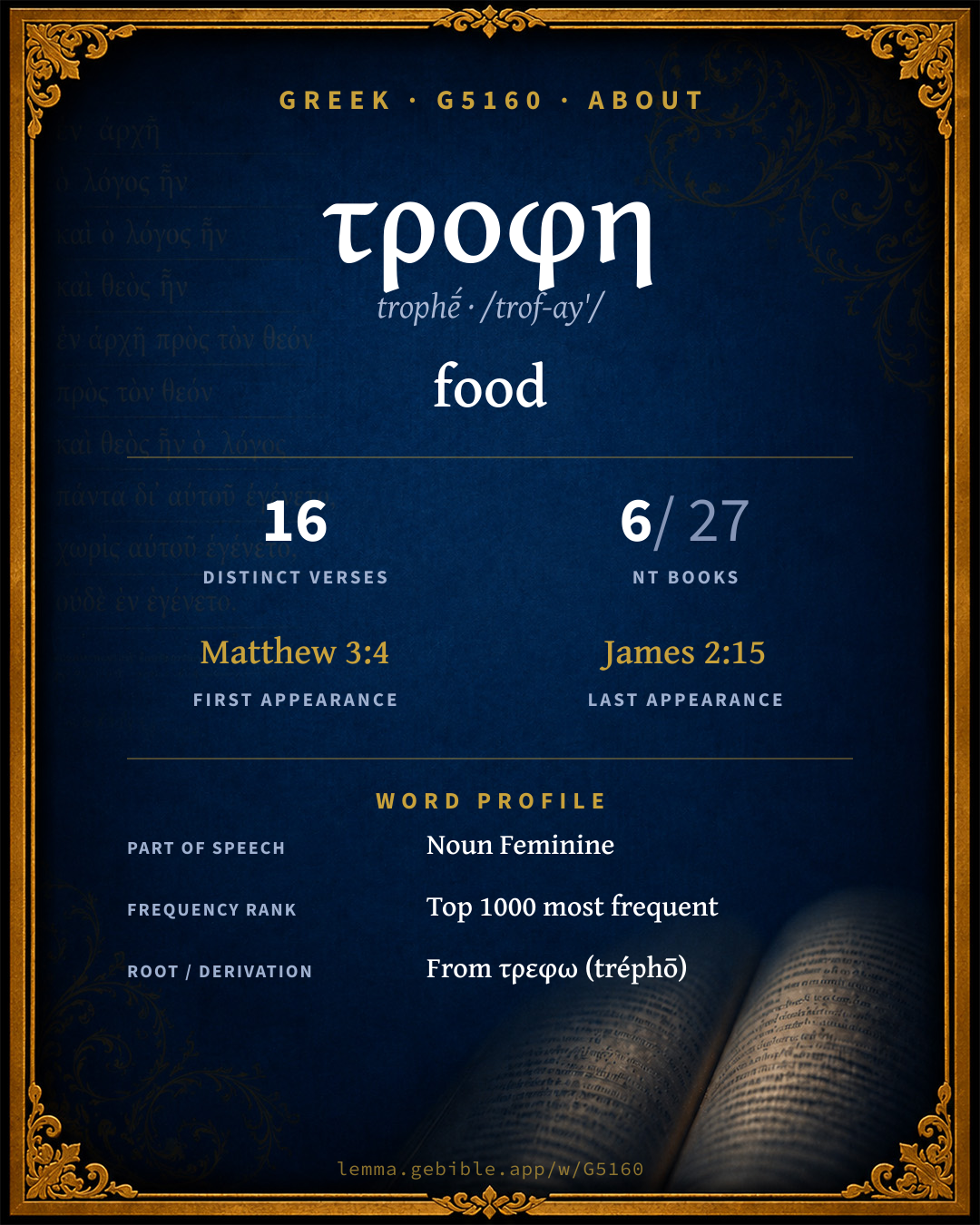
τροφή
food
Full lexicon entry — Thayer's Greek Lexicon
From Thayer's Greek Lexicon
Where this word appears
See every Genitive-case word in the Greek New Testament →
Grammar key — what these labels mean
Part of speech
- Noun
- A naming word — a person, place, thing, or idea.
Case
- Genitive
- The case of source, possession, or “of” — answers “whose / from what.”
- Accusative
- The case of the direct object and of extent.
- Nominative
- The case of the subject (and the predicate nominative).
Gender
- Feminine
- Grammatically feminine.
Number
- Singular
- One.
- Plural
- More than one.
Grammatical forms
- Noun, Genitive, Singular, Feminine 11 times (69%)
- Noun, Accusative, Singular, Feminine 2 times (13%)
- Noun, Nominative, Singular, Feminine 2 times (13%)
- Noun, Accusative, Plural, Feminine 1 time (6%)
Parsed forms decoded from the imported morphology (Robinson–Tischendorf, public domain), counted across 16 parsed occurrences — not distinct verses.
Every verse where G5160 appears — 16 distinct verses across 6 books. Click any verse to open its interlinear word-by-word view. Verse text shown in the World English Bible for context — . Each verse’s Greek form is shown with its reference; the English is not keyword-highlighted, since the data carries no word-level English alignment. Use “Compare translations” on any verse to read it across multiple English versions. This concordance covers the Greek New Testament; Septuagint (Greek Old Testament) occurrences of this word are not indexed here.
Matthew 4 verses
- Matthew 3:4 τροφὴ n nom sg fem Now John himself wore clothing made of camel's hair, with a leather belt around his waist. His food was locusts and wild honey.
- Matthew 6:25 τροφῆς n gen sg fem Therefore, I tell you, don't be anxious for your life: what you will eat, or what you will drink; nor yet for your body, what you will wear. Isn't life more than food, and the body more than clothing?
- Matthew 10:10 τροφῆς n gen sg fem Take no bag for your journey, neither two coats, nor shoes, nor staff: for the laborer is worthy of his food.
- Matthew 24:45 τροφὴν n acc sg fem "Who then is the faithful and wise servant, whom his lord has set over his household, to give them their food in due season?
Luke 1 verse
John 1 verse
Acts 7 verses
- Acts 2:46 τροφῆς n gen sg fem Day by day, continuing steadfastly with one accord in the temple, and breaking bread at home, they took their food with gladness and singleness of heart,
- Acts 9:19 τροφὴν n acc sg fem He took food and was strengthened. Saul stayed several days with the disciples who were at Damascus.
- Acts 14:17 τροφῆς n gen sg fem Yet he didn't leave himself without witness, in that he did good and gave you rains from the sky and fruitful seasons, filling our hearts with food and gladness."
- Acts 27:33 τροφῆς n gen sg fem While the day was coming on, Paul begged them all to take some food, saying, "This day is the fourteenth day that you wait and continue fasting, having taken nothing.
- Acts 27:34 τροφῆς n gen sg fem Therefore I beg you to take some food, for this is for your safety; for not a hair will perish from any of your heads."
- Acts 27:36 τροφῆς n gen sg fem Then they all cheered up, and they also took food.
- Acts 27:38 τροφῆς n gen sg fem When they had eaten enough, they lightened the ship, throwing out the wheat into the sea.
Hebrews 2 verses
- Hebrews 5:12 τροφῆς n gen sg fem For when by reason of the time you ought to be teachers, you again need to have someone teach you the rudiments of the first principles of the oracles of God. You have come to need milk, and not solid food.
- Hebrews 5:14 τροφή n nom sg fem But solid food is for those who are full grown, who by reason of use have their senses exercised to discern good and evil.
James 1 verse
About this entry
At a glance — auto-summarized from this page’s data, not written by a person. Every figure links to its source below. This summary describes the numbers; it doesn’t interpret them.
The Greek noun τροφη centers on the idea of “food.” Its earliest occurrence is Matthew 3:4. It appears 16 verses across 6 books of the Greek New Testament, among its uncommon vocabulary. The word gravitates to Acts (44%), then Matthew and Hebrews. It clusters with τρεφω, θρεμμα and θρομβος under a shared root. Dig into 16-verse concordance and the renderings breakdown below.
Gloss history
Strong's 1890 vs modern scholarship
About this word
Strong's G5160 catalogs a Greek word from the Greek New Testament.
These counts are not copied from any lexicon or concordance. They are computed here, from the morphology-tagged Greek New Testament. What Lemma adds →
- 16
- distinct verses
- The word appears in 16 distinct verses.
- 6 / 27
- NT books
- The word appears in 6 of 27 New Testament books.
- #726
- by frequency
- Top 1000 most frequent Greek words (rank 726 of 5,347 Greek words by occurrence).
View all 16 occurrences in the concordance →
By section of the New Testament
By traditional corpus
Conventional, traditional groupings — biblical authorship is debated, so this is a traditional corpus grouping, not an authorship claim. Some books belong to more than one corpus (Luke is in both the Gospels and the Lukan corpus, and so on), so these shares overlap and need not total 100%. Each figure is a share of the word’s 16 distinct verses.
- Lukan (Luke–Acts) 8 verses · 50%
- Gospels 6 verses · 38%
- Hebrews 2 verses · 13%
- Johannine 1 verse · 6%
- General (Catholic) Epistles 1 verse · 6%
How translations render this word
Counts come from each version’s own published word-to-Strong’s tagging or interlinear alignment — an approximate guide to how each version renders this word, not a word-level alignment the data otherwise carries. Because each total is that version’s own tagged count, the per-version totals vary from one another and need not match the appearance or distinct-verse counts above. These counts may also differ from a printed concordance because Lemma counts each distinctly tagged rendering and does not collapse phrase taggings into a single head-word total. This is a fixed set of word-tagged versions (KJV, ASV, BSB, ULT) and does not change with the reading translation you choose elsewhere. Each version’s license is shown beside its name below (and on Sources).
- King James Version: Meat 10×, Food 2×, Some meat 2×
- American Standard Version: Food 10×, Some food 2×, Than the food 2×
- Berean Standard Bible: Food 11×
- unfoldingWord Literal Text: Food 16×
King James Version Public Domain
Renders G5160 across 16 tagged occurrences — most commonly:
Plus 2 renderings that appear only once — usually multi-word phrases or single function words the recovered tagging swept in, not distinct renderings.
American Standard Version Public Domain
Renders G5160 across 16 tagged occurrences — most commonly:
Plus 2 renderings that appear only once — usually multi-word phrases or single function words the recovered tagging swept in, not distinct renderings.
Berean Standard Bible Public Domain
Renders G5160 across 13 tagged occurrences — most commonly:
Plus 2 renderings that appear only once — usually multi-word phrases or single function words the recovered tagging swept in, not distinct renderings. Not rendered by a distinct English word in 3 further occurrences.
unfoldingWord Literal Text CC BY-SA 4.0
Renders G5160 across 17 tagged occurrences — most commonly:
Plus 1 rendering that appears only once — usually multi-word phrases or single function words the recovered tagging swept in, not distinct renderings.
Senses in Thayer's
The 1 sense Thayer's distinguishes for this word, in lexicon order (not ranked by frequency or importance). The full entry — with sub-senses — is in the Lexicon Entry tab.
- food, nourishment
Word origin
Derived from τρεφω (tréphō) (G5142) — to nourish.
From G5142 ; nourishment (literally or figuratively); by implication rations ( wages ): - food meat.
— Strong’s Exhaustive Concordance (1890), public domain.
Forms in the corpus
The 5 distinct written forms G5160 takes in the Greek New Testament, most frequent first — each parse links to that case’s occurrences in the concordance.
| Form | Parsing | Example | Uses |
|---|---|---|---|
| τροφῆς trophē̂s | Noun, Genitive, Singular, Feminine | Matthew 6:25 | 11 |
| τροφὴν trophḕn | Noun, Accusative, Singular, Feminine | Matthew 24:45 | 2 |
| τροφή trophḗ | Noun, Nominative, Singular, Feminine | Hebrews 5:14 | 1 |
| τροφὰς trophàs | Noun, Accusative, Plural, Feminine | John 4:8 | 1 |
| τροφὴ trophḕ | Noun, Nominative, Singular, Feminine | Matthew 3:4 | 1 |
Same root — word family
Other Thayer's entries built from the same root as G5160, grouped by Strong’s listed origin. These share a root / origin per the lexicon — not necessarily a shared meaning. Each links to that word’s own entry.
Derives from
Shares the same root
Proper names from this root
People and places named from this root — a name, not an additional meaning of the word.
Compare all same-root words → Showing 4 of 6 — not the complete family. 1 of the same-root words is a proper name (a person or place). They share a root, not necessarily a meaning.
Septuagint usage
The same Greek word τροφη appears 13 times in the Greek Old Testament (Septuagint), across 13 verses in 6 books.
- 13
- LXX occurrences
- Tagged occurrences of this Greek word in the Septuagint.
- 13
- verses
- Distinct Septuagint verses containing this word.
- 6 / 39
- OT books
- The word appears in 6 of the 39 Old Testament books.
Sample Septuagint occurrences
- Genesis 49:27 τροφή
- Judges 8:5 τροφή
- 2 Chronicles 11:23 τροφή
- Job 36:31 τροφή
- Psalms 64:10 τροφή
- Proverbs 6:8 τροφή
Septuagint occurrences (same lexeme)
Every verse where the same Strong’s number (G5160) appears in the Greek Septuagint. Verse text shown in the World English Bible for context; the Greek form is the matched word — the English is not keyword-highlighted.
- Genesis 49:27 τροφή "Benjamin is a ravenous wolf. In the morning he will devour the prey. At evening he will divide the spoil."
- Judges 8:5 τροφή He said to the men of Succoth, Please give loaves of bread to the people who follow me; for they are faint, and I am pursuing after Zebah and Zalmunna, the kings of Midian.
- 2 Chronicles 11:23 τροφή He dealt wisely, and dispersed of all his sons throughout all the lands of Judah and Benjamin, to every fortified city: and he gave them food in abundance. He sought [for them] many wives.
- Job 36:31 τροφή For by these he judges the people. He gives food in abundance.
- Psalms 64:10 τροφή The righteous shall be glad in Yahweh, And shall take refuge in him. All the upright in heart shall praise him!
- Psalms 103:27 τροφή
- Psalms 110:5 τροφή The Lord is at your right hand. He will crush kings in the day of his wrath.
- Psalms 135:25 τροφή
- Psalms 144:15 τροφή Happy are the people who are in such a situation. Happy are the people whose God is Yahweh.
- Psalms 145:7 τροφή They will utter the memory of your great goodness, And will sing of your righteousness.
- Psalms 146:9 τροφή Yahweh preserves the foreigners. He upholds the fatherless and widow, But the way of the wicked he turns upside down.
- Proverbs 6:8 τροφή Provides her bread in the summer, And gathers her food in the harvest.
- Proverbs 30:25 τροφή The ants are not a strong people, Yet they provide their food in the summer;
These are occurrences of the same Greek lexeme (G5160) in the Septuagint — not a translation of any one Hebrew word. The store carries no word-level Hebrew↔Greek alignment, so no Hebrew original is asserted here. Counts come from the recovered LXX Strong's tagging — high-frequency vocabulary is well covered, while rare or late forms may be untagged — so they reflect tagged occurrences and may slightly undercount.