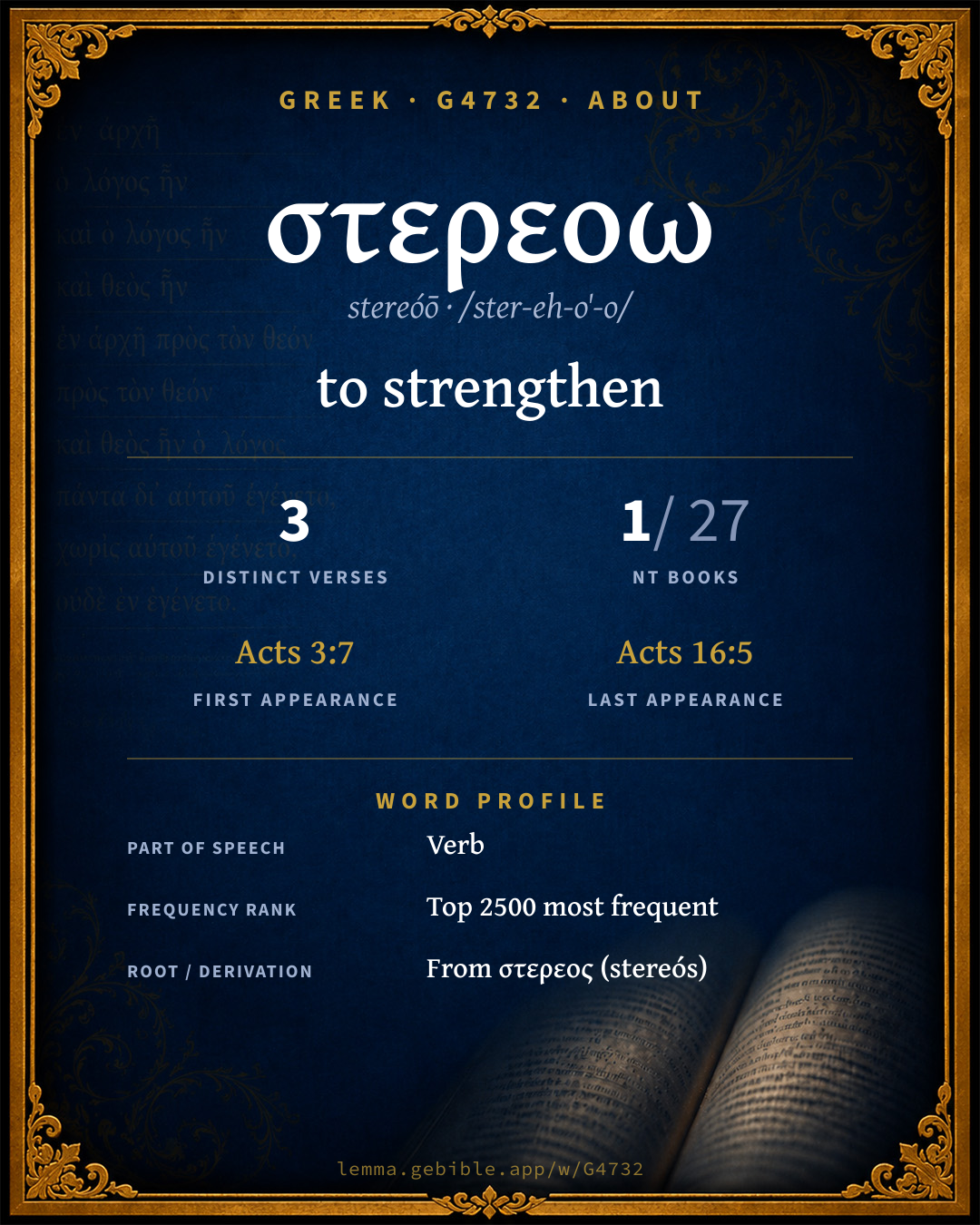
στερεόω
to strengthen
Full lexicon entry — Thayer's Greek Lexicon
From Thayer's Greek Lexicon
Where this word appears
See every Aorist-tense verb in the Greek New Testament →
Grammar key — what these labels mean
Part of speech
- Verb
- An action or state-of-being word.
Tense
- Aorist
- Action viewed as a simple whole, without regard to duration — often past (perfective aspect).
- Imperfect
- Continuous or repeated action in past time (“was writing”).
Voice
- Active
- The subject performs the action.
- Passive
- The subject receives the action.
Mood
- Indicative
- States a fact or asks a factual question (the mood of reality).
Person
- 3rd person
- The one spoken about (“he / she / it / they”).
Number
- Singular
- One.
- Plural
- More than one.
2 distinct verses where G4732 appears in the Aorist tense, across 1 book. Filtered view — show all forms. Click any verse to open its interlinear word-by-word view. Verse text shown in the World English Bible for context — . Each verse’s Greek form is shown with its reference; the English is not keyword-highlighted, since the data carries no word-level English alignment. Use “Compare translations” on any verse to read it across multiple English versions. This concordance covers the Greek New Testament; Septuagint (Greek Old Testament) occurrences of this word are not indexed here.
Acts 2 verses
- Acts 3:7 ἐστερεώθησαν aor pass ind 3pl He took him by the right hand, and raised him up. Immediately his feet and his ankle bones received strength.
- Acts 3:16 ἐστερέωσεν aor act ind 3sg By faith in his name has his name made this man strong, whom you see and know. Yes, the faith which is through him has given him this perfect soundness in the presence of you all.
About this entry
At a glance — auto-summarized from this page’s data, not written by a person. Every figure links to its source below. This summary describes the numbers; it doesn’t interpret them.
“to strengthen” is the headline sense of the Greek verb στερεοω (stereóō). The Greek New Testament uses it only 3 verses. It clusters heavily in Acts, which alone accounts for 100% of its uses. First canonically at Acts 3:7, it enters the text early. From the same root come στερεος, στειρος and στρηνος. See the sense tree, 3-verse concordance, and the renderings breakdown below.
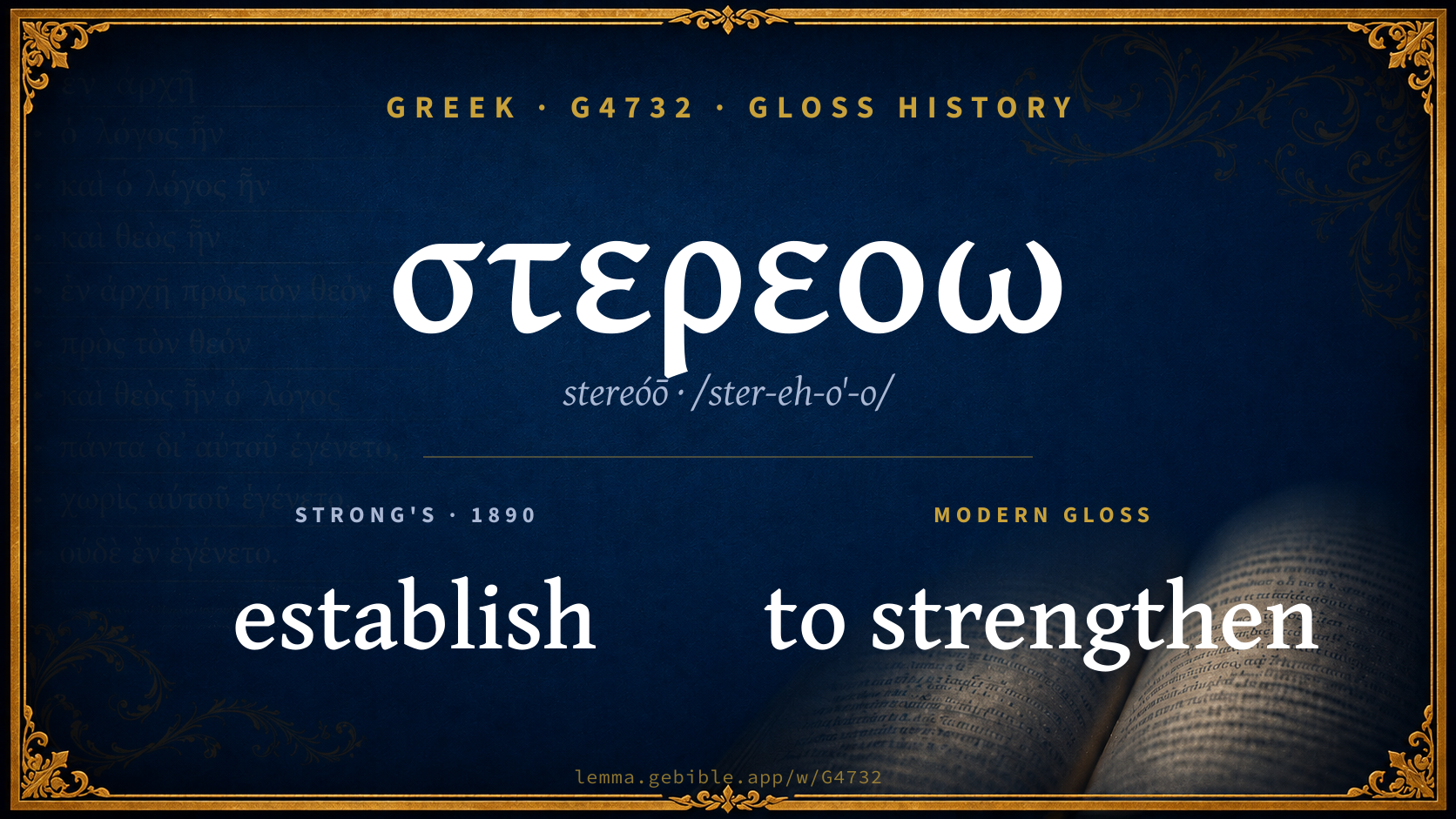
Gloss history
Strong's 1890 vs modern scholarship
About this word
Strong's G4732 catalogs a Greek word from the Greek New Testament.
These counts are not copied from any lexicon or concordance. They are computed here, from the morphology-tagged Greek New Testament. What Lemma adds →
- 3
- distinct verses
- The word appears in 3 distinct verses.
- 1 / 27
- NT books
- The word appears in 1 of 27 New Testament books.
- #2,203
- by frequency
- Top 2500 most frequent Greek words (rank 2,203 of 5,347 Greek words by occurrence).
View all 3 occurrences in the concordance →
Most concentrated in
- Acts 3 verses 100%
By section of the New Testament
By traditional corpus
Conventional, traditional groupings — biblical authorship is debated, so this is a traditional corpus grouping, not an authorship claim. Some books belong to more than one corpus (Luke is in both the Gospels and the Lukan corpus, and so on), so these shares overlap and need not total 100%. Each figure is a share of the word’s 3 distinct verses.
- Lukan (Luke–Acts) 3 verses · 100%
How translations render this word
Counts come from each version’s own published word-to-Strong’s tagging or interlinear alignment — an approximate guide to how each version renders this word, not a word-level alignment the data otherwise carries. Because each total is that version’s own tagged count, the per-version totals vary from one another and need not match the appearance or distinct-verse counts above. These counts may also differ from a printed concordance because Lemma counts each distinctly tagged rendering and does not collapse phrase taggings into a single head-word total. This is a fixed set of word-tagged versions (KJV, ASV, BSB, ULT) and does not change with the reading translation you choose elsewhere. Each version’s license is shown beside its name below (and on Sources).
- King James Version: Established 1×, Hath made 1×, Received strength 1×
- American Standard Version: Made 1×, Received strength 1×, Strengthened 1×
- Berean Standard Bible: Has been made strong 1×, Were made strong 1×, Were strengthened 1×
- unfoldingWord Literal Text: Has made strong 1×, Were being strengthened 1×, Were made strong 1×
King James Version Public Domain
Renders G4732 across 5 tagged occurrences — most commonly:
American Standard Version Public Domain
Renders G4732 across 5 tagged occurrences — most commonly:
Berean Standard Bible Public Domain
Renders G4732 across 3 tagged occurrences — most commonly:
unfoldingWord Literal Text CC BY-SA 4.0
Renders G4732 across 3 tagged occurrences — most commonly:
Senses in Thayer's
The 1 sense Thayer's distinguishes for this word, in lexicon order (not ranked by frequency or importance). The full entry — with sub-senses — is in the Lexicon Entry tab.
- to make solid, make firm, strengthen, make strong
Word origin
Derived from στερεος (stereós) (G4731) — strong.
From G4731 ; to solidify that is confirm (literally or figuratively): - establish receive strength make strong.
— Strong’s Exhaustive Concordance (1890), public domain.
Forms in the corpus
The 3 distinct written forms G4732 takes in the Greek New Testament, most frequent first — each parse links to that tense’s occurrences in the concordance.
| Form | Parsing | Example | Uses |
|---|---|---|---|
| ἐστερέωσεν esteréōsen | Verb, Aorist, Active, Indicative, 3rd person, Singular | Acts 3:16 | 1 |
| ἐστερεοῦντο estereoûnto | Verb, Imperfect, Passive, Indicative, 3rd person, Plural | Acts 16:5 | 1 |
| ἐστερεώθησαν estereṓthēsan | Verb, Aorist, Passive, Indicative, 3rd person, Plural | Acts 3:7 | 1 |
Same root — word family
Other Thayer's entries built from the same root as G4732, grouped by Strong’s listed origin. These share a root / origin per the lexicon — not necessarily a shared meaning. Each links to that word’s own entry.
Derives from
Shares the same root
- στειρος steíros G4723 hard
- στρηνος strēnos G4764 excess strength
- στρωννυμι strṓnnymi G4766 to spread
Derived from this word
Compare all same-root words → Showing 4 of 6 — not the complete family. They share a root, not necessarily a meaning.
Septuagint usage
The same Greek word στερεοω appears 20 times in the Greek Old Testament (Septuagint), across 20 verses in 10 books.
- 20
- LXX occurrences
- Tagged occurrences of this Greek word in the Septuagint.
- 20
- verses
- Distinct Septuagint verses containing this word.
- 10 / 39
- OT books
- The word appears in 10 of the 39 Old Testament books.
Sample Septuagint occurrences
- 1 Samuel 2:1 στερεόω
- Job 37:18 στερεόω
- Psalms 17:18 στερεόω
- Isaiah 42:5 στερεόω
- Jeremiah 5:3 στερεόω
- Lamentations 2:4 στερεόω
- Ezekiel 4:7 στερεόω
- Daniel 8:24 στερεόω
- Hosea 13:4 στερεόω
- Amos 4:13 στερεόω
Septuagint occurrences (same lexeme)
Every verse where the same Strong’s number (G4732) appears in the Greek Septuagint. Verse text shown in the World English Bible for context; the Greek form is the matched word — the English is not keyword-highlighted.
- 1 Samuel 2:1 στερεόω Hannah prayed, and said: My heart exults in Yahweh; My horn is exalted in Yahweh; My mouth is enlarged over my enemies; Because I rejoice in your salvation.
- Job 37:18 στερεόω Can you, with him, spread out the sky, Which is strong as a cast metal mirror?
- Psalms 17:18 στερεόω
- Psalms 32:6 στερεόω For this, let everyone who is godly pray to you in a time when you may be found. Surely when the great waters overflow, they shall not reach to him.
- Psalms 74:4 στερεόω Your adversaries have roared in the midst of your assembly. They have set up their standards as signs.
- Psalms 92:1 στερεόω It is a good thing to give thanks to Yahweh, To sing praises to your name, Most High;
- Psalms 135:6 στερεόω Whatever Yahweh pleased, that he has done, In heaven and in earth, in the seas and in all deeps;
- Isaiah 42:5 στερεόω Thus says God Yahweh, he who created the heavens, and stretched them forth; he who spread abroad the earth and that which comes out of it; he who gives breath to the people on it, and spirit to those who walk therein:
- Isaiah 44:24 στερεόω Thus says Yahweh, your Redeemer, and he who formed you from the womb: I am Yahweh, who makes all things; who stretches forth the heavens alone; who spreads abroad the earth (who is with me?);
- Isaiah 45:12 στερεόω I have made the earth, and created man on it: I, even my hands, have stretched out the heavens; and all their host have I commanded.
- Isaiah 48:13 στερεόω Yes, my hand has laid the foundation of the earth, and my right hand has spread out the heavens: when I call to them, they stand up together.
- Isaiah 51:6 στερεόω Lift up your eyes to the heavens, and look on the earth beneath; for the heavens shall vanish away like smoke, and the earth shall wax old like a garment; and those who dwell therein shall die in like manner: but my salvation shall be forever, and my righteousness shall not be abolished.
- Jeremiah 5:3 στερεόω O Yahweh, don't your eyes look on truth? you have stricken them, but they were not grieved; you have consumed them, but they have refused to receive correction: they have made their faces harder than a rock; they have refused to return.
- Jeremiah 10:4 στερεόω They deck it with silver and with gold; they fasten it with nails and with hammers, that it not move.
- Jeremiah 52:6 στερεόω In the fourth month, in the ninth day of the month, the famine was sore in the city, so that there was no bread for the people of the land.
- Lamentations 2:4 στερεόω He has bent his bow like an enemy, he has stood with his right hand as an adversary, Has killed all that were pleasant to the eye: In the tent of the daughter of Zion he has poured out his wrath like fire.
- Ezekiel 4:7 στερεόω You shall set your face toward the siege of Jerusalem, with your arm uncovered; and you shall prophesy against it.
- Daniel 8:24 στερεόω His power shall be mighty, but not by his own power; and he shall destroy wonderfully, and shall prosper and do [his pleasure]; and he shall destroy the mighty ones and the holy people.
- Hosea 13:4 στερεόω "Yet I am Yahweh your God from the land of Egypt; And you will know no god but me, And besides me there is no savior.
- Amos 4:13 στερεόω For, behold, he who forms the mountains, And creates the wind, And declares to man what is his thought; Who makes the morning darkness, And treads on the high places of the Earth: Yahweh, the God of hosts, is his name."
These are occurrences of the same Greek lexeme (G4732) in the Septuagint — not a translation of any one Hebrew word. The store carries no word-level Hebrew↔Greek alignment, so no Hebrew original is asserted here. Counts come from the recovered LXX Strong's tagging — high-frequency vocabulary is well covered, while rare or late forms may be untagged — so they reflect tagged occurrences and may slightly undercount.