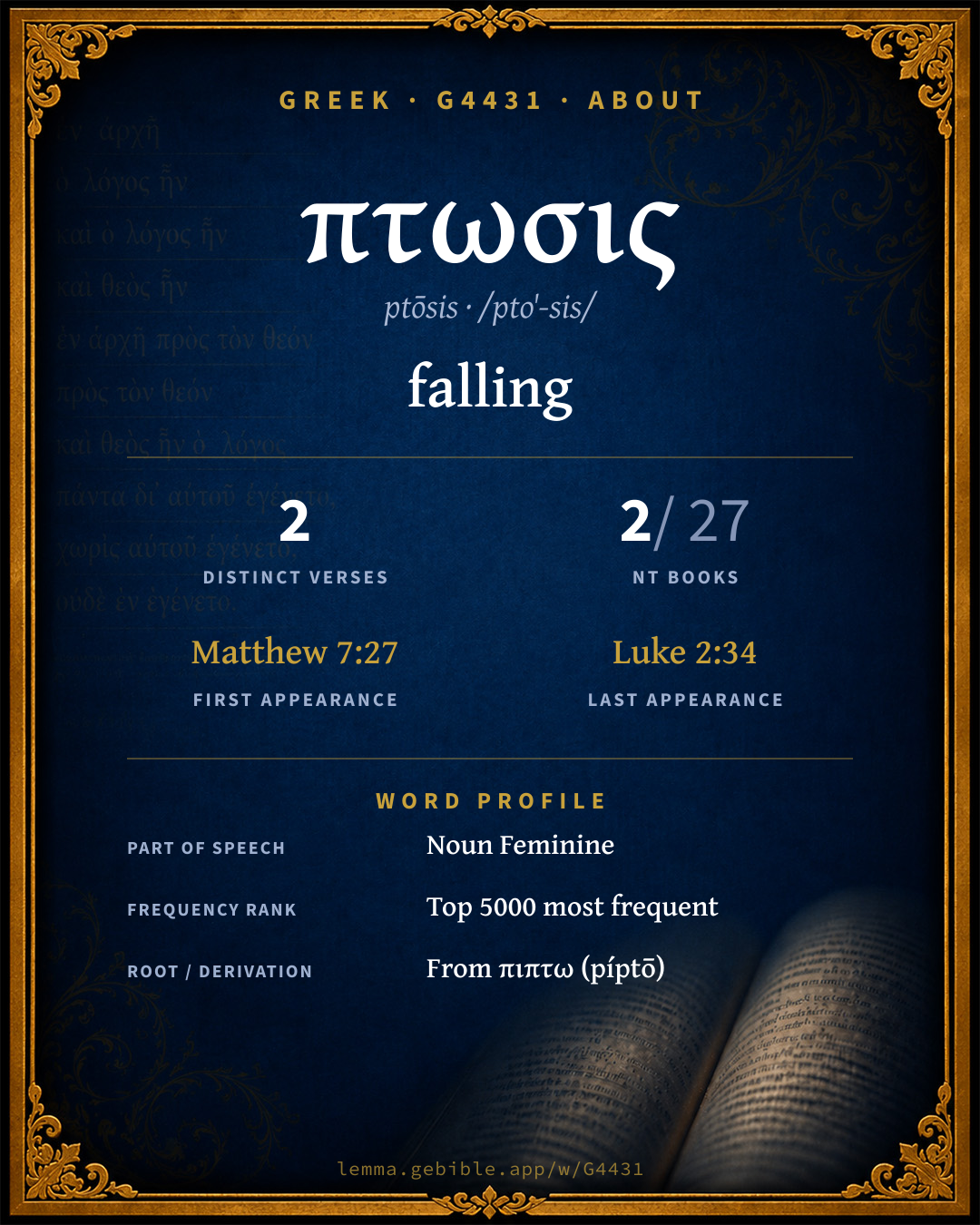
πτῶσις
falling
Full lexicon entry — Thayer's Greek Lexicon
From Thayer's Greek Lexicon
Where this word appears
Grammar key — what these labels mean
Part of speech
- Noun
- A naming word — a person, place, thing, or idea.
Case
- Accusative
- The case of the direct object and of extent.
- Nominative
- The case of the subject (and the predicate nominative).
Gender
- Feminine
- Grammatically feminine.
Number
- Singular
- One.
Every verse where G4431 appears in the Book of Matthew — 1 distinct verse. Click any verse to open its interlinear word-by-word view. Verse text shown in the World English Bible for context — . Each verse’s Greek form is shown with its reference; the English is not keyword-highlighted, since the data carries no word-level English alignment. Use “Compare translations” on any verse to read it across multiple English versions. This concordance covers the Greek New Testament; Septuagint (Greek Old Testament) occurrences of this word are not indexed here.
Matthew
About this entry
At a glance — auto-summarized from this page’s data, not written by a person. Every figure links to its source below. This summary describes the numbers; it doesn’t interpret them.
“falling” is the headline sense of the Greek noun πτωσις (ptōsis). It occurs a mere 2 verses across Scripture. It clusters heavily in Matthew, which alone accounts for 50% of its uses. Its earliest occurrence is Matthew 7:27. It clusters with πιπτω, πταιω and πτοεω under a shared root. See the sense tree, 2-verse concordance, and the renderings breakdown below.
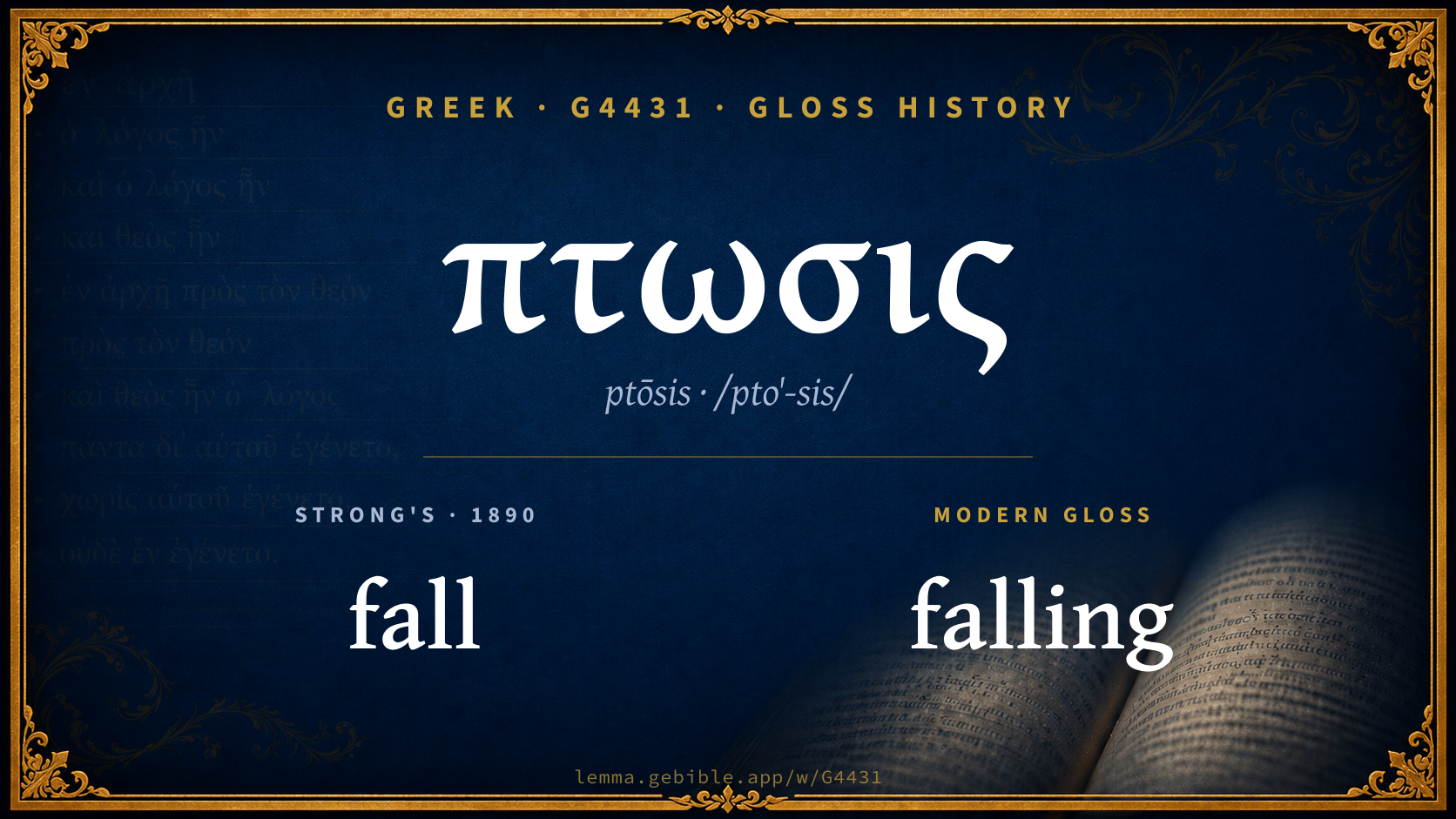
Gloss history
Strong's 1890 vs modern scholarship
About this word
Strong's G4431 catalogs a Greek word from the Greek New Testament.
These counts are not copied from any lexicon or concordance. They are computed here, from the morphology-tagged Greek New Testament. What Lemma adds →
- 2
- distinct verses
- The word appears in 2 distinct verses.
- 2 / 27
- NT books
- The word appears in 2 of 27 New Testament books.
- #2,678
- by frequency
- Top 5000 most frequent Greek words (rank 2,678 of 5,347 Greek words by occurrence).
View all 2 occurrences in the concordance →
By traditional corpus
Conventional, traditional groupings — biblical authorship is debated, so this is a traditional corpus grouping, not an authorship claim. Some books belong to more than one corpus (Luke is in both the Gospels and the Lukan corpus, and so on), so these shares overlap and need not total 100%. Each figure is a share of the word’s 2 distinct verses.
- Gospels 2 verses · 100%
- Lukan (Luke–Acts) 1 verse · 50%
How translations render this word
Counts come from each version’s own published word-to-Strong’s tagging or interlinear alignment — an approximate guide to how each version renders this word, not a word-level alignment the data otherwise carries. Because each total is that version’s own tagged count, the per-version totals vary from one another and need not match the appearance or distinct-verse counts above. These counts may also differ from a printed concordance because Lemma counts each distinctly tagged rendering and does not collapse phrase taggings into a single head-word total. This is a fixed set of word-tagged versions (KJV, ASV, BSB, ULT) and does not change with the reading translation you choose elsewhere. Each version’s license is shown beside its name below (and on Sources).
- King James Version: Fall 2×
- American Standard Version: Fall 1×, Falling 1×
- Berean Standard Bible: Collapse 1×, Fall 1×
- unfoldingWord Literal Text: Destruction 1×, Downfall 1×
King James Version Public Domain
Renders G4431 across 2 tagged occurrences — most commonly:
American Standard Version Public Domain
Renders G4431 across 2 tagged occurrences — most commonly:
Berean Standard Bible Public Domain
Renders G4431 across 2 tagged occurrences — most commonly:
unfoldingWord Literal Text CC BY-SA 4.0
Renders G4431 across 2 tagged occurrences — most commonly:
Senses in Thayer's
The 1 sense Thayer's distinguishes for this word, in lexicon order (not ranked by frequency or importance). The full entry — with sub-senses — is in the Lexicon Entry tab.
- a falling, downfall
Word origin
Derived from πιπτω (píptō) (G4098) — to fall.
From the alternate of G4098 ; a crash that is downfall (literally or figuratively): - fall.
— Strong’s Exhaustive Concordance (1890), public domain.
Forms in the corpus
The 2 distinct written forms G4431 takes in the Greek New Testament, most frequent first — each parse links to that case’s occurrences in the concordance.
| Form | Parsing | Example | Uses |
|---|---|---|---|
| πτῶσιν ptō̂sin | Noun, Accusative, Singular, Feminine | Luke 2:34 | 1 |
| πτῶσις ptō̂sis | Noun, Nominative, Singular, Feminine | Matthew 7:27 | 1 |
Same root — word family
Other Thayer's entries built from the same root as G4431, grouped by Strong’s listed origin. These share a root / origin per the lexicon — not necessarily a shared meaning. Each links to that word’s own entry.
Derives from
Shares the same root
Compare all same-root words → Showing 4 of 5 — not the complete family. They share a root, not necessarily a meaning.
Septuagint usage
The same Greek word πτωσις appears 20 times in the Greek Old Testament (Septuagint), across 18 verses in 8 books.
- 20
- LXX occurrences
- Tagged occurrences of this Greek word in the Septuagint.
- 18
- verses
- Distinct Septuagint verses containing this word.
- 8 / 39
- OT books
- The word appears in 8 of the 39 Old Testament books.
Sample Septuagint occurrences
- Exodus 30:12 πτῶσις
- Judges 20:39 πτῶσις
- Psalms 105:29 πτῶσις
- Isaiah 17:1 πτῶσις
- Jeremiah 6:15 πτῶσις
- Ezekiel 26:15 πτῶσις
- Nahum 3:3 πτῶσις
- Zechariah 14:12 πτῶσις
Septuagint occurrences (same lexeme)
Every verse where the same Strong’s number (G4431) appears in the Greek Septuagint. Verse text shown in the World English Bible for context; the Greek form is the matched word — the English is not keyword-highlighted.
- Exodus 30:12 πτῶσις "When you take a census of the children of Israel, according to those who are numbered among them, then each man shall give a ransom for his soul to Yahweh, when you number them; that there be no plague among them when you number them.
- Judges 20:39 πτῶσις The men of Israel turned in the battle, and Benjamin began to strike and kill of the men of Israel about thirty persons; for they said, Surely they are struck down before us, as in the first battle.
- Psalms 105:29 πτῶσις He turned their waters into blood, And killed their fish.
- Isaiah 17:1 πτῶσις The burden of Damascus. Behold, Damascus is taken away from being a city, and it shall be a ruinous heap.
- Isaiah 51:17 πτῶσις Awake, awake, stand up, Jerusalem, that have drunk at the hand of Yahweh the cup of his wrath; you have drunken the bowl of the cup of staggering, and drained it.
- Isaiah 51:22 πτῶσις Thus says your Lord Yahweh, and your God who pleads the cause of his people, Behold, I have taken out of your hand the cup of staggering, even the bowl of the cup of my wrath; you shall no more drink it again:
- Jeremiah 6:15 πτῶσις Were they ashamed when they had committed abomination? nay, they were not at all ashamed, neither could they blush: therefore they shall fall among those who fall; at the time that I visit them they shall be cast down, says Yahweh.
- Jeremiah 30:15 πτῶσις Why cry you for your hurt? your pain is incurable: for the greatness of your iniquity, because your sins were increased, I have done these things to you.
- Ezekiel 26:15 πτῶσις Thus says the Lord Yahweh to Tyre: shall not the isles shake at the sound of your fall, when the wounded groan, when the slaughter is made in the midst of you?
- Ezekiel 26:18 πτῶσις Now shall the isles tremble in the day of your fall; yes, the isles that are in the sea shall be dismayed at your departure.
- Ezekiel 27:27 πτῶσις Your riches, and your wares, your merchandise, your mariners, and your pilots, your repairers of ship seams, and the dealers in your merchandise, and all your men of war, who are in you, with all your company which is in the midst of you, shall fall into the heart of the seas in the day of your ruin.
- Ezekiel 31:13 πτῶσις On his ruin all the birds of the sky shall dwell, and all the animals of the field shall be on his branches;
- Ezekiel 31:16 πτῶσις I made the nations to shake at the sound of his fall, when I cast him down to Sheol with those who descend into the pit; and all the trees of Eden, the choice and best of Lebanon, all that drink water, were comforted in the lower parts of the earth.
- Ezekiel 32:10 πτῶσις Yes, I will make many peoples amazed at you, and their kings shall be horribly afraid for you, when I shall brandish my sword before them; and they shall tremble at every moment, every man for his own life, in the day of your fall.
- Nahum 3:3 πτῶσις the horseman mounting, and the flashing sword, the glittering spear, and a multitude of slain, and a great heap of corpses, and there is no end of the bodies. They stumble on their bodies,
- Zechariah 14:12 πτῶσις This will be the plague with which Yahweh will strike all the peoples who have warred against Jerusalem: their flesh will consume away while they stand on their feet, and their eyes will consume away in their sockets, and their tongue will consume away in their mouth.
- Zechariah 14:15 πτῶσις So will be the plague of the horse, of the mule, of the camel, and of the donkey, and of all the animals that will be in those camps, as that plague.
- Zechariah 14:18 πτῶσις If the family of Egypt doesn't go up, and doesn't come, neither will it rain on them. This will be the plague with which Yahweh will strike the nations that don't go up to keep the feast of tents.
These are occurrences of the same Greek lexeme (G4431) in the Septuagint — not a translation of any one Hebrew word. The store carries no word-level Hebrew↔Greek alignment, so no Hebrew original is asserted here. Counts come from the recovered LXX Strong's tagging — high-frequency vocabulary is well covered, while rare or late forms may be untagged — so they reflect tagged occurrences and may slightly undercount.