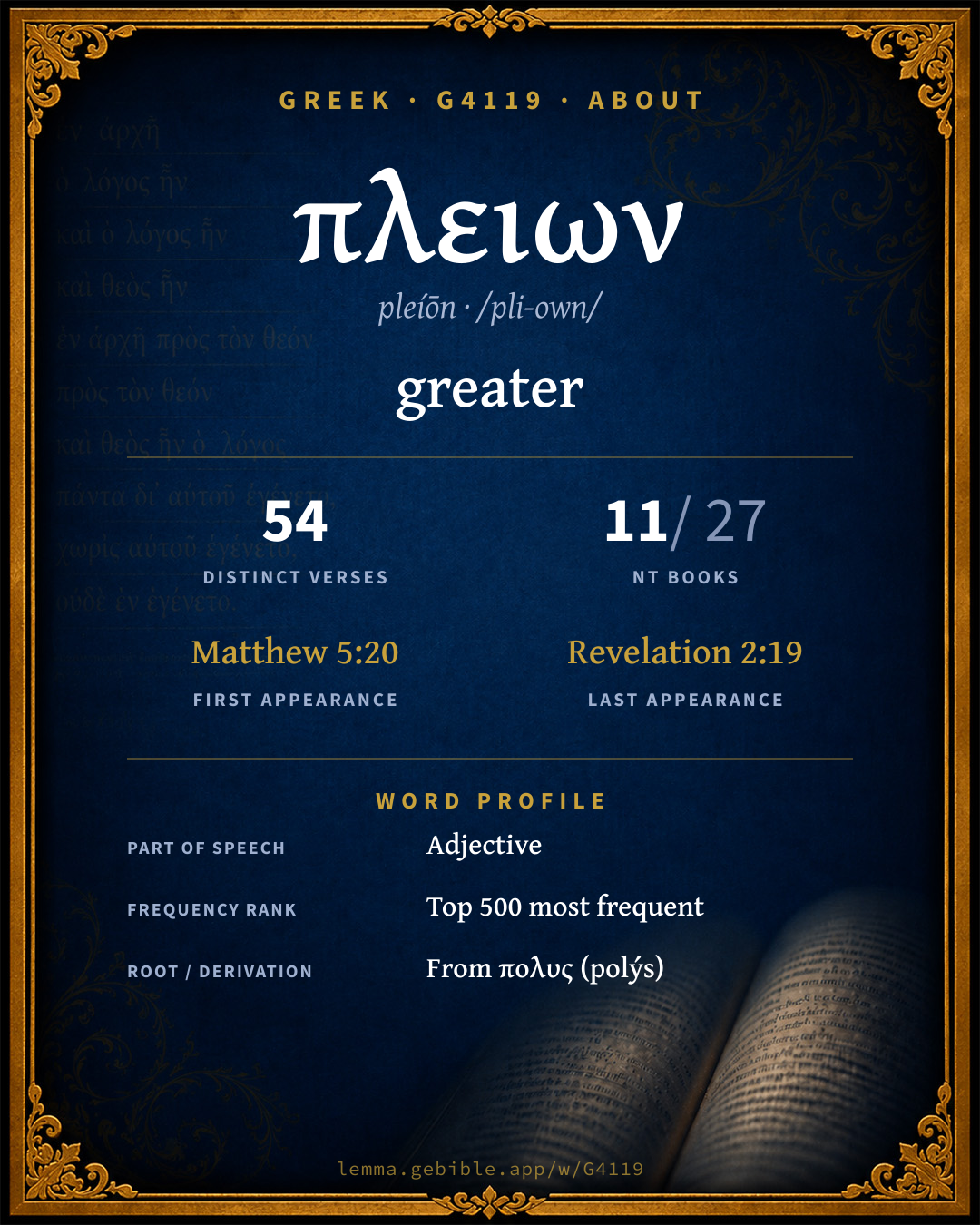
πλειων
greater
‘greater’ is one of 2 main senses fuller range ↓
Full lexicon entry — Thayer's Greek Lexicon
From Thayer's Greek Lexicon
Where this word appears
See every Accusative-case word in the Greek New Testament →
Grammar key — what these labels mean
Part of speech
- Adjective
- A word that describes or qualifies a noun.
Case
- Accusative
- The case of the direct object and of extent.
- Nominative
- The case of the subject (and the predicate nominative).
- Genitive
- The case of source, possession, or “of” — answers “whose / from what.”
- Dative
- The case of the indirect object, means, or location — “to / for / with / in.”
Gender
- Neuter
- Grammatically neuter.
- Masculine
- Grammatically masculine.
- Feminine
- Grammatically feminine.
Number
- Singular
- One.
- Plural
- More than one.
Degree
- Comparative
- Expresses a greater degree (“greater,” “more”).
Every verse where G4119 appears in the Book of Acts — 19 distinct verses. Click any verse to open its interlinear word-by-word view. Verse text shown in the World English Bible for context — . Each verse’s Greek form is shown with its reference; the English is not keyword-highlighted, since the data carries no word-level English alignment. Use “Compare translations” on any verse to read it across multiple English versions. This concordance covers the Greek New Testament; Septuagint (Greek Old Testament) occurrences of this word are not indexed here.
Acts
- Acts 2:40 πλείοσιν adj dat pl masc comp With many other words he testified, and exhorted them, saying, "Save yourselves from this crooked generation!"
- Acts 4:17 πλεῖον adj acc sg neut comp But so that this spreads no further among the people, let's threaten them, that from now on they don't speak to anyone in this name."
- Acts 4:22 πλειόνων adj gen pl neut comp For the man on whom this miracle of healing was performed was more than forty years old.
- Acts 13:31 πλείους adj acc pl fem comp and he was seen for many days by those who came up with him from Galilee to Jerusalem, who are his witnesses to the people.
- Acts 15:28 πλέον adj acc sg neut comp For it seemed good to the Holy Spirit, and to us, to lay no greater burden on you than these necessary things:
- Acts 18:20 πλείονα adj acc sg masc comp When they asked him to stay with them a longer time, he declined;
- Acts 19:32 πλείους adj nom pl masc comp Some therefore cried one thing, and some another, for the assembly was in confusion. Most of them didn't know why they had come together.
- Acts 20:9 πλεῖον adj acc sg neut comp A certain young man named Eutychus sat in the window, weighed down with deep sleep. As Paul spoke still longer, being weighed down by his sleep, he fell down from the third story, and was taken up dead.
- Acts 21:10 πλείους adj acc pl fem comp As we stayed there some days, a certain prophet named Agabus came down from Judea.
- Acts 23:13 πλείους adj nom pl masc comp There were more than forty people who had made this conspiracy.
- Acts 23:21 πλείους adj nom pl masc comp Therefore don't yield to them, for more than forty men lie in wait for him, who have bound themselves under a curse neither to eat nor to drink until they have killed him. Now they are ready, looking for the promise from you."
- Acts 24:4 πλεῖόν adj acc sg neut comp But, that I don't delay you, I entreat you to bear with us and hear a few words.
- Acts 24:11 πλείους adj nom pl fem comp seeing that you can recognize that it is not more than twelve days since I went up to worship at Jerusalem.
- Acts 24:17 πλειόνων adj gen pl neut comp Now after some years, I came to bring gifts for the needy to my nation, and offerings;
- Acts 25:6 πλείους adj acc pl fem comp When he had stayed among them more than ten days, he went down to Caesarea, and on the next day he sat on the judgment seat, and commanded Paul to be brought.
- Acts 25:14 πλείους adj acc pl fem comp As he stayed there many days, Festus laid Paul's case before the king, saying, "There is a certain man left a prisoner by Felix;
- Acts 27:12 πλείονες adj nom pl masc comp Because the haven was not suitable to winter in, the majority advised going to sea from there, if by any means they could reach Phoenix, and winter there, which is a port of Crete, looking northeast and southeast.
- Acts 27:20 πλείονας adj acc pl fem comp When neither sun nor stars shone on us for many days, and no small tempest pressed on us, all hope that we would be saved was now taken away.
- Acts 28:23 πλείονες adj nom pl masc comp When they had appointed him a day, many people came to him at his lodging. He explained to them, testifying about the Kingdom of God, and persuading them concerning Jesus, both from the law of Moses and from the prophets, from morning until evening.
About this entry
At a glance — auto-summarized from this page’s data, not written by a person. Every figure links to its source below. This summary describes the numbers; it doesn’t interpret them.
“greater” is the headline sense of the Greek adjective πλειων (pleíōn). Scripture first uses it in Matthew 5:20. It appears 54 verses across 11 books of the Greek New Testament, among its moderately common vocabulary. More than a third of its appearances fall in Acts. Catalogued under 2 senses, its meaning is not single-sense. The sections below give every sense, occurrence, and version rendering.
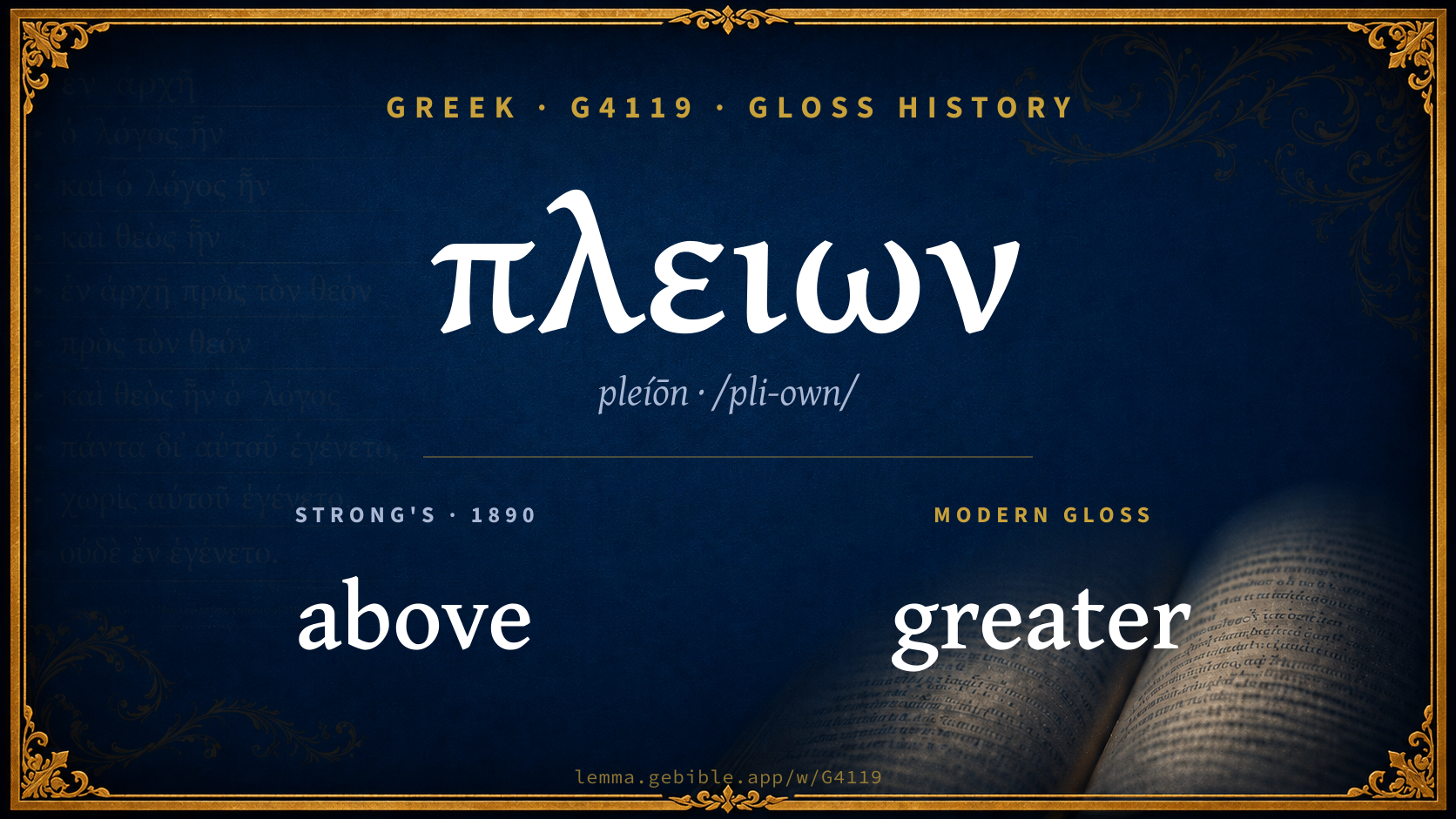
Gloss history
Strong's 1890 vs modern scholarship
About this word
Strong's G4119 catalogs a Greek word from the Greek New Testament.
These counts are not copied from any lexicon or concordance. They are computed here, from the morphology-tagged Greek New Testament. What Lemma adds →
- 54
- distinct verses
- The word appears in 54 distinct verses.
- 11 / 27
- NT books
- The word appears in 11 of 27 New Testament books.
- #292
- by frequency
- Top 500 most frequent Greek words (rank 292 of 5,347 Greek words by occurrence).
View all 54 occurrences in the concordance →
By section of the New Testament
By traditional corpus
Conventional, traditional groupings — biblical authorship is debated, so this is a traditional corpus grouping, not an authorship claim. Some books belong to more than one corpus (Luke is in both the Gospels and the Lukan corpus, and so on), so these shares overlap and need not total 100%. Each figure is a share of the word’s 54 distinct verses.
- Lukan (Luke–Acts) 28 verses · 52%
- Gospels 22 verses · 41%
- Pauline corpus 9 verses · 17%
- Johannine 6 verses · 11%
- Hebrews 3 verses · 6%
- Revelation 1 verse · 2%
How translations render this word
Counts come from each version’s own published word-to-Strong’s tagging or interlinear alignment — an approximate guide to how each version renders this word, not a word-level alignment the data otherwise carries. Because each total is that version’s own tagged count, the per-version totals vary from one another and need not match the appearance or distinct-verse counts above. These counts may also differ from a printed concordance because Lemma counts each distinctly tagged rendering and does not collapse phrase taggings into a single head-word total. This is a fixed set of word-tagged versions (KJV, ASV, BSB, ULT) and does not change with the reading translation you choose elsewhere. Each version’s license is shown beside its name below (and on Sources).
- King James Version: More 16×, Many 11×, More than 5×
- American Standard Version: More 21×, Many 7×, Greater 5×
- Berean Standard Bible: More 12×, More than 7×, Greater 5×
- unfoldingWord Literal Text: More 10×, More than 8×, Many 7×
King James Version Public Domain
Renders G4119 across 50 tagged occurrences — most commonly:
Plus 10 renderings that appear only once — usually multi-word phrases or single function words the recovered tagging swept in, not distinct renderings. Not rendered by a distinct English word in 7 further occurrences.
American Standard Version Public Domain
Renders G4119 across 54 tagged occurrences — most commonly:
Plus 10 renderings that appear only once — usually multi-word phrases or single function words the recovered tagging swept in, not distinct renderings.
Berean Standard Bible Public Domain
Renders G4119 across 52 tagged occurrences — most commonly:
Plus 10 renderings that appear only once — usually multi-word phrases or single function words the recovered tagging swept in, not distinct renderings. Not rendered by a distinct English word in 2 further occurrences.
unfoldingWord Literal Text CC BY-SA 4.0
Renders G4119 across 51 tagged occurrences — most commonly:
Plus 9 renderings that appear only once — usually multi-word phrases or single function words the recovered tagging swept in, not distinct renderings.
Senses in Thayer's
The 2 senses Thayer's distinguishes for this word, in lexicon order (not ranked by frequency or importance). The full entry — with sub-senses — is in the Lexicon Entry tab.
- greater in quantity
- greater in quality, superior, more excellent
Word origin
Derived from πολυς (polýs) (G4183) — many.
Comparative of G4183 ; more in quantity number or quality; also (in plural) the major portion : - X above + exceed more excellent further (very) great (-er) long (-er) (very) many greater (more) part + yet but.
— Strong’s Exhaustive Concordance (1890), public domain.
Forms in the corpus
The 12 distinct written forms G4119 takes in the Greek New Testament, most frequent first — each parse links to that case’s occurrences in the concordance.
Same root — word family
Other Thayer's entries built from the same root as G4119, grouped by Strong’s listed origin. These share a root / origin per the lexicon — not necessarily a shared meaning. Each links to that word’s own entry.
Derives from
Shares the same root
- πλειστος pleîstos G4118 most
- πολλακις pollákis G4178 often
- πολλαπλασιων pollaplasíōn G4179 manifold
- πολυλογια polylogía G4180 much speaking
- πολυμερως polymerōs G4181 by many times
- πολυποικιλος polypoíkilos G4182 much variegated
- πολυσπλαγχνος polýsplanchnos G4184 compassionate
- πολυτελης polytelḗs G4185 precious
- πολυτιμος polýtimos G4186 very valuable
- πολυτροπως polytrópōs G4187 in many ways
Derived from this word
- πλεοναζω pleonázō G4121 to superabound
- πλεονεκτης pleonéktēs G4123 covetous
- πλην plḗn G4133 moreover
Compare all same-root words → Showing 4 of 15 — not the complete family. They share a root, not necessarily a meaning.