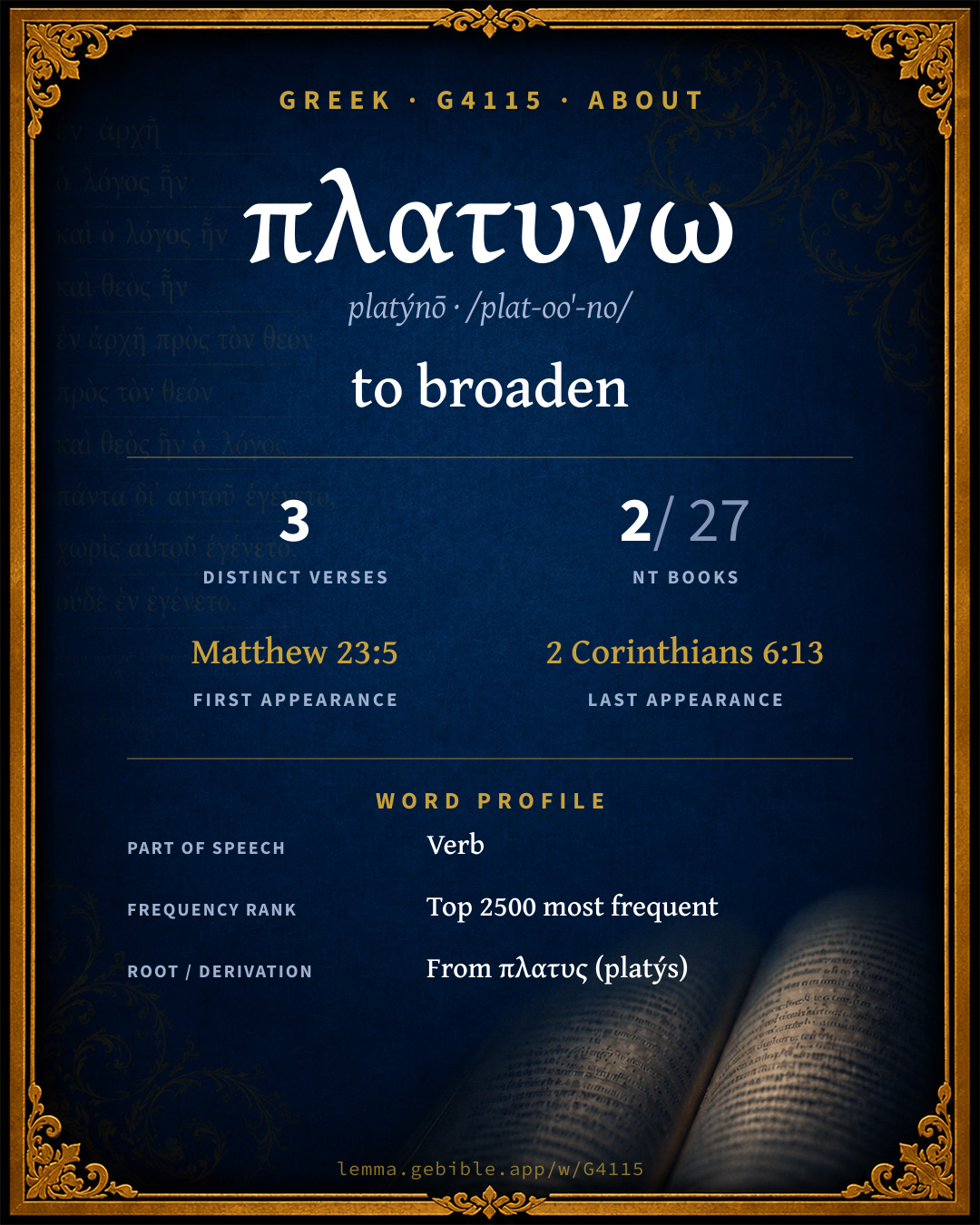
πλατύνω
to broaden
‘to broaden’ is one of 2 main senses fuller range ↓
Full lexicon entry — Thayer's Greek Lexicon
From Thayer's Greek Lexicon
Where this word appears
See every Aorist-tense verb in the Greek New Testament →
Grammar key — what these labels mean
Part of speech
- Verb
- An action or state-of-being word.
Tense
- Aorist
- Action viewed as a simple whole, without regard to duration — often past (perfective aspect).
- Present
- Ongoing or general action in present time (imperfective aspect).
- Perfect
- A completed past action with continuing present results.
Voice
- Passive
- The subject receives the action.
- Active
- The subject performs the action.
Mood
- Imperative
- Expresses a command or request.
- Indicative
- States a fact or asks a factual question (the mood of reality).
Person
- 2nd person
- The one addressed (“you”).
- 3rd person
- The one spoken about (“he / she / it / they”).
Number
- Plural
- More than one.
- Singular
- One.
1 distinct verse where G4115 appears in the Present tense, across 1 book. Filtered view — show all forms. Click any verse to open its interlinear word-by-word view. Verse text shown in the World English Bible for context — . Each verse’s Greek form is shown with its reference; the English is not keyword-highlighted, since the data carries no word-level English alignment. Use “Compare translations” on any verse to read it across multiple English versions. This concordance covers the Greek New Testament; Septuagint (Greek Old Testament) occurrences of this word are not indexed here.
Matthew 1 verse
About this entry
At a glance — auto-summarized from this page’s data, not written by a person. Every figure links to its source below. This summary describes the numbers; it doesn’t interpret them.
At its core, πλατυνω (platýnō) means “to broaden.” The Greek New Testament uses it only 3 verses. The word gravitates to 2 Corinthians (67%), then Matthew. Scripture first uses it in Matthew 23:5. Catalogued under 2 senses, its meaning is not single-sense. Dig into 3-verse concordance and the renderings breakdown below.
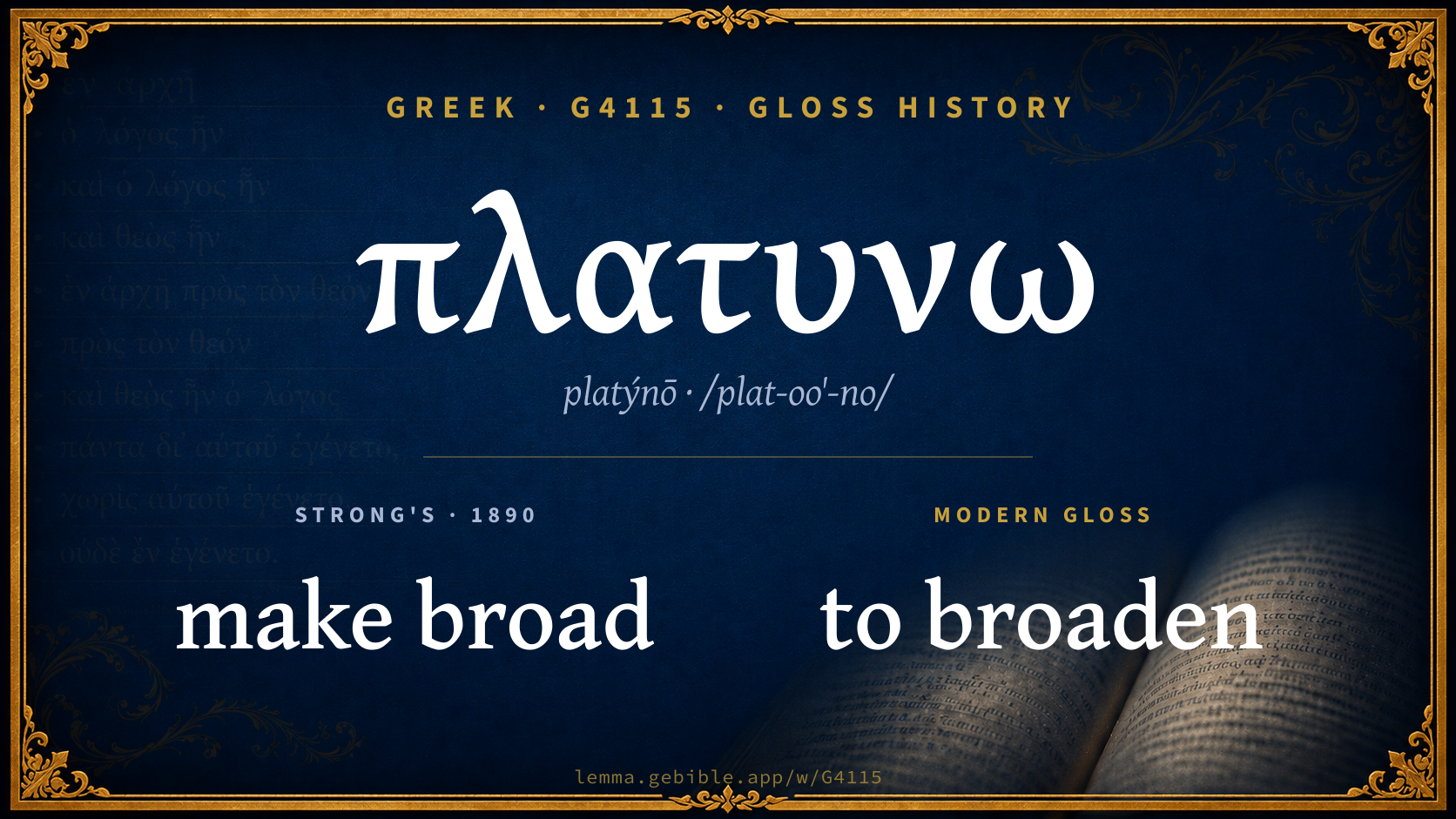
Gloss history
Strong's 1890 vs modern scholarship
About this word
Strong's G4115 catalogs a Greek word from the Greek New Testament.
These counts are not copied from any lexicon or concordance. They are computed here, from the morphology-tagged Greek New Testament. What Lemma adds →
- 3
- distinct verses
- The word appears in 3 distinct verses.
- 2 / 27
- NT books
- The word appears in 2 of 27 New Testament books.
- #2,203
- by frequency
- Top 2500 most frequent Greek words (rank 2,203 of 5,347 Greek words by occurrence).
View all 3 occurrences in the concordance →
Most concentrated in
- 2 Corinthians 2 verses 67%
- Matthew 1 verse 33%
By section of the New Testament
By traditional corpus
Conventional, traditional groupings — biblical authorship is debated, so this is a traditional corpus grouping, not an authorship claim. Some books belong to more than one corpus (Luke is in both the Gospels and the Lukan corpus, and so on), so these shares overlap and need not total 100%. Each figure is a share of the word’s 3 distinct verses.
- Pauline corpus 2 verses · 67%
- Gospels 1 verse · 33%
How translations render this word
Counts come from each version’s own published word-to-Strong’s tagging or interlinear alignment — an approximate guide to how each version renders this word, not a word-level alignment the data otherwise carries. Because each total is that version’s own tagged count, the per-version totals vary from one another and need not match the appearance or distinct-verse counts above. These counts may also differ from a printed concordance because Lemma counts each distinctly tagged rendering and does not collapse phrase taggings into a single head-word total. This is a fixed set of word-tagged versions (KJV, ASV, BSB, ULT) and does not change with the reading translation you choose elsewhere. Each version’s license is shown beside its name below (and on Sources).
- King James Version: Be 1×, Enlarged 1×, Is enlarged 1×
- American Standard Version: Be 1×, Enlarged 1×, Is enlarged 1×
- Berean Standard Bible: Are open wide 1×, Open wide 1×, They broaden 1×
- unfoldingWord Literal Text: Has been opened wide 1×, Open 1×, They broaden 1×
King James Version Public Domain
Renders G4115 across 4 tagged occurrences — most commonly:
American Standard Version Public Domain
Renders G4115 across 4 tagged occurrences — most commonly:
Berean Standard Bible Public Domain
Renders G4115 across 3 tagged occurrences — most commonly:
unfoldingWord Literal Text CC BY-SA 4.0
Renders G4115 across 4 tagged occurrences — most commonly:
Senses in Thayer's
The 2 senses Thayer's distinguishes for this word, in lexicon order (not ranked by frequency or importance). The full entry — with sub-senses — is in the Lexicon Entry tab.
- to make broad, enlarge
- be enlarged in heart, i.e. to welcome and embrace you in love
Word origin
Derived from πλατυς (platýs) (G4116) — broad.
From G4116 ; to widen (literally or figuratively): - make broad enlarge.
— Strong’s Exhaustive Concordance (1890), public domain.
Forms in the corpus
The 3 distinct written forms G4115 takes in the Greek New Testament, most frequent first — each parse links to that tense’s occurrences in the concordance.
| Form | Parsing | Example | Uses |
|---|---|---|---|
| πεπλάτυνται peplátyntai | Verb, Perfect, Passive, Indicative, 3rd person, Singular | 2 Corinthians 6:11 | 1 |
| πλατύνθητε platýnthēte | Verb, Aorist, Passive, Imperative, 2nd person, Plural | 2 Corinthians 6:13 | 1 |
| πλατύνουσιν platýnousin | Verb, Present, Active, Indicative, 3rd person, Plural | Matthew 23:5 | 1 |
Same root — word family
Other Thayer's entries built from the same root as G4115, grouped by Strong’s listed origin. These share a root / origin per the lexicon — not necessarily a shared meaning. Each links to that word’s own entry.
Derives from
Shares the same root
Compare all same-root words → They share a root, not necessarily a meaning.
Septuagint usage
The same Greek word πλατυνω appears 20 times in the Greek Old Testament (Septuagint), across 20 verses in 10 books.
- 20
- LXX occurrences
- Tagged occurrences of this Greek word in the Septuagint.
- 20
- verses
- Distinct Septuagint verses containing this word.
- 10 / 39
- OT books
- The word appears in 10 of the 39 Old Testament books.
Sample Septuagint occurrences
- Genesis 9:27 πλατύνω
- Exodus 34:24 πλατύνω
- Deuteronomy 11:16 πλατύνω
- 1 Samuel 2:1 πλατύνω
- Psalms 4:2 πλατύνω
- Proverbs 24:28 πλατύνω
- Isaiah 5:14 πλατύνω
- Jeremiah 2:24 πλατύνω
- Ezekiel 31:5 πλατύνω
- Habakkuk 2:5 πλατύνω
Septuagint occurrences (same lexeme)
Every verse where the same Strong’s number (G4115) appears in the Greek Septuagint. Verse text shown in the World English Bible for context; the Greek form is the matched word — the English is not keyword-highlighted.
- Genesis 9:27 πλατύνω God enlarge Japheth, Let him dwell in the tents of Shem; Let Canaan be his servant."
- Genesis 26:22 πλατύνω He left that place, and dug another well. They didn't argue over that one. He called it Rehoboth. He said, "For now Yahweh has made room for us, and we will be fruitful in the land."
- Genesis 28:14 πλατύνω Your seed will be as the dust of the earth, and you will spread abroad to the west, and to the east, and to the north, and to the south. In you and in your seed will all the families of the earth be blessed.
- Exodus 34:24 πλατύνω For I will drive out nations before you and enlarge your borders; neither shall any man desire your land when you go up to appear before Yahweh, your God, three times in the year.
- Deuteronomy 11:16 πλατύνω Take heed to yourselves, lest your heart be deceived, and you turn aside, and serve other gods, and worship them;
- Deuteronomy 32:15 πλατύνω But Jeshurun grew fat, and kicked: You have grown fat, you are grown thick, you are become sleek; Then he forsook God who made him, Lightly esteemed the Rock of his salvation.
- 1 Samuel 2:1 πλατύνω Hannah prayed, and said: My heart exults in Yahweh; My horn is exalted in Yahweh; My mouth is enlarged over my enemies; Because I rejoice in your salvation.
- Psalms 4:2 πλατύνω You sons of men, how long shall my glory be turned into dishonor? Will you love vanity, and seek after falsehood? Selah.
- Psalms 17:37 πλατύνω
- Psalms 24:17 πλατύνω
- Psalms 34:21 πλατύνω Evil shall kill the wicked. Those who hate the righteous shall be condemned.
- Psalms 80:11 πλατύνω It sent out its branches to the sea, Its shoots to the River.
- Psalms 118:32 πλατύνω
- Proverbs 24:28 πλατύνω Don't be a witness against your neighbor without cause. Don't deceive with your lips.
- Isaiah 5:14 πλατύνω Therefore Sheol has enlarged its desire, And opened its mouth without measure; And their glory, their multitude, their pomp, and he who rejoices among them, descend into it.
- Isaiah 54:2 πλατύνω Enlarge the place of your tent, and let them stretch forth the curtains of your habitations; don't spare: lengthen your cords, and strengthen your stakes.
- Jeremiah 2:24 πλατύνω a wild donkey used to the wilderness, that snuffs up the wind in her desire; in her occasion who can turn her away? all those who seek her will not weary themselves; in her month they shall find her.
- Jeremiah 28:58 πλατύνω
- Ezekiel 31:5 πλατύνω Therefore its stature was exalted above all the trees of the field; and its boughs were multiplied, and its branches became long by reason of many waters, when it shot [them] forth.
- Habakkuk 2:5 πλατύνω Yes, moreover, wine is treacherous. A haughty man who doesn't stay at home, who enlarges his desire as Sheol, and he is like death, and can't be satisfied, but gathers to himself all nations, and heaps to himself all peoples.
These are occurrences of the same Greek lexeme (G4115) in the Septuagint — not a translation of any one Hebrew word. The store carries no word-level Hebrew↔Greek alignment, so no Hebrew original is asserted here. Counts come from the recovered LXX Strong's tagging — high-frequency vocabulary is well covered, while rare or late forms may be untagged — so they reflect tagged occurrences and may slightly undercount.