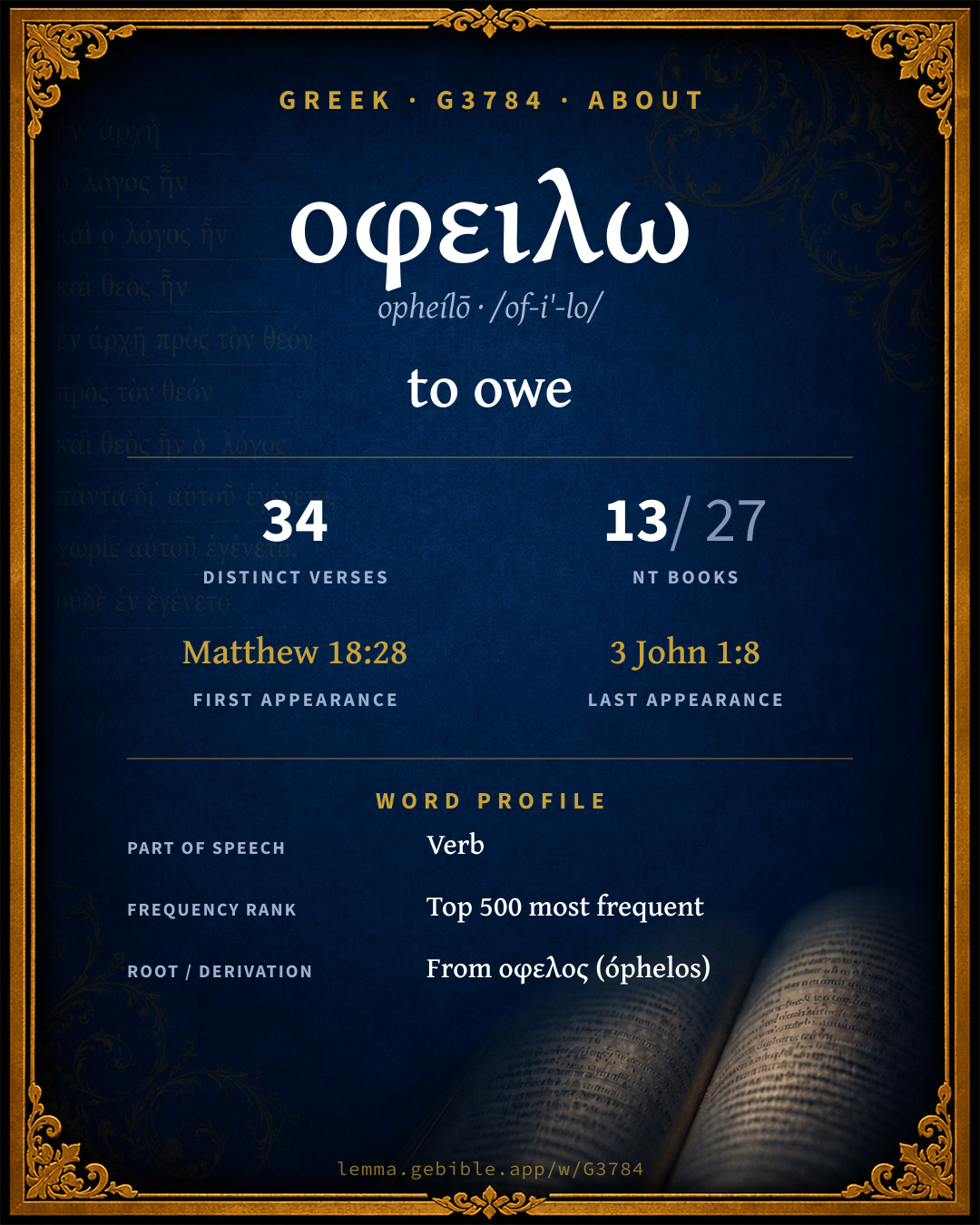
οφειλω
to owe
‘to owe’ is one of 2 main senses fuller range ↓
Full lexicon entry — Thayer's Greek Lexicon
From Thayer's Greek Lexicon
Where this word appears
See every Imperfect-tense verb in the Greek New Testament →
Grammar key — what these labels mean
Part of speech
- Verb
- An action or state-of-being word.
Tense
- Present
- Ongoing or general action in present time (imperfective aspect).
- Imperfect
- Continuous or repeated action in past time (“was writing”).
Voice
- Active
- The subject performs the action.
- Passive
- The subject receives the action.
Mood
- Indicative
- States a fact or asks a factual question (the mood of reality).
- Participle
- A verbal adjective (“writing,” “having written”).
- Imperative
- Expresses a command or request.
Case
- Accusative
- The case of the direct object and of extent.
- Dative
- The case of the indirect object, means, or location — “to / for / with / in.”
- Nominative
- The case of the subject (and the predicate nominative).
Person
- 3rd person
- The one spoken about (“he / she / it / they”).
- 1st person
- The speaker (“I / we”).
- 2nd person
- The one addressed (“you”).
Gender
- Neuter
- Grammatically neuter.
- Masculine
- Grammatically masculine.
Number
- Singular
- One.
- Plural
- More than one.
Every verse where G3784 appears in the Book of 2 Corinthians — 2 distinct verses. Click any verse to open its interlinear word-by-word view. Verse text shown in the World English Bible for context — . Each verse’s Greek form is shown with its reference; the English is not keyword-highlighted, since the data carries no word-level English alignment. Use “Compare translations” on any verse to read it across multiple English versions. This concordance covers the Greek New Testament; Septuagint (Greek Old Testament) occurrences of this word are not indexed here.
2 Corinthians
- 2 Corinthians 12:11 ὤφειλον impf act ind 1sg I have become foolish in boasting. You compelled me, for I ought to have been commended by you, for in nothing was I inferior to the very best apostles, though I am nothing.
- 2 Corinthians 12:14 ὀφείλει pres act ind 3sg Behold, this is the third time I am ready to come to you, and I will not be a burden to you; for I seek not your possessions, but you. For the children ought not to save up for the parents, but the parents for the children.
About this entry
At a glance — auto-summarized from this page’s data, not written by a person. Every figure links to its source below. This summary describes the numbers; it doesn’t interpret them.
The Greek verb οφειλω centers on the idea of “to owe.” Debuting at Matthew 18:28, it then recurs through the corpus. Spanning 34 verses in 13 books, it ranks among the moderately common words of the Greek New Testament. Thayer's distinguishes 2 senses for it. Sharing its root, it stands alongside οφελος, ωφελιμος and οφειλετης. For the data behind this summary, explore the sense tree and the renderings breakdown below.
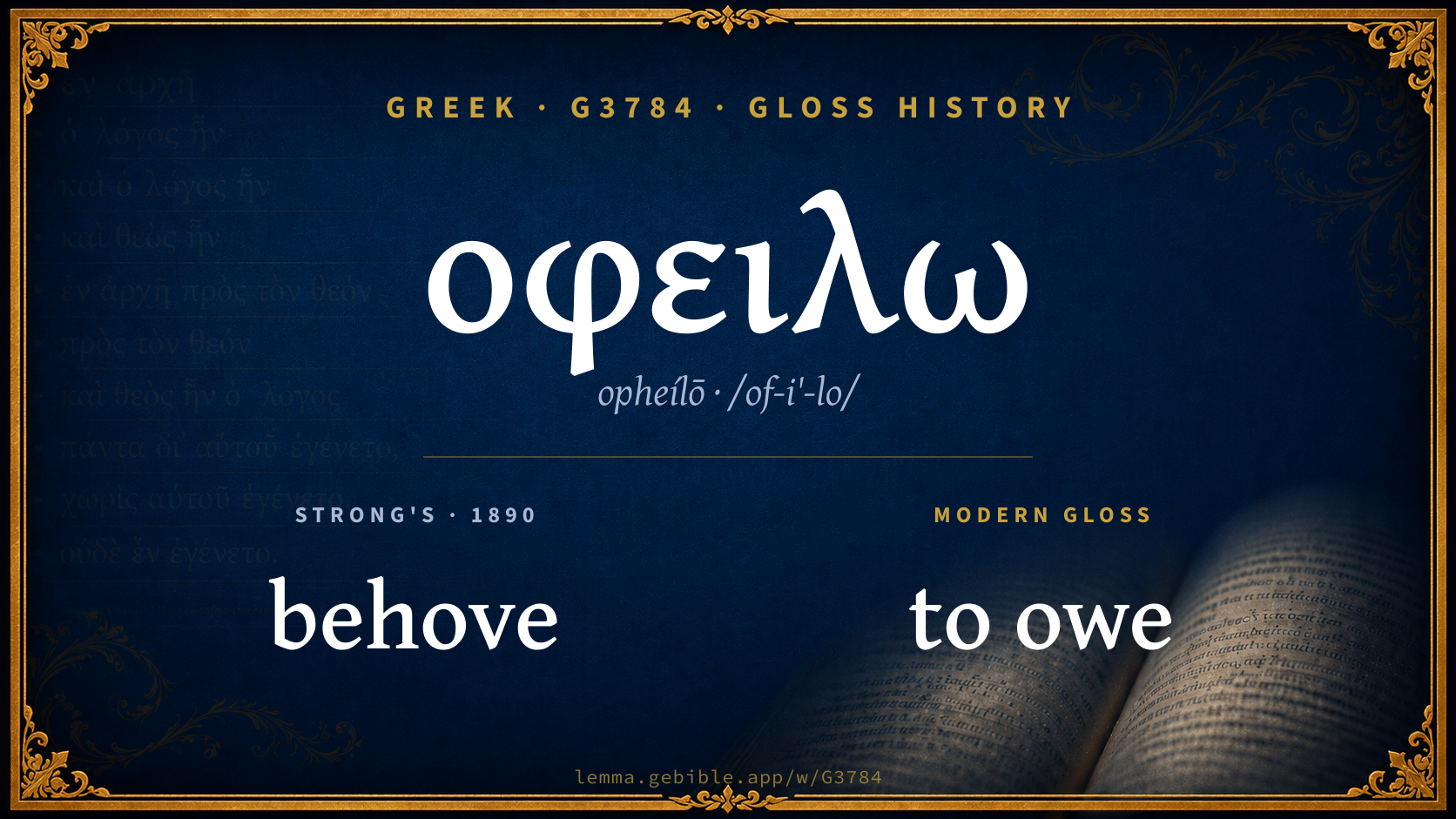
Gloss history
Strong's 1890 vs modern scholarship
About this word
Strong's G3784 catalogs a Greek word from the Greek New Testament.
These counts are not copied from any lexicon or concordance. They are computed here, from the morphology-tagged Greek New Testament. What Lemma adds →
- 34
- distinct verses
- The word appears in 34 distinct verses.
- 13 / 27
- NT books
- The word appears in 13 of 27 New Testament books.
- #419
- by frequency
- Top 500 most frequent Greek words (rank 419 of 5,347 Greek words by occurrence).
View all 34 occurrences in the concordance →
Most concentrated in
- Matthew 5 verses 15%
- Luke 5 verses 15%
- 1 Corinthians 5 verses 15%
By section of the New Testament
By traditional corpus
Conventional, traditional groupings — biblical authorship is debated, so this is a traditional corpus grouping, not an authorship claim. Some books belong to more than one corpus (Luke is in both the Gospels and the Lukan corpus, and so on), so these shares overlap and need not total 100%. Each figure is a share of the word’s 34 distinct verses.
- Pauline corpus 14 verses · 41%
- Gospels 12 verses · 35%
- Lukan (Luke–Acts) 6 verses · 18%
- Johannine 6 verses · 18%
- General (Catholic) Epistles 4 verses · 12%
- Hebrews 3 verses · 9%
How translations render this word
Counts come from each version’s own published word-to-Strong’s tagging or interlinear alignment — an approximate guide to how each version renders this word, not a word-level alignment the data otherwise carries. Because each total is that version’s own tagged count, the per-version totals vary from one another and need not match the appearance or distinct-verse counts above. These counts may also differ from a printed concordance because Lemma counts each distinctly tagged rendering and does not collapse phrase taggings into a single head-word total. This is a fixed set of word-tagged versions (KJV, ASV, BSB, ULT) and does not change with the reading translation you choose elsewhere. Each version’s license is shown beside its name below (and on Sources).
- King James Version: Ought 11×, He ought 2×, Owed 2×
- American Standard Version: Ought 12×, He is a debtor 2×, Owed 2×
- Berean Standard Bible: Ought 8×, Should 4×, He is bound by his oath 2×
- unfoldingWord Literal Text: Ought 12×, He is obligated 3×, We ought 3×
King James Version Public Domain
Renders G3784 across 36 tagged occurrences — most commonly:
Plus 21 renderings that appear only once — usually multi-word phrases or single function words the recovered tagging swept in, not distinct renderings.
American Standard Version Public Domain
Renders G3784 across 36 tagged occurrences — most commonly:
Plus 18 renderings that appear only once — usually multi-word phrases or single function words the recovered tagging swept in, not distinct renderings.
Berean Standard Bible Public Domain
Renders G3784 across 35 tagged occurrences — most commonly:
Plus 19 renderings that appear only once — usually multi-word phrases or single function words the recovered tagging swept in, not distinct renderings.
unfoldingWord Literal Text CC BY-SA 4.0
Renders G3784 across 37 tagged occurrences — most commonly:
Plus 13 renderings that appear only once — usually multi-word phrases or single function words the recovered tagging swept in, not distinct renderings.
Senses in Thayer's
The 2 senses Thayer's distinguishes for this word, in lexicon order (not ranked by frequency or importance). The full entry — with sub-senses — is in the Lexicon Entry tab.
- to owe money, be in debt for
- metaph. the goodwill due
Word origin
Derived from οφελος (óphelos) (G3786) — advantage.
Including its prolonged form (second form) used in certain tenses. Probably from the base of G3786 (through the idea of accruing ); to owe (pecuniarily); figuratively to be under obligation ( ought must should ); morally to fail in duty : - behove be bound (be) debt (-or) (be) due (-ty) be guilty (indebted) (must) need (-s) ought owe should. See also G3785 .
— Strong’s Exhaustive Concordance (1890), public domain.
Forms in the corpus
The 13 distinct written forms G3784 takes in the Greek New Testament, most frequent first — each parse links to that tense’s occurrences in the concordance.
Same root — word family
Other Thayer's entries built from the same root as G3784, grouped by Strong’s listed origin. These share a root / origin per the lexicon — not necessarily a shared meaning. Each links to that word’s own entry.
Derives from
Shares the same root
Derived from this word
- οφειλετης opheilétēs G3781 debtor
- οφειλη opheilḗ G3782 debt
- οφειλημα opheílēma G3783 sin
- οφελον óphelon G3785 would that
Compare all same-root words → Showing 4 of 7 — not the complete family. They share a root, not necessarily a meaning.
Septuagint usage
The same Greek word οφειλω appears 13 times in the Greek Old Testament (Septuagint), across 12 verses in 9 books.
- 13
- LXX occurrences
- Tagged occurrences of this Greek word in the Septuagint.
- 12
- verses
- Distinct Septuagint verses containing this word.
- 9 / 39
- OT books
- The word appears in 9 of the 39 Old Testament books.
Sample Septuagint occurrences
- Exodus 16:3 ὀφείλω
- Numbers 14:2 ὀφείλω
- Deuteronomy 15:2 ὀφείλω
- 2 Kings 5:3 ὀφείλω
- Job 6:20 ὀφείλω
- Psalms 118:5 ὀφείλω
- Proverbs 14:9 ὀφείλω
- Isaiah 24:2 ὀφείλω
- Ezekiel 18:7 ὀφείλω
Septuagint occurrences (same lexeme)
Every verse where the same Strong’s number (G3784) appears in the Greek Septuagint. Verse text shown in the World English Bible for context; the Greek form is the matched word — the English is not keyword-highlighted.
- Exodus 16:3 ὀφείλω and the children of Israel said to them, "We wish that we had died by the hand of Yahweh in the land of Egypt, when we sat by the flesh-pots, when we ate our fill of bread, for you have brought us out into this wilderness, to kill this whole assembly with hunger."
- Numbers 14:2 ὀφείλω All the children of Israel murmured against Moses and against Aaron: and the whole congregation said to them, Would that we had died in the land of Egypt! or would that we had died in this wilderness!
- Numbers 20:3 ὀφείλω The people strove with Moses, and spoke, saying, Would that we had died when our brothers died before Yahweh!
- Deuteronomy 15:2 ὀφείλω This is the manner of the release: every creditor shall release that which he has lent to his neighbor; he shall not exact it of his neighbor and his brother; because Yahweh's release has been proclaimed.
- 2 Kings 5:3 ὀφείλω She said to her mistress, Would that my lord were with the prophet who is in Samaria! then would he recover him of his leprosy.
- Job 6:20 ὀφείλω They were distressed because they were confident; They came there, and were confounded.
- Job 14:13 ὀφείλω "Oh that you would hide me in Sheol, That you would keep me secret, until your wrath is past, That you would appoint me a set time, and remember me!
- Job 30:24 ὀφείλω "However doesn't one stretch out a hand in his fall? Or in his calamity therefore cry for help?
- Psalms 118:5 ὀφείλω Out of my distress, I called on Yah. Yah answered me with freedom.
- Proverbs 14:9 ὀφείλω Fools mock at making atonement for sins, But among the upright there is good will.
- Isaiah 24:2 ὀφείλω It shall be, as with the people, so with the priest; as with the servant, so with his master; as with the maid, so with her mistress; as with the buyer, so with the seller; as with the creditor, so with the debtor; as with the taker of interest, so with the giver of interest to him.
- Ezekiel 18:7 ὀφείλω and has not wronged any, but has restored to the debtor his pledge, has taken nothing by robbery, has given his bread to the hungry, and has covered the naked with a garment;
These are occurrences of the same Greek lexeme (G3784) in the Septuagint — not a translation of any one Hebrew word. The store carries no word-level Hebrew↔Greek alignment, so no Hebrew original is asserted here. Counts come from the recovered LXX Strong's tagging — high-frequency vocabulary is well covered, while rare or late forms may be untagged — so they reflect tagged occurrences and may slightly undercount.