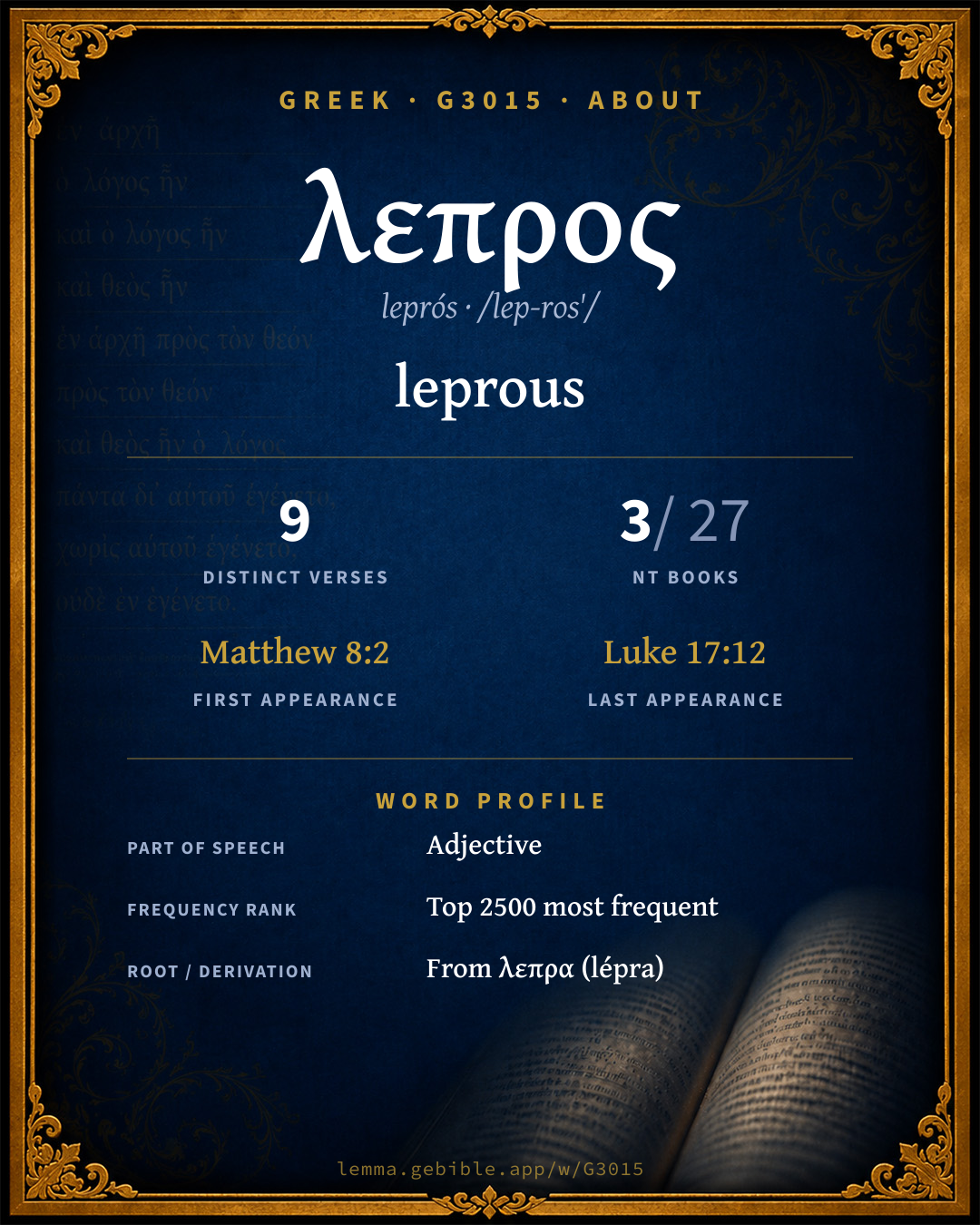
λεπρός
leprous
‘leprous’ is one of 2 main senses fuller range ↓
Full lexicon entry — Thayer's Greek Lexicon
From Thayer's Greek Lexicon
Where this word appears
Grammar key — what these labels mean
Part of speech
- Adjective
- A word that describes or qualifies a noun.
Case
- Nominative
- The case of the subject (and the predicate nominative).
- Genitive
- The case of source, possession, or “of” — answers “whose / from what.”
- Accusative
- The case of the direct object and of extent.
Gender
- Masculine
- Grammatically masculine.
Number
- Plural
- More than one.
- Singular
- One.
Every verse where G3015 appears in the Book of Luke — 3 distinct verses. Click any verse to open its interlinear word-by-word view. Verse text shown in the World English Bible for context — . Each verse’s Greek form is shown with its reference; the English is not keyword-highlighted, since the data carries no word-level English alignment. Use “Compare translations” on any verse to read it across multiple English versions. This concordance covers the Greek New Testament; Septuagint (Greek Old Testament) occurrences of this word are not indexed here.
Luke
- Luke 4:27 λεπροὶ adj nom pl masc There were many lepers in Israel in the time of Elisha the prophet, yet not one of them was cleansed, except Naaman, the Syrian."
- Luke 7:22 λεπροὶ adj nom pl masc Jesus answered them, "Go and tell John the things which you have seen and heard: that the blind receive their sight, the lame walk, the lepers are cleansed, the deaf hear, the dead are raised up, and the poor have good news preached to them.
- Luke 17:12 λεπροὶ adj nom pl masc As he entered into a certain village, ten men who were lepers met him, who stood at a distance.
About this entry
At a glance — auto-summarized from this page’s data, not written by a person. Every figure links to its source below. This summary describes the numbers; it doesn’t interpret them.
λεπρος (leprós) is a Greek adjective most often rendered “leprous.” It first appears in Matthew 8:2. With 9 verses in 3 books, it is an uncommon word in the Greek New Testament. It concentrates in Matthew, which alone accounts for 44% of its uses. Ranging over 2 senses, it is not a single-sense word. For the data behind this summary, explore the sense tree and the renderings breakdown below.
Gloss history
Strong's 1890 vs modern scholarship

About this word
Strong's G3015 catalogs a Greek word from the Greek New Testament.
These counts are not copied from any lexicon or concordance. They are computed here, from the morphology-tagged Greek New Testament. What Lemma adds →
- 9
- distinct verses
- The word appears in 9 distinct verses.
- 3 / 27
- NT books
- The word appears in 3 of 27 New Testament books.
- #1,140
- by frequency
- Top 2500 most frequent Greek words (rank 1,140 of 5,347 Greek words by occurrence).
View all 9 occurrences in the concordance →
By section of the New Testament
By traditional corpus
Conventional, traditional groupings — biblical authorship is debated, so this is a traditional corpus grouping, not an authorship claim. Some books belong to more than one corpus (Luke is in both the Gospels and the Lukan corpus, and so on), so these shares overlap and need not total 100%. Each figure is a share of the word’s 9 distinct verses.
- Gospels 9 verses · 100%
- Lukan (Luke–Acts) 3 verses · 33%
How translations render this word
Counts come from each version’s own published word-to-Strong’s tagging or interlinear alignment — an approximate guide to how each version renders this word, not a word-level alignment the data otherwise carries. Because each total is that version’s own tagged count, the per-version totals vary from one another and need not match the appearance or distinct-verse counts above. These counts may also differ from a printed concordance because Lemma counts each distinctly tagged rendering and does not collapse phrase taggings into a single head-word total. This is a fixed set of word-tagged versions (KJV, ASV, BSB, ULT) and does not change with the reading translation you choose elsewhere. Each version’s license is shown beside its name below (and on Sources).
- King James Version: Leper 4×, Lepers 4×
- American Standard Version: Leper 4×, Lepers 4×
- Berean Standard Bible: Lepers 5×, Leper 4×
- unfoldingWord Literal Text: Leper 4×, Lepers 4×
King James Version Public Domain
Renders G3015 across 9 tagged occurrences — most commonly:
Plus 1 rendering that appears only once — usually multi-word phrases or single function words the recovered tagging swept in, not distinct renderings.
American Standard Version Public Domain
Renders G3015 across 9 tagged occurrences — most commonly:
Plus 1 rendering that appears only once — usually multi-word phrases or single function words the recovered tagging swept in, not distinct renderings.
Berean Standard Bible Public Domain
Renders G3015 across 9 tagged occurrences — most commonly:
unfoldingWord Literal Text CC BY-SA 4.0
Renders G3015 across 9 tagged occurrences — most commonly:
Plus 1 rendering that appears only once — usually multi-word phrases or single function words the recovered tagging swept in, not distinct renderings.
Senses in Thayer's
The 2 senses Thayer's distinguishes for this word, in lexicon order (not ranked by frequency or importance). The full entry — with sub-senses — is in the Lexicon Entry tab.
- scaly, rough
- leprous, affected with leprosy
Word origin
Derived from λεπρα (lépra) (G3014) — leprosy.
From the same as G3014 ; scaly that is leprous (a leper ): - leper.
— Strong’s Exhaustive Concordance (1890), public domain.
Forms in the corpus
The 4 distinct written forms G3015 takes in the Greek New Testament, most frequent first — each parse links to that case’s occurrences in the concordance.
| Form | Parsing | Example | Uses |
|---|---|---|---|
| λεπροὶ leproì | Adjective, Nominative, Plural, Masculine | Matthew 11:5 | 4 |
| λεπροῦ leproû | Adjective, Genitive, Singular, Masculine | Matthew 26:6 | 2 |
| λεπρὸς lepròs | Adjective, Nominative, Singular, Masculine | Matthew 8:2 | 2 |
| λεπροὺς leproùs | Adjective, Accusative, Plural, Masculine | Matthew 10:8 | 1 |
Septuagint usage
The same Greek word λεπρος appears 13 times in the Greek Old Testament (Septuagint), across 12 verses in 5 books.
- 13
- LXX occurrences
- Tagged occurrences of this Greek word in the Septuagint.
- 12
- verses
- Distinct Septuagint verses containing this word.
- 5 / 39
- OT books
- The word appears in 5 of the 39 Old Testament books.
Sample Septuagint occurrences
- Leviticus 13:44 λεπρός
- Numbers 5:2 λεπρός
- 2 Samuel 3:29 λεπρός
- 2 Kings 5:11 λεπρός
- 2 Chronicles 26:20 λεπρός
Septuagint occurrences (same lexeme)
Every verse where the same Strong’s number (G3015) appears in the Greek Septuagint. Verse text shown in the World English Bible for context; the Greek form is the matched word — the English is not keyword-highlighted.
- Leviticus 13:44 λεπρός he is a leprous man. He is unclean. The priest shall surely pronounce him unclean. His plague is on his head.
- Leviticus 13:45 λεπρός "The leper in whom the plague is shall wear torn clothes, and the hair of his head shall hang loose. He shall cover his upper lip, and shall cry, 'Unclean! Unclean!'
- Leviticus 14:2 λεπρός "This shall be the law of the leper in the day of his cleansing. He shall be brought to the priest,
- Leviticus 14:3 λεπρός and the priest shall go forth out of the camp. The priest shall examine him, and, behold, if the plague of leprosy is healed in the leper,
- Numbers 5:2 λεπρός "Command the children of Israel that they put out of the camp every leper, and everyone who has an issue, and whoever is unclean by the dead.
- 2 Samuel 3:29 λεπρός let it fall on the head of Joab, and on all his father's house; and let there not fail from the house of Joab one who has an issue, or who is a leper, or who leans on a staff, or who falls by the sword, or who lacks bread.
- 2 Kings 5:11 λεπρός But Naaman was angry, and went away, and said, Behold, I thought, He will surely come out to me, and stand, and call on the name of Yahweh his God, and wave his hand over the place, and recover the leper.
- 2 Kings 7:3 λεπρός Now there were four leprous men at the entrance of the gate: and they said one to another, Why sit we here until we die?
- 2 Kings 7:8 λεπρός When these lepers came to the outermost part of the camp, they went into one tent, and ate and drink, and carried there silver, and gold, and clothing, and went and hid it; and they came back, and entered into another tent, and carried there also, and went and hid it.
- 2 Chronicles 26:20 λεπρός Azariah the chief priest, and all the priests, looked on him, and, behold, he was leprous in his forehead, and they thrust him out quickly from there; yes, himself hurried also to go out, because Yahweh had struck him.
- 2 Chronicles 26:21 λεπρός Uzziah the king was a leper to the day of his death, and lived in a separate house, being a leper; for he was cut off from the house of Yahweh: and Jotham his son was over the king's house, judging the people of the land.
- 2 Chronicles 26:23 λεπρός So Uzziah slept with his fathers; and they buried him with his fathers in the field of burial which belonged to the kings; for they said, He is a leper: and Jotham his son reigned in his place.
These are occurrences of the same Greek lexeme (G3015) in the Septuagint — not a translation of any one Hebrew word. The store carries no word-level Hebrew↔Greek alignment, so no Hebrew original is asserted here. Counts come from the recovered LXX Strong's tagging — high-frequency vocabulary is well covered, while rare or late forms may be untagged — so they reflect tagged occurrences and may slightly undercount.