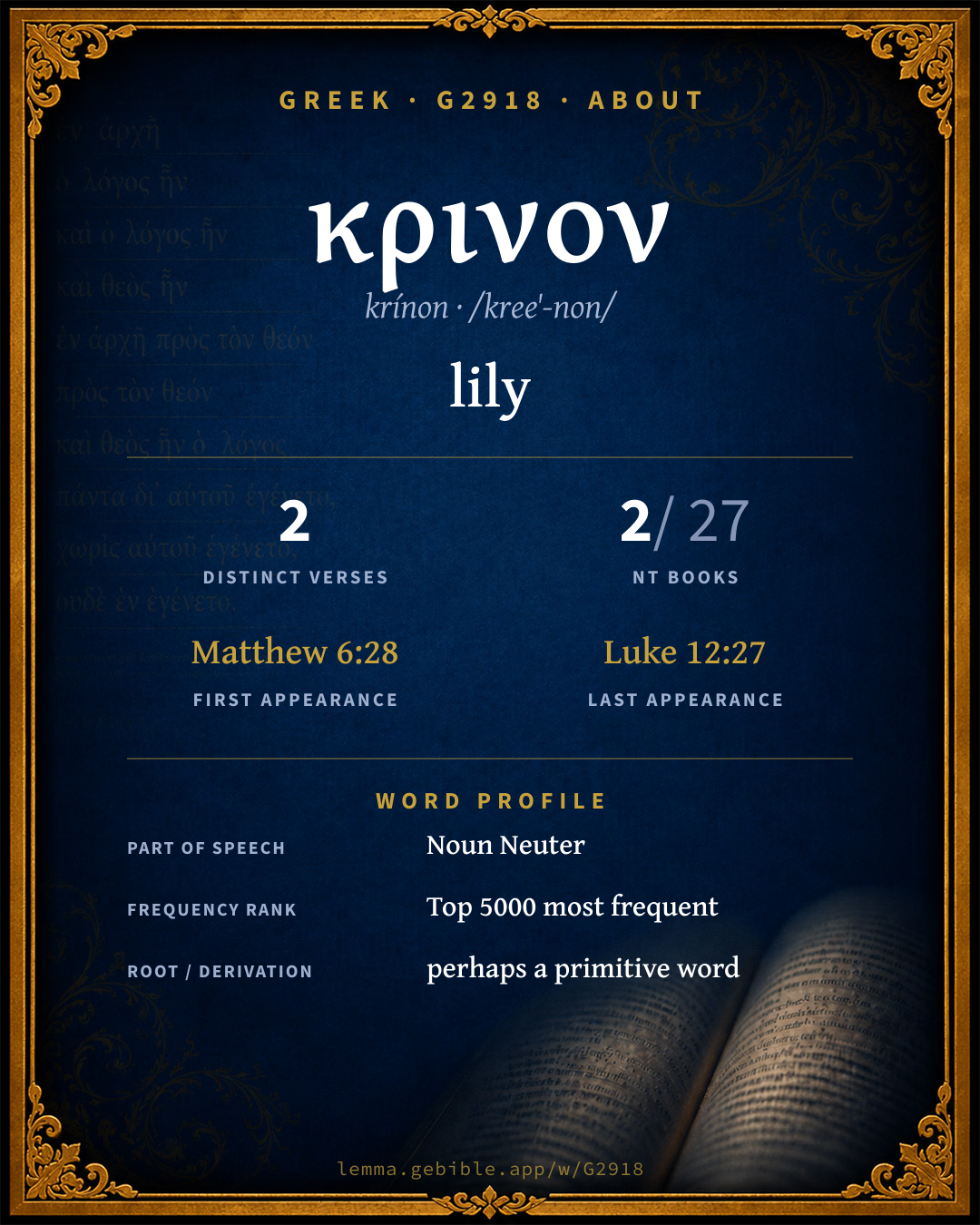
κρίνον
lily
Full lexicon entry — Thayer's Greek Lexicon
From Thayer's Greek Lexicon
Where this word appears
Grammar key — what these labels mean
Part of speech
- Noun
- A naming word — a person, place, thing, or idea.
Case
- Accusative
- The case of the direct object and of extent.
Gender
- Neuter
- Grammatically neuter.
Number
- Plural
- More than one.
Every verse where G2918 appears in the Book of Matthew — 1 distinct verse. Click any verse to open its interlinear word-by-word view. Verse text shown in the World English Bible for context — . Each verse’s Greek form is shown with its reference; the English is not keyword-highlighted, since the data carries no word-level English alignment. Use “Compare translations” on any verse to read it across multiple English versions. This concordance covers the Greek New Testament; Septuagint (Greek Old Testament) occurrences of this word are not indexed here.
Matthew
About this entry
At a glance — auto-summarized from this page’s data, not written by a person. Every figure links to its source below. This summary describes the numbers; it doesn’t interpret them.
“lily” is the headline sense of the Greek noun κρινον (krínon). It occurs a mere 2 verses across Scripture. It clusters heavily in Matthew, which alone accounts for 50% of its uses. First canonically at Matthew 6:28, it enters the text early. See the sense tree, 2-verse concordance, and the renderings breakdown below.
Gloss history
Strong's 1890 vs modern scholarship
About this word
Strong's G2918 catalogs a Greek word from the Greek New Testament.
These counts are not copied from any lexicon or concordance. They are computed here, from the morphology-tagged Greek New Testament. What Lemma adds →
- 2
- distinct verses
- The word appears in 2 distinct verses.
- 2 / 27
- NT books
- The word appears in 2 of 27 New Testament books.
- #2,678
- by frequency
- Top 5000 most frequent Greek words (rank 2,678 of 5,347 Greek words by occurrence).
View all 2 occurrences in the concordance →
By traditional corpus
Conventional, traditional groupings — biblical authorship is debated, so this is a traditional corpus grouping, not an authorship claim. Some books belong to more than one corpus (Luke is in both the Gospels and the Lukan corpus, and so on), so these shares overlap and need not total 100%. Each figure is a share of the word’s 2 distinct verses.
- Gospels 2 verses · 100%
- Lukan (Luke–Acts) 1 verse · 50%
How translations render this word
Counts come from each version’s own published word-to-Strong’s tagging or interlinear alignment — an approximate guide to how each version renders this word, not a word-level alignment the data otherwise carries. Because each total is that version’s own tagged count, the per-version totals vary from one another and need not match the appearance or distinct-verse counts above. These counts may also differ from a printed concordance because Lemma counts each distinctly tagged rendering and does not collapse phrase taggings into a single head-word total. This is a fixed set of word-tagged versions (KJV, ASV, BSB, ULT) and does not change with the reading translation you choose elsewhere. Each version’s license is shown beside its name below (and on Sources).
- King James Version: Lilies 2×
- American Standard Version: Lilies 1×
- Berean Standard Bible: Lilies 2×
- unfoldingWord Literal Text: Lilies 2×
King James Version Public Domain
Renders G2918 across 2 tagged occurrences — most commonly:
American Standard Version Public Domain
Renders G2918 across 1 tagged occurrence — most commonly:
Berean Standard Bible Public Domain
Renders G2918 across 2 tagged occurrences — most commonly:
unfoldingWord Literal Text CC BY-SA 4.0
Renders G2918 across 2 tagged occurrences — most commonly:
Senses in Thayer's
The 1 sense Thayer's distinguishes for this word, in lexicon order (not ranked by frequency or importance). The full entry — with sub-senses — is in the Lexicon Entry tab.
- a flower, the lily
Word origin
Origin: perhaps a primitive word
Perhaps a primary word; a lily : - lily.
— Strong’s Exhaustive Concordance (1890), public domain.
Septuagint usage
The same Greek word κρινον appears 19 times in the Greek Old Testament (Septuagint), across 19 verses in 9 books.
- 19
- LXX occurrences
- Tagged occurrences of this Greek word in the Septuagint.
- 19
- verses
- Distinct Septuagint verses containing this word.
- 9 / 39
- OT books
- The word appears in 9 of the 39 Old Testament books.
Sample Septuagint occurrences
- Exodus 25:31 κρίνον
- Numbers 8:4 κρίνον
- 1 Kings 7:8 κρίνον
- 2 Kings 15:5 κρίνον
- 2 Chronicles 4:5 κρίνον
- Song of Solomon 2:1 κρίνον
- Isaiah 35:1 κρίνον
- Hosea 14:6 κρίνον
- Micah 3:11 κρίνον
Septuagint occurrences (same lexeme)
Every verse where the same Strong’s number (G2918) appears in the Greek Septuagint. Verse text shown in the World English Bible for context; the Greek form is the matched word — the English is not keyword-highlighted.
- Exodus 25:31 κρίνον "You shall make a lampstand of pure gold. Of hammered work shall the lampstand be made, even its base, its shaft, its cups, its buds, and its flowers, shall be of one piece with it.
- Exodus 25:33 κρίνον three cups made like almond blossoms in one branch, a bud and a flower; and three cups made like almond blossoms in the other branch, a bud and a flower, so for the six branches going out of the lampstand;
- Exodus 25:34 κρίνον and in the lampstand four cups made like almond blossoms, its buds and its flowers;
- Numbers 8:4 κρίνον This was the workmanship of the lampstand, beaten work of gold. From its base to its flowers, it was beaten work: according to the pattern which Yahweh had shown Moses, so he made the lampstand.
- 1 Kings 7:8 κρίνον His house where he was to dwell, the other court within the porch, was of the like work. He made also a house for Pharaoh's daughter (whom Solomon had taken as wife), like this porch.
- 1 Kings 7:12 κρίνον The great court round about had three courses of hewn stone, and a course of cedar beams; like as the inner court of the house of Yahweh, and the porch of the house.
- 2 Kings 15:5 κρίνον Yahweh struck the king, so that he was a leper to the day of his death, and lived in a separate house. Jotham the king's son was over the household, judging the people of the land.
- 2 Chronicles 4:5 κρίνον It was a handbreadth thick; and the brim of it was worked like the brim of a cup, like the flower of a lily: it received and held three thousand baths.
- Song of Solomon 2:1 κρίνον I am a rose of Sharon, A lily of the valleys.
- Song of Solomon 2:2 κρίνον As a lily among thorns, So is my love among the daughters. Beloved
- Song of Solomon 2:16 κρίνον My beloved is mine, and I am his. He browses among the lilies.
- Song of Solomon 4:5 κρίνον Your two breasts are like two fawns That are twins of a roe, Which feed among the lilies.
- Song of Solomon 5:13 κρίνον His cheeks are like a bed of spices with towers of perfumes. His lips are like lilies, dropping liquid myrrh.
- Song of Solomon 6:2 κρίνον My beloved has gone down to his garden, To the beds of spices, To feed in the gardens, and to gather lilies.
- Song of Solomon 6:3 κρίνον I am my beloved's, and my beloved is mine. He browses among the lilies,
- Song of Solomon 7:3 κρίνον Your two breasts are like two fawns, That are twins of a roe.
- Isaiah 35:1 κρίνον The wilderness and the dry land shall be glad; and the desert shall rejoice, and blossom as the rose.
- Hosea 14:6 κρίνον His branches will spread, And his beauty will be like the olive tree, And his fragrance like Lebanon.
- Micah 3:11 κρίνον Her leaders judge for bribes, And her priests teach for a price, And her prophets of it tell forturnes for money: Yet they lean on Yahweh, and say, Isn't Yahweh in the midst of us? No disaster will come on us.
These are occurrences of the same Greek lexeme (G2918) in the Septuagint — not a translation of any one Hebrew word. The store carries no word-level Hebrew↔Greek alignment, so no Hebrew original is asserted here. Counts come from the recovered LXX Strong's tagging — high-frequency vocabulary is well covered, while rare or late forms may be untagged — so they reflect tagged occurrences and may slightly undercount.