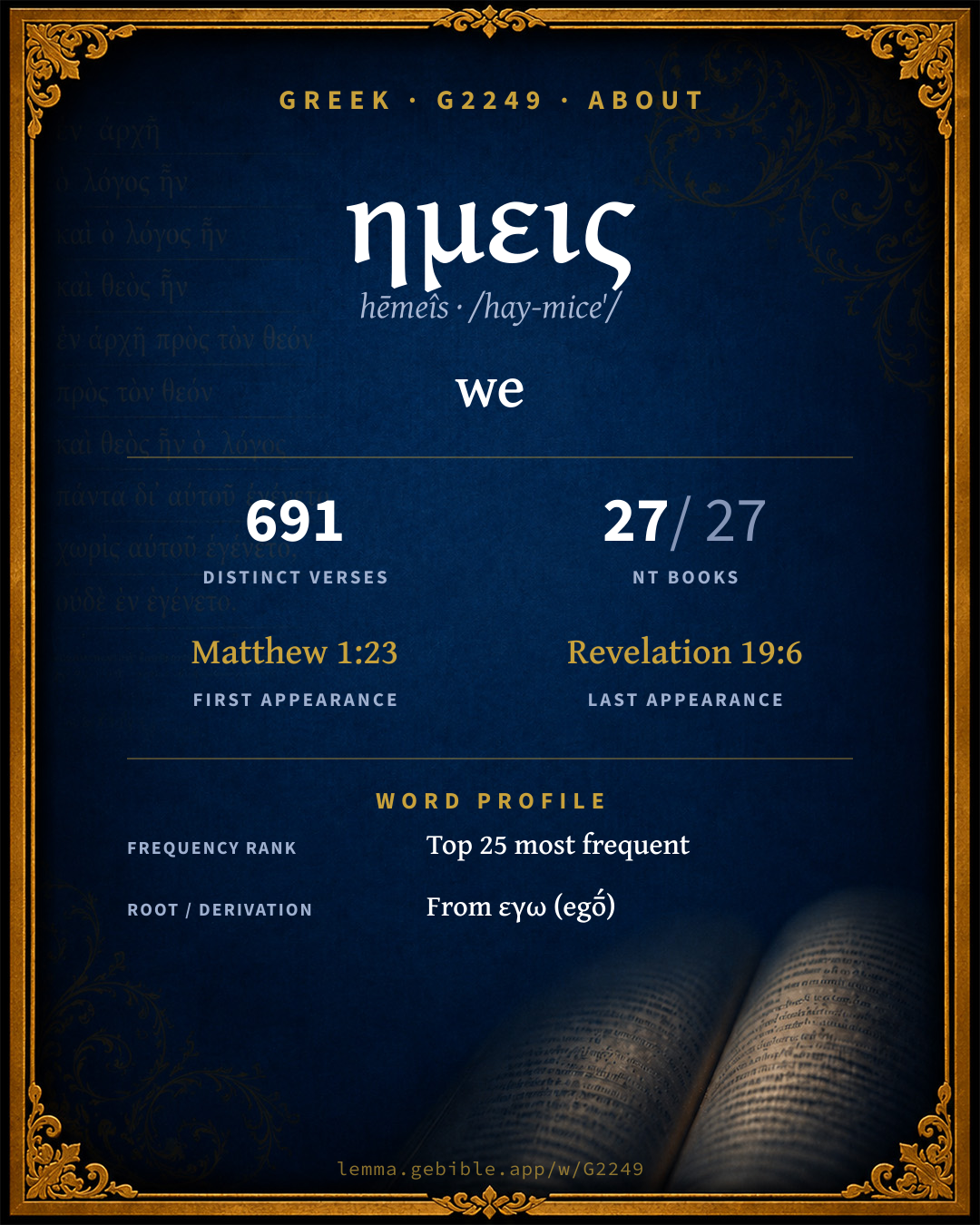
ἡμεῖς
we
Full lexicon entry — Thayer's Greek Lexicon
From Thayer's Greek Lexicon
Where this word appears
See every Genitive-case word in the Greek New Testament →
Grammar key — what these labels mean
Part of speech
- Personal pronoun
- Stands in for a person already named (“I,” “you,” “he”).
Case
- Genitive
- The case of source, possession, or “of” — answers “whose / from what.”
- Dative
- The case of the indirect object, means, or location — “to / for / with / in.”
- Accusative
- The case of the direct object and of extent.
- Nominative
- The case of the subject (and the predicate nominative).
Person
- 1st person
- The speaker (“I / we”).
Number
- Plural
- More than one.
14 verses where G2249 appears in the Dative case in the Book of 1 John. Filtered view — show all forms. Click any verse to open its interlinear word-by-word view. Verse text shown in the World English Bible for context — . Each verse’s Greek form is shown with its reference; the English is not keyword-highlighted, since the data carries no word-level English alignment. Use “Compare translations” on any verse to read it across multiple English versions. This concordance covers the Greek New Testament; Septuagint (Greek Old Testament) occurrences of this word are not indexed here.
1 John
- 1 John 1:2 ἡμῖν pron 1 dat pl (and the life was revealed, and we have seen, and testify, and declare to you the life, the eternal life, which was with the Father, and was revealed to us);
- 1 John 1:8 ἡμῖν pron 1 dat pl If we say that we have no sin, we deceive ourselves, and the truth is not in us.
- 1 John 1:9 ἡμῶν ἡμῖν ἡμᾶς pron 1 gen pl pron 1 dat pl pron 1 acc pl If we confess our sins, he is faithful and righteous to forgive us the sins, and to cleanse us from all unrighteousness.
- 1 John 1:10 ἡμῖν pron 1 dat pl If we say that we haven't sinned, we make him a liar, and his word is not in us.
- 1 John 2:25 ἡμῖν pron 1 dat pl This is the promise which he promised us, the eternal life.
- 1 John 3:1 ἡμῖν ἡμᾶς pron 1 dat pl pron 1 acc pl Behold, how great a love the Father has bestowed on us, that we should be called children of God! For this cause the world doesn't know us, because it didn't know him.
- 1 John 3:23 ἡμῖν pron 1 dat pl This is his commandment, that we should believe in the name of his Son, Jesus Christ, and love one another, even as he commanded.
- 1 John 3:24 ἡμῖν ἡμῖν pron 1 dat pl pron 1 dat pl He who keeps his commandments remains in him, and he in him. By this we know that he remains in us, by the Spirit which he gave us.
- 1 John 4:9 ἡμῖν pron 1 dat pl By this was God's love revealed in us, that God has sent his one and only Son into the world that we might live through him.
- 1 John 4:12 ἡμῖν ἡμῖν pron 1 dat pl pron 1 dat pl No one has seen God at any time. If we love one another, God remains in us, and his love has been perfected in us.
- 1 John 4:13 ἡμῖν ἡμῖν pron 1 dat pl pron 1 dat pl By this we know that we remain in him and he in us, because he has given us of his Spirit.
- 1 John 4:16 ἡμεῖς ἡμῖν pron 1 nom pl pron 1 dat pl We know and have believed the love which God has for us. God is love, and he who remains in love remains in God, and God remains in him.
- 1 John 5:11 ἡμῖν pron 1 dat pl The testimony is this, that God gave to us eternal life, and this life is in his Son.
- 1 John 5:20 ἡμῖν pron 1 dat pl We know that the Son of God has come, and has given us an understanding, that we know him who is true, and we are in him who is true, in his Son Jesus Christ. This is the true God, and eternal life.
About this entry
At a glance — auto-summarized from this page’s data, not written by a person. Every figure links to its source below. This summary describes the numbers; it doesn’t interpret them.
ημεις (hēmeîs) is a Greek word most often rendered “we.” It first appears in Matthew 1:23. The Greek New Testament uses it across 691 verses — among the most common. Sharing its root, it stands alongside εγω, εμος and εμου. For the data behind this summary, explore the sense tree and the renderings breakdown below.
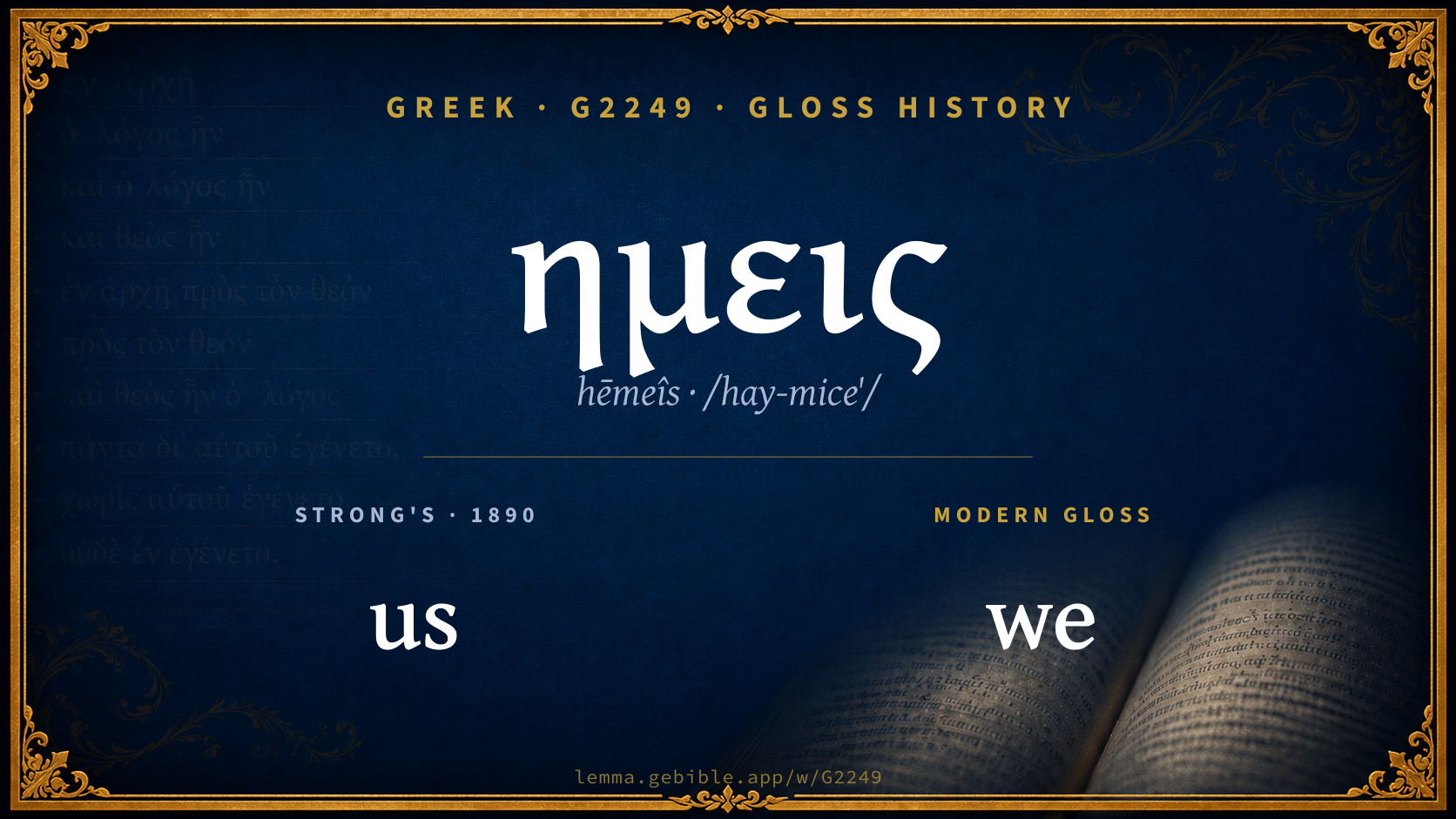
Gloss history
Strong's 1890 vs modern scholarship
About this word
Strong's G2249 catalogs a Greek word from the Greek New Testament.
These counts are not copied from any lexicon or concordance. They are computed here, from the morphology-tagged Greek New Testament. What Lemma adds →
- 691
- distinct verses
- The word appears in 691 distinct verses.
- 27 / 27
- NT books
- The word appears in 27 of 27 New Testament books.
- #23
- by frequency
- Top 25 most frequent Greek words (rank 23 of 5,347 Greek words by occurrence).
View all 691 occurrences in the concordance →
Most concentrated in
- Acts 109 verses 16%
- 2 Corinthians 81 verses 12%
- Luke 54 verses 8%
By section of the New Testament
By traditional corpus
Conventional, traditional groupings — biblical authorship is debated, so this is a traditional corpus grouping, not an authorship claim. Some books belong to more than one corpus (Luke is in both the Gospels and the Lukan corpus, and so on), so these shares overlap and need not total 100%. Each figure is a share of the word’s 691 distinct verses.
- Pauline corpus 318 verses · 46%
- Lukan (Luke–Acts) 163 verses · 24%
- Gospels 157 verses · 23%
- Johannine 99 verses · 14%
- General (Catholic) Epistles 68 verses · 10%
- Hebrews 25 verses · 4%
- Revelation 14 verses · 2%
How translations render this word
Counts come from each version’s own published word-to-Strong’s tagging or interlinear alignment — an approximate guide to how each version renders this word, not a word-level alignment the data otherwise carries. Because each total is that version’s own tagged count, the per-version totals vary from one another and need not match the appearance or distinct-verse counts above. These counts may also differ from a printed concordance because Lemma counts each distinctly tagged rendering and does not collapse phrase taggings into a single head-word total. This is a fixed set of word-tagged versions (KJV, ASV, BSB, ULT) and does not change with the reading translation you choose elsewhere. Each version’s license is shown beside its name below (and on Sources).
- King James Version: We 118×, Shall we 2×, Us 2×
- American Standard Version: We 117×, Us 3×
King James Version Public Domain
Renders G2249 across 126 tagged occurrences — most commonly:
Plus 4 renderings that appear only once — usually multi-word phrases or single function words the recovered tagging swept in, not distinct renderings.
American Standard Version Public Domain
Renders G2249 across 129 tagged occurrences — most commonly:
Plus 9 renderings that appear only once — usually multi-word phrases or single function words the recovered tagging swept in, not distinct renderings.
Senses in Thayer's
The 1 sense Thayer's distinguishes for this word, in lexicon order (not ranked by frequency or importance). The full entry — with sub-senses — is in the Lexicon Entry tab.
- us, we etc.
Word origin
Derived from εγω (egṓ) (G1473) — I.
Nomitive plural of G1473 ; we (only used when emphatic): - us we (ourselves).
— Strong’s Exhaustive Concordance (1890), public domain.
Forms in the corpus
The 5 distinct written forms G2249 takes in the Greek New Testament, most frequent first — each parse links to that case’s occurrences in the concordance.
| Form | Parsing | Example | Uses |
|---|---|---|---|
| ἡμῶν hēmō̂n | Personal pronoun, 1st person, Genitive, Plural | Matthew 1:23 | 401 |
| ἡμῖν hēmîn | Personal pronoun, 1st person, Dative, Plural | Matthew 3:15 | 168 |
| ἡμᾶς hēmâs | Personal pronoun, 1st person, Accusative, Plural | Matthew 6:13 | 167 |
| ἡμεῖς hēmeîs | Personal pronoun, 1st person, Nominative, Plural | Matthew 6:12 | 122 |
| Ἡμεῖς Hēmeîs | Personal pronoun, 1st person, Nominative, Plural | Acts 20:13 | 4 |
Same root — word family
Other Thayer's entries built from the same root as G2249, grouped by Strong’s listed origin. These share a root / origin per the lexicon — not necessarily a shared meaning. Each links to that word’s own entry.
Derives from
Shares the same root
Compare all same-root words → Showing 4 of 7 — not the complete family. 1 of the same-root words is a proper name (a person or place). They share a root, not necessarily a meaning.