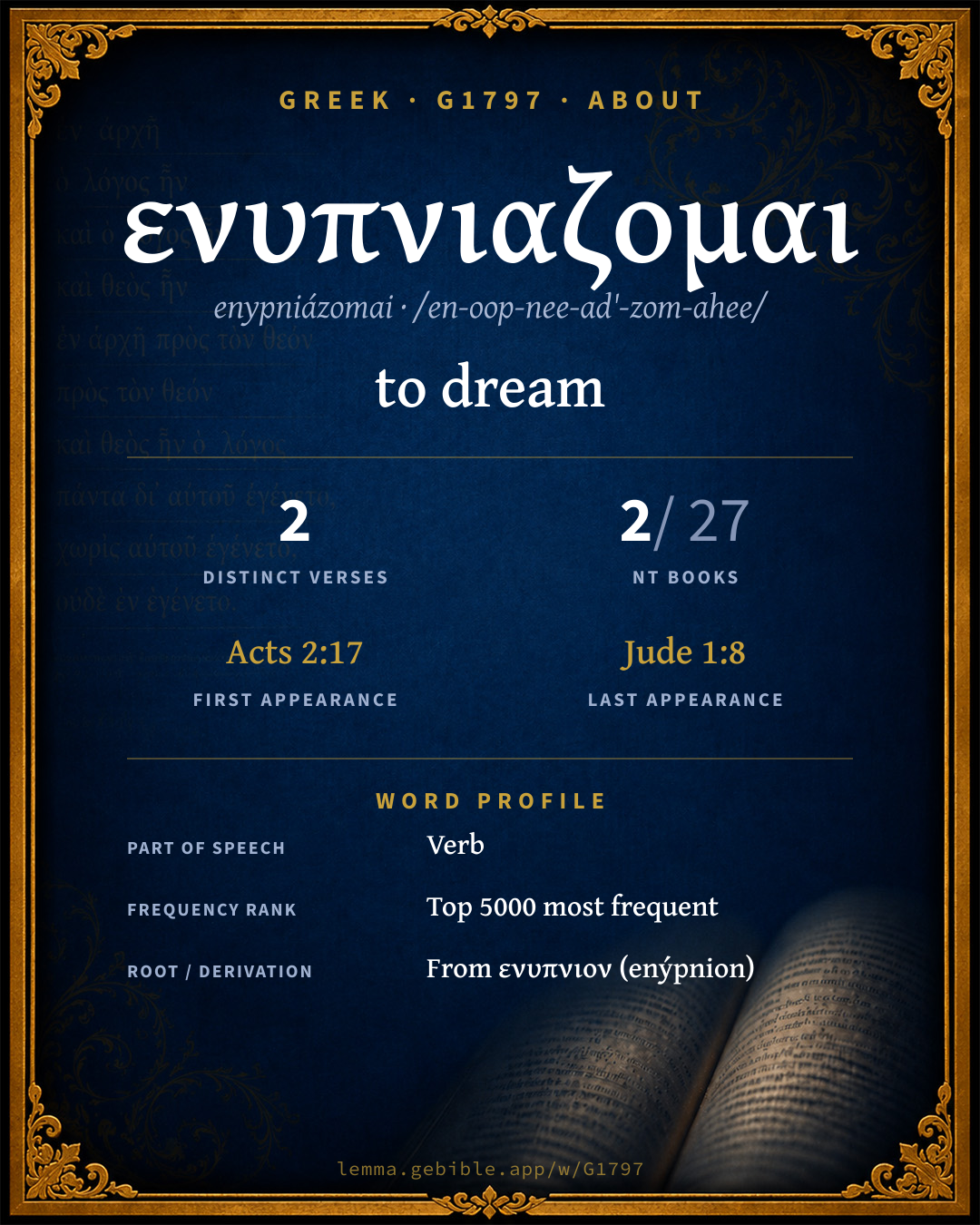
ἐνυπνιάζομαι
to dream
‘to dream’ is one of 2 main senses fuller range ↓
Full lexicon entry — Thayer's Greek Lexicon
From Thayer's Greek Lexicon
Where this word appears
See every Future-tense verb in the Greek New Testament →
Grammar key — what these labels mean
Part of speech
- Verb
- An action or state-of-being word.
Tense
- Future
- Action expected in future time.
- Present
- Ongoing or general action in present time (imperfective aspect).
Voice
- Passive
- The subject receives the action.
- Middle or Passive deponent
- Middle/passive in form but active in meaning.
Mood
- Indicative
- States a fact or asks a factual question (the mood of reality).
- Participle
- A verbal adjective (“writing,” “having written”).
Case
- Nominative
- The case of the subject (and the predicate nominative).
Person
- 3rd person
- The one spoken about (“he / she / it / they”).
Gender
- Masculine
- Grammatically masculine.
Number
- Plural
- More than one.
Grammatical forms
- Verb, Future, Passive, Indicative, 3rd person, Plural 1 time (50%)
- Verb, Present, Middle or Passive deponent, Participle, Nominative, Plural, Masculine 1 time (50%)
Parsed forms decoded from the imported morphology (Robinson–Tischendorf, public domain), counted across 2 parsed occurrences — not distinct verses.
Every verse where G1797 appears — 2 distinct verses across 2 books. Click any verse to open its interlinear word-by-word view. Verse text shown in the World English Bible for context — . Each verse’s Greek form is shown with its reference; the English is not keyword-highlighted, since the data carries no word-level English alignment. Use “Compare translations” on any verse to read it across multiple English versions. This concordance covers the Greek New Testament; Septuagint (Greek Old Testament) occurrences of this word are not indexed here.
Acts 1 verse
Jude 1 verse
About this entry
At a glance — auto-summarized from this page’s data, not written by a person. Every figure links to its source below. This summary describes the numbers; it doesn’t interpret them.
At its core, ενυπνιαζομαι (enypniázomai) means “to dream.” The Greek New Testament uses it only 2 verses. Its uses cluster heavily in Acts (50% of all occurrences). Scripture first uses it in Acts 2:17. Ranging over 2 senses, it is not a single-sense word. Each statement above links to its evidence; the full detail follows below.
Gloss history
Strong's 1890 vs modern scholarship
About this word
Strong's G1797 catalogs a Greek word from the Greek New Testament.
These counts are not copied from any lexicon or concordance. They are computed here, from the morphology-tagged Greek New Testament. What Lemma adds →
- 2
- distinct verses
- The word appears in 2 distinct verses.
- 2 / 27
- NT books
- The word appears in 2 of 27 New Testament books.
- #2,678
- by frequency
- Top 5000 most frequent Greek words (rank 2,678 of 5,347 Greek words by occurrence).
View all 2 occurrences in the concordance →
By traditional corpus
Conventional, traditional groupings — biblical authorship is debated, so this is a traditional corpus grouping, not an authorship claim. Some books belong to more than one corpus (Luke is in both the Gospels and the Lukan corpus, and so on), so these shares overlap and need not total 100%. Each figure is a share of the word’s 2 distinct verses.
- Lukan (Luke–Acts) 1 verse · 50%
- General (Catholic) Epistles 1 verse · 50%
How translations render this word
Counts come from each version’s own published word-to-Strong’s tagging or interlinear alignment — an approximate guide to how each version renders this word, not a word-level alignment the data otherwise carries. Because each total is that version’s own tagged count, the per-version totals vary from one another and need not match the appearance or distinct-verse counts above. These counts may also differ from a printed concordance because Lemma counts each distinctly tagged rendering and does not collapse phrase taggings into a single head-word total. This is a fixed set of word-tagged versions (KJV, ASV, BSB, ULT) and does not change with the reading translation you choose elsewhere. Each version’s license is shown beside its name below (and on Sources).
- King James Version: Filthy dreamers 1×, Shall dream 1×
- American Standard Version: Dreamings 1×, Shall dream 1×
- Berean Standard Bible: Dreamers 1×, Will dream 1×
- unfoldingWord Literal Text: Dreaming 1×, Will dream 1×
King James Version Public Domain
Renders G1797 across 2 tagged occurrences — most commonly:
American Standard Version Public Domain
Renders G1797 across 2 tagged occurrences — most commonly:
Berean Standard Bible Public Domain
Renders G1797 across 2 tagged occurrences — most commonly:
unfoldingWord Literal Text CC BY-SA 4.0
Renders G1797 across 2 tagged occurrences — most commonly:
Senses in Thayer's
The 2 senses Thayer's distinguishes for this word, in lexicon order (not ranked by frequency or importance). The full entry — with sub-senses — is in the Lexicon Entry tab.
- to dream (divinely suggested) dreams
- metaph., to be beguiled with sensual images and carried away to an impious course of conduct
Word origin
Derived from ενυπνιον (enýpnion) (G1798) — dream.
Middle voice from G1798 ; to dream : - dream (-er).
— Strong’s Exhaustive Concordance (1890), public domain.
Forms in the corpus
The 2 distinct written forms G1797 takes in the Greek New Testament, most frequent first — each parse links to that tense’s occurrences in the concordance.
| Form | Parsing | Example | Uses |
|---|---|---|---|
| ἐνυπνιαζόμενοι enypniazómenoi | Verb, Present, Middle or Passive deponent, Participle, Nominative, Plural, Masculine | Jude 1:8 | 1 |
| ἐνυπνιασθήσονται enypniasthḗsontai | Verb, Future, Passive, Indicative, 3rd person, Plural | Acts 2:17 | 1 |
Septuagint usage
The same Greek word ενυπνιαζομαι appears 17 times in the Greek Old Testament (Septuagint), across 17 verses in 6 books.
- 17
- LXX occurrences
- Tagged occurrences of this Greek word in the Septuagint.
- 17
- verses
- Distinct Septuagint verses containing this word.
- 6 / 39
- OT books
- The word appears in 6 of the 39 Old Testament books.
Sample Septuagint occurrences
- Genesis 28:12 ἐνὑπνιάζω
- Deuteronomy 13:2 ἐνὑπνιάζω
- Judges 7:13 ἐνυπνιάζω
- Isaiah 29:7 ἐνυπνιάζομαι
- Jeremiah 23:25 ἐνυπνιάζω
- Joel 3:1 ἐνὑπνιάζω
Septuagint occurrences (same lexeme)
Every verse where the same Strong’s number (G1797) appears in the Greek Septuagint. Verse text shown in the World English Bible for context; the Greek form is the matched word — the English is not keyword-highlighted.
- Genesis 28:12 ἐνὑπνιάζω He dreamed. Behold, a stairway set up on the earth, and the top of it reached to heaven. Behold, the angels of God ascending and descending on it.
- Genesis 37:5 ἐνὑπνιάζω Joseph dreamed a dream, and he told it to his brothers, and they hated him all the more.
- Genesis 37:6 ἐνὑπνιάζω He said to them, "Please hear this dream which I have dreamed:
- Genesis 37:9 ἐνὑπνιάζω He dreamed yet another dream, and told it to his brothers, and said, "Behold, I have dreamed yet another dream: and behold, the sun and the moon and eleven stars bowed down to me."
- Genesis 37:10 ἐνὑπνιάζω He told it to his father and to his brothers. His father rebuked him, and said to him, "What is this dream that you have dreamed? Will I and your mother and your brothers indeed come to bow ourselves down to you to the earth?"
- Genesis 41:5 ἐνὑπνιάζω He slept and dreamed a second time: and, behold, seven heads of grain came up on one stalk, healthy and good.
- Deuteronomy 13:2 ἐνὑπνιάζω and the sign or the wonder come to pass, of which he spoke to you, saying, Let us go after other gods, which you have not known, and let us serve them;
- Deuteronomy 13:4 ἐνὑπνιάζω You shall walk after Yahweh your God, and fear him, and keep his commandments, and obey his voice, and you shall serve him, and cleave to him.
- Deuteronomy 13:6 ἐνὑπνιάζω If your brother, the son of your mother, or your son, or your daughter, or the wife of your bosom, or your friend, who is as your own soul, entice you secretly, saying, Let us go and serve other gods, which you have not known, you, nor your fathers;
- Judges 7:13 ἐνυπνιάζω When Gideon had come, behold, there was a man telling a dream to his fellow; and he said, Behold, I dreamed a dream; and, behold, a cake of barley bread tumbled into the camp of Midian, and came to the tent, and struck it so that it fell, and turned it upside down, so that the tent lay flat.
- Isaiah 29:7 ἐνυπνιάζομαι The multitude of all the nations that fight against Ariel, even all who fight against her and her stronghold, and who distress her, shall be as a dream, a vision of the night.
- Isaiah 29:8 ἐνυπνιάζομαι It shall be as when a hungry man dreams, and, behold, he eats; but he awakes, and his soul is empty: or as when a thirsty man dreams, and, behold, he drinks; but he awakes, and, behold, he is faint, and his soul has appetite: so shall the multitude of all the nations be, that fight against Mount Zion.
- Isaiah 56:10 ἐνὑπνιάζω His watchmen are blind, they are all without knowledge; they are all mute dogs, they can't bark; dreaming, lying down, loving to slumber.
- Jeremiah 23:25 ἐνυπνιάζω I have heard what the prophets have said, who prophesy lies in my name, saying, I have dreamed, I have dreamed.
- Jeremiah 34:9 ἐνὑπνιάζω that every man should let his man-servant, and every man his maid-servant, who is a Hebrew or a Hebrewess, go free; that none should make bondservants of them, [to wit], of a Jew his brother.
- Jeremiah 36:8 ἐνὑπνιάζω Baruch the son of Neriah did according to all that Jeremiah the prophet commanded him, reading in the book the words of Yahweh in Yahweh's house.
- Joel 3:1 ἐνὑπνιάζω "For, behold, in those days, And in that time, When I restore the fortunes of Judah and Jerusalem,
These are occurrences of the same Greek lexeme (G1797) in the Septuagint — not a translation of any one Hebrew word. The store carries no word-level Hebrew↔Greek alignment, so no Hebrew original is asserted here. Counts come from the recovered LXX Strong's tagging — high-frequency vocabulary is well covered, while rare or late forms may be untagged — so they reflect tagged occurrences and may slightly undercount.