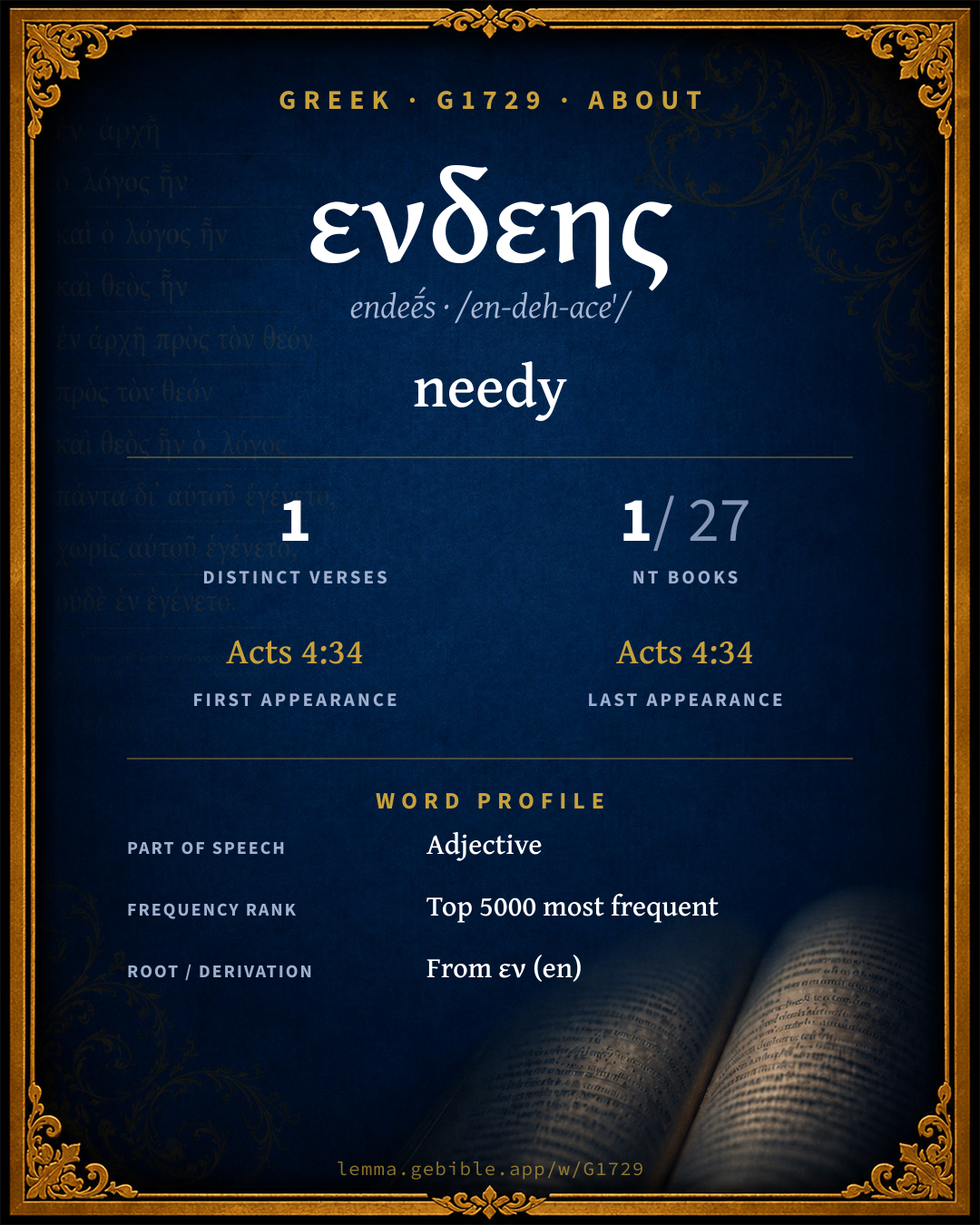
ἐνδεής
needy
Full lexicon entry — Thayer's Greek Lexicon
From Thayer's Greek Lexicon
Where this word appears
Grammar key — what these labels mean
Part of speech
- Adjective
- A word that describes or qualifies a noun.
Case
- Nominative
- The case of the subject (and the predicate nominative).
Gender
- Masculine
- Grammatically masculine.
Number
- Singular
- One.
Every verse where G1729 appears — 1 distinct verse across 1 book. Click any verse to open its interlinear word-by-word view. Verse text shown in the World English Bible for context — . Each verse’s Greek form is shown with its reference; the English is not keyword-highlighted, since the data carries no word-level English alignment. Use “Compare translations” on any verse to read it across multiple English versions. This concordance covers the Greek New Testament; Septuagint (Greek Old Testament) occurrences of this word are not indexed here.
Acts 1 verse
About this entry
At a glance — auto-summarized from this page’s data, not written by a person. Every figure links to its source below. This summary describes the numbers; it doesn’t interpret them.
ενδεης (endeḗs) is a Greek adjective most often rendered “needy.” It occurs a mere 1 verse across Scripture. It clusters heavily in Acts, which alone accounts for 100% of its uses. A true hapax — its single appearance is Acts 4:34. From the same root come εν, εγγραφω and εγγυος. For the data behind this summary, explore the sense tree and the renderings breakdown below.
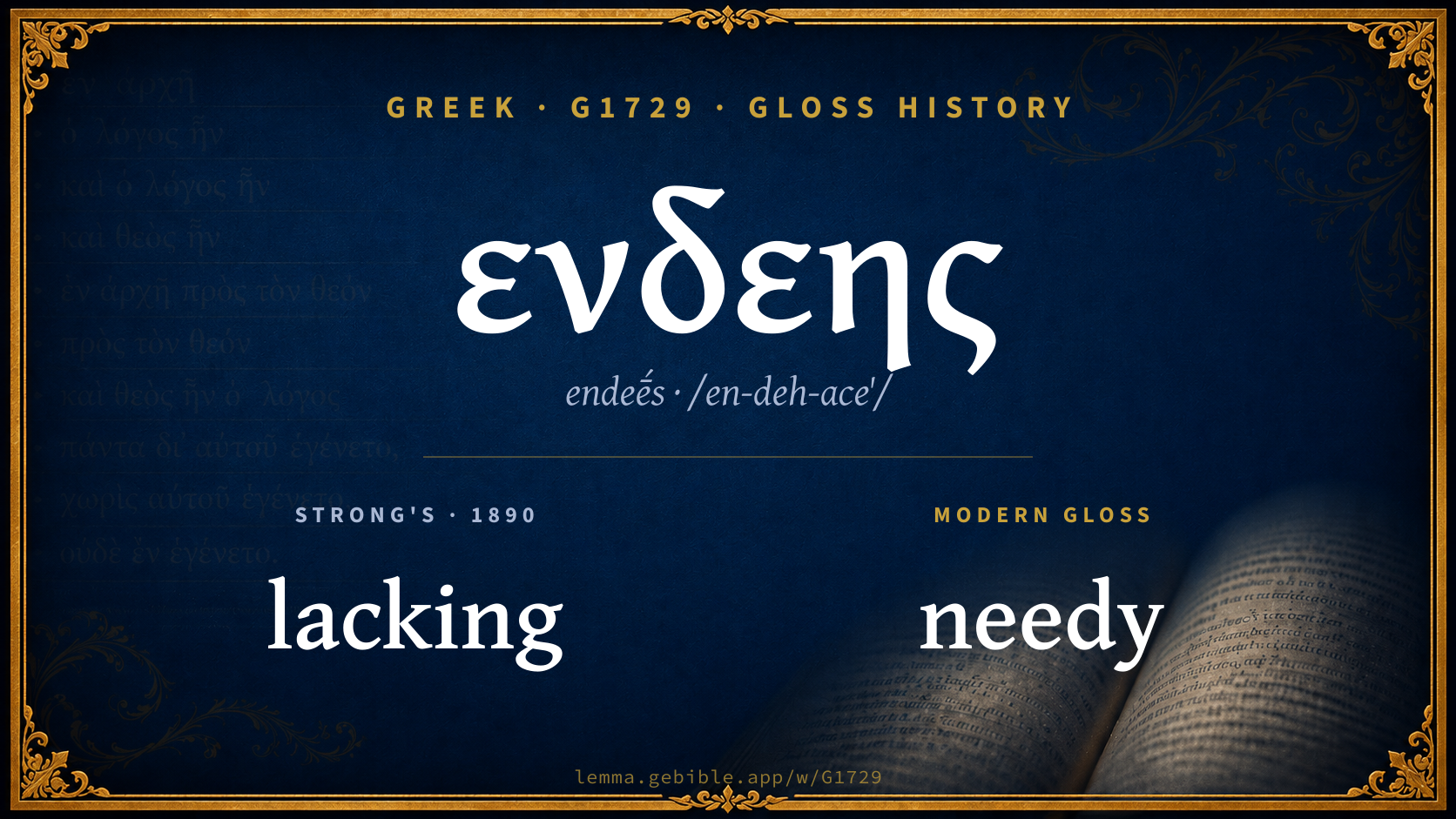
Gloss history
Strong's 1890 vs modern scholarship
About this word
Strong's G1729 catalogs a Greek word from the Greek New Testament.
These counts are not copied from any lexicon or concordance. They are computed here, from the morphology-tagged Greek New Testament. What Lemma adds →
- 1
- distinct verses
- The word appears in 1 distinct verse.
- 1 / 27
- NT books
- The word appears in 1 of 27 New Testament books.
- #3,503
- by frequency
- Top 5000 most frequent Greek words (rank 3,503 of 5,347 Greek words by occurrence).
View all 1 occurrence in the concordance →
Most concentrated in
- Acts 1 verse 100%
By section of the New Testament
By traditional corpus
Conventional, traditional groupings — biblical authorship is debated, so this is a traditional corpus grouping, not an authorship claim. Some books belong to more than one corpus (Luke is in both the Gospels and the Lukan corpus, and so on), so these shares overlap and need not total 100%. Each figure is a share of the word’s 1 distinct verse.
- Lukan (Luke–Acts) 1 verse · 100%
How translations render this word
Counts come from each version’s own published word-to-Strong’s tagging or interlinear alignment — an approximate guide to how each version renders this word, not a word-level alignment the data otherwise carries. Because each total is that version’s own tagged count, the per-version totals vary from one another and need not match the appearance or distinct-verse counts above. These counts may also differ from a printed concordance because Lemma counts each distinctly tagged rendering and does not collapse phrase taggings into a single head-word total. This is a fixed set of word-tagged versions (KJV, ASV, BSB, ULT) and does not change with the reading translation you choose elsewhere. Each version’s license is shown beside its name below (and on Sources).
- King James Version: Lacked 1×
- American Standard Version: Lacked 1×
- Berean Standard Bible: Needy 1×
- unfoldingWord Literal Text: Needy 1×
King James Version Public Domain
Renders G1729 across 1 tagged occurrence — most commonly:
American Standard Version Public Domain
Renders G1729 across 1 tagged occurrence — most commonly:
Berean Standard Bible Public Domain
Renders G1729 across 1 tagged occurrence — most commonly:
unfoldingWord Literal Text CC BY-SA 4.0
Renders G1729 across 1 tagged occurrence — most commonly:
Senses in Thayer's
The 1 sense Thayer's distinguishes for this word, in lexicon order (not ranked by frequency or importance). The full entry — with sub-senses — is in the Lexicon Entry tab.
- needy, destitute
Word origin
Derived from εν (en) (G1722).
Same root — word family
Other Thayer's entries built from the same root as G1729, grouped by Strong’s listed origin. These share a root / origin per the lexicon — not necessarily a shared meaning. Each links to that word’s own entry.
Derives from
Shares the same root
- εγγραφω engráphō G1449 to inscribe
- εγγυος éngyos G1450 surety
- εγκαθετος enkáthetos G1455 to spy
- εγκαινια enkaínia G1456 dedication
- εγκαλεω enkaléō G1458 to accuse
- εγκαταλειπω enkataleípō G1459 to abandon
- εγκατοικεω enkatoikéō G1460 to dwell
- εγκεντριζω enkentrízō G1461 to graft
- εγκομβοομαι enkombóomai G1463 band
- εγκοπτω enkóptō G1465 to hinder
- εγκρατης enkratḗs G1468 strong
- εγκρινω enkrínō G1469 to judge worthy
- εγκρυπτω enkrýptō G1470 to conceal
- εγκυος énkyos G1471 pregnant
- εγχριω enchríō G1472 to anoint
- ελλογεω ellogéō G1677 impute
- εμβαινω embaínō G1684 to enter
- εμβαλλω embállō G1685 to cast in
- εμβαπτω embáptō G1686 to dip in
- εμβατευω embateúō G1687 to enter
- εμβιβαζω embibázō G1688 to lead in
- εμβλεπω emblépō G1689 to look at
- εμβριμαομαι embrimáomai G1690 to warn sternly
- εμμαινομαι emmaínomai G1693 to rage against
+58 more words share this root (not shown).
Compare all same-root words → Showing 4 of 84 — not the complete family. They share a root, not necessarily a meaning.
Septuagint usage
The same Greek word ενδεης appears 22 times in the Greek Old Testament (Septuagint), across 22 verses in 5 books.
- 22
- LXX occurrences
- Tagged occurrences of this Greek word in the Septuagint.
- 22
- verses
- Distinct Septuagint verses containing this word.
- 5 / 39
- OT books
- The word appears in 5 of the 39 Old Testament books.
Sample Septuagint occurrences
- Deuteronomy 15:4 ἐνδεής
- Job 30:4 ἐνδεής
- Proverbs 3:27 ἐνδεής
- Isaiah 41:17 ἐνδεής
- Ezekiel 4:17 ἐνδεής
Septuagint occurrences (same lexeme)
Every verse where the same Strong’s number (G1729) appears in the Greek Septuagint. Verse text shown in the World English Bible for context; the Greek form is the matched word — the English is not keyword-highlighted.
- Deuteronomy 15:4 ἐνδεής However there shall be no poor with you; (for Yahweh will surely bless you in the land which Yahweh your God gives you for an inheritance to possess it;)
- Deuteronomy 15:7 ἐνδεής If there be with you a poor man, one of your brothers, within any of your gates in your land which Yahweh your God gives you, you shall not harden your heart, nor shut your hand from your poor brother;
- Deuteronomy 15:11 ἐνδεής For the poor will never cease out of the land: therefore I command you, saying, You shall surely open your hand to your brother, to your needy, and to your poor, in your land.
- Deuteronomy 24:14 ἐνδεής You shall not oppress a hired servant who is poor and needy, whether he be of your brothers, or of your foreigners who are in your land within your gates:
- Job 30:4 ἐνδεής They pluck salt herbs by the bushes. The roots of the broom are their food.
- Proverbs 3:27 ἐνδεής Don't withhold good from those to whom it is due, When it is in the power of your hand to do it.
- Proverbs 7:7 ἐνδεής I saw among the simple ones. I discerned among the youths a young man void of understanding,
- Proverbs 9:4 ἐνδεής "Whoever is simple, let him turn in here!" As for him who is void of understanding, she says to him,
- Proverbs 9:13 ἐνδεής The foolish woman is loud, Undisciplined, and knows nothing.
- Proverbs 9:16 ἐνδεής "Whoever is simple, let him turn in here." As for him who is void of understanding, she says to him,
- Proverbs 11:12 ἐνδεής One who despises his neighbor is void of wisdom, But a man of understanding holds his peace.
- Proverbs 11:16 ἐνδεής A gracious woman obtains honor, But violent men obtain riches.
- Proverbs 12:11 ἐνδεής He who tills his land shall have plenty of bread, But he who chases fantasies is void of understanding.
- Proverbs 13:25 ἐνδεής The righteous one eats to the satisfying of his soul, But the belly of the wicked goes hungry.
- Proverbs 15:21 ἐνδεής Folly is joy to one who is void of wisdom, But a man of understanding keeps his way straight.
- Proverbs 18:2 ἐνδεής A fool has no delight in understanding, But only in revealing his own opinion.
- Proverbs 21:17 ἐνδεής He who loves pleasure shall be a poor man: He who loves wine and oil shall not be rich.
- Proverbs 24:30 ἐνδεής I went by the field of the sluggard, By the vineyard of the man void of understanding;
- Proverbs 27:7 ἐνδεής A full soul loathes a honeycomb; But to a hungry soul, every bitter thing is sweet.
- Proverbs 28:16 ἐνδεής A tyrannical ruler lacks judgment. One who hates ill-gotten gain will have long days.
- Isaiah 41:17 ἐνδεής The poor and needy seek water, and there is none, and their tongue fails for thirst; I, Yahweh, will answer them, I, the God of Israel, will not forsake them.
- Ezekiel 4:17 ἐνδεής that they may want bread and water, and be dismayed one with another, and pine away in their iniquity.
These are occurrences of the same Greek lexeme (G1729) in the Septuagint — not a translation of any one Hebrew word. The store carries no word-level Hebrew↔Greek alignment, so no Hebrew original is asserted here. Counts come from the recovered LXX Strong's tagging — high-frequency vocabulary is well covered, while rare or late forms may be untagged — so they reflect tagged occurrences and may slightly undercount.