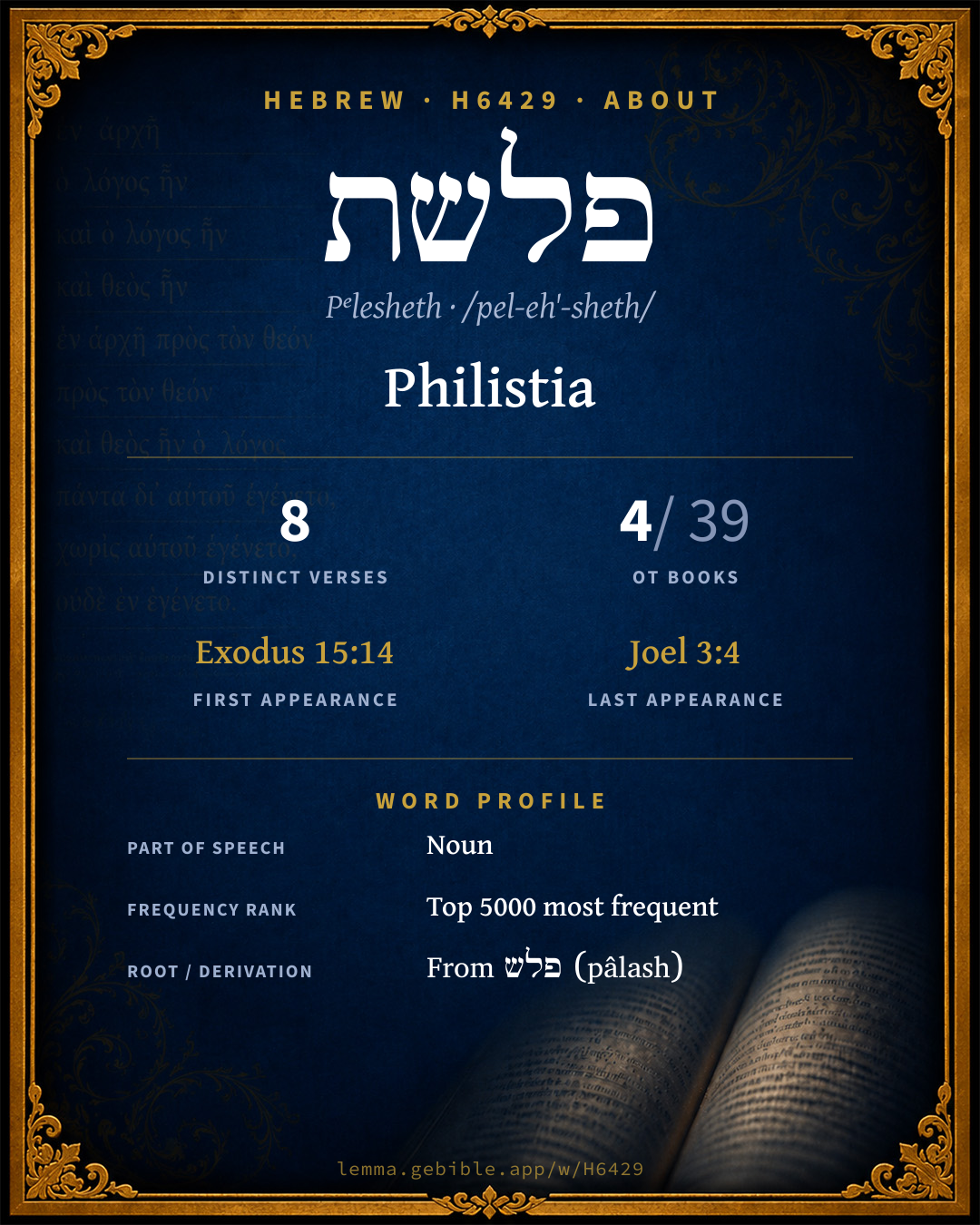
פְּלֶ֫שֶׁת
Philistia
BDB lists 2 entries for ‘Philistia’ fuller range ↓
Full lexicon entry — Brown-Driver-Briggs (BDB)
From Brown-Driver-Briggs (BDB)
Where this word appears
Grammar key — what these labels mean
Part of speech
- Noun
- A naming word — a person, place, thing, or idea.
Noun type
- Proper
- A name of a specific person, place, or people (e.g. Abraham, Zion, Israel).
Every verse where H6429 appears — 8 distinct verses across 4 books. Click any verse to open its interlinear word-by-word view. Verse text shown in the World English Bible for context — . Each verse’s Hebrew form is shown with its reference; the English is not keyword-highlighted, since the data carries no word-level English alignment. Use “Compare translations” on any verse to read it across multiple English versions. This concordance covers the Hebrew Bible; Septuagint (Greek Old Testament) occurrences are not indexed here.
Exodus 1 verse
Psalms 4 verses
- Psalms 60:8 פְּלֶ֣שֶׁת n Proper Moab is my wash basin. I will throw my shoe on Edom. I shout in triumph over Philistia."
- Psalms 83:7 פְּ֝לֶ֗שֶׁת n Proper Gebal, Ammon, and Amalek; Philistia with the inhabitants of Tyre;
- Psalms 87:4 פְלֶ֣שֶׁת n Proper I will record Rahab and Babylon among those who acknowledge me. Behold, Philistia, Tyre, and also Ethiopia: "This one was born there."
- Psalms 108:9 פְ֝לֶ֗שֶׁת n Proper Moab is my wash pot. I will toss my sandal on Edom. I will shout over Philistia."
Isaiah 2 verses
- Isaiah 14:29 פְלֶ֨שֶׁת֙ n Proper Don't rejoice, O Philistia, all of you, because the rod that struck you is broken; for out of the serpent's root shall come forth an adder, and his fruit shall be a fiery flying serpent.
- Isaiah 14:31 פְּלֶ֣שֶׁת n Proper Howl, gate; cry, city; you are melted away, Philistia, all of you; for there comes a smoke out of the north, and there is no straggler in his ranks.
Joel 1 verse
About this entry
At a glance — auto-summarized from this page’s data, not written by a person. Every figure links to its source below. This summary describes the numbers; it doesn’t interpret them.
At its core, פלשת (Pᵉlesheth) means “Philistia.” The word gravitates to Psalms (50%), then Isaiah and Exodus. It appears 8 verses across 4 books of the Hebrew Bible, among its uncommon vocabulary. First canonically at Exodus 15:14, it enters the text early. Each statement above links to its evidence; the full detail follows below.
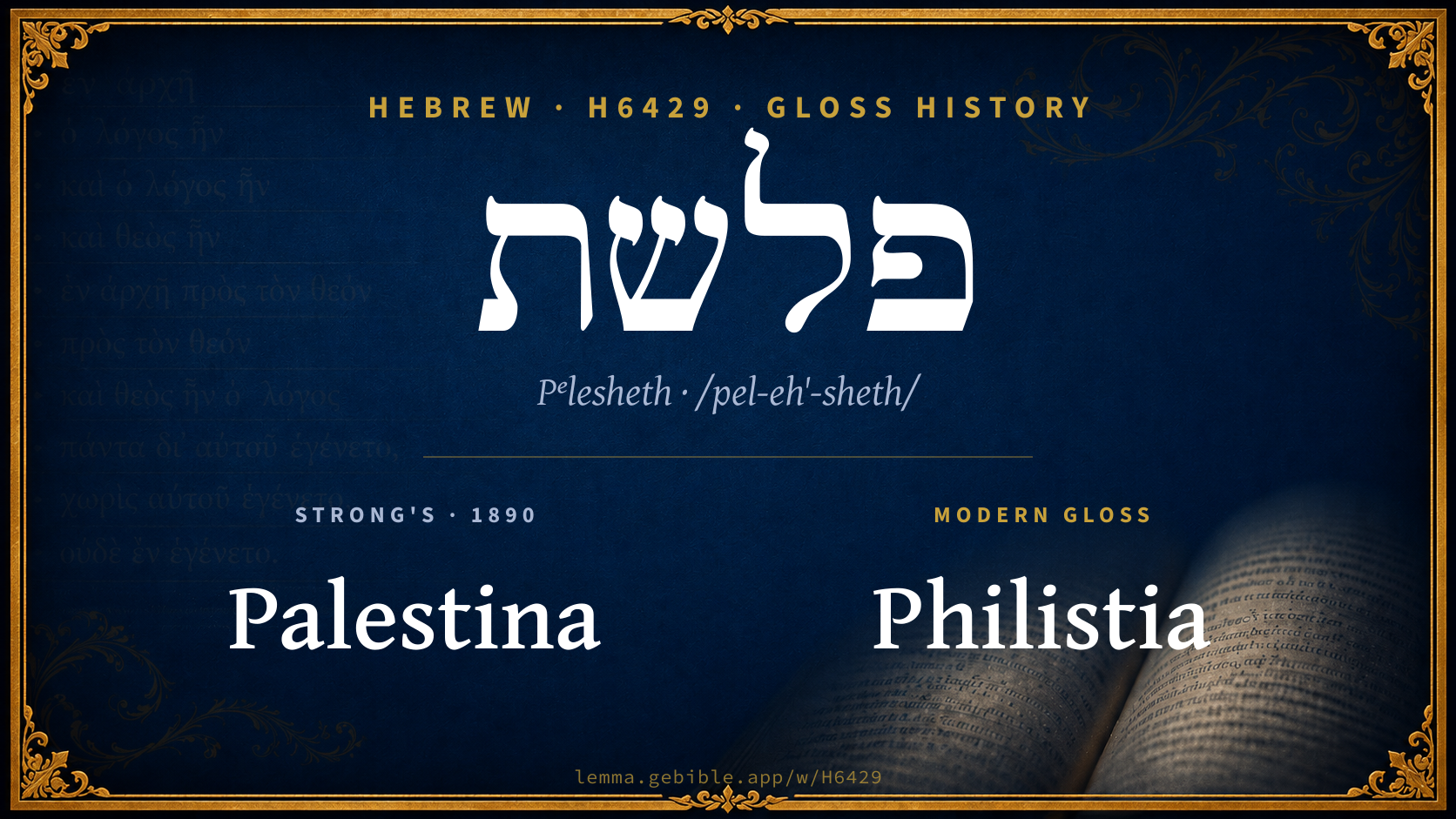
Gloss history
Strong's 1890 vs modern scholarship
About this word
Strong's H6429 catalogs a Hebrew word from the Hebrew Old Testament.
These counts are not copied from any lexicon or concordance. They are computed here, from the morphology-tagged Hebrew Old Testament. What Lemma adds →
- 8
- distinct verses
- The word appears in 8 distinct verses.
- 4 / 39
- OT books
- The word appears in 4 of 39 Old Testament books.
- #2,625
- by frequency
- Top 5000 most frequent Hebrew words (rank 2,625 of 8,640 Hebrew words by occurrence).
View all 8 occurrences in the concordance →
By section of the Old Testament
By traditional corpus
Conventional, traditional groupings — biblical authorship is debated, so this is a traditional corpus grouping, not an authorship claim. Each share is this word’s portion of its verses in that division of the Hebrew canon. Each figure is a share of the word’s 8 distinct verses.
- Writings (Ketuvim) 4 verses · 50%
- Prophets (Nevi'im) 3 verses · 38%
- Torah (Pentateuch) 1 verse · 13%
How translations render this word
Counts come from each version’s own published word-to-Strong’s tagging or interlinear alignment — an approximate guide to how each version renders this word, not a word-level alignment the data otherwise carries. Because each total is that version’s own tagged count, the per-version totals vary from one another and need not match the appearance or distinct-verse counts above. These counts may also differ from a printed concordance because Lemma counts each distinctly tagged rendering and does not collapse phrase taggings into a single head-word total. This is a fixed set of word-tagged versions (KJV, ASV, BSB, ULT) and does not change with the reading translation you choose elsewhere. Each version’s license is shown beside its name below (and on Sources).
- King James Version: Thou whole palestina 2×
- American Standard Version: Philistia 4×
- Berean Standard Bible: Philistia 6×, You philistines 2×
- unfoldingWord Literal Text: Philistia 8×
King James Version Public Domain
Renders H6429 across 8 tagged occurrences — most commonly:
Plus 6 renderings that appear only once — usually multi-word phrases or single function words the recovered tagging swept in, not distinct renderings.
American Standard Version Public Domain
Renders H6429 across 8 tagged occurrences — most commonly:
Plus 4 renderings that appear only once — usually multi-word phrases or single function words the recovered tagging swept in, not distinct renderings.
Berean Standard Bible Public Domain
Renders H6429 across 8 tagged occurrences — most commonly:
unfoldingWord Literal Text CC BY-SA 4.0
Renders H6429 across 8 tagged occurrences — most commonly:
Senses in BDB
The 2 senses BDB distinguishes for this word, in lexicon order (not ranked by frequency or importance). The full entry — with sub-senses — is in the Lexicon Entry tab.
- Philistia = "land of sojourners"
- the general territory on the west coast of Canaan or the entire country of Palestine
Word origin
n.pr.terr. Philistia, poet. and late;—פְּלָ֑שֶׁת (ישְׁבֵי) Ex 15:14 (Φυλιστιειμ; elsewhere (οἱ) ἀλλόφυλοι), Jo 4:4, elsewhere פְּלֶשֶׁת Is 14:29, 31 ψ 60:10 = 108:10; 83:8; 87:4; Assyrian Palastu, Pilistu, COT Gn 10:14 DlPa 288 f. Gk. Παλαιστίνη Herod. ii. 104, 106, vii. 89 JosAnt. i, 6, 2 (also Φυλιστίνου); v. Rel Pal. 73 f.
— Brown-Driver-Briggs (Oxford 1906, public domain), digitized via Sefaria, supplemented by the OpenScriptures HebrewLexicon (CC BY 4.0). See Sources.
Derived from פלש (pâlash) (H6428) — to roll.
Forms in the corpus
The 7 distinct written forms H6429 takes in the Hebrew Bible, most frequent first — each parse links to that state’s occurrences in the concordance. Hebrew forms include their vowel points and cantillation, so a single lemma takes many written forms.
| Form | Parsing | Example | Uses |
|---|---|---|---|
| פְּלֶ֣שֶׁת | Noun, Proper | Isaiah 14:31 | 2 |
| פְ֝לֶ֗שֶׁת | Noun, Proper | Psalms 108:9 | 1 |
| פְלֶ֣שֶׁת | Noun, Proper | Psalms 87:4 | 1 |
| פְלֶ֨שֶׁת֙ | Noun, Proper | Isaiah 14:29 | 1 |
| פְּ֝לֶ֗שֶׁת | Noun, Proper | Psalms 83:7 | 1 |
| פְּלָ֑שֶׁת | Noun, Proper | Joel 3:4 | 1 |
| פְּלָֽשֶׁת | Noun, Proper | Exodus 15:14 | 1 |
Same root — word family
Other BDB entries built from the same root as H6429, grouped by Strong’s listed origin. These share a root / origin per the lexicon — not necessarily a shared meaning. Each links to that word’s own entry.
Derives from
Proper names from this root
People and places named from this root — a name, not an additional meaning of the word.
Compare all same-root words → 1 of the same-root words is a proper name (a person or place). They share a root, not necessarily a meaning.
Bible dictionary
Public-domain dictionary articles matched to this entry by name (Philistia). A biblical name can be shared by more than one person or place, so an article may treat several.
Easton's Bible Dictionary · M. G. Easton, 1897
=Palestine (q.v.), "the land of the Philistines" (Ps. 60:8; 87:4; 108:9). The word is supposed to mean "the land of wanderers" or "of strangers."
Smith's Bible Dictionary · William Smith, 1863
(Heb. Pelesheth) (land of sojourners). The word thus translated (in) (Psalms 60:8; 87:4; 108:9) is in the original identical with that elsewhere rendered Palestine, which always means land of the Philistines. (Philistia was the plain on the southwest coast of Palestine. It was 40 miles long on the coast of the Mediterranean between Gerar and Joppa, and 10 miles wide at the northern end and 20 at the southern.--ED.) This plain has been in all ages remarkable for the extreme richness of its soil. It was also adapted to the growth of military power; for while the itself permitted. the use of war-chariots, which were the chief arm of offence, the occasional elevations which rise out of it offered secure sites for towns and strongholds. It was, moreover, a commercial country: from its position it must have been at all times the great thoroughfare between Phoenicia and Syria in the north and Egypt and Arabia in the south.
Classic public-domain reference works; full attribution on Sources.
Septuagint verse parallels
This word appears in 8 verses that also exist in the Greek Old Testament (Septuagint), out of the 8 Hebrew verses it occurs in. You can read those verses in Greek by switching the Old Testament edition to the Septuagint.
Read these verses in the Septuagint
This is a verse-level parallel only — the same verses exist in both the Hebrew and Greek Old Testaments. No word-level Hebrew↔Greek correspondence is claimed: the data carries no such alignment, so no Greek word is shown as this Hebrew word’s translation. Coverage is not total — the Septuagint omits the deuterocanon and renumbers the Psalms, so some Hebrew verses have no direct Greek parallel.