
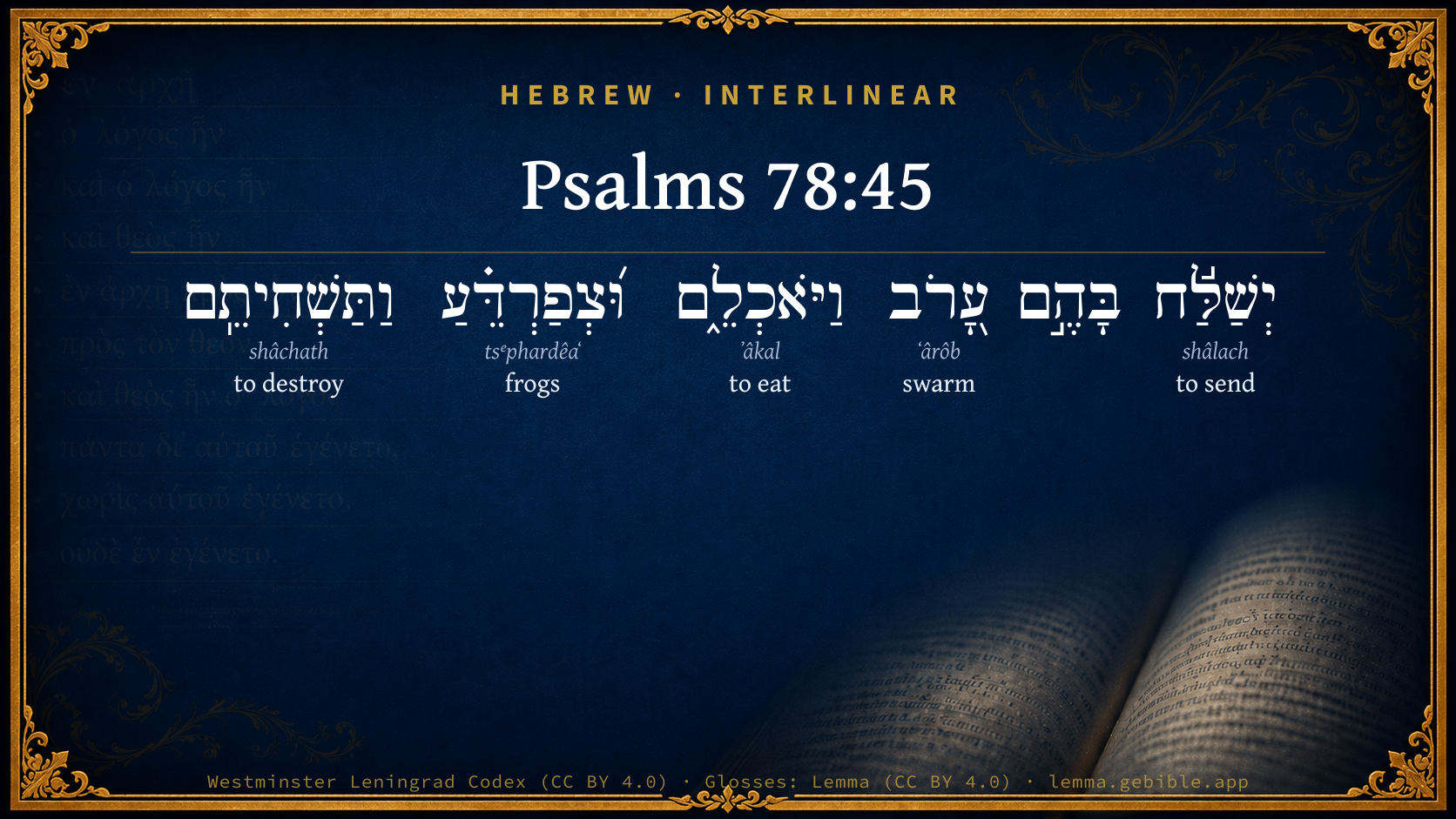
Psalms 78:45

Hebrew (Westminster Leningrad Codex) Psalms 78:45 appears in the Hebrew Old Testament. The text above is from the Westminster Leningrad Codex. Each word links to its Strong’s number, a concise gloss, and parsing drawn from the Open Scriptures Hebrew Bible morphology. Click any word for its full Brown-Driver-Briggs (BDB) entry.
Download image
Cite this verse

Psalms 78:45 (World English Bible). Public Domain. Lemma interlinear Bible study tool, https://lemma.gebible.app/v/psalms/78/45.

Show BibTeX & RIS
BibTeX
RIS
English Translation
He sent among them swarms of flies, which devoured them; And frogs, which destroyed them.
World English Bible · Public Domain
Download a study sheet

One document with this verse’s original text, its word-by-word gloss line, the meaning frame, cross-references with their text, attributed commentary, and full source and license credits — printable, and it pastes into notes with its structure intact.

This verse Autodidact and up

Study sheet (.html) Plain text (.txt)

A passage Seminary Student

Up to 50 verses in one chapter. A passage sheet keeps up to 6 commentary sources and 12 cross-references per verse, in the order this page ranks them, and says so on the sheet whenever that leaves anything out. Ask for a single verse and you get the Autodidact verse sheet above.

Everything on this page stays free to read, with no account — the sheet is a download of what is already on screen, not access to it.

Want to remove ads? Support Godless Engineer
Compare translations 3

The same verse in 3 English versions, stacked beneath the original-language interlinear above. Click any original word for its lexicon entry.

Each is an independent rendering of the whole verse — the interlinear is not word-aligned to these translations.

Highlighted words mark where these versions differ — a whole-verse word diff, not a word-by-word alignment.

  • World English Bible Public Domain
    He sent among them swarms of flies, which devoured them; And frogs, which destroyed them.
  • King James Version Public Domain
    He sent divers sorts of flies among them, which devoured them; and frogs, which destroyed them.
  • unfoldingWord Literal Text CC BY-SA 4.0
    He sent a swarm among them, and it devoured them, and the frog and it destroyed them.

unfoldingWord Literal Text — © unfoldingWord, licensed CC BY-SA 4.0. Word-aligned USFM3 via Door43 (git.door43.org/unfoldingWord/en_ult).

Versions to compare (up to 4)

3 of 4 selected

Show all 18 translations

Every available English version of this verse, each an independent rendering of the whole verse.

  • World English Bible Public Domain
    He sent among them swarms of flies, which devoured them; And frogs, which destroyed them.
  • Berean Standard Bible Public Domain
    He sent swarms of flies that devoured them, and frogs that devastated them.
  • Majority Standard Bible Public Domain
    He sent swarms of flies that devoured them, and frogs that devastated them.
  • King James Version Public Domain
    He sent divers sorts of flies among them, which devoured them; and frogs, which destroyed them.
  • American Standard Version (1901) Public Domain
    He sent among them swarms of flies, which devoured them; And frogs, which destroyed them.
  • Revised Version (1885) Public Domain
    He sent among them swarms of flies, which devoured them; and frogs, which destroyed them.
  • Geneva Bible (1599) Public Domain
    Hee sent a swarme of flies among them, which deuoured them, and frogs, which destroyed them.
  • Douay-Rheims (1899) Public Domain
    He sent amongst them divers sores of flies, which devoured them: and frogs which destroyed them.
  • Young's Literal Translation Public Domain
    He sendeth among them the beetle, and it consumeth them, And the frog, and it destroyeth them,
  • Literal Standard Version CC BY-SA 4.0
    He sends among them the beetle, and it consumes them, || And the frog, and it destroys them,
  • Unlocked Literal Bible CC BY-SA 4.0
    He sent swarms of flies that devoured them and frogs that overran their land.
  • unfoldingWord Literal Text CC BY-SA 4.0
    He sent a swarm among them, and it devoured them, and the frog and it destroyed them.
  • Darby Bible Public Domain
    He sent dog-flies among them, which devoured them, and frogs, which destroyed them;
  • World Messianic Bible Public Domain
    He sent among them swarms of flies, which devoured them; and frogs, which destroyed them.
  • Webster's Bible Public Domain
    He sent divers sorts of flies among them, which devoured them; and frogs, which destroyed them.
  • Free Bible Version CC BY-SA 4.0
    He sent flies among them to destroy them, and frogs to ruin everything.
  • Bible in Basic English Public Domain
    He sent different sorts of flies among them, poisoning their flesh; and frogs for their destruction.
  • JPS Tanakh (1917) Public Domain
    He sent among them swarms of flies, which devoured them; and frogs, which destroyed them.

Literal Standard Version (2020), Covenant Press — licensed CC BY-SA 4.0. Text via the HelloAO Bible API (eBible.org). Unlocked Literal Bible (unfoldingWord) — licensed CC BY-SA 4.0. Text via the HelloAO Bible API (eBible.org). unfoldingWord Literal Text — © unfoldingWord, licensed CC BY-SA 4.0. Word-aligned USFM3 via Door43 (git.door43.org/unfoldingWord/en_ult). Free Bible Version, Dr. Jonathan Gallagher — licensed CC BY-SA 4.0. Text via the HelloAO Bible API (eBible.org).

Word by word

More ways to search: Search by grammar → Find every occurrence → Compare this word →

Practice this passage: Drill this verse → Learn its vocabulary →

About this verse

These counts appear in no published source. They are computed here, from the morphology-tagged text and Lemma’s own curated glosses. What Lemma adds →

6
words
5
distinct lemmas
Wisdom
section

Notable vocabulary

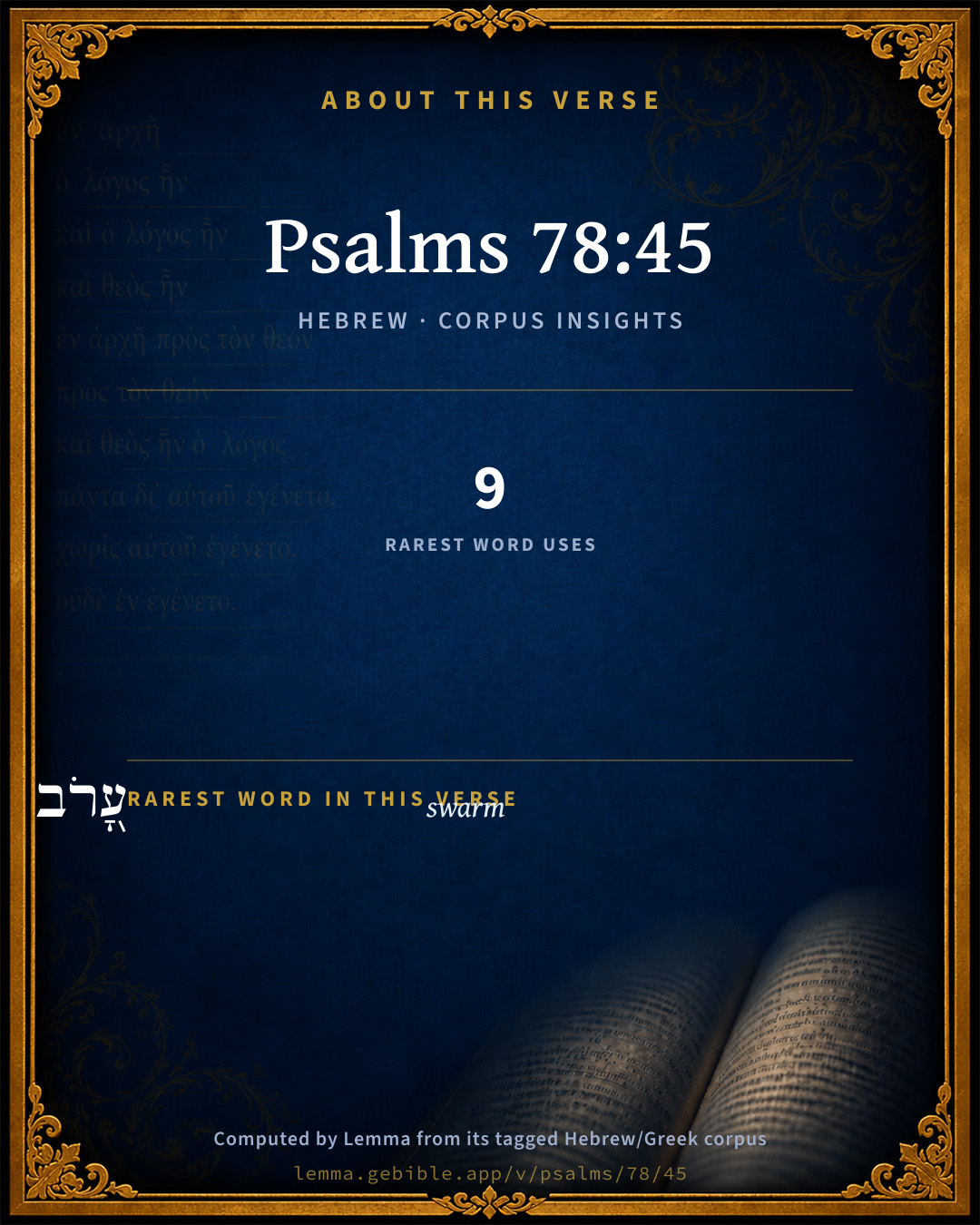
The rarest word here is עָ֭רֹב swarm H6157 — appearing just 9 times in the whole Hebrew Bible.

Shared distinctive vocabulary

עָ֭רֹב swarm H6157 occurs in 7 verses of the Hebrew Bible. Also found in:

Grammatical profile

  • 3 verbs
  • 2 nouns
  • 1 preposition

Verb forms

  • יְשַׁלַּ֬ח Piel · Imperfect
  • וַיֹּאכְלֵ֑ם Qal · Sequential Imperfect
  • וַתַּשְׁחִיתֵֽם Hiphil · Sequential Imperfect

Hebrew & Septuagint length

In English translation the verse runs 15 words from the Hebrew and 17 from the Septuagint (LXX English) — closely comparable.

A rough comparison of the two English renderings, which tokenize alike — not a word-level alignment.

Word counts can differ between the Hebrew and the Greek without any difference in meaning — e.g. the Hebrew direct-object marker אֵת has no separate Greek word, and Greek often adds the article ὁ.

Cross-references

4

Topical passages linked to Psalms 78:45 in the Treasury of Scripture Knowledge — connected by theme and wording, ordered by reader-vote popularity; previews shown in the World English Bible.

  • Exodus 8:21–24 Else, if you will not let my people go, behold, I will send swarms of flies on you, and on your servants, and on your people, and into your houses: and the houses of the Egyptians shall be full of swarms of flies, and also the ground whereon they are.
  • Exodus 8:2–15 If you refuse to let them go, behold, I will plague all your borders with frogs:
  • Psalms 105:30–31 Their land swarmed with frogs, Even in the chambers of their kings.
  • Revelation 16:3 The second angel poured out his bowl into the sea, and it became blood as of a dead man. Every living thing in the sea died.

Cross-references courtesy of OpenBible.info (CC BY 4.0).

Hebrew and Greek witnesses Masoretic Hebrew ↔ Greek Septuagint

The same verse in the two great witnesses to the Old Testament, shown verse-for-verse.

You’re reading Greek Psalm 77 (Hebrew Psalm 78). The Septuagint counts the superscription, so verse numbers can differ from the Hebrew — chapter-level alignment, not verse-by-verse. Numbering follows Rahlfs.

These are two independent witnesses, not word-aligned to each other, and the Septuagint is shown in lemma (dictionary) form.

Hebrew Psalms 78:45 Masoretic · Westminster Leningrad Codex

יְשַׁלַּ֬ח בָּהֶ֣ם עָ֭רֹב וַיֹּאכְלֵ֑ם וּ֝צְפַרְדֵּ֗עַ וַתַּשְׁחִיתֵֽם

He sent among them swarms of flies, which devoured them; And frogs, which destroyed them.

World English Bible · Public Domain

Greek LXX Greek Psalm 77:45 Septuagint · lemma form

ἐκ ἀποστέλλω εἰς αὐτός κυνόμυια καί καταἐσθίω αὐτός καί βάτραχος καί διαφθείρω αὐτός

He sent against them the dog-fly, and it devoured them; and the frog, and it spoiled them.

LXX2012 (modern English Septuagint) · Public Domain

On this verse, Albert Barnes' Notes on the Bible discusses the Septuagint’s reading. Read the note in Commentary ↓

Hebrew: Westminster Leningrad Codex (CC BY 4.0). Greek: Septuagint (public domain); English from LXX2012 (modern English Septuagint) (Public Domain). How the Septuagint differs from the Hebrew →

Commentary

Notes on Psalms 78:45 from classic Christian and Jewish commentators (each source and its license shown beneath its notes). The classic Christian expositions comment on the surrounding passage and are grouped to its opening verse, so a note may address several verses; the Jewish commentaries on the Tanakh (Rashi and others) are per-verse, so they appear only where the commentator wrote on this verse.

Lemma curates 59 commentaries, every one of them public domain or Creative Commons licensed, each selected and text-cleaned for this edition rather than reprinted as found. About our sources →

Trapp's Complete Commentary

John Trapp

Psa 78:45 He sent divers sorts of flies among them, which devoured them; and frogs, which destroyed them.

Ver. 45. He sent divers sorts of flies among them] Miscellam muscarum venenatarum, venomous flies and flying serpents, whose poison and sting did even corrupt the land, Exo 8:24. The Greek rendereth it κυνομυιαν, the dog-fly.

John Trapp, A Commentary or Exposition upon All the Books of the Old and New Testament (1647–1656) — public domain. Text from a community e-Sword module.

J. A. Alexander on Psalms

Joseph Addison Alexander

45. (Psa 78:45) He sends among them (or against them) flies and they devour them, and frogs and they destroy them. Two of the other plagues are here added, from the narrative in Exodus 8. The first noun in Hebrew was explained by the ancient writers as denoting a mixture of noxious animals; but the best interpreters are now agreed that it means the Egyptian dog-fly, which Philo represents as feeding upon flesh and blood.

Joseph Addison Alexander, The Psalms Translated and Explained (1850) — public domain. Text from a community e-Sword module.

Geneva Bible (1599)

Geneva Bible translators

This word signifieth a confused mixture of flies and venomous worms. Some take it for all sorts of serpents: some for all wild beasts.

Geneva Bible (1599) marginal notes — public domain. Text via Bolls.life.

Adam Clarke's Commentary

Verse 45. He sent - flies - and frogs] See on Ex 8:6; Ex 8:24.

Adam Clarke's Commentary on the Bible (1810–1826) — public domain. Text from a community e-Sword/MySword module.

Ellicott's Commentary for English Readers

(45) Divers sorts of flies.—Better, simply flies. See Note Exo_8:21.

Frogs.—See Exo_8:2, and Bib. Ed., iv. 145.

A Bible Commentary for English Readers, edited by Charles John Ellicott (1878–1897) — public domain. Text from a community e-Sword module.

The Cambridge Bible for Schools and Colleges

gen. ed. J. J. S. Perowne

45. The fourth and second plagues, Exo_8:20 ff., Exo_8:1 ff. The word rendered divers sorts of flies, or, swarms of flies (R.V.), is used only with reference to this plague (Exodus 8; Psa_105:31), and probably means some venomous kind of fly, such as abound in Egypt.

The Cambridge Bible for Schools and Colleges (gen. ed. J. J. S. Perowne; Cambridge University Press, 1878–1918) — public domain. Text from a community e-Sword module.

John Gill's Exposition

He gave also their increase unto the caterpillar,.... A kind of locust, and the same with the locust in the next clause; for we read but of the locust only in Exo 10:13.

and their labour unto the locust; which devoured the increase of the field, all green grass and trees, all sorts of corn, wheat, barley and rye, and the increase of vineyards, and all fruit trees, on which much labour had been used to manure and cultivate; see Rev 9:3 this was the eighth plague.

John Gill's Exposition of the Whole Bible (1746–1763) — public domain (CC PDM 1.0). Text via the HelloAO Bible API.

Albert Barnes' Notes on the Bible

He sent divers sorts of flies ... - The account of this plague is found in Exo 8:24. The word there used is simply “swarm,” without indicating what the swarm was composed of. The rabbis explain the word as denoting a mixture, or a conflux of noxious insects, as if the word were derived from ערב ‛ârab - “to mix.” The Septuagint renders it κυνόμνια kunomnia - “dog-fly” - which Philo describes as so named from its impudence. The common explanation of the word now is that it denotes a species of fly - the gad-fly - exceedingly troublesome to man and beast, and that it derives its name - ערב ‛ârôb - from the verb ערב ‛ârab, in one of its significations to suck, and hence, the allusion to sucking the blood of animals. The word occurs only in the following places, Exo 8:21-22, Exo 8:24, Exo 8:29, Exo 8:31, where it is rendered swarm, or swarms, and Psa 105:31, where (as here) it is rendered divers sorts of flies.

And frogs which destroyed them - Exo 8:6. The order in which the plagues occurred is not preserved in the account in the psalm.

Albert Barnes' Notes on the Bible (1834–1885) — public domain. Text from a community e-Sword/MySword module.

Matthew Poole's English Annotations

Devoured them; or, destroyed them; which they might do by their cruel and numerous stings, for these flies were doubtless extraordinary in their nature and quantity, and poisonous and hurtful qualities. And the like is to be thought concerning the frogs here following, which also might destroy the people by infecting the air with their stink, and corrupting their meats and drinks.

Matthew Poole's English Annotations on the Holy Bible (1683–1685) — public domain. Text from a community e-Sword/MySword module.

The Treasury of David

Charles H. Spurgeon

Ver. 45. He sent diverse sorts of flies among them, which devoured them. Small creatures become great tormentors. When they swarm they can sting a man till they threaten to eat him up. In this case, various orders of insects fought under the same banner; lice and beetles, gnats and hornets, wasps and gadflies dashed forward in fierce battalions, and worried the sinners of Egypt without mercy. The tiniest plagues are the greatest. What sword or spear could fight with these innumerable bands? Vain were the monarch's armour and robes of majesty, the little cannibals were no more lenient towards royal flesh than any other; it had the same blood in it, and the same sin upon it. How great is that God who thus by the minute can crush the magnificent.

And frogs, which destroyed them. These creatures swarmed everywhere when they were alive, until the people felt ready to die at the sight; and when the reptiles died, the heaps of their bodies made the land to stink so foully, that a pestilence was imminent. Thus not only did earth and air send forth armies of horrible life, but the water also added its legions of loathsomeness. It seemed as if the Nile was first made nauseous and then caused to leave its bed altogether, crawling and leaping in the form of frogs. Those who contend with the Almighty, little know what arrows are in his quiver; surprising sin shall be visited with surprising punishment.

Ver. 45. Flies. Ex 8:13-14, (Mnk) or (Mynk). It is a matter of difficulty precisely to determine the species or kind of animals denoted by that expression; but so mush is certain: 1. That they must be a very small kind of insects, as they are represented to arise from the grains of dust; 2. That they are noxious both to man and beasts Ps 78:13, and in a still higher degree than the frogs. The singular (Kk), is used in Isa 51:6, where it represents something very frail, weak, and perishable. The etymology leads to the Greek root knaw, to gnaw or pinch and this coincides with the English noun gnats, with which, indeed, all the qualities just mentioned perfectly agree. And the Septuagint, which is naturally of great authority in all matters concerning the natural phenomena of Egypt, translates also sknifev (mosquito gnats); which Philo, likewise an Egyptian, describes thus: "It is an insect although of very small size, yet of a most troublesome nature; for it hurts not only the surface, causing intolerable and protracted itching, but penetrates also into the interior through the ears and noses. It flies even into the eyes of those who do not guard themselves, and produces pain." All which qualities are perfectly applicable to gnats. M. M. Kalisch.

Ver. 45. He sent diverse sorts of flies. "I will send swarms of flies upon thee, "etc. Ex 8:21. Hebrew (bre), arob, a mixture, or mixed swarm, i.e., probably of flies, wasps, hornets, and other vexatious and stinging insects. It will be observed that "flies" in our version, being printed in italics, is not in the original...the Septuagint renders (bre), arob, by kunomuian, dog fly, from its biting, an insect that fastens its teeth so deep in the flesh, and sticks so very close, that it oftentimes makes cattle run mad... He sent (bre,)arob, divers sorts of flies among them which devoured them. The arob is described as devouring the Egyptians, which is an act which seems inapplicable to a fly. Upon the whole we strongly incline to the opinion which has found some able supporters of late years, that the Egyptian beetle (blatta Agyptiaca) is denoted in this place. The beetle, which is almost everywhere a nuisance, is particularly abundant and offensive in Egypt, and all the circumstances which the Scriptures in different places intimates concerning the arob, applies with much accuracy to this species. It devours everything that comes in its way, even clothes, books, and plants, and does not hesitate to inflict severe bites on men. If also we conceive that one object of these plagues was to chasten the Egyptians through their own idols, there is no creature of its class which could be more fitly employed than this insect. What precise place is filled in the religious system of that remarkable people has never, we believe, been exactly determined; but that it occupied a conspicuous place among their sacred creatures seems to be evinced by the fact, that there is scarcely any figure which occurs more frequently in Egyptian sculpture and painting. George Bush.

Ver. 45. Flies, which devoured them. (See Ex 8:24.) "The land was corrupted by reason of the swarm of flies." Bochart understands by land, the inhabitants, whose blood these flies sucked, and left such a poison in it, that their bodies swelled, and many of them died. Le Clerc understands it of the flesh and other eatables, which these vermin having preyed upon, and fly blown, bred maggots, stench and putrefaction throughout the land, Jameson's Critical and Practical Exposition of the Pentateuch. 1748.

Ver. 45. And frogs, which destroyed them. Galerius observes, that the Egyptians were punished in this plague upon all the five senses. The sight was punished, that was offended with the multitude, with the greatness, with the hideous form and colour of these frogs. Their hearing was offended with the croaking of them; for it was but harsh music to dainty ears. Their smell was offended with the stench of them. Their taste was offended that they came into their troughs, the places of their dough, and so hindered them of the food that was provided for their nourishment..."The frogs shall come up both on thee, and upon thy people, and upon all thy servants, "Ex 8:4. So that thou shalt not rid thyself of this annoyance. What! in their meat, and drink; and upon their bodies! Then observe with me, beloved, God can lay judgments upon people, that shall be more painful, and troublesome, than odious, loathsome and noisome. Josiah Shute, in "Judgment and Mercy: or the Plague of Frogs" (inflicted, removed). 1645.

Ver. 45. Frogs. The Egyptians suffered most keenly from the infliction. They were a singularly fastidious people, and abhorred the contact of anything that they held to be unclean. We may well realise, therefore, the effect of a visitation of frogs, which rendered their houses unclean by entering them, and themselves unclean by leaping upon them; which deprived them of rest by getting on their beds, and of food by crawling into their ovens and upon the dough in the kneading troughs. And, as if to make the visitation still worse, when the plague was removed, the frogs died in the places into which they had intruded, so that the Egyptians were obliged to clear their houses of the dead carcases, and to pile them up in heaps, to be dried by the sun, or eaten by birds and other scavengers of the East. As to the species of frog which thus invaded the houses of the Egyptians, there is no doubt whatever. It can be but the green, or edible frog (Rana esculenta), which is so well known for the delicacy of its flesh. This is believed to be the only aquatic frog of Egypt, and therefore must be the species which came out of the river into the houses. Both in Egypt and Palestine it exists in very great numbers, swarming in every marshy place, and inhabiting the pools in such numbers that the water can scarcely be seen for the frogs. Thus the multitudes of the frogs which invaded the Egyptians was no matter of wonder, the only miraculous element being that the reptiles were simultaneously directed to the houses, and their simultaneous death when the plague was taken away. J. G. Wood.

Ver. 45. Frogs. The rod is lifted up again. Behold, the Nilus, which they had before adored, was never so beneficial as it is now troublesome; yielding them not only a dead, but a living annoyance: it never did so store them with fish as it now plagued them with frogs. Whatsoever any man makes his god, besides the true one, shall be one day his tormentor. These loathsome creatures leave their own element to punish them which rebelliously detained Israel from their own. No bed, no table, can be free from them: their dainty ladies cannot keep them out of their bosoms; neither can the Egyptians sooner open their mouths than they are ready to creep into their throats, as if they would tell them, that they came on purpose to revenge the wrongs of their Maker. Joseph Hall.

Ver. 45. The power of little things when commissioned to plague us.

Charles H. Spurgeon's The Treasury of David (1869–1885) — public domain. Psalms only. Text from a community e-Sword/MySword module.

Whedon's Commentary on the Bible

Daniel D. Whedon

45. Divers sorts of flies—This was the fourth plague. Exo_8:21. The English translation of ערב, (‘arobh,) here and Psa_105:31, supposes a mixture of species, but the commonly accepted derivation of the word by modern critics does not justify this ancient interpretation, but denotes a species that stings like a scorpion and sucks blood. See Isa_7:18. Clark (Israel in Egypt, p. 22) would favour the common fly of Egypt, which is bad enough. Van Lennep (Bible Lands, page 323,) supposes “the destructive fly called tsaltsalya by the Abyssinians and tsetse in South Africa, which kills cattle and horses, and attacks men.” The Septuagint reads κυνομυιαν, dog-fly. The precise species is not known. Flies are terrible in Egypt and Palestine. Baal-zebub, lord of flies, was the god of Ekron, and was supposed to protect from flies.

Frogs—These were by the law “unclean” and “abominable,” (Lev_11:12-13,) and emblematic of the “spirits of devils.” Rev_16:13-14. The vilest creatures were made the instruments of the humiliation and sufferings of the Egyptians.

Daniel D. Whedon (gen. ed.), Commentary on the Old and New Testaments (1874–1909) — public domain. Text from a community e-Sword module.

The Pulpit Commentary

He sent divers sorts of flies among them. (see Exo_8:24) A particular sort of fly or beetle is meant, rather than many different sorts. Dr. Kay and Professor Cheyne suggest "dog flies Canon Cook, the Blatta Orientalis. Which devoured them; i.e. "preyed upon them," sucking out their life blood. And frogs, which destroyed them. (see Exo_8:6) The poet, not being a historian, does not give the plagues in their chronological order, neither regards himself as bound to mention all of them. He omits the third, and reverses the order of the second and fourth.

The Pulpit Commentary (1880–1919), ed. H.D.M. Spence-Jones & Joseph S. Exell — public domain. Text from a community e-Sword module.

John Wesley's Explanatory Notes

Flies - These flies were doubtless extraordinary in their nature, and hurtful qualities. And the like is to be thought concerning the frogs.

John Wesley, Explanatory Notes Upon the Whole Bible (1754–1765) — public domain. Text via the GEBible commentary corpus.

Rashi

Rabbi Shlomo Yitzchaki (Rashi)

which mutilated them They would pull off their testicles.

Rashi on the Tanakh — English translations: “The Judaica Press complete Tanach with Rashi, translated by A. J. Rosenberg” (CC BY 4.0); “Pentateuch with Rashi's commentary by M. Rosenbaum and A.M. Silbermann, 1929-1934” (public domain); “The Metsudah Tanach series, Lakewood, N.J” (CC BY 4.0); and “The Book of Joshua, Metsudah Publications, 1997” (CC BY 4.0). Text via Sefaria.

Lesson kit

Teaching starters — assembled from the data on this page, not authored interpretation. Every prompt links to the verse data it draws on. Edit before teaching.

Psalms, in the Wisdom, opens this verse with 6 words (5 distinct Hebrew lemmas). Its most distinctive word is ʻârôb (“swarm”). A historical commentator’s framing appears above. Read the whole chapter for the surrounding context.

Discussion questions

  1. How does “swarm” (ʻârôb) shape what this verse is saying?
  2. Exodus 8:21 shares the word «swarm» with this verse. How do the two illuminate each other?
  3. The translations on this page render this verse differently — a whole-verse word diff, not a word-by-word alignment. What might account for the different wordings?
  4. The verb «יְשַׁלַּ֬ח» is Piel Imperfect. How does its form color the action?
  5. Reading how Trapp's Complete Commentary and J. A. Alexander on Psalms read this verse, where do the two commentators agree and where do they part?

Things to notice

Reading settings

Reading text

Shown beneath each verse's original-language words.

Old Testament
Old Testament edition

Read the OT as the Masoretic Hebrew (MT) or the Greek Septuagint (LXX).

English shown for the Greek Septuagint (in the Hebrew ↔ Greek comparison).

Comparing translations? Open the Compare panel on any verse page to stack up to four side by side.