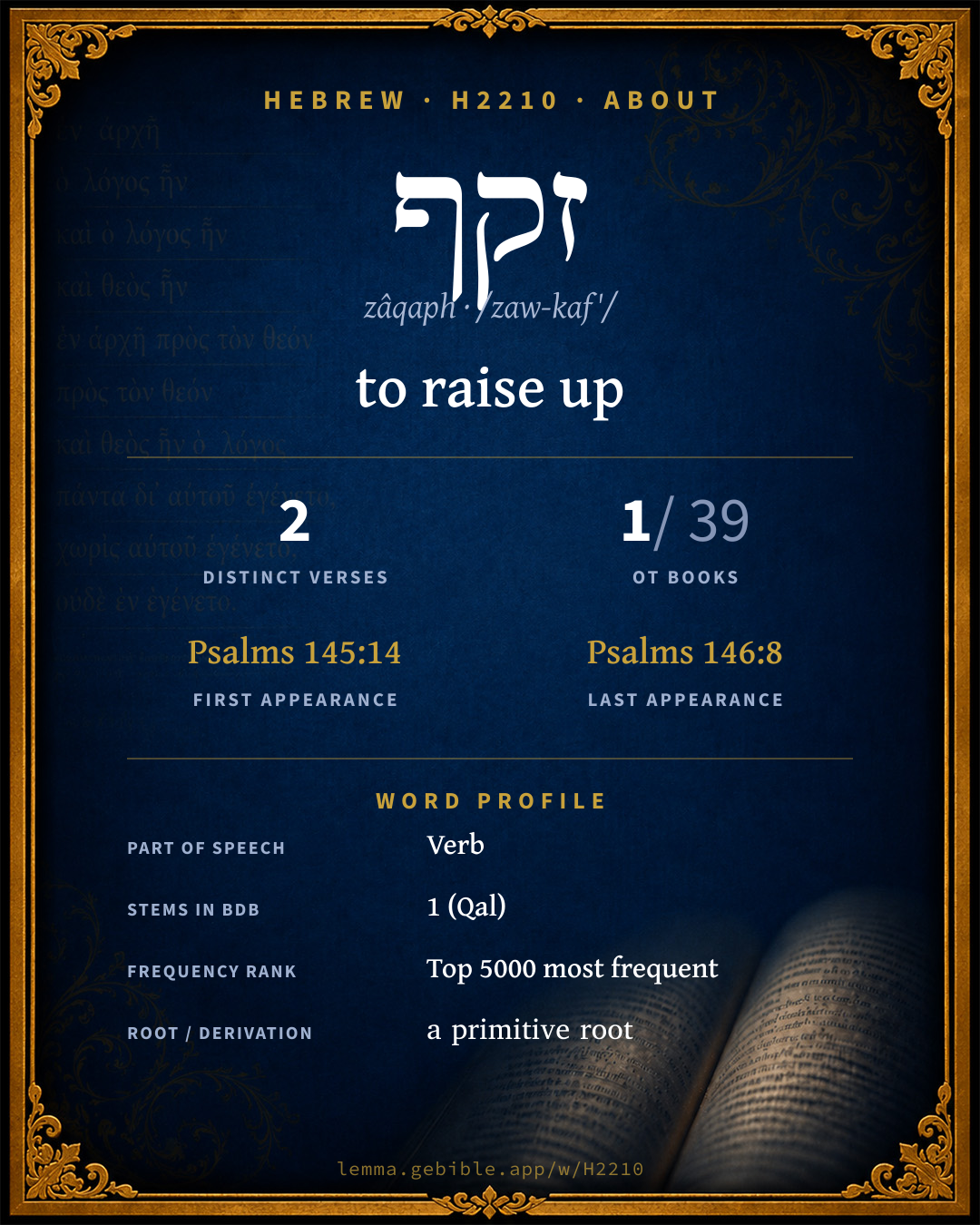
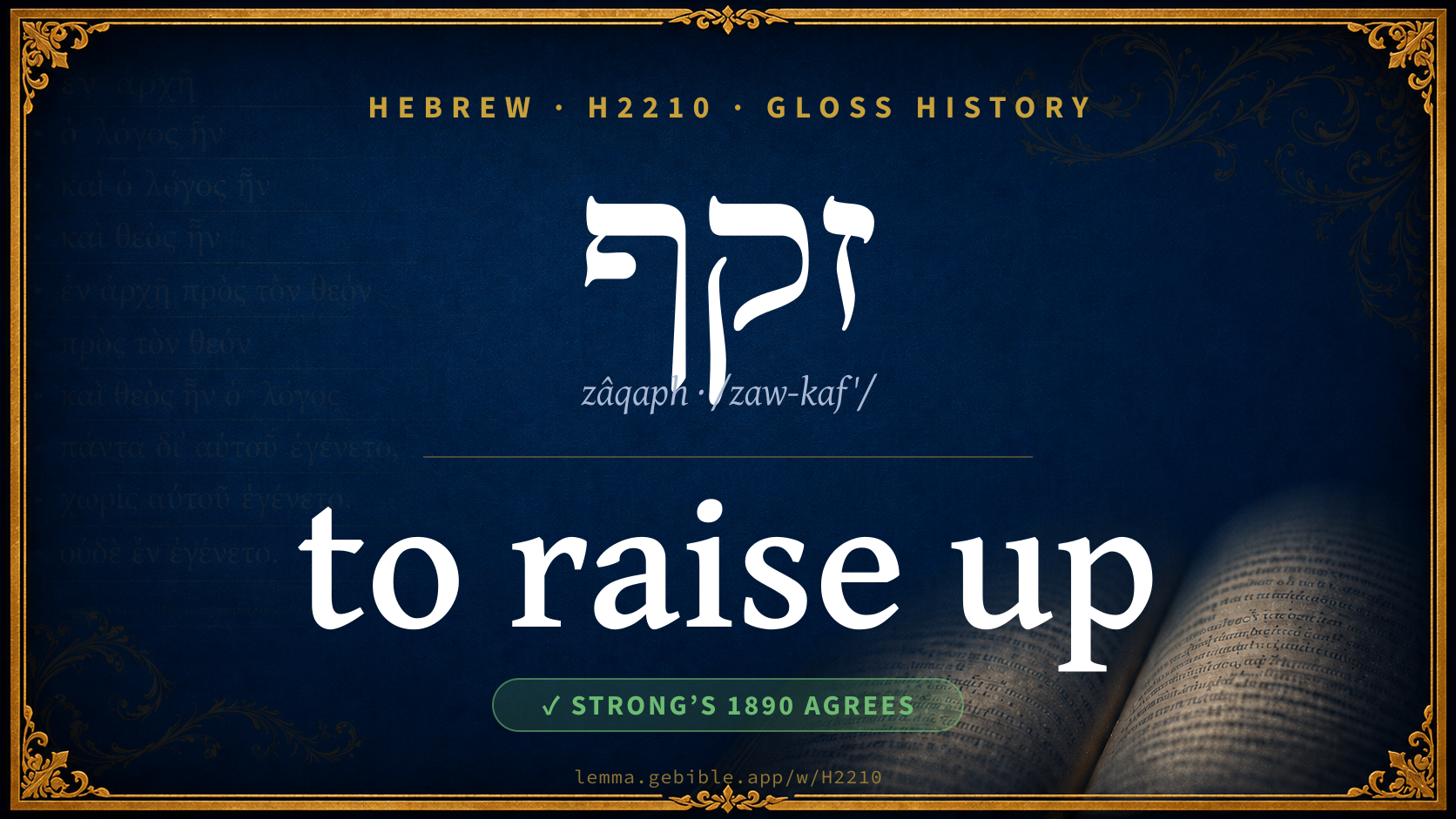
זָקַף
to raise up
Full lexicon entry — Brown-Driver-Briggs (BDB)
From Brown-Driver-Briggs (BDB)
Where this word appears
Grammar key — what these labels mean
Part of speech
- Verb
- An action or state-of-being word.
Stem
- Qal
- The basic, simple active stem — the plain form of the verb (“he wrote”). Here: ‘and only fig. of’
Form
- Participle Active
- A verbal adjective expressing ongoing or characteristic action (“writing / one who writes”).
State
- Absolute
- The independent form of a noun, not bound to a following word.
Gender
- Masculine
- Grammatically masculine.
Number
- Singular
- One.
Every verse where H2210 appears — 2 distinct verses across 1 book. Click any verse to open its interlinear word-by-word view. Verse text shown in the World English Bible for context — . Each verse’s Hebrew form is shown with its reference; the English is not keyword-highlighted, since the data carries no word-level English alignment. Use “Compare translations” on any verse to read it across multiple English versions. This concordance covers the Hebrew Bible; Septuagint (Greek Old Testament) occurrences are not indexed here.
Psalms 2 verses
About this entry
At a glance — auto-summarized from this page’s data, not written by a person. Every figure links to its source below. This summary describes the numbers; it doesn’t interpret them.
זקף (zâqaph) is a Hebrew verb most often rendered “to raise up.” It occurs a mere 2 verses across Scripture. Psalms dominates its distribution — 2 of 2 verses. It first appears in Psalms 145:14. Related forms include זקף. The sections below give every sense, occurrence, and version rendering.
Gloss history
Strong's 1890 vs modern scholarship
About this word
Strong's H2210 catalogs a Hebrew word from the Hebrew Old Testament.
These counts are not copied from any lexicon or concordance. They are computed here, from the morphology-tagged Hebrew Old Testament. What Lemma adds →
- 2
- distinct verses
- The word appears in 2 distinct verses.
- 1 / 39
- OT books
- The word appears in 1 of 39 Old Testament books.
- #4,807
- by frequency
- Top 5000 most frequent Hebrew words (rank 4,807 of 8,640 Hebrew words by occurrence).
View all 2 occurrences in the concordance →
Most concentrated in
- Psalms 2 verses 100%
By section of the Old Testament
By traditional corpus
Conventional, traditional groupings — biblical authorship is debated, so this is a traditional corpus grouping, not an authorship claim. Each share is this word’s portion of its verses in that division of the Hebrew canon. Each figure is a share of the word’s 2 distinct verses.
- Writings (Ketuvim) 2 verses · 100%
How translations render this word
Counts come from each version’s own published word-to-Strong’s tagging or interlinear alignment — an approximate guide to how each version renders this word, not a word-level alignment the data otherwise carries. Because each total is that version’s own tagged count, the per-version totals vary from one another and need not match the appearance or distinct-verse counts above. These counts may also differ from a printed concordance because Lemma counts each distinctly tagged rendering and does not collapse phrase taggings into a single head-word total. This is a fixed set of word-tagged versions (KJV, ASV, BSB, ULT) and does not change with the reading translation you choose elsewhere. Each version’s license is shown beside its name below (and on Sources).
- King James Version: Raiseth 1×, Raiseth up 1×
- American Standard Version: Raiseth 1×, Raiseth up 1×
- Berean Standard Bible: Lifts 1×, Lifts up 1×
- unfoldingWord Literal Text: Is raising up 1×, Raising up 1×
King James Version Public Domain
Renders H2210 across 2 tagged occurrences — most commonly:
American Standard Version Public Domain
Renders H2210 across 2 tagged occurrences — most commonly:
Berean Standard Bible Public Domain
Renders H2210 across 2 tagged occurrences — most commonly:
unfoldingWord Literal Text CC BY-SA 4.0
Renders H2210 across 2 tagged occurrences — most commonly:
Senses in the full BDB
What do BDB’s symbols mean?
BDB uses these scholarly abbreviations:
| Symbol | Meaning |
|---|---|
| 𝔊 | the Septuagint (the ancient Greek translation, LXX) |
| 𝔙 | the Vulgate (the Latin translation) |
| 𝔖 | the Syriac version (the Peshitta) |
| 𝔗 | the Targum (the Aramaic translation) |
| ψ | the Psalms |
| √ | root (the underlying root or stem) |
| ‖ | parallel passage (a synonymous or contrasted parallel) |
| † | the dagger: every passage where the word occurs is cited |
The 1 sense the full Brown-Driver-Briggs lexicon distinguishes for this word, in lexicon order (not ranked by frequency), with BDB’s own verbatim wording and sub-sense lettering. Shown in Hebrew script with BDB’s own scholarly abbreviations. The condensed entry is in the Lexicon Entry tab. See also the Forms in the corpus table below.
Qal
- Pt. act. and only fig. of י׳’s dealing with prostrate men:—וְזוֹקֵף לְכָל־הַכְּפוּפִים ψ 145:14 (‖ סוֹמךְ); זֹקֵף כְּפוּפִים 146:8 י׳ raiseth up prostrate ones. e.g. Psalms 145:14
Senses from the full Brown-Driver-Briggs lexicon (Brown, Driver, Briggs; Oxford 1906 — public domain), digitized via Sefaria, supplemented by the OpenScriptures HebrewLexicon (CC BY 4.0). Full attribution on Sources.
Word origin
vb. (late) raise up (NH id.; Aramaic זְקַף, ܙܩܰܦ; Assyrian zaḳâpu, Asrb.Hunting Inscr. IR 7, ix. A, 3; NöZMG 1886, 725 suggests Arabic زَقَفَ carry off (Ḳam.), orig. lift up)—only
— Brown-Driver-Briggs (Oxford 1906, public domain), digitized via Sefaria, supplemented by the OpenScriptures HebrewLexicon (CC BY 4.0). See Sources.
Origin: a primitive root
Jastrow Dictionary
A second Hebrew/Aramaic lexicon for comparison, covering Aramaic and post-biblical (Talmudic, Targumic, Midrashic) usage that the biblical-Hebrew BDB does not. Matched by lemma rather than by Strong’s number, so a lemma may carry more than one Jastrow headword (shown separately below), and the entries cover usage well beyond the Bible.
זָקַף
- (b. h.)
- 1. to join, put together, put up, erect, restore (to proper position). Bets. II, 6 אין זוֹקְפִין וכ׳ you must not set up (put together the links of) a lamp on a Holy Day (v. ib. 22ᵃ). M. Kat. 27ᵃ מאימתי זוֹקְפִין וכ׳ from what time on the eve of the Sabbath are the mourners’ couches put up again? Ab. Zar. 46ᵃ ז׳ לבינה וכ׳ if one put a brick up to worship it, v. זְקִיפָה; a. fr.—Part. pass. זָקוּף, f. זְקוּפָה. M. Kat. III, 7 מטה ז׳ a put-up couch, opp. מ׳ כפויה an upset couch whereon mourners are seated; a. fr.
- 2. (cmp. לָוָה a. Lat. nexus) to establish a loan, to obligate, enjoin upon (with על). B. Mets. 72ᵃ וזְקָפָן עליו במלוה and the creditor settles the interests on the debtor as a loan (the note stating the combined amount of principle and interest as principle). Gitt. 18ᵃ עד שתפגום ותִזְקוֹף until she accepts partial payment (of her widowhood) and settles the balance as a loan (by taking a note &c.). Ib. זָקְפָה ולא פגמה if she allows her widowhood to be entered as a loan without taking a partial payment. Ib. אונס … שזְקָפָן במלוה indemnity for outrage, fines … which were settled in the way of a loan; a. e.
- 3. (neut. verb) to stand upright, to be restored again. B. Mets. 59ᵇ לא נפלו … ולא זָקְפוּ the bent walls did not fall, nor did they assume their straight position. Ber. 11ᵃ וז׳ ר׳ ישמ׳ R. Y. remained upright, opp. הִטָּה. Ib. כשאני … אתה זָקַפְתָּ when I bowed, thou didst remain upright. Y. ib. IV, beg. 7ᵃ זוֹקֵף he erects himself (from his bowed position).—Part. pass. זָקוּף, f. זְקוּפָה upright, erect. Ber. l. c.—קומה זקופה erect stature, proud carriage. Ib. 43ᵇ; a. fr.
- 1. to be put up, to erect one’s self. Tosef. ib. I, 6; Sifré Deut. 34; a. e.
- 2. to be converted into a loan. Gitt. l. c. מאימתי נִזְקָפִים במלוה from what time are fines &c. considered as converted loans (so as to be subject to limitation)?
זְקַף
- 1. to put up, rear, erect, raise (arms, head &c.). Targ. Gen. XXXI, 45. Targ. Y. Ex. XVII, 11 זָקֵיף; a. fr.—Bets. 22ᵃ ז׳ לה לשרגא he put the lamp up. M. Kat. 25ᵃ זַקְפֵיה לארוניה he set his coffin upright.—Part. pass. זְקִיף q. v.
- 2. to stand erect. Targ. Job XXIX, 8. Ib. XXIV, 24 זקופו Ms. (ed. אוריכו) stand undiscouraged (wait).
- 3. to hang up. Targ. I Chr. X, 10; a. e.—Part. pass. זְקִיף hanged. B. Mets. 59ᵇ, v. דְּיוּקְתָּא.
- to elevate, Targ. Ps. XXX, 2 (Regia Pe.; h. text דלה).
- 1. to be erect, to rise. Targ. Gen. XXXVII, 7. Targ. Ps. XXI, 14; a. e.
- 2. to be hanged. Meg. 16ᵇ אִזְדַּקִּיפוּ, v. זְקִיפָא II.
A Dictionary of the Targumim, the Talmud Babli and Yerushalmi, and the Midrashic Literature (Marcus Jastrow; London, Luzac, 1903) — Public Domain. Digitized via Sefaria. Digitized via Sefaria. Full attribution on Sources.
Forms in the corpus
The 2 distinct written forms H2210 takes in the Hebrew Bible, most frequent first — each parse links to that stem’s occurrences in the concordance. Hebrew forms include their vowel points and cantillation, so a single lemma takes many written forms.
| Form | Parsing | Example | Uses |
|---|---|---|---|
| וְ֝/זוֹקֵ֗ף | Verb, Qal, Participle Active, Masculine, Singular, Absolute | Psalms 145:14 | 1 |
| זֹקֵ֣ף | Verb, Qal, Participle Active, Masculine, Singular, Absolute | Psalms 146:8 | 1 |
Same root — word family
Other BDB entries built from the same root as H2210, grouped by Strong’s listed origin. These share a root / origin per the lexicon — not necessarily a shared meaning. Each links to that word’s own entry.
Derived from this word
Compare all same-root words → They share a root, not necessarily a meaning.
Septuagint verse parallels
This word appears in 1 verse that also exists in the Greek Old Testament (Septuagint), out of the 2 Hebrew verses it occurs in. You can read those verses in Greek by switching the Old Testament edition to the Septuagint.
Read these verses in the Septuagint
This is a verse-level parallel only — the same verses exist in both the Hebrew and Greek Old Testaments. No word-level Hebrew↔Greek correspondence is claimed: the data carries no such alignment, so no Greek word is shown as this Hebrew word’s translation. Coverage is not total — the Septuagint omits the deuterocanon and renumbers the Psalms, so some Hebrew verses have no direct Greek parallel.