

Psalms 118:3

Hebrew (Westminster Leningrad Codex) Psalms 118:3 appears in the Hebrew Old Testament. The text above is from the Westminster Leningrad Codex. Each word links to its Strong’s number, a concise gloss, and parsing drawn from the Open Scriptures Hebrew Bible morphology. Click any word for its full Brown-Driver-Briggs (BDB) entry.
Download image
Cite this verse

Psalms 118:3 (World English Bible). Public Domain. Lemma interlinear Bible study tool, https://lemma.gebible.app/v/psalms/118/3.

Show BibTeX & RIS
BibTeX
RIS
English Translation
Let the house of Aaron now say That his loving kindness endures forever.
World English Bible · Public Domain
Download a study sheet

One document with this verse’s original text, its word-by-word gloss line, the meaning frame, cross-references with their text, attributed commentary, and full source and license credits — printable, and it pastes into notes with its structure intact.

This verse Autodidact and up

Study sheet (.html) Plain text (.txt)

A passage Seminary Student

Up to 50 verses in one chapter. A passage sheet keeps up to 6 commentary sources and 12 cross-references per verse, in the order this page ranks them, and says so on the sheet whenever that leaves anything out. Ask for a single verse and you get the Autodidact verse sheet above.

Everything on this page stays free to read, with no account — the sheet is a download of what is already on screen, not access to it.

Want to remove ads? Support Godless Engineer
Compare translations 3

The same verse in 3 English versions, stacked beneath the original-language interlinear above. Click any original word for its lexicon entry.

Each is an independent rendering of the whole verse — the interlinear is not word-aligned to these translations.

Highlighted words mark where these versions differ — a whole-verse word diff, not a word-by-word alignment.

  • World English Bible Public Domain
    Let the house of Aaron now say That his loving kindness endures forever.
  • King James Version Public Domain
    Let the house of Aaron now say, that his mercy endureth for ever.
  • unfoldingWord Literal Text CC BY-SA 4.0
    Let the house of Aaron indeed say, “For his covenant faithfulness to forever.”

unfoldingWord Literal Text — © unfoldingWord, licensed CC BY-SA 4.0. Word-aligned USFM3 via Door43 (git.door43.org/unfoldingWord/en_ult).

Versions to compare (up to 4)

3 of 4 selected

Show all 18 translations

Every available English version of this verse, each an independent rendering of the whole verse.

  • World English Bible Public Domain
    Let the house of Aaron now say That his loving kindness endures forever.
  • Berean Standard Bible Public Domain
    Let the house of Aaron say, “His loving devotion endures forever.”
  • Majority Standard Bible Public Domain
    Let the house of Aaron say, “His loving devotion endures forever.”
  • King James Version Public Domain
    Let the house of Aaron now say, that his mercy endureth for ever.
  • American Standard Version (1901) Public Domain
    Let the house of Aaron now say, That his lovingkindness `endureth' for ever.
  • Revised Version (1885) Public Domain
    Let the house of Aaron now say, that his mercy endureth for ever.
  • Geneva Bible (1599) Public Domain
    Let the house of Aaron nowe say, That his mercy endureth for euer.
  • Douay-Rheims (1899) Public Domain
    Let the house of Aaron now say, that his mercy endureth for ever.
  • Young's Literal Translation Public Domain
    I pray you, let the house of Aaron say, That, to the age `is' His kindness.
  • Literal Standard Version CC BY-SA 4.0
    Now let the house of Aaron say, || His kindness [is] for all time.
  • Unlocked Literal Bible CC BY-SA 4.0
    Let the house of Aaron say, “His covenant faithfulness endures forever.”
  • unfoldingWord Literal Text CC BY-SA 4.0
    Let the house of Aaron indeed say, “For his covenant faithfulness to forever.”
  • Darby Bible Public Domain
    Oh let the house of Aaron say, that his loving-kindness [endureth] for ever.
  • World Messianic Bible Public Domain
    Let the house of Aaron now say that his loving kindness endures forever.
  • Webster's Bible Public Domain
    Let the house of Aaron now say, that his mercy endureth for ever.
  • Free Bible Version CC BY-SA 4.0
    Let Aaron's descendants say, “His trustworthy love lasts forever.”
  • Bible in Basic English Public Domain
    Let the house of Aaron now say, that his mercy is unchanging for ever.
  • JPS Tanakh (1917) Public Domain
    So let the house of Aaron now say, for His mercy endureth for ever.

Literal Standard Version (2020), Covenant Press — licensed CC BY-SA 4.0. Text via the HelloAO Bible API (eBible.org). Unlocked Literal Bible (unfoldingWord) — licensed CC BY-SA 4.0. Text via the HelloAO Bible API (eBible.org). unfoldingWord Literal Text — © unfoldingWord, licensed CC BY-SA 4.0. Word-aligned USFM3 via Door43 (git.door43.org/unfoldingWord/en_ult). Free Bible Version, Dr. Jonathan Gallagher — licensed CC BY-SA 4.0. Text via the HelloAO Bible API (eBible.org).

Word by word

More ways to search: Search by grammar → Find every occurrence → Compare this word →

Practice this passage: Drill this verse → Learn its vocabulary →

About this verse

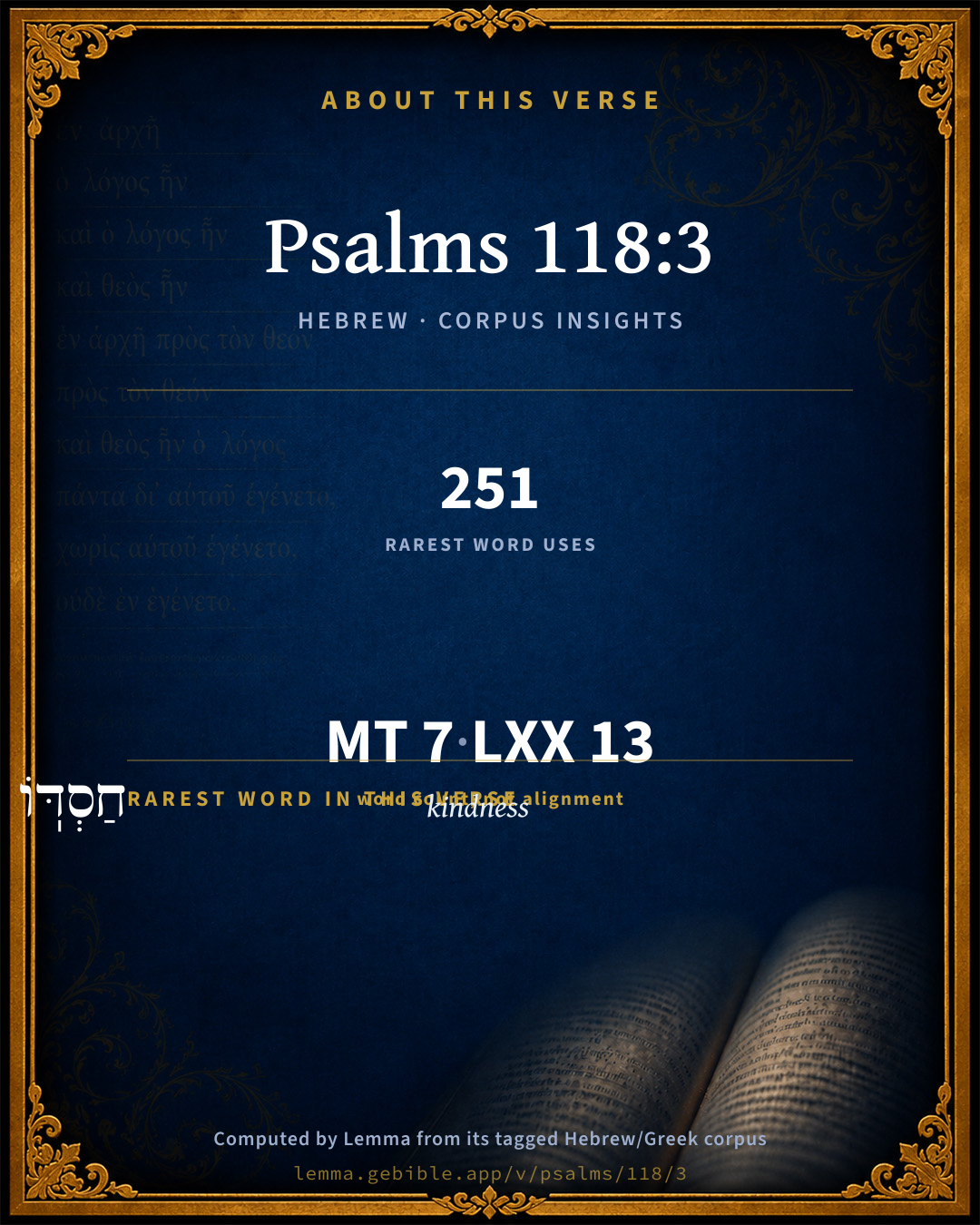
These counts appear in no published source. They are computed here, from the morphology-tagged text and Lemma’s own curated glosses. What Lemma adds →

7
words
7
distinct lemmas
Wisdom
section

Grammatical profile

  • 1 verb
  • 4 nouns
  • 1 conjunction
  • 1 particle

Verb forms

  • יֹֽאמְרוּ Qal · Jussive

Hebrew & Septuagint length

In English translation the verse runs 13 words from the Hebrew and 17 from the Septuagint (LXX English) — closely comparable.

A rough comparison of the two English renderings, which tokenize alike — not a word-level alignment.

Word counts can differ between the Hebrew and the Greek without any difference in meaning — e.g. the Hebrew direct-object marker אֵת has no separate Greek word, and Greek often adds the article ὁ.

In the original languages it is 7 Hebrew tokens and 13 Greek tokens — but the two are counted differently (Hebrew bundles its prefixes and suffixes into one token; the Greek is in lemma form), so that isn’t a like-for-like length.

Cross-references

5

Topical passages linked to Psalms 118:3 in the Treasury of Scripture Knowledge — connected by theme and wording, ordered by reader-vote popularity; previews shown in the World English Bible.

  • Psalms 134:1–3 Look! Praise Yahweh, all you servants of Yahweh, Who stand by night in Yahweh's house!
  • 1 Peter 2:5 You also, as living stones, are built up as a spiritual house, to be a holy priesthood, to offer up spiritual sacrifices, acceptable to God through Jesus Christ.
  • Revelation 1:6 and he made us to be a Kingdom, priests to his God and Father; to him be the glory and the dominion forever and ever. Amen.
  • Revelation 4:7–11 The first creature was like a lion, and the second creature like a calf, and the third creature had a face like a man, and the fourth was like a flying eagle.
  • Revelation 5:8–10 Now when he had taken the book, the four living creatures and the twenty-four elders fell down before the Lamb, each one having a harp, and golden bowls full of incense, which are the prayers of the saints.

Cross-references courtesy of OpenBible.info (CC BY 4.0).

Hebrew and Greek witnesses Masoretic Hebrew ↔ Greek Septuagint

The same verse in the two great witnesses to the Old Testament, shown verse-for-verse.

You’re reading Greek Psalm 117 (Hebrew Psalm 118). The Septuagint counts the superscription, so verse numbers can differ from the Hebrew — chapter-level alignment, not verse-by-verse. Numbering follows Rahlfs.

These are two independent witnesses, not word-aligned to each other, and the Septuagint is shown in lemma (dictionary) form.

Hebrew Psalms 118:3 Masoretic · Westminster Leningrad Codex

יֹֽאמְרוּ נָ֥א בֵֽית אַהֲרֹ֑ן כִּ֖י לְעוֹלָ֣ם חַסְדּֽוֹ

Let the house of Aaron now say That his loving kindness endures forever.

World English Bible · Public Domain

Greek LXX Greek Psalm 117:3 Septuagint · lemma form

εἶπον δή οἶκος ἀαρών ὅτι ἀγαθός ὅτι εἰς ὁ αἰών ὁ ἔλεος αὐτός

Let now the house of Aaron say, that he is good: for his mercy endures for ever.

LXX2012 (modern English Septuagint) · Public Domain

Hebrew: Westminster Leningrad Codex (CC BY 4.0). Greek: Septuagint (public domain); English from LXX2012 (modern English Septuagint) (Public Domain). How the Septuagint differs from the Hebrew →

Commentary

Notes on Psalms 118:3 from classic Christian and Jewish commentators (each source and its license shown beneath its notes). The classic Christian expositions comment on the surrounding passage and are grouped to its opening verse, so a note may address several verses; the Jewish commentaries on the Tanakh (Rashi and others) are per-verse, so they appear only where the commentator wrote on this verse.

Lemma curates 59 commentaries, every one of them public domain or Creative Commons licensed, each selected and text-cleaned for this edition rather than reprinted as found. About our sources →

Trapp's Complete Commentary

John Trapp

Psa 118:3 Let the house of Aaron now say, that his mercy [endureth] for ever.

Ver. 3. Let the house of Aaron now say] Ministers are chieftains, Heb 13:7; Heb 13:17, and should be as the chief chanters in God’s praises.

John Trapp, A Commentary or Exposition upon All the Books of the Old and New Testament (1647–1656) — public domain. Text from a community e-Sword module.

J. A. Alexander on Psalms

Joseph Addison Alexander

3, 4. (Psa 118:3-4) Oh that the house of Aaron would say—'for unto eternity (is) his mercy.' Oh, that the fearers of Jehovah would say--'for unto eternity (is) his mercy.' The succession of Israel, the house of Aaron, and the fearers of Jehovah, in this and the following verses, is the same as in Psa 115:9-11. This and the trine repetitions in Psa 118:10-12; Psa 118:15-16, compared with that in Psa 115:12-13, are corroborations of the assumed affinity between the psalms of this whole series, both in origin and purpose.

Joseph Addison Alexander, The Psalms Translated and Explained (1850) — public domain. Text from a community e-Sword module.

Adam Clarke's Commentary

Verse 3. The house of Aaron] The priesthood is still preserved, and the temple worship restored.

Adam Clarke's Commentary on the Bible (1810–1826) — public domain. Text from a community e-Sword/MySword module.

John Gill's Exposition

Let them now that fear the Lord say, that his mercy endureth for ever. Not the proselytes to the Jewish religion only, but all that feared the Lord among all people, as Aben Ezra observes; such as fear the Lord and his goodness, and have had an experience of his grace and mercy, which has caused them to fear him; and to whom the mercy of God is great, and on whom it is from everlasting to everlasting; and therefore should speak well of it, and set their seal to it, that it abides for ever; see Psa 103:11.

.

Psalms 118:5

psa 118:5

psa 118:5

psa 118:5I called upon the Lord in distress,.... Or "out of that strait" (q); when David was encompassed by Saul and his men, or when at the court of Achish, or when his own people talked of stoning him. As this may respect the Messiah, it may design his distresses in the garden, when surrounded with sorrow, and being in an agony prayed the more earnestly, and his sweat was as it were great drops of blood; and may be applied to his members, as it often is their case to be in distress, straits and difficulties, through outward afflictions and pressures, inward corruptions, temptations, and desertions, and through the low exercise of grace; when they are as it were imprisoned, and so straitened they cannot come forth in the free exercise of it; at all which seasons prayer is necessary; and nothing is more proper than to call upon the Lord, which is both duty and privilege, and often attended with success, as follows;

the Lord answered me, and set me in a large place; as he did David, when he delivered him from all his troubles, placed him on the throne of Israel, and gave him rest from all his enemies round about; see Psa 31:8. And so he did the Messiah, when he raised him from the dead, received him to heaven, where he sits at the right of God in human nature: this is a large place indeed, large enough for the innumerable company of angels, and for all the saints, for whom everlasting habitations and mansions of bliss are preparing by him; and which is the glories liberty of the children of God; see Psa 18:19; and these also, upon calling on the Lord in distress, are heard and answered, and brought into large places, where they walk at liberty; so at first conversion, when distressed about their souls, and cry for help, they are answered and brought out of the pit, and have their feet set upon a rock and their goings established; and when at other times their grace is drawn forth into exercise, their souls are enlarged in duty, are favoured with large views of the love of God, with an increase of spiritual light, knowledge, peace, and joy; and are delivered from their troubles, and out of the hands of their enemies. Or it may be rendered, "the Lord answered me largely" (r); as he did Solomon, when he gave him more than he asked for; and as he does his people, when he gives them a sufficiency, and an abundance of his grace, and even not only above their deserts, but above their thoughts and expectations; see Eph 3:20.

(q) "ex ipso angore", Junius & Tremellius; "ex illa angustia", Michaelis. (r) "in latitudine", V. L. Pagninus, Montanus, Munster, Musculus, Cocceius, Michaelis.

John Gill's Exposition of the Whole Bible (1746–1763) — public domain (CC PDM 1.0). Text via the HelloAO Bible API.

Albert Barnes' Notes on the Bible

Let the house of Aaron now say ... - Compare Psa 115:10. The ministers of religion. They are appointed to serve God; to lead in his worship; to defend his truth; to keep up faith in the truth of religion. They are, therefore, interested in my case, and may derive from it a new proof of the merciful character of God which they may employ, not only for their own encouragement in personal piety, but in the duties of their office. My case furnishes a new argument, of which they can make use in defending the truth, and in illustrating the power of religion.

Albert Barnes' Notes on the Bible (1834–1885) — public domain. Text from a community e-Sword/MySword module.

Matthew Poole's English Annotations

The priests and Levites, who were greatly discouraged and oppressed in Saul’s time, and shall receive great benefits by my government.

Matthew Poole's English Annotations on the Holy Bible (1683–1685) — public domain. Text from a community e-Sword/MySword module.

The Treasury of David

Charles H. Spurgeon

Ver. 3. Let the house of Aaron now say, that his mercy endureth for ever. The sons of Aaron were specially set apart to come nearest to God, and it was only because of his mercy that they were enabled to live in the presence of the thrice holy Jehovah, who is a consuming fire. Every time the morning and evening lamb was sacrificed, the priests saw the continual mercy of the Lord, and in all the holy vessels of the sanctuary, and all its services from hour to hour, they had renewed witness of the goodness of the Most High. When the high priest went in unto the holy place and came forth accepted, he might, above all men, sing of the eternal mercy. If this Psalm refers to David, the priests had special reason for thankfulness on his coming to the throne, for Saul had made a great slaughter among them, and had at various times interfered with their sacred office. A man had now come to the throne who for their Master's sake would esteem them, give them their dues, and preserve them safe from all harm. Our Lord Jesus, having made all his people priests unto God, may well call upon them in that capacity to magnify the everlasting mercy of the Most High. Can any one of the royal priesthood be silent?

Psalms 118:4*

Charles H. Spurgeon's The Treasury of David (1869–1885) — public domain. Psalms only. Text from a community e-Sword/MySword module.

The Pulpit Commentary

Let the house of Aaron now say, that his mercy endureth forever. Let the priests endorse what the people generally have declared, that God"s mercy is ever lasting.

HOMILIES BY R. TUCK Ver. 3. Family experience of Divine mercies.

This is evidently a liturgical psalm, and on the whole it seems best to associate it either with the dedication of the second temple by the returned exiles, or with their keeping of the Feast of Tabernacles. The personal expressions in it need not be misunderstood. The speaker is a typical individual representing the nation. (For the probable occasion, see Neh_8:13-18) "The psalm is vividly dramatic, representing the leader of Israel with his train coming to the temple, calling for the gates to be opened to his triumphal entrance, and going in to worship the Lord. The psalm is dramatically distributed to different actors. In vers. 1-4 we have

(a) the opening chorus of thanksgiving from the train of the king or leader without and the priests within; then

(b) in vers. 5-9 the king thankfully records his deliverance and confidence in the Lord, and his thanksgiving is taken up by a response of like trust; next

(c) in vers. 10-16 he again exults in his sure victory over all nations in the Lord"s Name, in spite of fierce opposition and danger, and is answered similarly by utterance of triumph from the people; on this,

(d) in vers. 16-20, follows his summons to open the gates, answered by consent from within; then

(e) in vers. 21-24, entering the temple, he pours out his thanksgiving, and all alike, priests and people, glorify the Lord on " the day that he has made;" finally,

(f) in vers. 25-29, he prays, "Save, I beseech thee" (Hosanna), and is "blessed as coming in the Name of the Lord; " and the whole psalm ends with a chorus of universal praise to God" (Barry). "One or two writers have thought this psalm to be too legal in its constant dwelling upon the idea of duty. But duty is the fly-wheel of the spiritual machinery. It does not inspire the noble life, it regulates it, and the psalm is for the use of those who have already received inspiration from the sight of the city of God. We fix attention on the first sphere of the enduring Divine mercy. For his goodness in family life our thanks are continually due. The house of Aaron was the type and representative of the houses (families) of Israel. And God"s dealings with it suggest his dealings with them.

I GOD"S FAMILY MERCIES APPEAR AS DIVINE SELECTIONS. We are familiar with the idea that God, in his wisdom and mercy, selects individuals for particular ministries, and honors them with the trust of such ministries; and it is but an enlargement of the truth to see, that in a similar way he selects families and communities and nations. The selection of the house, or family, of Aaron for priestly services, and of Heman for musical services, and of David for kingly services, are illustrations. And it is well when families can realize that the mercies of God to them are not merely comfortable provisions, or business successes, but their selection for high and holy trusts and responsible services.

II GOD"S FAMILY MERCIES APPEAR AS DIVINE CORRECTIONS. This is very strikingly illustrated in the record of the "house of Aaron." We may even say that the visitations of Divine love in judgment were frequent and severe, as may be illustrated in the deaths of Nadab and Abihu; the limitation of Aaron"s own life; the shifting of the priestly order in later years, etc. They who read their life-stories aright their family life stories never hesitate to praise God most of all for the mercy in discipline that was hard to bear.

III GOD"S FAMILY MERCIES APPEAR AS DIVINE DELIVERANCES. Family life has its perils, its disasters, its wilfulnesses, and its mistakes. These variously affect the heads of the family as well as the members. Every family story is made up of sick nesses, sorrows, follies, and sins, and God"s mercies come into the family life at every point of need as redemption, as deliverance. This the psalmists constantly recognize. This we too recognize who fully believe that God is in our family life. He is ever delivering the family from its bad self, from untoward circumstances, and from active foes.

IV GOD"S FAMILY MERCIES APPEAR AS STRENGTHENING FOR SERVICE. In the case of the "house of Aaron" we have unusually solemn service; but that is only typical of the service which every family has to render, and which it never can render well save as it realizes the strengthening and sustaining mercy of God. Under priestly burdens a man may say, "O Lord, I am oppressed; undertake thou for me." But that is precisely what every man should say in the bearing of his own burden.

V GOD"S FAMILY MERCIES APPEAR AS HELPINGS OF ONE ANOTHER. The clinging together and mutual helpfulness of family life are usually traced as due to family dispositions, paternal or maternal characteristics. It is altogether a higher and more inspiring view to see in family brotherliness the signs of the Divine mercy. R.T.

The Pulpit Commentary (1880–1919), ed. H.D.M. Spence-Jones & Joseph S. Exell — public domain. Text from a community e-Sword module.

unfoldingWord translationNotes

Door43 World Missions Community

Let the house of Aaron say

Here the word "house" represents the family and descendants of a person. This phrase refers to the priests, who were descendants of Aaron. AT: "Let the descendants of Aaron say" or "Let the priests say" (See: Metonymy)

His covenant faithfulness endures forever

The abstract noun "faithfulness" can be translated with an adjective. See how you translated this in Psalms 118:1-2. AT: "He remains faithful to his covenant forever" (See: Abstract Nouns)

the loyal followers of Yahweh

"those who fear Yahweh" or "those who worship Yahweh"

translationWords

house

Aaron

unfoldingWord translationNotes — © Distant Shores Media and the Door43 World Missions Community, licensed CC BY-SA 4.0. Source: git.door43.org/Door43/en_tn.

Lesson kit

Teaching starters — assembled from the data on this page, not authored interpretation. Every prompt links to the verse data it draws on. Edit before teaching.

Psalms, in the Wisdom, opens this verse with 7 words (7 distinct Hebrew lemmas). Its most distinctive word is chêçêd (“kindness”). A historical commentator’s framing appears above. Read the whole chapter for the surrounding context.

Discussion questions

  1. What does “kindness” (chêçêd) contribute to the verse as a whole?
  2. How does Psalms 134:1–3, which shares this passage’s theme, read alongside this verse?
  3. These translations render this verse differently; the difference is in the English rendering, not the original. What questions does that raise?
  4. «יֹֽאמְרוּ» is a Qal Jussive verb. How does that grammatical form shape the action described?
  5. Compare how Trapp's Complete Commentary and J. A. Alexander on Psalms read this verse. Where do they agree or differ?

Things to notice

Reading settings

Reading text

Shown beneath each verse's original-language words.

Old Testament
Old Testament edition

Read the OT as the Masoretic Hebrew (MT) or the Greek Septuagint (LXX).

English shown for the Greek Septuagint (in the Hebrew ↔ Greek comparison).

Comparing translations? Open the Compare panel on any verse page to stack up to four side by side.