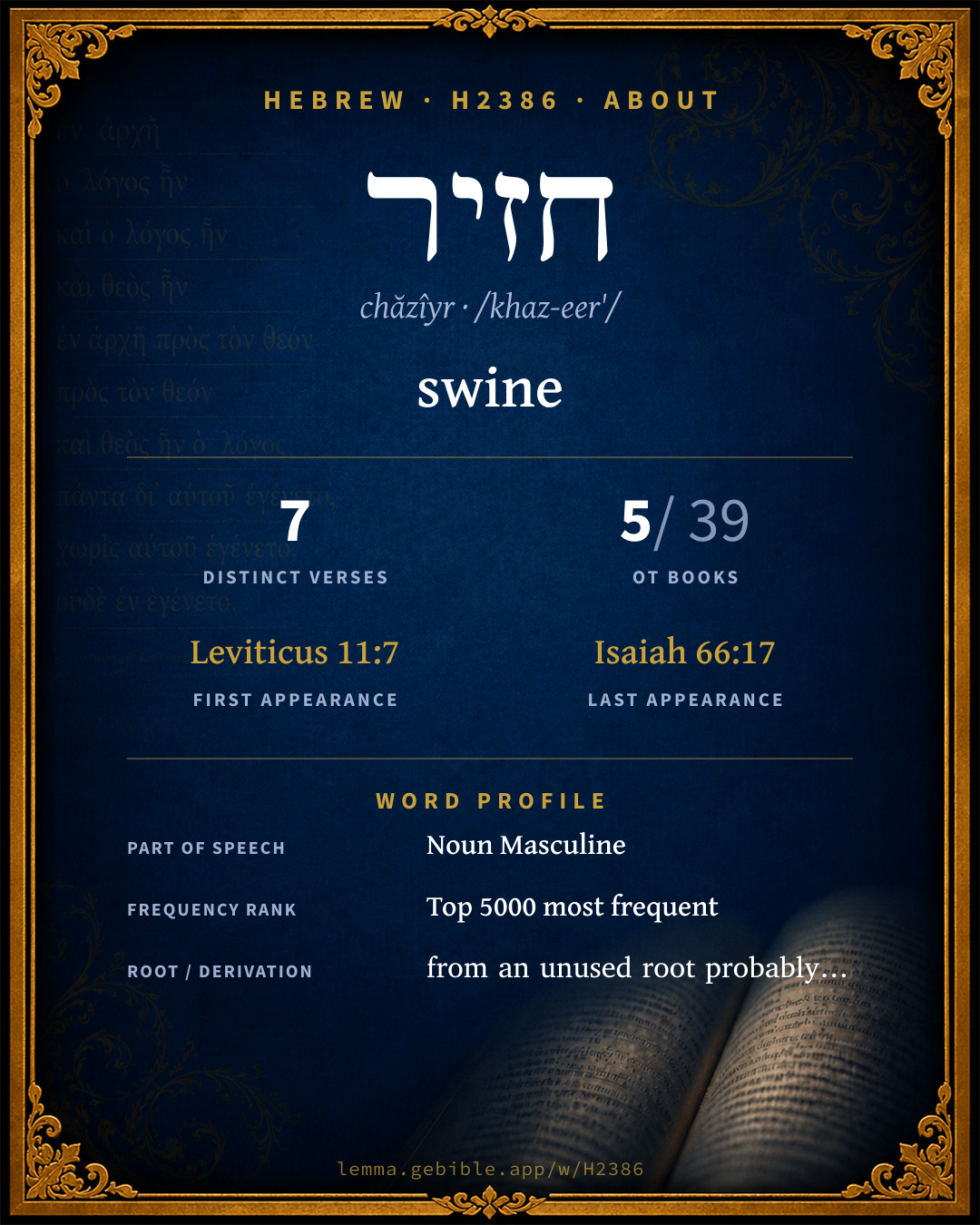
חֲזִיר
swine
also: hog, boar fuller range ↓
Full lexicon entry — Brown-Driver-Briggs (BDB)
From Brown-Driver-Briggs (BDB)
Where this word appears
Grammar key — what these labels mean
Part of speech
- Noun
- A naming word — a person, place, thing, or idea.
Noun type
- Common
- A common noun — a general class of person, place, or thing (“king,” “city,” “water”), not a specific name.
State
- Absolute
- The independent form of a noun, not bound to a following word.
Gender
- Masculine
- Grammatically masculine.
Number
- Singular
- One.
Every verse where H2386 appears — 7 distinct verses across 5 books. Click any verse to open its interlinear word-by-word view. Verse text shown in the World English Bible for context — . Each verse’s Hebrew form is shown with its reference; the English is not keyword-highlighted, since the data carries no word-level English alignment. Use “Compare translations” on any verse to read it across multiple English versions. This concordance covers the Hebrew Bible; Septuagint (Greek Old Testament) occurrences are not indexed here.
Leviticus 1 verse
Deuteronomy 1 verse
Psalms 1 verse
Proverbs 1 verse
Isaiah 3 verses
- Isaiah 65:4 הַ/חֲזִ֔יר ptcl def.art + n c ms who sit among the graves, and lodge in the secret places; who eat pig's flesh, and broth of abominable things is in their vessels;
- Isaiah 66:3 חֲזִ֔יר n c ms He who kills an ox is as he who kills a man; he who sacrifices a lamb, as he who breaks a dog's neck; he who offers an offering, [as he who offers] pig's blood; he who burns frankincense, as he who blesses an idol. Yes, they have chosen their own ways, and their soul delights in their abominations:
- Isaiah 66:17 הַ/חֲזִ֔יר ptcl def.art + n c ms Those who sanctify themselves and purify themselves [to go] to the gardens, behind one in the midst, eating pig's flesh, and the abomination, and the mouse, they shall come to an end together, says Yahweh.
About this entry
At a glance — auto-summarized from this page’s data, not written by a person. Every figure links to its source below. This summary describes the numbers; it doesn’t interpret them.
The Hebrew noun חזיר centers on the idea of “swine.” Its earliest occurrence is Leviticus 11:7. It appears 7 verses across 5 books of the Hebrew Bible, among its uncommon vocabulary. The word gravitates to Isaiah (43%), then Leviticus and Deuteronomy. Beyond “swine” it also covers “hog” and “boar” — see its full sense range. For the data behind this summary, explore the sense tree and the renderings breakdown below.
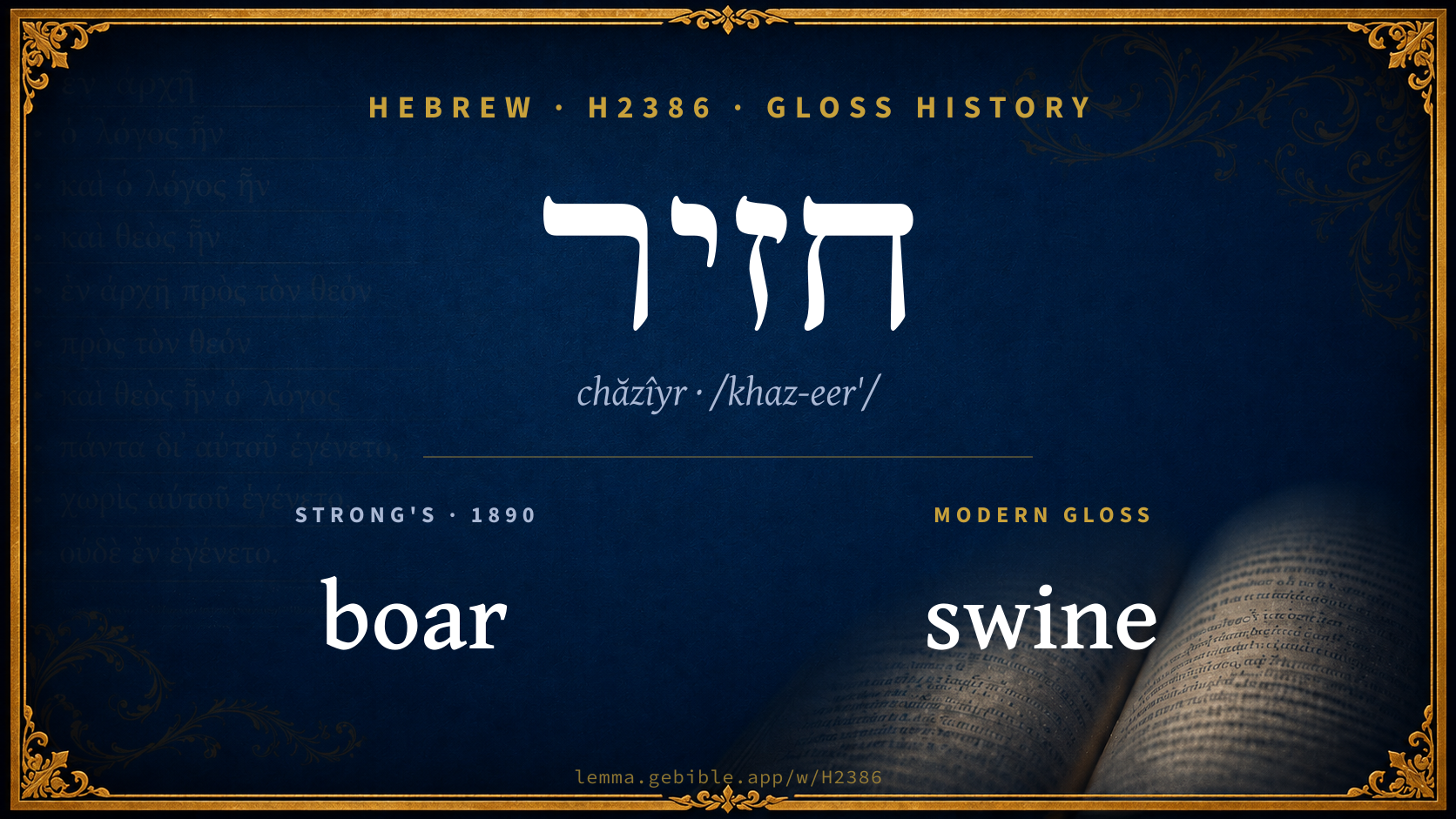
Gloss history
Strong's 1890 vs modern scholarship
About this word
Strong's H2386 catalogs a Hebrew word from the Hebrew Old Testament.
These counts are not copied from any lexicon or concordance. They are computed here, from the morphology-tagged Hebrew Old Testament. What Lemma adds →
- 7
- distinct verses
- The word appears in 7 distinct verses.
- 5 / 39
- OT books
- The word appears in 5 of 39 Old Testament books.
- #2,835
- by frequency
- Top 5000 most frequent Hebrew words (rank 2,835 of 8,640 Hebrew words by occurrence).
View all 7 occurrences in the concordance →
Most concentrated in
- Isaiah 3 verses 43%
- Leviticus 1 verse 14%
- Deuteronomy 1 verse 14%
By section of the Old Testament
By traditional corpus
Conventional, traditional groupings — biblical authorship is debated, so this is a traditional corpus grouping, not an authorship claim. Each share is this word’s portion of its verses in that division of the Hebrew canon. Each figure is a share of the word’s 7 distinct verses.
- Prophets (Nevi'im) 3 verses · 43%
- Torah (Pentateuch) 2 verses · 29%
- Writings (Ketuvim) 2 verses · 29%
How translations render this word
Counts come from each version’s own published word-to-Strong’s tagging or interlinear alignment — an approximate guide to how each version renders this word, not a word-level alignment the data otherwise carries. Because each total is that version’s own tagged count, the per-version totals vary from one another and need not match the appearance or distinct-verse counts above. These counts may also differ from a printed concordance because Lemma counts each distinctly tagged rendering and does not collapse phrase taggings into a single head-word total. This is a fixed set of word-tagged versions (KJV, ASV, BSB, ULT) and does not change with the reading translation you choose elsewhere. Each version’s license is shown beside its name below (and on Sources).
- King James Version: Swine's 3×, Swine 2×
- American Standard Version: Swine 5×
- Berean Standard Bible: Pig 2×, Pig’s 2×
- unfoldingWord Literal Text: Pig 6×
King James Version Public Domain
Renders H2386 across 7 tagged occurrences — most commonly:
Plus 2 renderings that appear only once — usually multi-word phrases or single function words the recovered tagging swept in, not distinct renderings.
American Standard Version Public Domain
Renders H2386 across 7 tagged occurrences — most commonly:
Plus 2 renderings that appear only once — usually multi-word phrases or single function words the recovered tagging swept in, not distinct renderings.
Berean Standard Bible Public Domain
Renders H2386 across 7 tagged occurrences — most commonly:
Plus 3 renderings that appear only once — usually multi-word phrases or single function words the recovered tagging swept in, not distinct renderings.
unfoldingWord Literal Text CC BY-SA 4.0
Renders H2386 across 7 tagged occurrences — most commonly:
Plus 1 rendering that appears only once — usually multi-word phrases or single function words the recovered tagging swept in, not distinct renderings.
Senses in the full BDB
What do BDB’s symbols mean?
BDB uses these scholarly abbreviations:
| Symbol | Meaning |
|---|---|
| 𝔊 | the Septuagint (the ancient Greek translation, LXX) |
| 𝔙 | the Vulgate (the Latin translation) |
| 𝔖 | the Syriac version (the Peshitta) |
| 𝔗 | the Targum (the Aramaic translation) |
| ψ | the Psalms |
| √ | root (the underlying root or stem) |
| ‖ | parallel passage (a synonymous or contrasted parallel) |
| † | the dagger: every passage where the word occurs is cited |
The 2 senses and sub-senses the full Brown-Driver-Briggs lexicon distinguishes for this word, in lexicon order (not ranked by frequency), with BDB’s own verbatim wording and sub-sense lettering. Shown in Hebrew script with BDB’s own scholarly abbreviations. The condensed entry is in the Lexicon Entry tab. See also the Forms in the corpus table below.
- 1. swine, forbidden as food Lv 11:7 (P), Dt 14:8, cf. בְּשַׂר הַח׳ Is 65:4; 66:17, and דַּם־ח׳ 66:3 as heathen offering (RSSem i, 272.325.338.392); with implication of repulsiveness נֶזֶם זָהָב בְּאַף ח׳ Pr 11:22 sim. of fair woman with dub. character. e.g. Leviticus 11:7
- 2. wild boar ח׳ מִיָּ֑עַר ψ 80:14 fig. of foes of Isr. (in fig. of vineyard). e.g. Psalms 80:14
Senses from the full Brown-Driver-Briggs lexicon (Brown, Driver, Briggs; Oxford 1906 — public domain), digitized via Sefaria, supplemented by the OpenScriptures HebrewLexicon (CC BY 4.0). Full attribution on Sources.
Word origin
n.m. ψ 80:14 swine, boar (NH id.; Aramaic חֲזִירָא, ܚܙܺܝܪܳܐ; Arabic خِنْزِيرٌ (Aramaic loan-wd. according to Frä 110, yet v. LagBN 113); Ethiopic ኀንዚር (only once; = wild boar), v. HomNS 319 f. 358, 385)—always st. abs., 4 times c. art. הַח׳;—
— Brown-Driver-Briggs (Oxford 1906, public domain), digitized via Sefaria, supplemented by the OpenScriptures HebrewLexicon (CC BY 4.0). See Sources.
Origin: from an unused root probably meaning to enclose
Jastrow Dictionary
A second Hebrew/Aramaic lexicon for comparison, covering Aramaic and post-biblical (Talmudic, Targumic, Midrashic) usage that the biblical-Hebrew BDB does not. Matched by lemma rather than by Strong’s number, so a lemma may carry more than one Jastrow headword (shown separately below), and the entries cover usage well beyond the Bible.
חֲזִיר
- (b. h.) swine. Ḥull. IX, 2 ח׳ של ישוב domesticated swine; ח׳ הבר wild boar. Num. R. s. 12 מה איסור … לְהַחֲ׳ וכ׳ is the swine more strictly forbidden than other unclean animals?—Lev. R. s. 13 ואת הח׳ זו פרס (read רומי or אדום). Ib. מה ח׳ וכ׳ as the swine … stretches out its cloven feet (sign of cleanness), … so does the Roman government &c., v. בִּימָה. Gen. R. s. 65, beg.; a. fr.—Pl. חֲזִירִים, חֲזִירִין. Kidd. 49ᵇ תשעה נטלו ח׳ nine (measures of plagues) did swines receive. B. Kam. VII, 7; a. e.—Fem. חֲזִירָה, חֲזִירְתָּה sow. Esth. R. to III, 1. Ib. to I, 15 לח׳ כדת וכ׳ the swine (Vashti) to be treated according to law, but the holy people &c.!, v. אַכְזְרִיּוּת.
חֲזִיר ²
- Targ. Ps. LXXX, 14. Targ. Lev. XI, 7 (some ed. חֲזֵי׳).—Y. Ber. II, 4ᶜ bot. אהן ח׳ וכ׳ the swine is a moving privy. Sabb. 155ᵇ לית … מן ח׳ none is poorer than the dog, none richer than the swine (finding its food everywhere); a. e.—Pl. חֲזִירִין, חֲזִירֵי. Gen. R. s. 63; Y. Ter. VIII, end, 46ᶜ, v. דִּיקְלִטְיָאנוֹס. Taan. 21ᵇ איכא מותנא בח׳ there is an epidemic among the swine; a. e.—Fem. חֲזִירְתָּא, Lam. R. to I, 16, end כהדא ח׳ וכ׳ like the (nursing) sow, the more their young fatten &c.
A Dictionary of the Targumim, the Talmud Babli and Yerushalmi, and the Midrashic Literature (Marcus Jastrow; London, Luzac, 1903) — Public Domain. Digitized via Sefaria. Digitized via Sefaria. Full attribution on Sources.
Forms in the corpus
The 5 distinct written forms H2386 takes in the Hebrew Bible, most frequent first — each parse links to that state’s occurrences in the concordance. Hebrew forms include their vowel points and cantillation, so a single lemma takes many written forms.
| Form | Parsing | Example | Uses |
|---|---|---|---|
| הַ/חֲזִ֔יר | Noun, Common, Masculine, Singular, Absolute | Isaiah 65:4 | 2 |
| הַ֠/חֲזִיר | Noun, Common, Masculine, Singular, Absolute | Deuteronomy 14:8 | 2 |
| חֲזִ֑יר | Noun, Common, Masculine, Singular, Absolute | Proverbs 11:22 | 1 |
| חֲזִ֔יר | Noun, Common, Masculine, Singular, Absolute | Isaiah 66:3 | 1 |
| חֲזִ֣יר | Noun, Common, Masculine, Singular, Absolute | Psalms 80:13 | 1 |
Same root — word family
Other BDB entries built from the same root as H2386, grouped by Strong’s listed origin. These share a root / origin per the lexicon — not necessarily a shared meaning. Each links to that word’s own entry.
Proper names from this root
People and places named from this root — a name, not an additional meaning of the word.
Compare all same-root words → 2 of the same-root words are proper names (people or places). They share a root, not necessarily a meaning.
Septuagint verse parallels
This word appears in 7 verses that also exist in the Greek Old Testament (Septuagint), out of the 7 Hebrew verses it occurs in. You can read those verses in Greek by switching the Old Testament edition to the Septuagint.
Read these verses in the Septuagint
This is a verse-level parallel only — the same verses exist in both the Hebrew and Greek Old Testaments. No word-level Hebrew↔Greek correspondence is claimed: the data carries no such alignment, so no Greek word is shown as this Hebrew word’s translation. Coverage is not total — the Septuagint omits the deuterocanon and renumbers the Psalms, so some Hebrew verses have no direct Greek parallel.